-
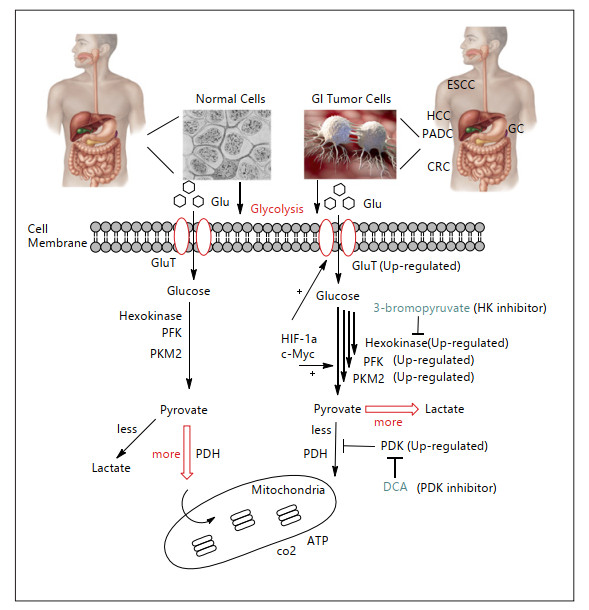
Figure 1.
Diagram showing the expression of glycolytic enzymes and GluTs in tumor and normal cells and also small-molecule inhibitors in the Warburg effect for cancer therapy. In normal cells, pyruvate is usually transported to the mitochondria for TCA and oxidative phosphorylation, but in tumor cells, Warburg effect increases lactate by converting most of pyruvate to lactate. TCA, tricarboxylic acid.
-
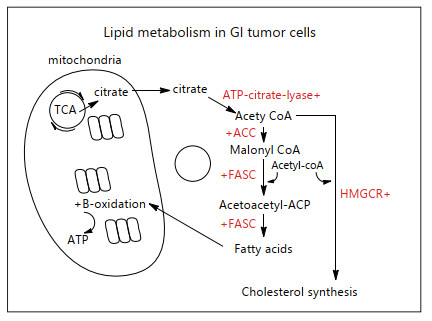
Figure 2.
Main metabolic pathways related to lipid metabolism in GI malignancies. GI, gastrointestinal; ACC, acetyl-CoA carboxylase; FASC, fatty acid synthase complex; HMGCR, hydroxyl methylglutaryl-CoA reductase.
-
Metabolic pathway Related enzymes and molecules Molecule function Some inhibitors in cancer research Glucose metabolism HK Phosphorylates glucose to glucose 6 phosphates and retains glucose in cells 3-Bromopyruvate [20] PK Catalyzes the reaction that produces pyruvate from phosphoenolpyruvate Shikonin [28, 29] PDK Inactivates pyruvate dehydrogenase by phosphorylation and increases the generation of pyruvate to lactic acid DCA [32, 33] PFK1 Converts glucose 6 phosphate to glucose 1–6 bisphosphate and ADP 3PO [39] Glucose transporters Membrane proteins responsible for the uptake of glucose into the cells across the plasma membrane Not reported Lipid metabolism ATP-citrate lyase Generates acetyl-CoA from citrate provided by tricarboxylic acid Hydroxycitric acid [60, 61] ACC Catalyzes the formation of malonyl-CoA from acetyl-CoA in the fatty acid synthesis pathway TOFA [65] FASC Generation of long-chain fatty acids from acetyl-coenzyme A C75, cerulenin, orlistat [73, 74] HMGCR Conversion of HMG-CoA to mevalonate in cholesterol biosynthesis pathway Statins [79, 80] HK, hexokinases; PK, pyruvate kinase; PDK, pyruvate dehydrogenase kinase; DCA, dichloroacetic acid; PFK1, phosphofructo-1-kinase; 3PO, 3-(3-pyridinyl)-1-(4-pyridinyl)-2-propen-1-one; ACC, acetyl-CoA carboxylase; TOFA, 5-(tetradecyloxy)-2-furoic acid; FASC, fatty acid synthase complex; HMGCR, hydroxy-3-methylglutaryl-CoA reductase. Table 1.
Summary of regulatory enzymes related to the glucose and lipid metabolic pathway and some inhibitors against GI malignancies
Figures
(2)
Tables
(1)