-
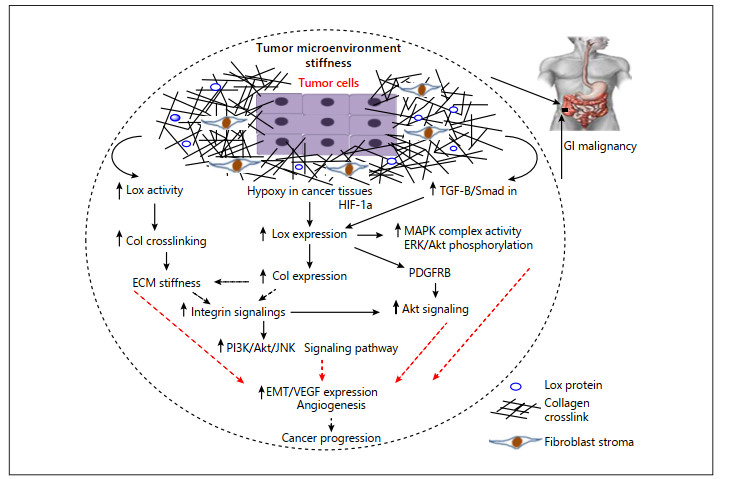
Figure 1.
Overview of the complex interplay between the roles of Lox in tumor microenvironment rigidity and cancer development. Lox with increase in collagen fiber cross-linking and ECM rigidity upregulates integrin signaling pathways to increase tumor cell invasive capacity. Moreover, Lox with activation of MAPK complex, phosphorylation of ERK and Akt, and stimulation of PDGFRβ induces EMT, angiogenesis, and cancer development. Also, Lox expression can be induced by HIF-1α and TGF-β/Smad which leads to cancer progression. ECM, extracellular matrix; Lox, lysyl oxidase; PDGFRβ, platelet-derived growth factor receptor beta; EMT, epithelial-mesenchymal transition; TGF-β, transforming growth factor β; Col, collagen; MAPK, mitogen-activated protein kinase.
-
Lox effects ECM dysregulation Lox overactivity in cancer leads to ECM dysregulation including ECM stiffness and fibrosis; these conditions lead to change in integrin signaling pathways, increase the cross-linking of collagens, and promote tumor cell invasion and metastasis Angiogenesis Most important molecular mechanisms affected by Lox which induces angiogenesis include the following: promotion of the MAPK and PI3K/Akt signaling pathways to stimulate the expression of VEGF and increase in the TGF-β/Smad signaling upregulates the expression of VEGF to induce angiogenesis in tumors site Inflammation Rigidity and fibrosis of ECM related to Lox overexpression lead to an increase in inflammation to promote tumor invasion. Also, inflammation and increase in the inflammatory cytokines around the tumor site increase the mRNA and protein expression of Lox. Inflammation and Lox increase each other around the tumors ECM, extracellular matrix; Lox, lysyl oxidase; TGF-β, transforming growth factor β; MAPK, mitogen-activated protein kinase; VEGF, vascular endothelial growth factor. Table 1.
The roles of Lox in cancer progression
Figures
(1)
Tables
(1)