-
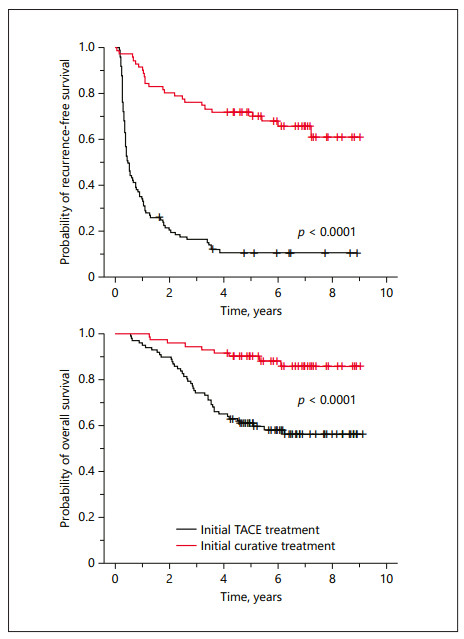
Figure 1.
Comparison of recurrence-free and overall survival between BCLC 0/A patients who had and had not received the initial curative treatment. There are 71 patients in the initial curative treatment group and 97 patients in the noncurative treatment TACE group. The result showed that patients of the initial curative treatment group had significantly better recurrence-free and overall survival than those of the TACE group (p < 0.0001). BCLC, Barcelona Clinic Liver Cancer; TACE, transcatheter arterial chemoembolization.
-
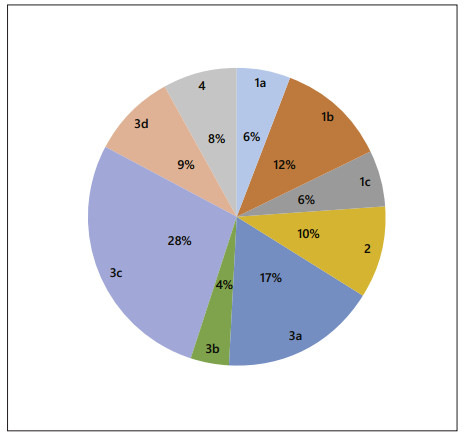
Figure 2.
Relative frequencies of different primary reasons for not receiving the initial curative treatment in BCLC 0/A patients (n = 97). Eleven out of 97 patients have additional secondary reasons. Only the primary reasons were used to calculate the relative frequencies in percentage for having the initial noncurative TACE treatment. The codes for reasons not receiving the initial curative treatment are shown in the outer pie chart, and the relative frequencies in percentages are shown in the inner pie chart. The definitions of codes for reasons not receiving the initial curative treatment are available in Table 2. BCLC, Barcelona Clinic Liver Cancer; TACE, transcatheter arterial chemoembolization.
-
Treatment groups p value curative treatment TACE Patients, N 71 97 Age Mean ± SD 55±12 64±12 < 0.0001a Sex Male 60 65 0.01b Female 11 32 BCLC stage 0 22 7 0.0001b A 49 90 Initial curative treatment Surgery 64 0 PEI 2 0 RFA 6 0 Tumors, n 0.03c 1 67 80 1 vs. > 1 2 3 12 3 1 5 BCLC, Barcelona Clinic Liver Cancer; TACE, transcatheter arterial chemoembolization; PEI, percutaneous ethanol injection; RFA, radiofrequency ablation. a The Wilcoxon rank-sum test was used. b Fisher's exact test was used. c The number of tumors was grouped as 1 and > 1, and Fisher's exact test was used for statistical comparison. Table 1.
Clinical characteristics of 2 different treatment groups
-
Reason for not receiving initial curative treatment Code 1. Presence of unacceptable comorbidity a. Patients of poor cardiovascular performance status 1a b. High surgical risk according to surgeons and not specified 1b c. Presence of other major medical conditions 1c 2. Refusal by the patient 2 3. Anatomical and liver condition(s) precluding the initial curative treatment a. Difficult or complicating anatomical location for the initial curative treatment 3a b. Bilobar distribution of tumors 3b c. Probable presence of additional tumor by image study and requiring diagnostic angiography 3c d. Patients at risk of posttreatment liver failure 3d 4. Eligible for curative treatment but failed to receive the treatment 4 5. Other reasons 5 Table 2.
Reasons and corresponding codes for not receiving the initial curative treatment
-
Curative treatment (N = 71) TACE (N = 97) p value Child-Pugh scorea A5 66 85 0.31b A6 4 9 B7 1 3 HBs Aga Negative 16 (23%) 44 (45%) 0.003b Positive 54 (77%) 53 (55%) Unknown 1 Anti-HCVa Negative 56 (84%) 67 (69%) 0.044b Positive 11 (16%) 30 (31%) Unknown 4 Tumor size, cm 2.5±0.9 2.8±0.9 0.028c Total bilirubin 0.69±0.28 0.82±0.36 0.032 c Albumin 4.4±0.4 4.1±0.4 < 0.0001c Prothrombin time 10.9±0.6 11.3±0.8 0.0001c Platelet (×10−3) 184±58 138±58 < 0.0001c FIB-4 1.8±1.0 4.0±3.0 < 0.0001c AFP 576±1,378 852±2,748 0.121c AST 37±20 50±34 0.001c ALT 48±28 54±40 0.710 TACE, transcatheter arterial chemoembolization; AFP, alpha-fetoprotein; FIB-4, Fibrosis-4. a The numbers for Child-Pugh score, HBs Ag, and Anti-HCV were numbers of patients. b Compared by Fisher's exact test. c Compared by the Wilcoxon rank-sum test. Table 3.
Comparison of clinically relevant parameters between the initial curative treatment and the initial TACE groups
Figures
(2)
Tables
(3)