-
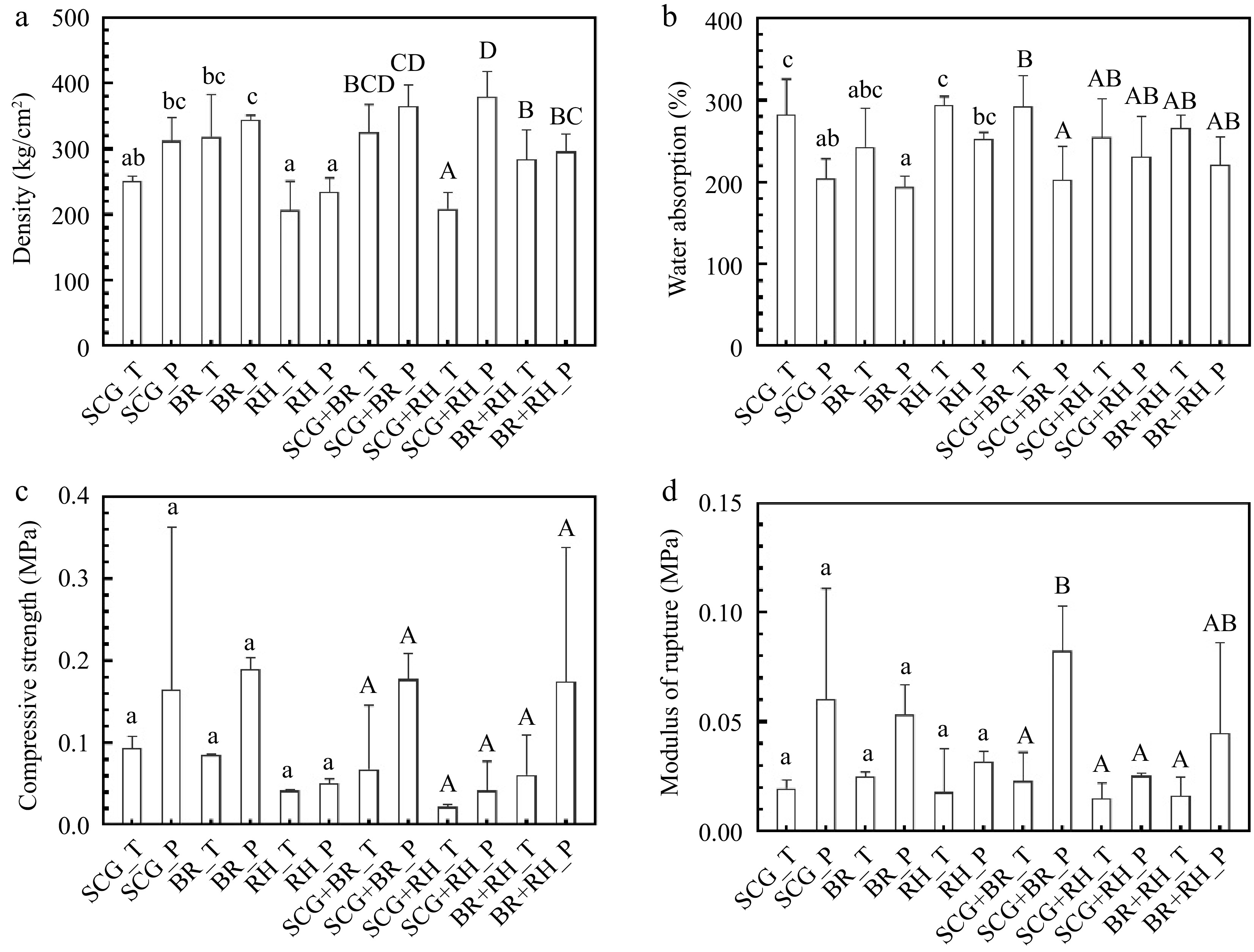
Figure 1.
Graphical representation of the mean ± standard deviation (SD) for (a) density, (b) water absorption, (c) compressive strength, and (d) modulus of rupture for each determination. The columns with different letters are significantly different under Dunnett's T3 post hoc test at p < 0.05. T: Trichoderma sp., P: Pleurotus ostreatus.
-
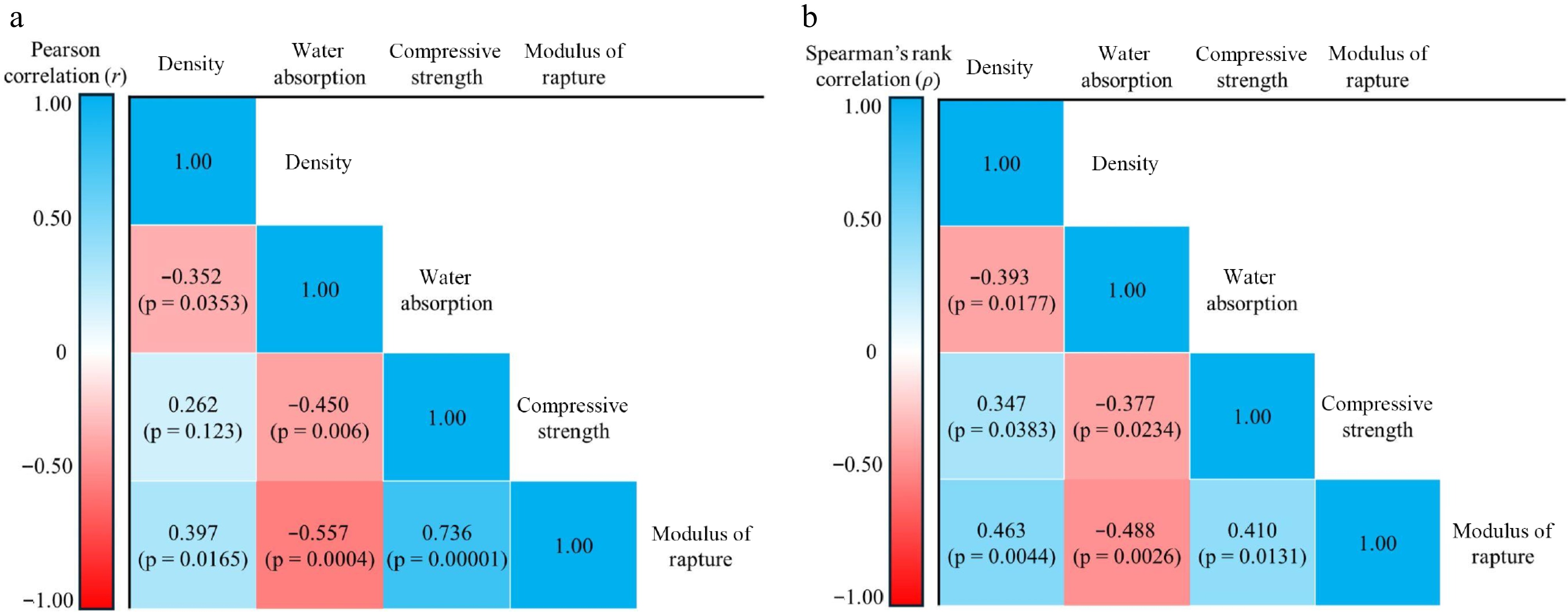
Figure 2.
Correlation analysis of density, water absorption, modulus of rupture, and compressive strength, evaluated using: (a) Pearson correlation, (b) Spearman's rank correlation.
-
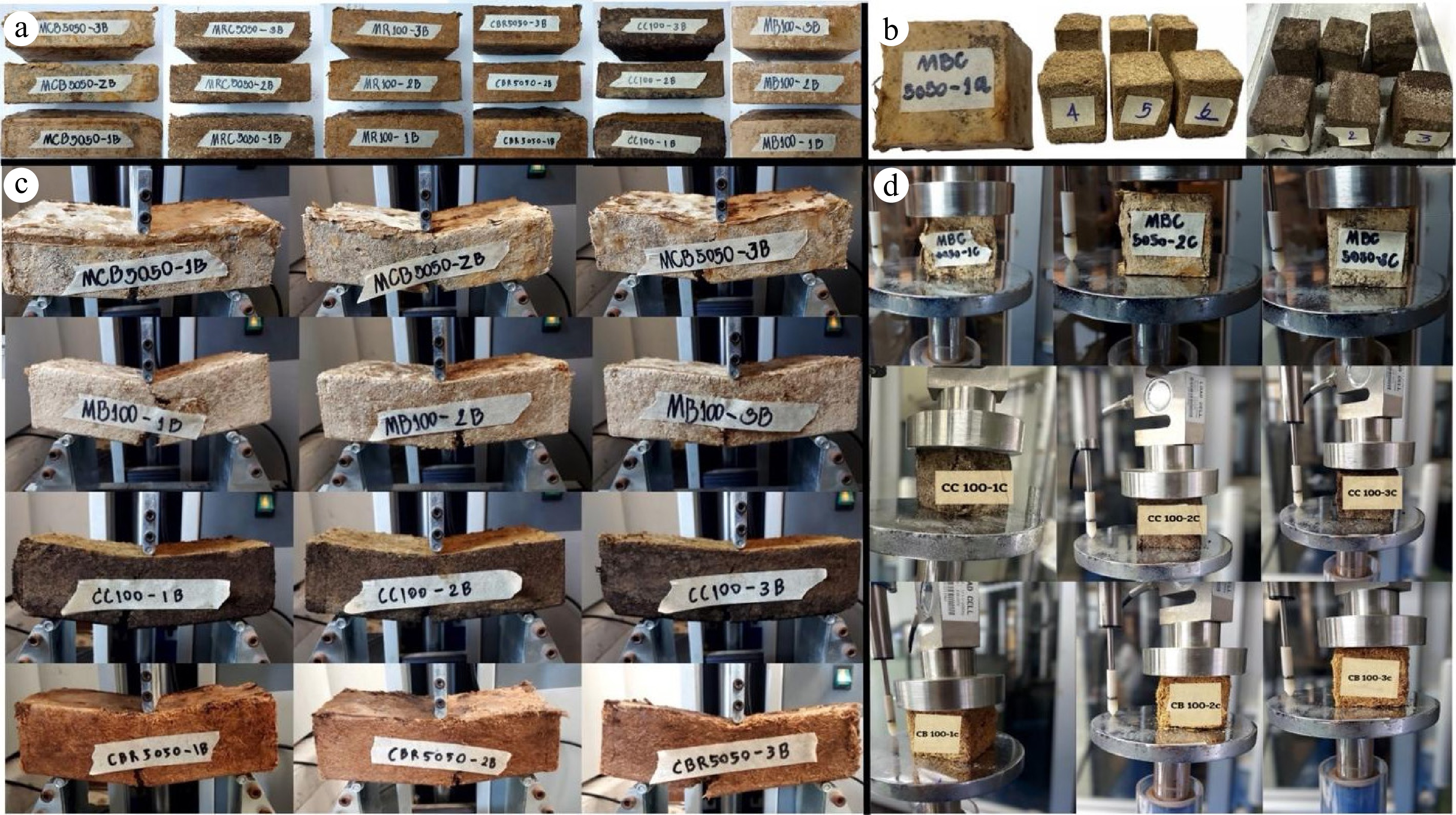
Figure 3.
Visual representation of mycelium-based block samples before testing, during testing, and after failure for modulus of rupture and compressive strength. (a) Test blocks for modulus of rupture prior to testing. (b) Test blocks for compressive strength prior to testing. (c) Samples after failure during modulus of rupture testing. (d) Samples during compressive strength testing.
-
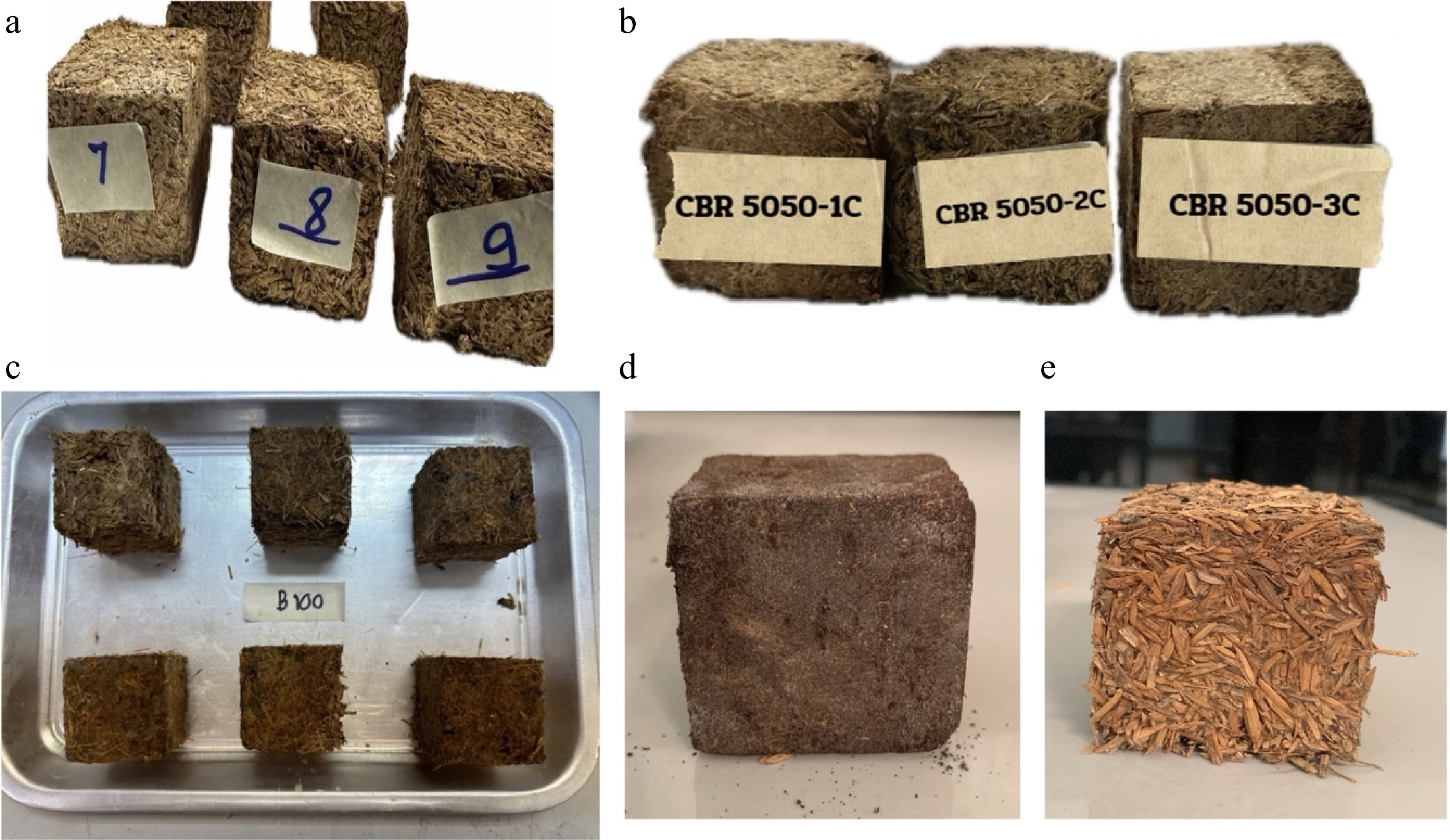
Figure 4.
Visual depiction of selected mycelium-based blocks developed using Trichoderma virens. (a) Dried blocks composed of 50% spent coffee grounds (SCGs) and 50% bamboo residues (BRs). (b) Dried blocks cultivated from a mixed substrate of 50% SCGs and 50% rice husks (RHs). (c) Dried blocks made entirely from bamboo residues (100% BRs). (d) Dried blocks produced solely from spent coffee grounds (100% SCGs). (e) Dried blocks fabricated entirely from rice husks (100% RHs).
-
Mycelium-based blocks/substrates Physical property Mechanical property Density
(kg/m³)Water
absorption (%)Compressive
strength (MPa)Modulus of
rupture (MPa)Individually (100%) mixed with fungal mycelium SCGs + Trichoderma virens 251.27 283.28(3rd) 0.094 0.020 SCGs + Pleurotus ostreatus 312.46 204.55 0.165 0.060(2nd) BRs + T. virens 318.64 243.50 0.085 0.025 BRs + P. ostreatus 344.84(3rd) 194.61Min 0.190Max (1st) 0.053(3rd) RHs + T. virens 206.70Min 294.25Max (1st) 0.042 0.018 RHs + P. ostreatus 234.84 253.11 0.051 0.032 The average data for T. virens mycelium obtained from individually (100%) substrate 258.87 273.68 0.0737 0.021 The average data for P. ostreatus mycelium obtained from individually (100%) substrate 297.38 217.42 0.1353 0.0483 1:1 blend (50% substrate : 50% substrate) combined with fungal mycelium RHs + BRs + T. virens 283.95 265.94 0.061 0.017 RHs + BRs + P. ostreatus 296.00 221.69 0.176(3rd) 0.045 RHs + SCGs + T. virens 209.00 255.28 0.022Min 0.015Min RHs + SCGs + P. ostreatus 379.00Max (1st) 231.80 0.042 0.025 SCGs + BRs + T. virens 325.00 292.58(2nd) 0.068 0.023 SCGs + BRs + P. ostreatus 365.82(2nd) 203.08 0.177(2nd) 0.082Max (1st) The average data for T. virens mycelium obtained from 1:1 blend
(50% substrate : 50% substrate)272.65 271.27 0.0503 0.0183 The average data for P. ostreatus mycelium obtained from 1:1 blend
(50% substrate : 50% substrate)346.94 218.86 0.1317 0.0507 Overall average data for T. virens mycelium obtained from both individually (100%) substrate and 1:1 blend (50% substrate : 50% substrate) 265.76 272.47 0.06 0.0197 Overall average data for P. ostreatus mycelium obtained from both individually (100%) substrate and 1:1 blend (50% substrate:50% substrate) 322.16 218.14 0.1335 0.0495 The results are reported as mean values for each substrate type. Within each column, the minimum values are highlighted in bold, and the maximum values are also denoted in bold. Additionally, the average values and overall averages are both bolded and underlined for emphasis. The rankings of the results in each property are noted as follows: 1st (maximum value) indicates the highest rank, 2nd the second highest, and 3rd the third highest. Table 1.
Summary of the properties of mycelium-based blocks examined in this study, highlighting the average density (kg/cm³), water absorption (%), compressive strength (MPa), and modulus of rupture (MPa). The data encompasses both the mean values and overall results for fungal mycelium cultivated on pure substrates (100%) and 1:1 blended substrate (50% substrate : 50% substrate). The table presents comprehensive measurements of density (kg/cm³), water absorption (%), compressive strength (MPa), and modulus of rupture (MPa).
-
Fungal taxa Substrate Density (kg/m3) Water absorption (%) Compression strength (Mpa) Modulus of
rupture (Mpa)Material properties# P. ostreatus and T. virens Bamboo residues, spent coffee grounds, rice husks 206.70−379.00 194.61−294.25 0.022−0.190 0.015−0.082 This study* P. ostreatus Spent coffee grounds, sawdust, pineapple fibres 280.00−360.00 99.96−114.30 1.65−2.92 0.20−0.48 Kohphaisansombat et al.[20] Lentinus sajor-caju, Ganoderma fornicatum, G. williamsianum, Trametes coccinea and Schizophyllum commune Bamboo, sawdust, corn pericarp 212.31−282.09 104.89−224.08 0.4−0.952 N/A Aiduang et al.[86] P. ostreatus Rubber wood sawdust N/A 122.39−134.15 N/A 0.72−1.57 Shakir et al.[13] P. sajor-caju Brewer's spent grains (fresh and dried) mixed with banana leaves 242.00 64.16−105.60 0.015−0.04 N/A do Nascimento Deschamps et al.[87] G. lucidum Spent coffee grounds, coffee chaff, sawdust, cereal waste 79.00−551.00 N/A 0.834−3.354 N/A Becze et al.[19] P. ostreatus Coffee silver, skin flakes N/A N/A 0.06−0.40 N/A Bonga et al.[88] Lentinus sajor-caju Corn husk, sawdust, paper waste 251.15−322.73 123.46−197.15 0.749−1.315 0.018−0.412 Teeraphantuvat et al.[85] P. ostreatus Bamboo fibers N/A N/A 0.05−0.25 N/A Gan et al.[50] P. ostreatus Rice husk, sawdust N/A 85.46−243.45 0.011−0.265 N/A Mbabali et al.[59] P. ostreatus Bamboo N/A N/A 0.14−0.45 N/A Soh et al.[12] P. florida Rice husk N/A 15.00−23.00 8.00−18.80 N/A Fahmy et al.[89] P. florida and P. citrinopileatus Rice husk, sawdust, sugarcane bagasse, teak leaves N/A 32.00−273.00 N/A N/A Majib et al.[90] P. ostreatus Rice husk, sawdust, sugarcane bagasse N/A N/A 0.277−1.350 N/A Nashiruddin et al.[55] L. squarrosulus and
L. polychrousCoconut husk, rice husk, rice straw N/A 229.08−609.00 0.46−0.54 N/A Ly & Jitjak[38] P. ostreatus Coffee husk, bagasse, sawdust 292.35−334.11 58.96−68.07 0.283−0.60533 N/A Alemu et al.[63] P. ostreatus Sawdust, rice husk, bagasse N/A N/A 0.08−12.37 N/A Sihombing et al.[29] N/A = Not Applicable or Not Available = information is currently unavailable or has not been provided. # Note: from minimum to maximum data or average overall study. Table 2.
A comparison of the properties of MBBs from this study* with those reported between 2022 and 2024 in selected previous studies. These studies primarily utilized Pleurotus ostreatus mycelium or closely related species within the genus Pleurotus, incorporating substrates such as spent coffee grounds, bamboo residues, sawdust, or rice husks. The comparison evaluates four key parameters: 1) density, 2) water absorption (%), 3) compressive strength, and 4) modulus of rupture, with adaptations from Kohphaisansombat et al.[20].
Figures
(4)
Tables
(2)