-
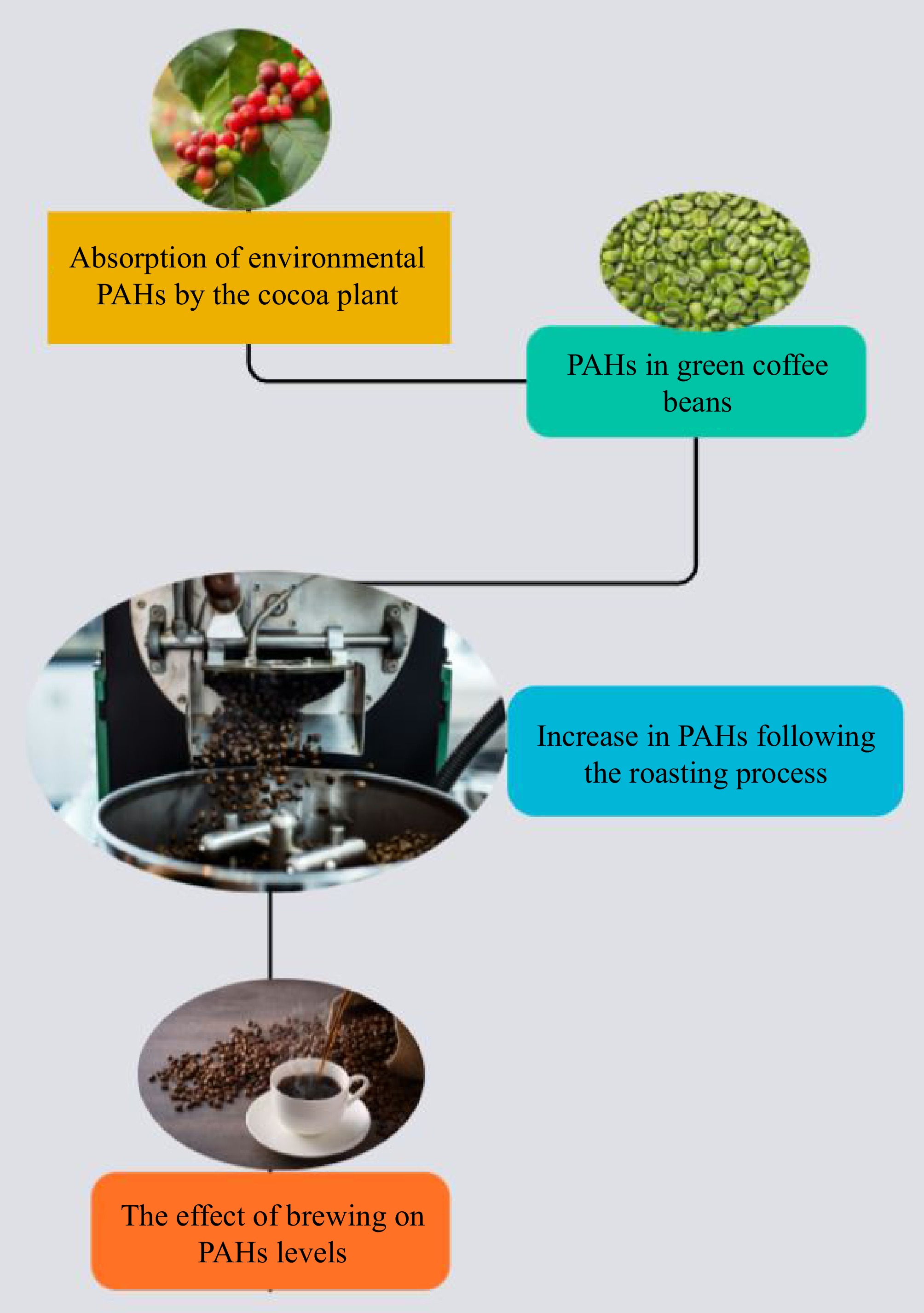
Figure 1.
Pathways to PAH entry into coffee.
-
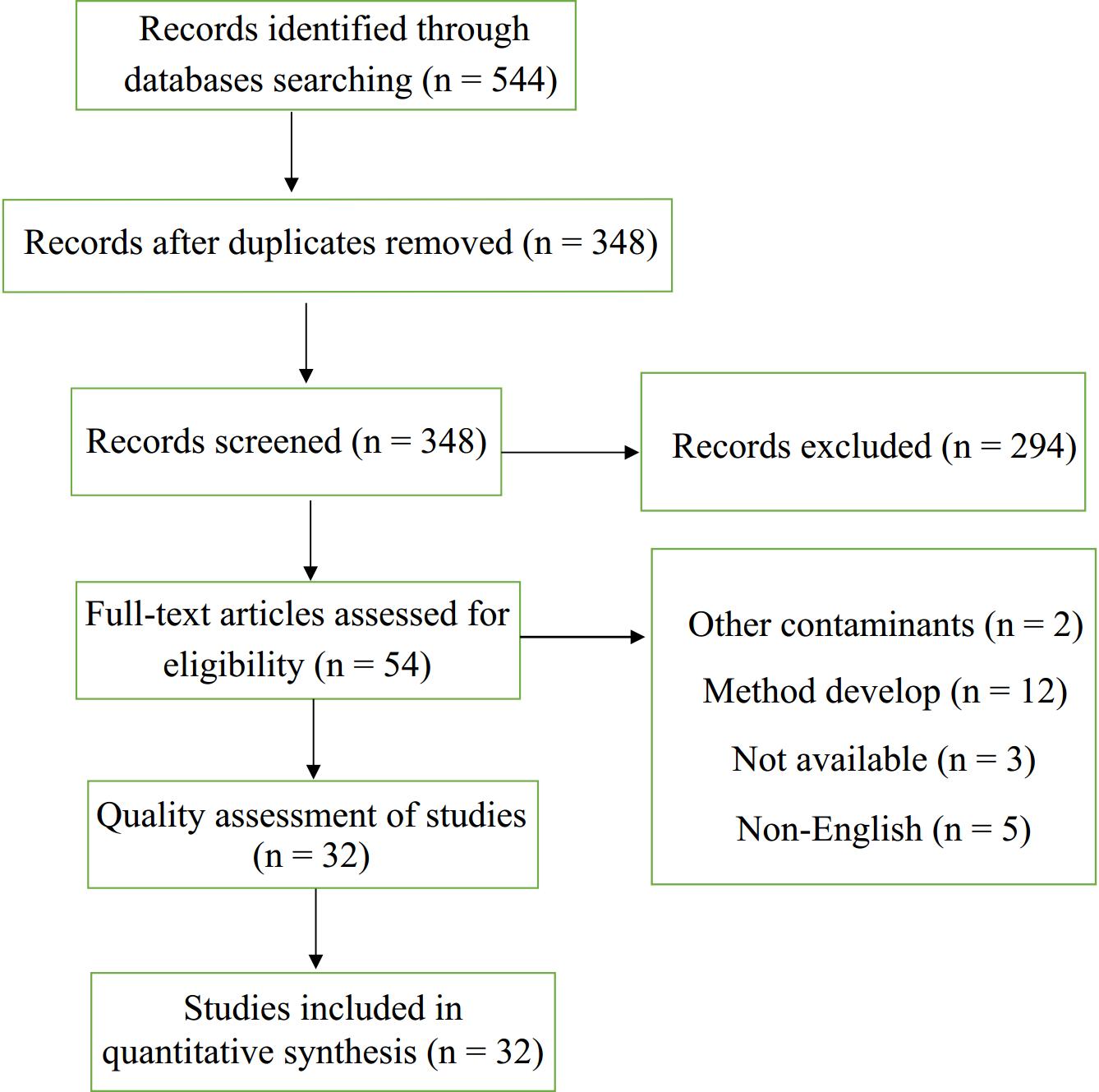
Figure 2.
PRISMA diagram.
-
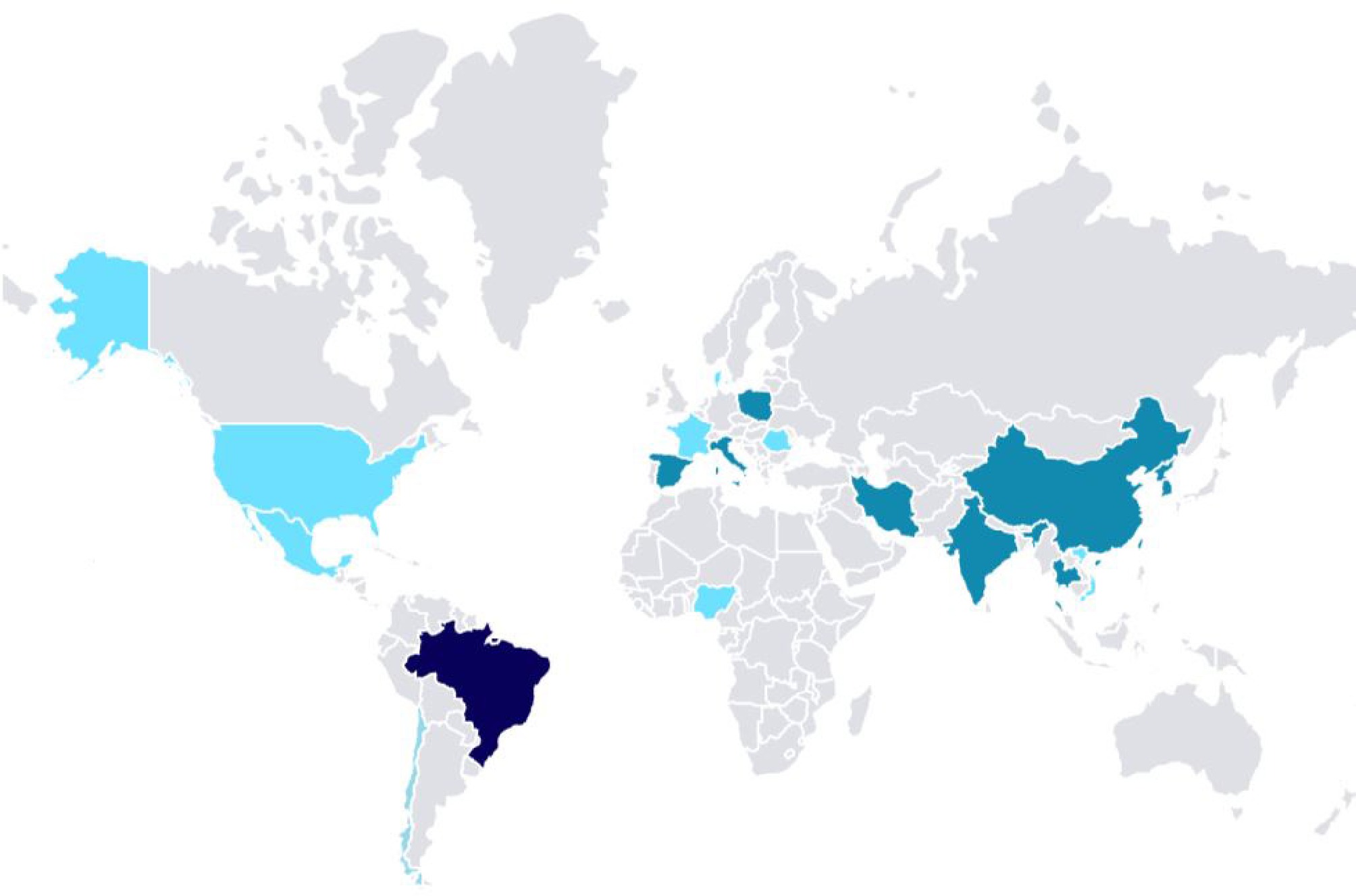
Figure 3.
The geographical distribution of studies (deep blue: 4 studies, medium blue: 2 or 3 studies, and light blue: 1 study).
-
Country Coffee/types Analytical method Main finding Ref. Italy Ground coffee; Espresso coffee GC-MS Benzo[a]pyrene was identified as a harmful compound in two samples (9.0 ng/g in coffee grounds). [15] Brazil Coffee brew GC-MS The identified PAHs included benzo(k)fluoranthene, benzo(b)fluoranthene, pyrene, acenaphthylene and acenaphthene. The most abundant amount was reported in oxy-PAH and nitro-PAH, 5,12-naphthacenequinone and 1-nitropyrene, respectively. [17] China Coffee GC-MS NiFe2O4@Ti3C2TX improved the detection efficiency. [21] Taiwan, China Coffee beans;
Coffee brewsHPLC and GC-MS With increasing degree of roasting, the content of PAHs increased significantly. [18] Thailand Coffee drink GC-FID Poly(o-phenylenediamine)-Zn composite improved PAHs extraction. PAHs values for Benzo(a)anthracene, chrysene, benzo(b)fluoranthene, and benzo(a)pyrene were 1.4 ± 0.4 to 16.5 ± 0.8 μg/L, 0.5 ± 0.2 to 2.1 ± 0.5 μg/L, 2.2 ± 0.6 μg/L, and 6.2 ± 1.0 μg/L, respectively. [22] Chile Coffee HPLC 6–31 μg/L range of PAHs in all samples was reported. [23] Vietnam Roasted coffee beans GC-MS/MS Among 100 samples the amount of PAHs in naphthalene, anthracene, pyrene, fluorene, phenanthrene, and benz[a]anthracene, was 943.7 ± 40.3, 195.1 ± 4.9, 36.1 ± 1.1, 33.3 ± 2.2, 28.2 ± 1.7, and 2.0 ± 0.1 μg/L, respectively. Increasing the coffee roasting time and temperature had the highest effect on increasing the amount of PAHs. There was no risk after assessing the carcinogenic and non-carcinogenic risks. [24] Iran Coffee GC-MS Among 150 imported coffee maximum and minimum mean levels of PAHs were found in samples from country A (20.78 ± 3.11 μg/kg dry mass (dm)) and F (13.00 ± 2.21 μg/kg dm), respectively. There was no carcinogenic risks. [25] Brazil Brewed coffee GC-MS Fluoranthene was measured only in two samples including 0.1 ± 15 and 22 ± 0.1 μg/L. Benzo[α]pyrene was measured in eight samples with a range of 0.0 ± 12 to 46 ± 0.6 μg/L. Other PAHs were not detected. [26] Iran Coffee GC–MS The maximum mean of PAHs in coffee samples was 13.75 ± 2.90 μg/kg, while the minimum mean PAHs in tea samples was 4.77 ± 1.01 μg/kg. 0.64 to 2.07 μg/kg was reported for average benzo[α]pyrene. There was negligible carcinogenicity. [27] Republic of Korea Roasted coffee beans HPLC-FLD The amount of benzopyrene in dark-roasted coffee beans samples was reported to be 1.27 μg/kg. The use of corona discharge plasma jet decreased the level of 53.6% of benzopyrene. [28] Thailand Robusta coffee beans roasted GC-MSD Only acenaphthylene, acenaphthene, fluorene, phenanthrene, and anthracene were found in the samples. This shows that the hot air method did not have a high effect on the production of PAHs. But increasing the temperature of the Superheated steam method could reduce the content of PAHs. [29] India Coffee HPLC- UV The total amount of PAHs was reported as 16.47 to 18.24 μg/L, in different brands. [30] Taiwan, China Coffee HPLC- UV Environmental migration and cooking method have a direct effect on the amount of PAHs. In unroasted coffee bean brewing solution, benzo[c]fluorene, dibenzo[a,i]pyrene, and dibenzo[a,h]pyrene values were reported as 0.02 ± 0.28, 0.02 ± 0.45, and 0.05 ± 0.05 μg/kg, respectively. Other PAHs were not measured. [31] Poland Arabica and Robusta coffee beans HPLC-FLD/DAD The level of 4.29 to 16.17 μg/kg was observed in roasted coffee beans. [32] Romania Roasted coffee beans HPLC-FLD Benzo[a]anthracene was not measured in Robusta coffee and Arabica coffee samples. Naphthalene had the highest amount of PAHs in all samples. [33] Denmark Coffee GC-MS The total sum of 25 PAHs in coffee samples was reported to be 5.1 μg/kg. PAH4 were not detected in instant coffee. [34] Spain Instant coffee HPLC The results of the analysis showed that benzo-[a]pyrene value was acceptable for EU Directives and was reported below 1 μg/kg. [35] India Grounded coffee brands GC-MS Range of PAHs was 831.7–1,589.7 μg/kg and benzo[a]pyrene was detected in all samples. [7] Mexico Roasted coffee GC-MS The summation of PAHs in coffee samples was from 3.5 to 16.4 mg/kg. [36] France Ground coffee GC-MS The amount of benzo[a]pyrene was low and was not in the range of carcinogenicity. [37] France Ground Arabica coffee brew HPLC Phenanthrene, anthracene, and benzo[a]anthracene was formed at a temperature higher than 220 °C, but the formation of pyrene and chrysene was reported at a temperature of 260 °C. They reported that increasing temperature resulted in the production of high molecular weight PAHs. [38] Nigeria Coffee based drinks GC-FID The amount of three- and four-ring PAHs was higher in the samples. [39] Taiwan, China Coffee HPLC The formation of PAHs increased with increasing roasting of coffee beans. The high pressure of the coffee machine significantly increased the production of PAHs. By calculating the risk assessment, a low level of concern was observed. [20] USA Roasted coffee HPLC Naphthalene, acenaphthylene, pyrene and chrysene were the most abundant in samples. The highest amount of PAHs was reported in dark roasted coffee samples and the lowest in light roasted coffee. [40] Spain Coffee brew HPLC The level of *8PAH was detected in 2.1 ng/L roasted coffees. * Fluoranthene, pyrene, benzo[a]anthracene, chrysene, benzo[e]pyrene,benzo[a]pyrene, benzo[g,h,i]perylene, and, dibenzo[a,h]anthracene. [41] Korea Roasted coffee Beans HPLC The 10 investigated coffee samples showed that concentrations of PAHs were reported between 0.08 ± 0.62 to 9.38 ± 53.25 μg/kg. BaP was reported as harmful PAHs at harmless levels for humans. [42] China Coffee HPLC-UV The range of PAHs in the samples was reported from 2.54 to 50.68 mg/L. The highest was related to benzo(b)fluoranthene and the lowest was related to benzo(k)fluoranthene. [43] Brazil Coffee brew samples HPLC-FLD The type of coffee, the degree of roasting and the brewing process are factors affecting the amount of PAHs. In C. arabica brews, the amount of total PAHs was in the range of 0.015 to 0.105 mg/L, and in C. canephora brews, the amount of 0.011 to 0.111 mg/L was reported. [9] Brazil C. arabica cv. Catuaí Amarelo
IAC-62 and C. canephora cv. Apoatã IAC-2258HPLC-FLD Medium roasting showed the highest amount of Benz(a)anthracene and total PAHs, but dark roasting showed the highest amount of benzo(b)fluoranthene and benzo(k)fluoranthene. [44] Poland Natural roasted coffee, instant coffee, cereal coffee GC-MS 7.20–68.15 μg/kg for natural roasted coffee and 2.97–19.55 μg/kg for instant coffee and 8.15–15.35 μg/kg for cereal coffee was reported. [3] Italy Coffee brew samples GC-MS Range of sum of PAHs was 0.52 to 1.8 μg/L. [45] GC-MS: Gas chromatography/mass spectrometry, HPLC: High-performance liquid chromatography. Table 1.
Total PAHs in coffee products according to the extracted data.
Figures
(3)
Tables
(1)