-
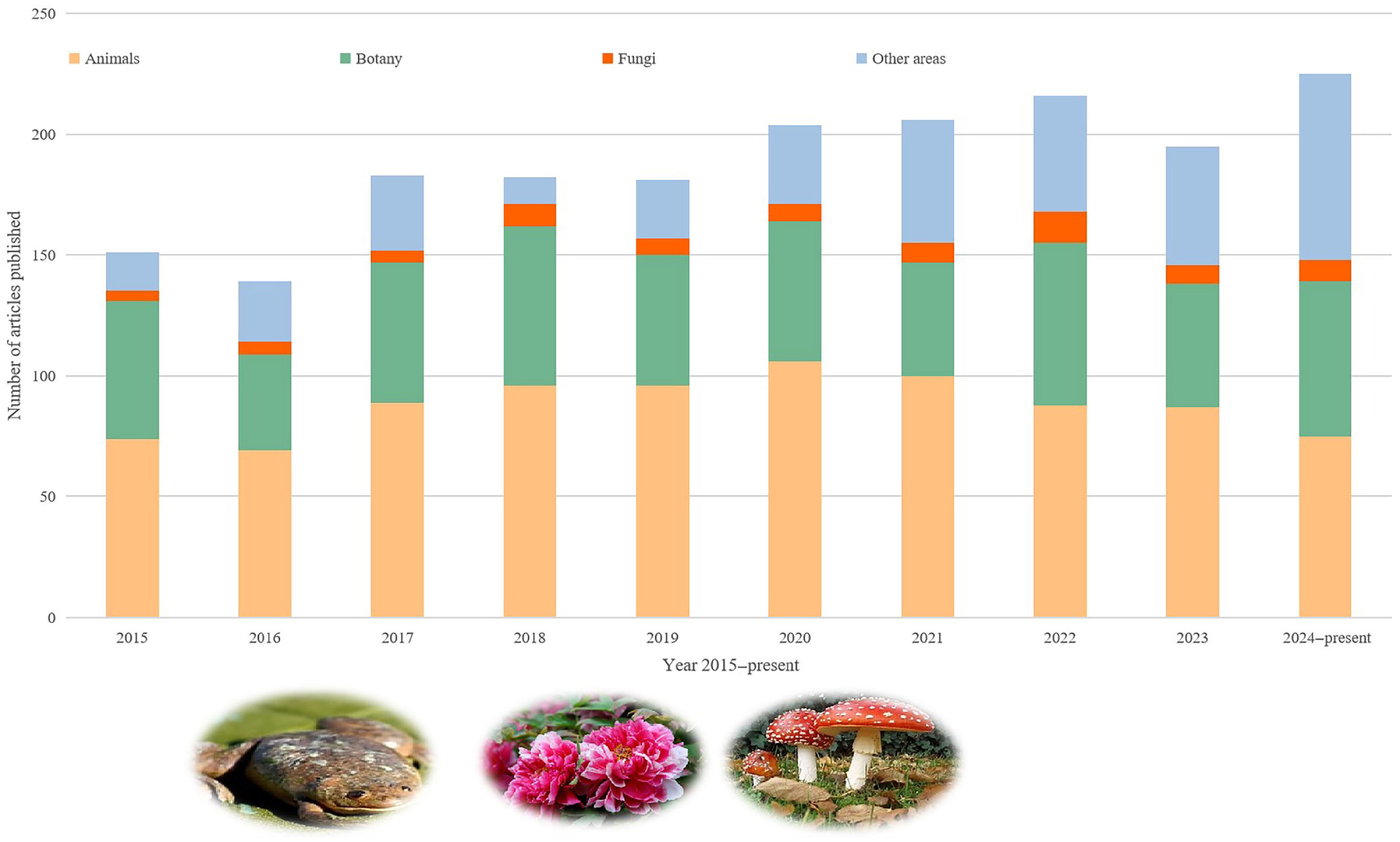
Figure 1.
Summary of articles on ancestral state reconstruction found on the Web of Science.
-
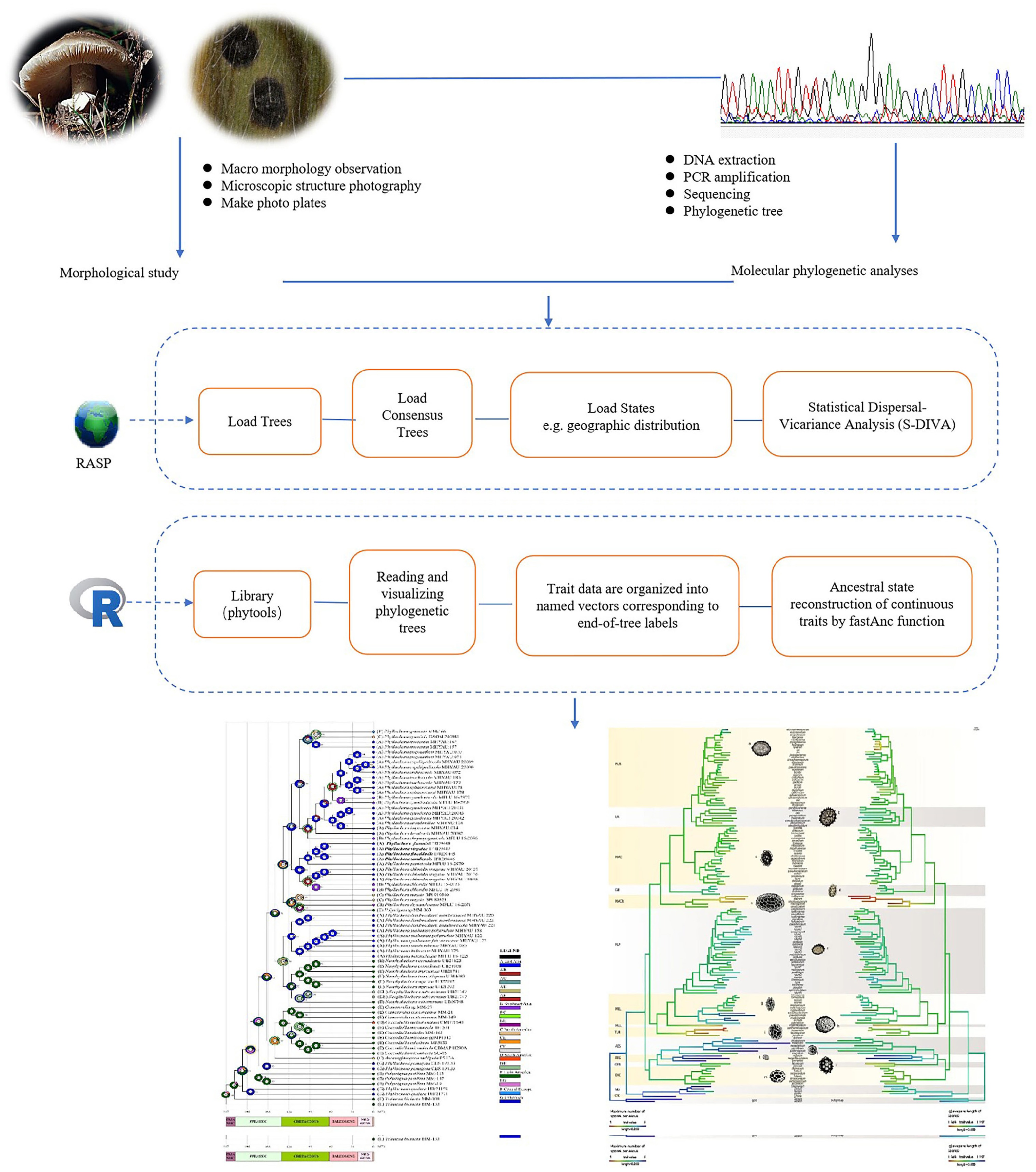
-
Principle Method Parsimony Maximum parsimony Stochastic modeling of trait evolution Maximum likelihood Bayesian inference Table 1.
The main approaches of ASR in mycological research.
-
Software Advantages Disadvantages Beast Framework for testing evolutionary hypotheses that does not require a single tree topology to be defined. It consumes computational resources. Fossil-based phylogenetic positions inferred from morphological data still need to be considered in conjunction with other evidence (e.g. palaeontological evidence). Diversitree Focuses on statistical modeling of species diversity and lineage differentiation, which can be used to explore patterns of species formation and extinction. Performs better with large amounts of data. Mesquite This is professional evolutionary biology software optimized for the analysis of comparative organism data, and is ideal for small datasets and educational applications. Processing large data sets is inefficient and the functionality is relatively simple, making it unsuitable for complex analysis. Multi-state Allowing the system and its components to assume more than two performance levels can provide a more realistic and accurate representation. Involves the estimation of a larger number of rate parameters. PHYLIP Open source and free, supports a wide range of phylogenetic analysis methods. The interface is older, less intuitive, and the functionality is relatively basic. R Powerful and flexible. It cannot be used to develop web-type or internet-type applications. RASP Supports multiple analysis methods and allows users to select models according to data characteristics, offering greater flexibility. Running Bayesian methods or complex models on large datasets or phylogenetic trees is time-consuming and requires high-spec hardware. Table 2.
Comparison of the advantages and disadvantages of the software and online websites for constructing ASR.
Figures
(2)
Tables
(2)