-
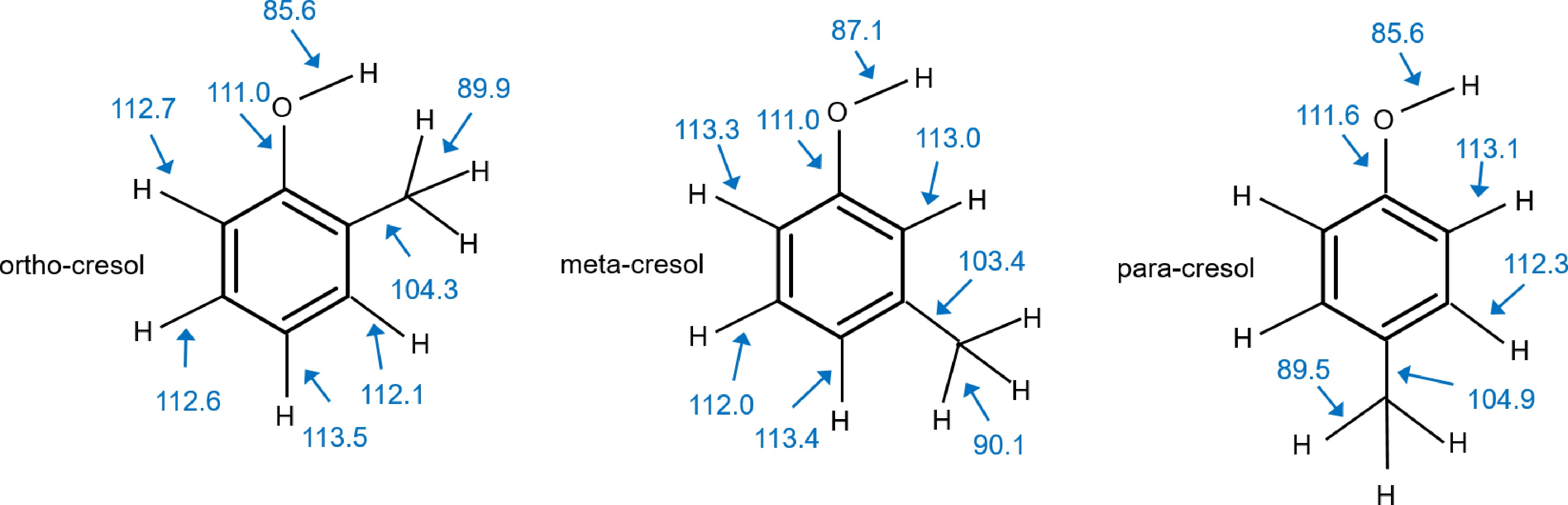
Figure 1.
Structures and BDE in kcal/mol of the three cresol isomers at the G4 level.
-
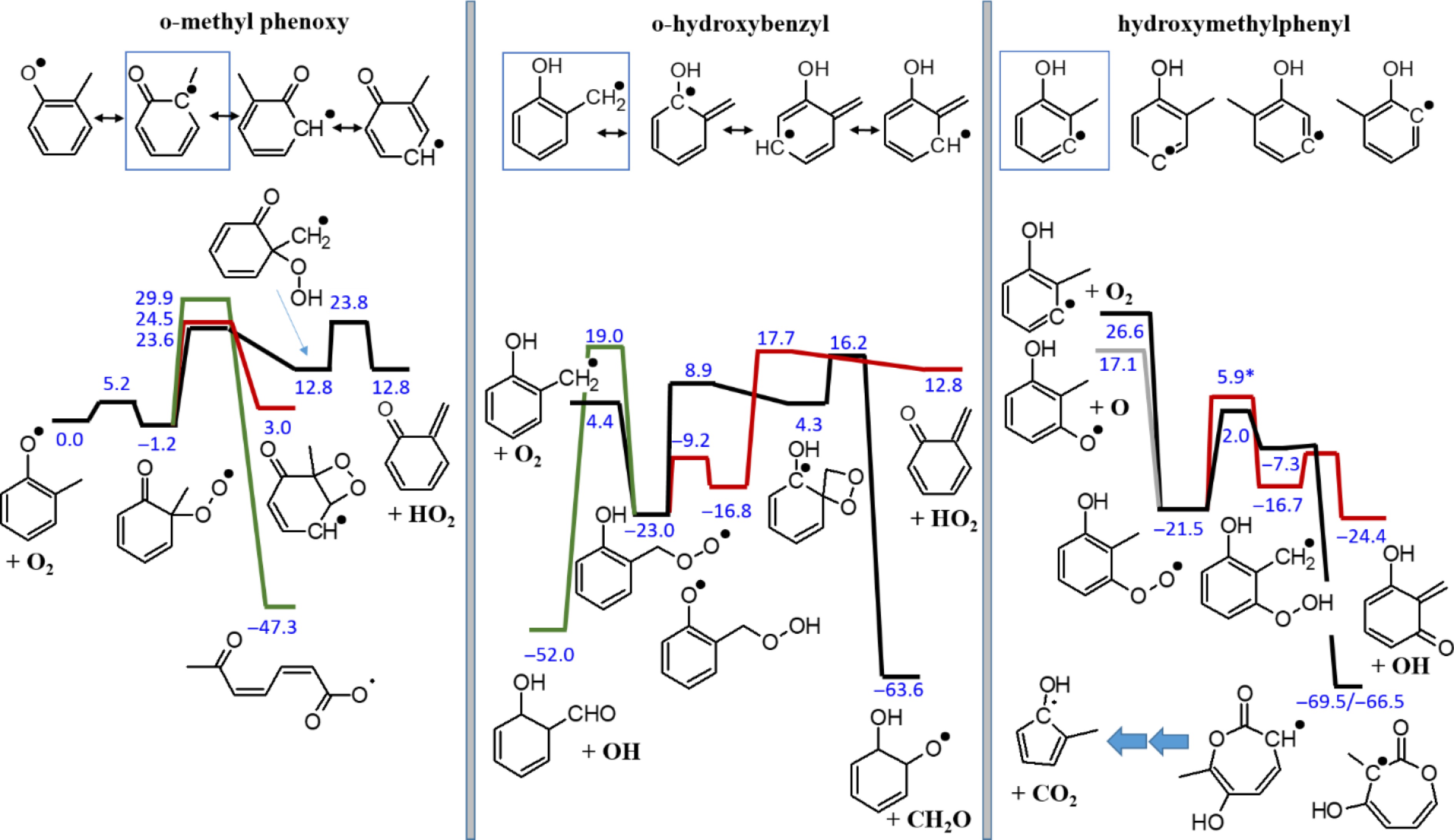
Figure 2.
Simplified potential energy surfaces for O2 addition to o-cresyl radicals. Only reaction pathways for the boxed resonance structures of o-methylphenoxy (left) or o-hydroxybenzyl (center) are considered. On the right, only pathways for the first arylic o-cresyl isomer are shown. The lowest energy pathways are shown in black. The value marked (*) is calculated at the CBS-QB3 level of theory, all other values are G4 results. All 298 K enthalpies are relative to o-methylphenoxy+O2.
-
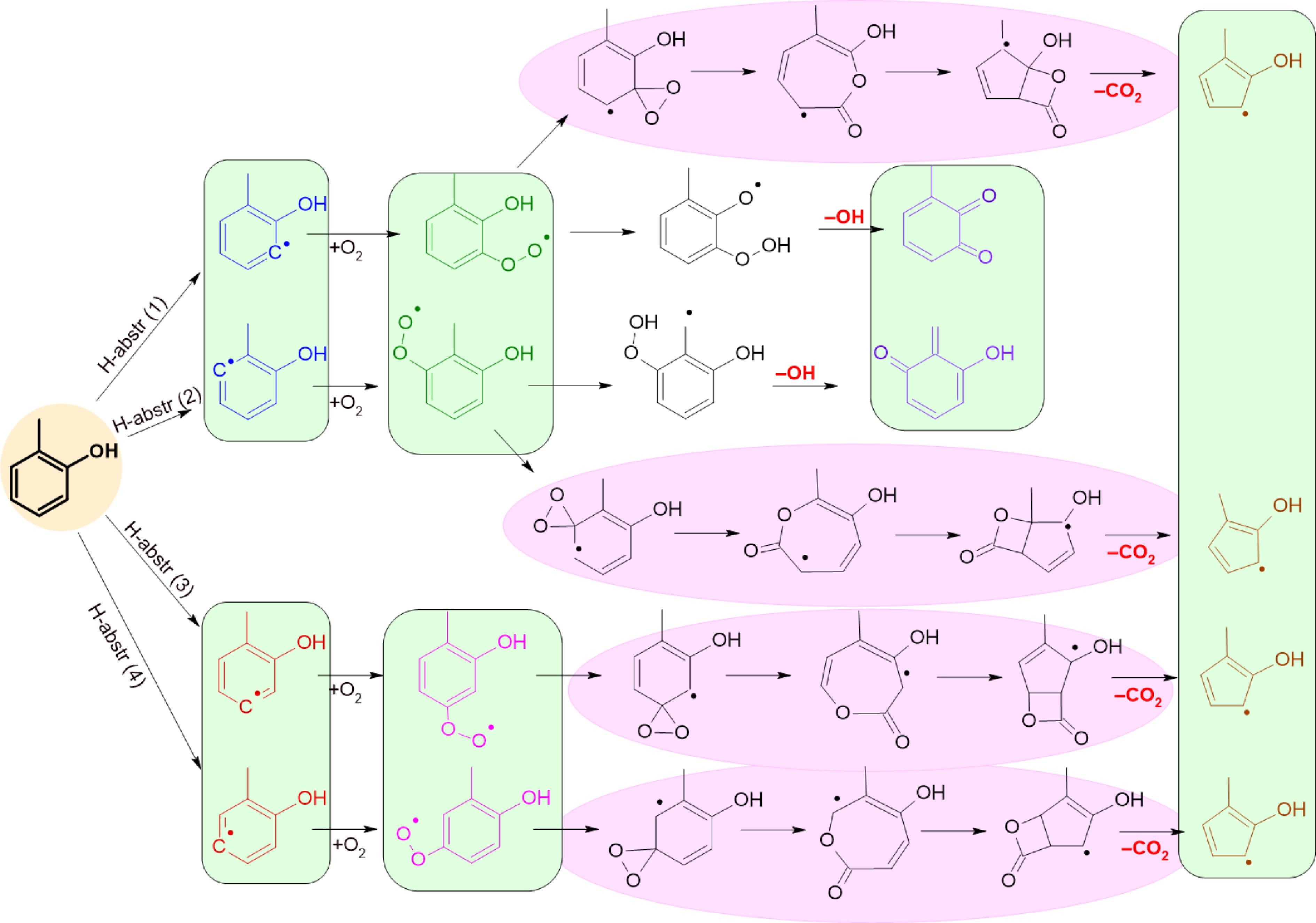
Figure 3.
Detailed pathways, which can be envisaged as derived from the H-abstractions of aryl H-atoms from o-cresol. In COLIBRIv5, the species in the green boxes are lumped species (species of the same color are considered as a single one), black intermediates are not considered, line reactions in the pink ovals are not written in details, but only their initial reactant and products.
-
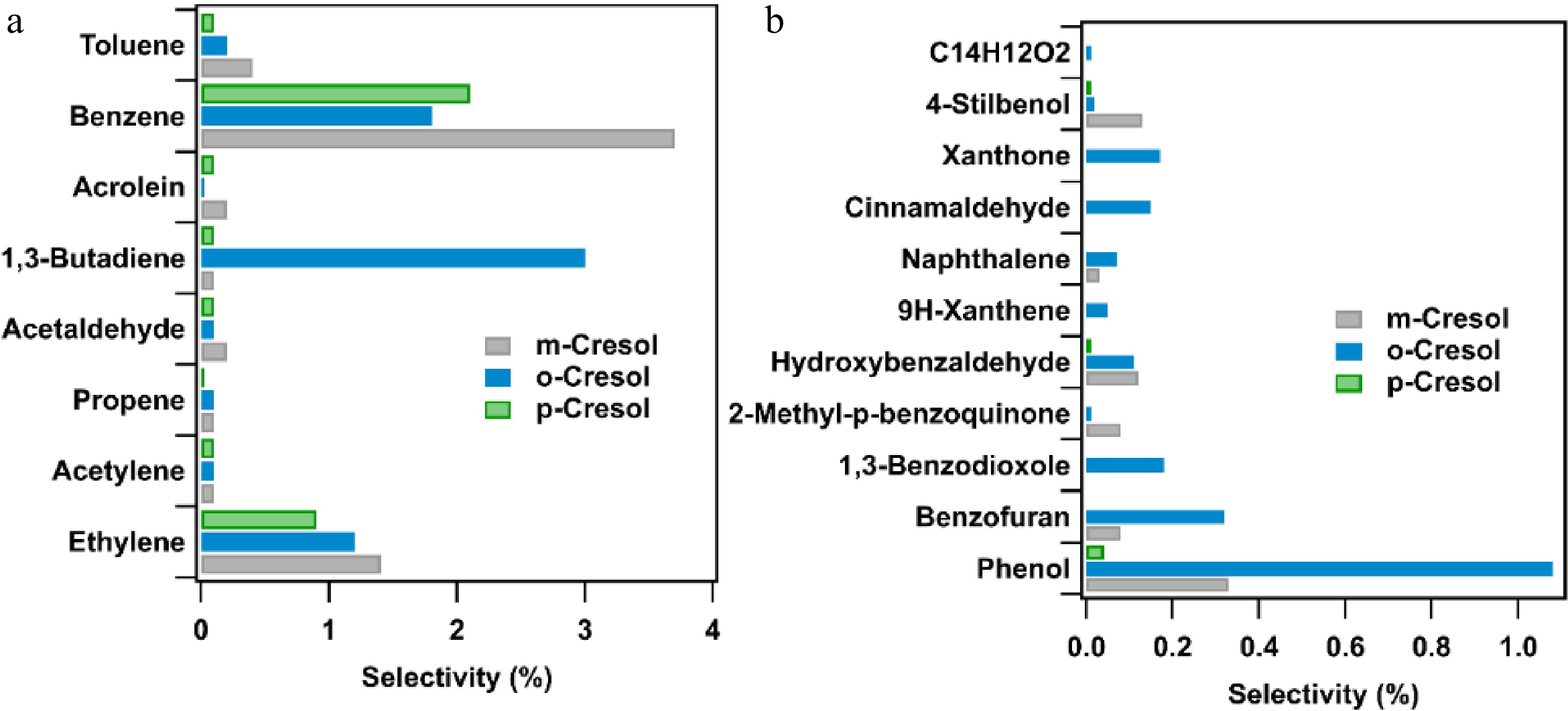
Figure 4.
Reaction product selectivity analyses for the oxidation of cresol isomers at φ = 1 and T = 1,000 K: (a) measured on-line (selectivity > 0.005), and (b) measured off-line (selectivity > 0.001, see structures in Table SI-1 in Supplementary File 1).
-
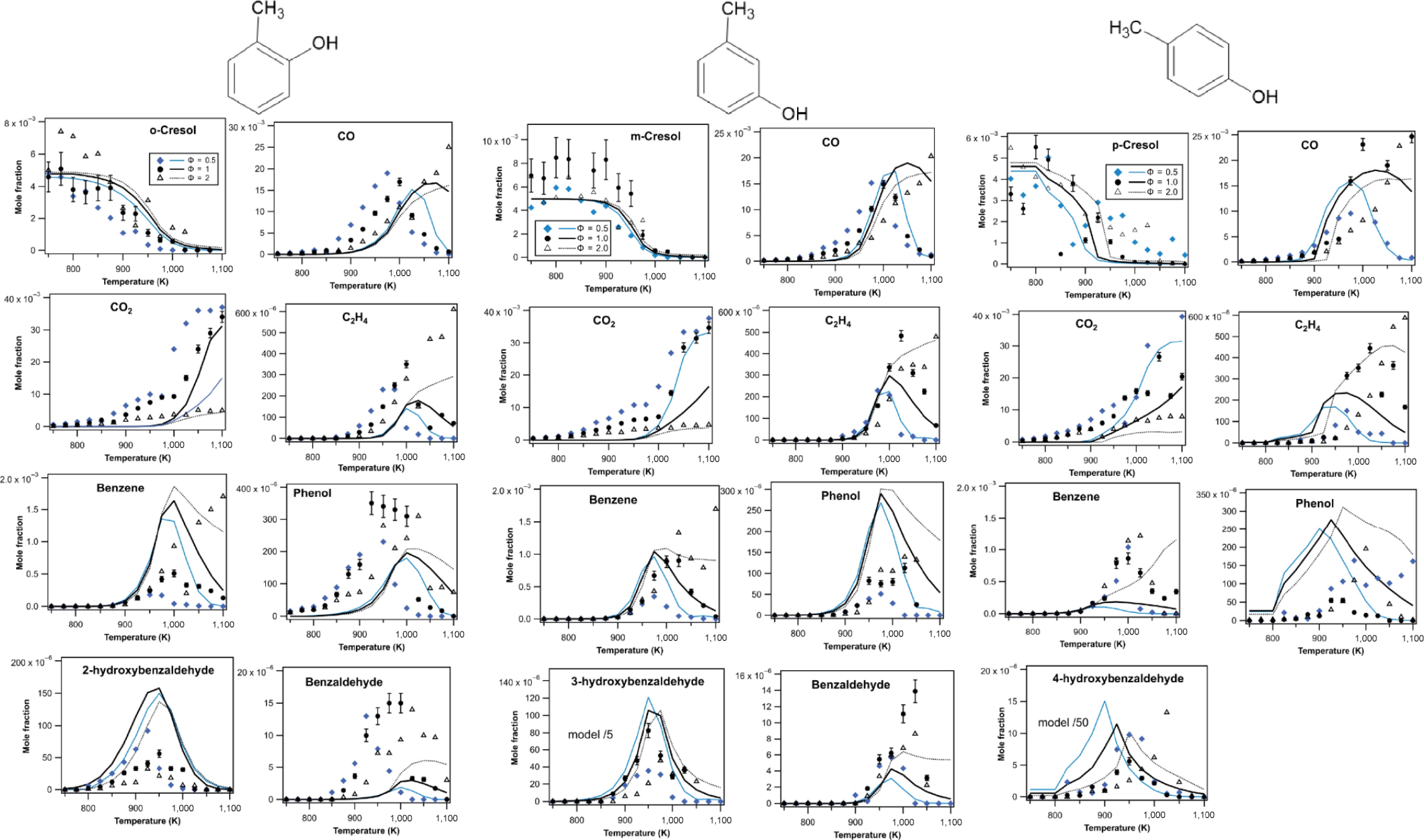
Figure 5.
Experimental and simulated mole fractions of fuels and main products during the JSR oxidation of the three isomers of cresol (symbols are experiments and lines modelling using COLIBRIv5, τ = 2 s, P = 1.07 atm).
-
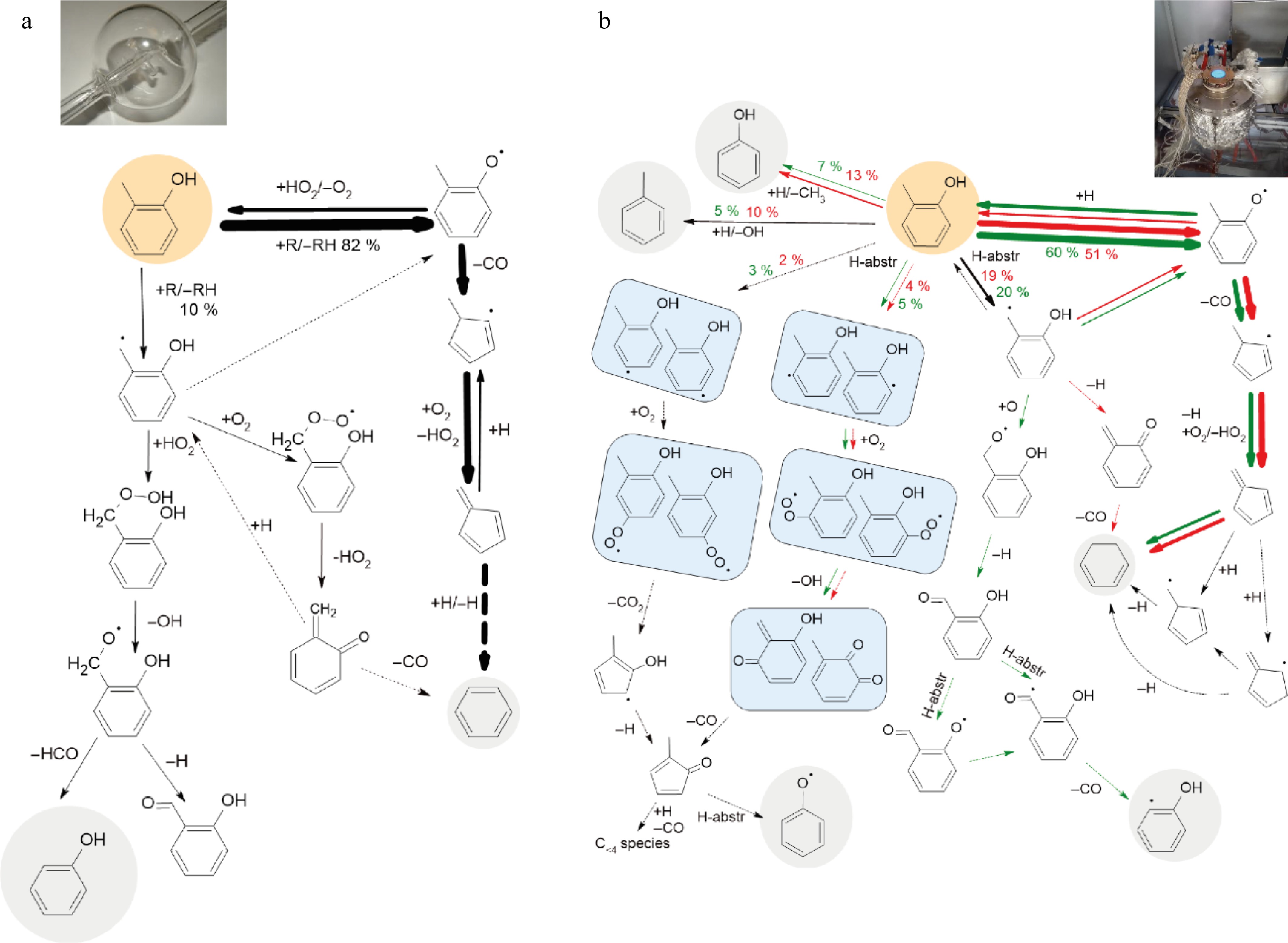
Figure 6.
Flow rate analyses for o-cresol using COLIBRIv5: (a) in JSR at 1,000 K at φ = 1, (b) integrated analysis for fuel decomposition in o-cresol flames, green arrows are for φ = 0.8, and red ones for φ = 1.3 (only flow rates above 2% are shown, grey backgrounds show species, the mechanism of which is already presented in analyses for toluene[4,20], the thickness of the arrows is proportional to their relative flow rates).
-
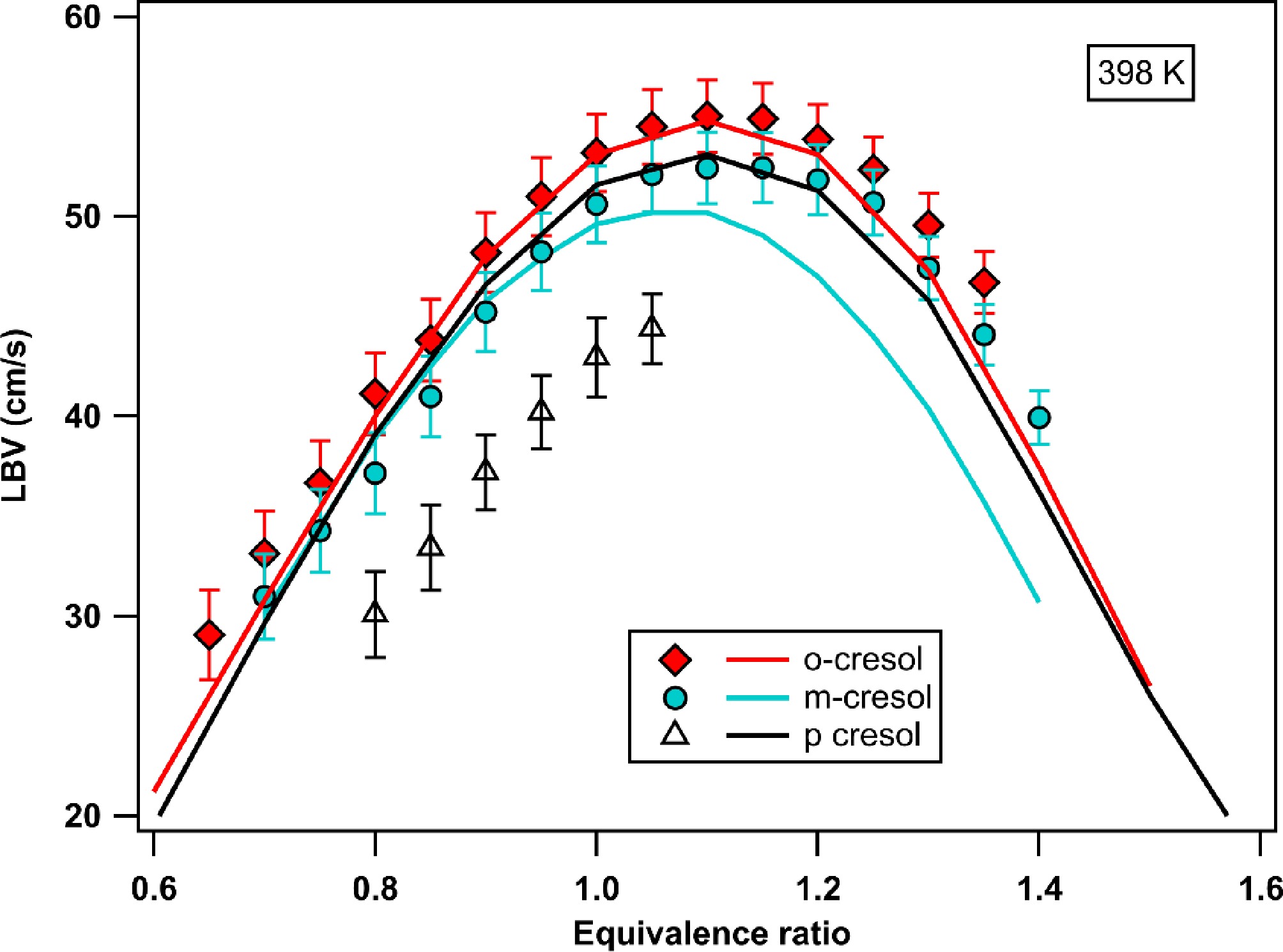
Figure 7.
Experimental (symbols with error bar) and simulated (using COLIBRIv5) LBV of cresols for a temperature of fresh gases of 398 K.
-
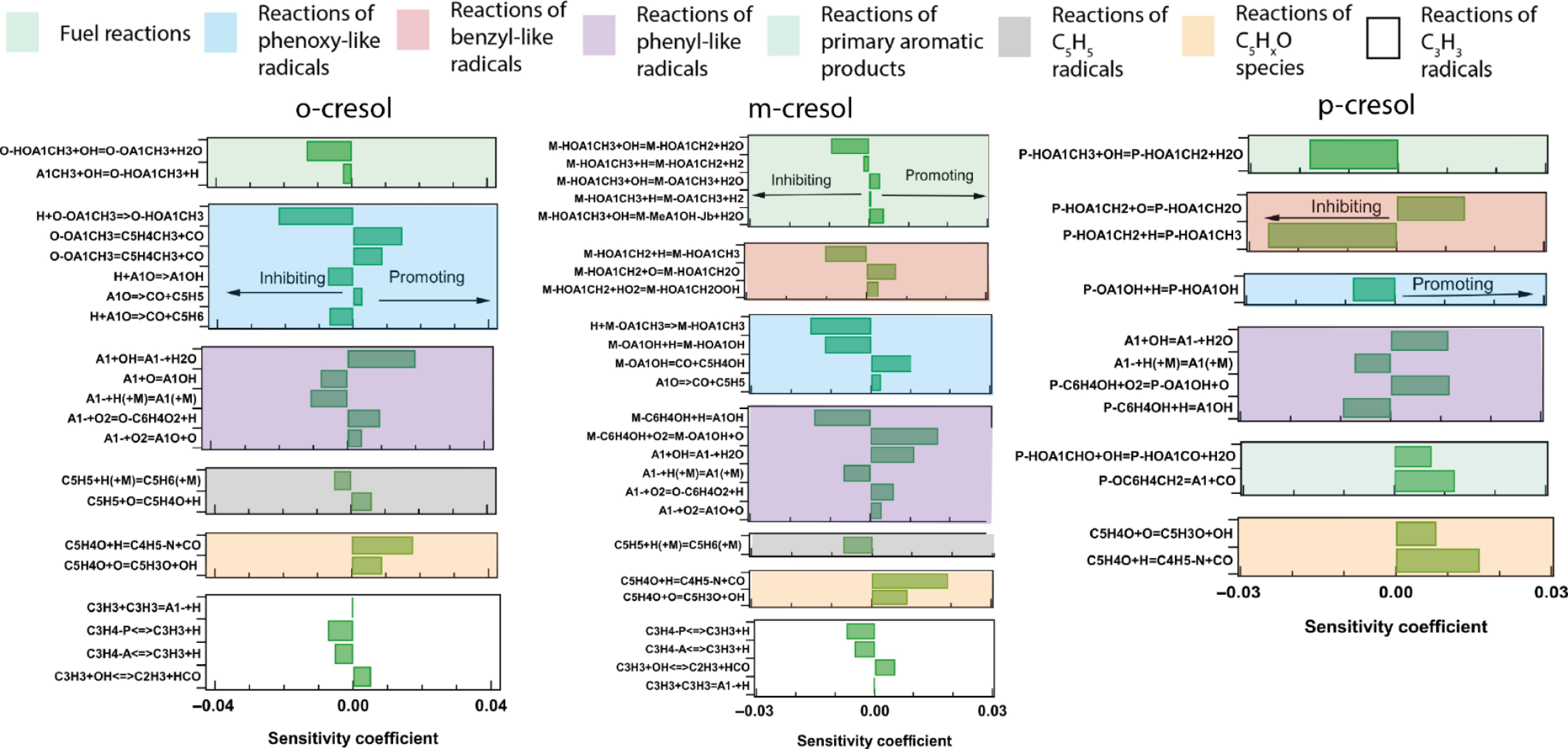
Figure 8.
Sensitivity analysis on the LBV of cresol isomers for a temperature of fresh gases of 398 K at φ = 0.8 using COLIBRIv5.
Figures
(8)
Tables
(0)