-
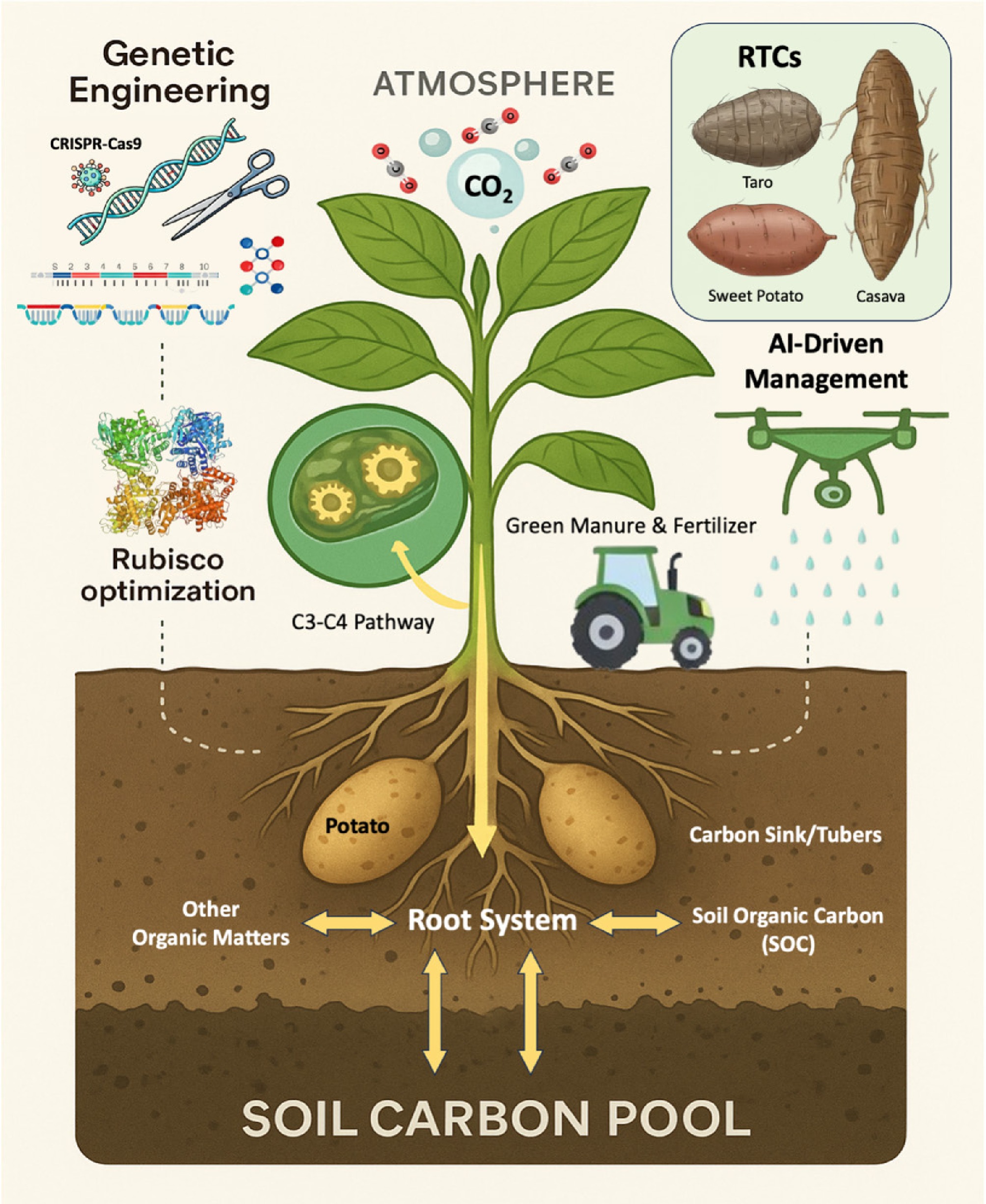
Figure 1.
Photosynthetic pathway of RTCs and their carbon sink potential. Genetic engineering includes a series of targeted molecular modification techniques, such as transgenesis, gene editing (e.g., CRISPR-Cas systems), RNA interference, gene overexpression, knockout, and knockdown, as well as transcriptional regulation via promoter engineering and regulatory element modification.
-
Crop type Specific crop Light-use efficiency (%) Net photosynthetic rate
(μmol CO2 m−2·s−1)Radiation use efficiency (RUE, g DM MJ−1 PAR) Photosynthetic conditions/
characteristics descriptionCarbon fixation notes Ref. RTCs (C3–C4 intermediate) Cassava 3.6–4.1 17.8–35 (typical field); 40–50 (Saturating light [>1,800 μmol m−2·s−1]) 0.22–1.64 (varied by study, cultivar, season) Low photorespiration;
heat-tolerantHigh carbon allocation to tubers [49,50] RTCs (C3) Sweet potato ≈4.0 15–35 (typical field); 21.4–40.3 (380−1,000 ppm CO2, 1,500 μmol m−2·s−1 PPFD) 0.8–2.5 (varied by
field experiment, cropping system)Closely related to cropping system, planting pattern,
and water contentLow photorespiration; heat tolerant [34,51] RTCs (C3) Potato 3.0–4.0 15–35 (influenced by variety, temperature, moisture); 30–35 (upper limit) 1.6–1.8 (multiple reviews; solar-radiation basis) Pn increases significantly with warming; C3 type, Pn rises with elevated CO2 (indoor tests) Moderate WUE [52−54] RTCs (C3) Yam ≈3.5 20–30 (up to 68% increase at elevated CO2) 0.8–1.8 (varied by experimental conditions) Mostly C3 type, responsive to elevated CO2; some reports
show ~60%–70% Pn increase under high CO2Shade-tolerant, moderate PN [55,56] C4 Maize 4.6–4.9 35–50 (field high-quality/superior cultivar; decreases under moderate/low humidity) 1.6–3.5 (the value is higher under special high-density/ideal conditions) High photosynthetic efficiency; Higher RUE under special stress/emergency conditions High PN and WUE [47,57] C4 Sorghum ≈4.7 32–46 (typical field/
greenhouse)1.4–4.9 (varied by cultivar and water,
3–5 in early stage)High photosynthetic efficiency; maintains photosynthetic and water use efficiency (WUE) under high temperature and drought High drought tolerance [58,59] C4 Sugarcane ≈5.0 30–50 (typical field);
40–50 (midday values)1.6–3.0 (1.6–2.0 in most field studies; cultivar/season led to upper limit near 3) High photosynthetic efficiency; robust under drought; energy sorghum (bioenergy type) has higher RUE than grain sorghum Highest biomass production [60,61] Table 1.
A comparison of photosynthetic and carbon sequestration of RTCs and C4 crops.
-
Gene/ref. Function Potential effects in potato rbcL[96] Encodes the large subunit of Rubisco, catalyzing CO2
fixation in the Calvin cycle.Improved catalytic efficiency could increase net photosynthesis by 10%–20%, enhancing tuber yield and carbon sequestration. rbcS[99] Encodes the small subunit of Rubisco, influencing enzyme stability and specificity. Optimized variants reduce photorespiration, potentially boosting biomass accumulation in tubers under high temperatures. RCA[90] Ribulose bisphosphate carboxylase/oxygenase activase; removes inhibitors from Rubisco active sites. Overexpression maintains Rubisco activity during heat stress, leading to sustained CO2 fixation and larger tubers. RAF1[100] Rubisco accumulation factor 1; aids in Rubisco assembly
and folding.Enhances Rubisco biogenesis, improving overall photosynthetic rate and carbon partitioning to storage organs. PRK, GAPDH,
FBPase, SBPase[97]Catalyze and regulate steps in the Calvin cycle (e.g., PRK regenerates ribulose-5-phosphate; GAPDH reduces 3-PGA; FBPase/SBPase hydrolyze sugar phosphates). Coordinated upregulation accelerates carbon assimilation, increasing starch synthesis and tuber size by up to 15%–25%. PEPC[98] Phosphoenolpyruvate carboxylase; initial CO2-fixing enzyme in C4 pathway, producing oxaloacetate. Introduction enables C4-like metabolism, concentrating CO2 and reducing photorespiration losses for higher yields in arid conditions. PPDK[101] Pyruvate orthophosphate dikinase; regenerates PEP to
sustain C4 cycle.Maintains efficient C4 flux, potentially elevating CO2 fixation rates and biomass in potato leaves. NADP-ME/
NAD-ME[102]Malic enzymes; decarboxylate malate in bundle sheath cells, releasing CO2 for Rubisco. Facilitates CO2 delivery, improving photosynthetic efficiency and carbon allocation to tubers. CA[103] Carbonic anhydrase; hydrates CO2 to HCO3−, providing substrate for PEPC. Enhances C4 initiation, leading to reduced water loss and increased carbon gain in drought-prone potato cultivation. TPT[104] Triose phosphate translocator; exports photosynthates
from chloroplasts to cytosol.Optimizes carbon export, preventing feedback inhibition and promoting starch accumulation in tubers. AGPase, SS[91] ADP-glucose pyrophosphorylase and starch synthase;
key in plastidial starch biosynthesis.Deregulation increases tuber starch content, enhancing sink strength and overall plant carbon storage. SPS[105] Sucrose phosphate synthase; catalyzes sucrose synthesis
in cytosol.Upregulation improves photosynthate partitioning, supporting tuber growth and long-term carbon sequestration in soil. Table 2.
Functional genes that may affect the carbon fixation efficiency.
Figures
(1)
Tables
(2)