-
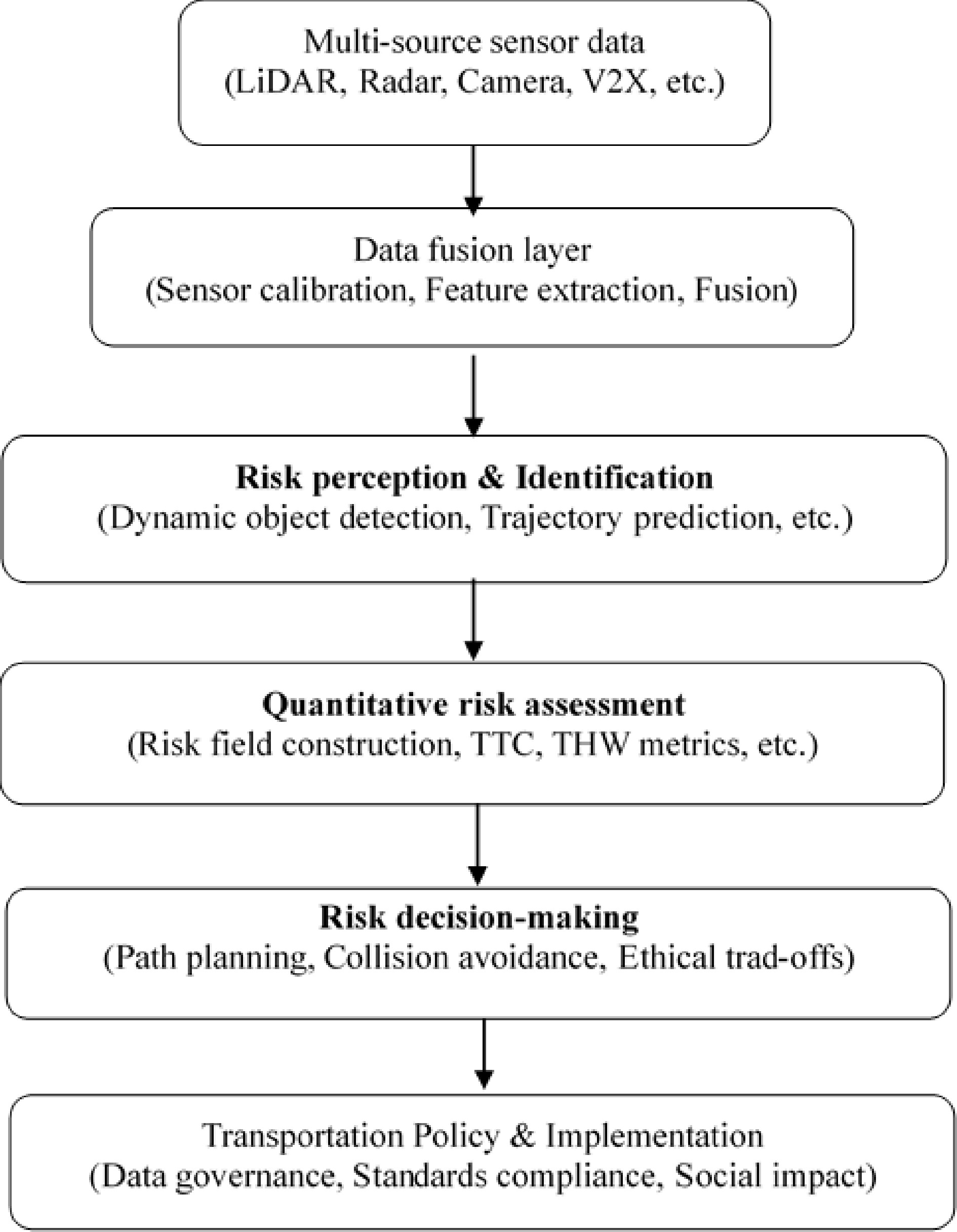
Figure 1.
Research framework of this study.
-
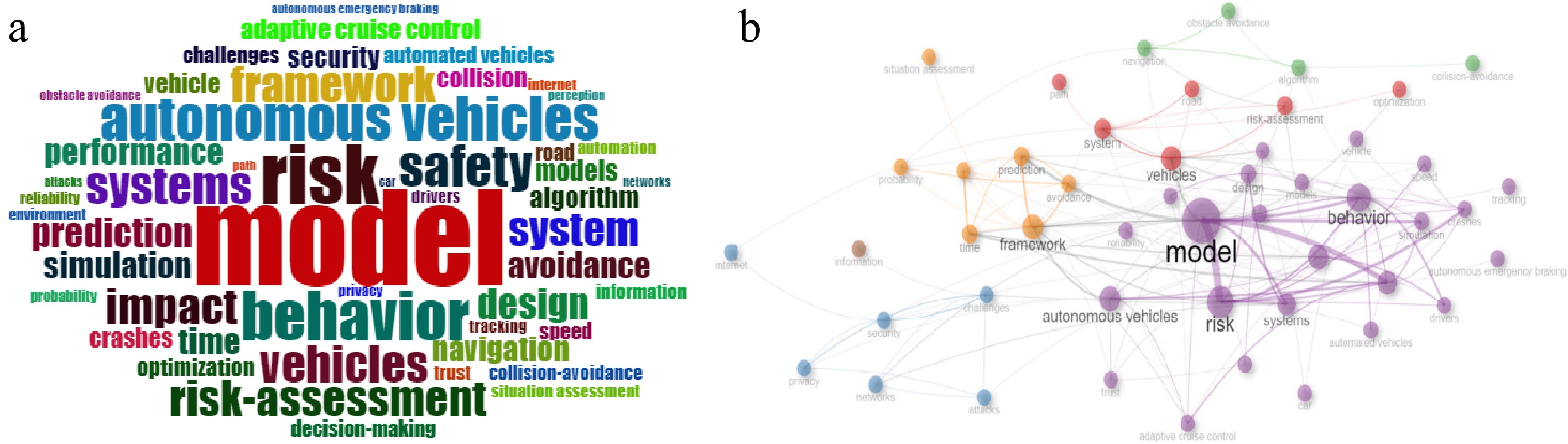
Figure 2.
Relationship between IVs and related studies.
-
Study Focus area Scope Limitation addressed by this study Xiong et al.[4] Driving risk assessment in multi-vehicle interaction Specific scenarios (interactions) Limited to specific interaction scenarios; does not cover broader risk architecture or decision-making ethics. Pei & Hou[5] Safety assessment of urban arterial traffic
flowTraffic flow level Focuses on traffic flow management rather than vehicle-level risk perception mechanisms. Cheng et al.[6] Driving safety risk progress (identification, prediction, warning) Technical methodologies Lacks integration with transportation policy and ethical governance. This review Risk perception, quantitative assessment, policy, and decision-making Systematic: 'human-vehicle-road' + policy integration Proposes a holistic framework integrating technical standards with practical transport applications and ethical considerations. Table 1.
Comparison between this review and existing literature.
-
Assessment dimension Typical methods Key indicators/models Strengths Limitations Ref. Risk architecture 'Human-vehicle-road' synergistic framework Driving risk field, neural domains Holistic perspective: Integrates multi-source factors High modeling complexity: Difficult to quantify interactions Sun et al.[7]; Lisowski[10] Risk identification and prediction Multi-source data fusion LiDAR, radar, camera fusion; LSTM,
transformerHigh real-time capability: High prediction accuracy in structured environments Sensitive to sensor noise: Poor generalization in unstructured scenarios Zhang et al.[14]; Han et al.[19] Quantitative risk evaluation Spatiotemporal risk modeling TTC, THW, Spatial-Temporal Risk Field
(STRF)Visualizable risk distribution: Good guidance for path planning Parameter tuning relies on experience: Static environment assumptions Ahmad et al.[18]; Zhang & Guo[24] Risk decision-making Reinforcement learning and game theory DRL (SAC, DDPG), dynamic game, MPC Adaptive decision-making: Handles multi-vehicle interactions 'Black box' nature: Ethical trade-offs hard to encode Fang et al.[35];
Yin et al.[43]Table 2.
Summary of risk assessment methodologies for intelligent vehicles.
-
Category Key challenges Impact on deployment Potential solutions/future directions Data governance Data silos: Fragmentation between traffic management agencies and OEMs: Heterogeneous data standards. Hinders cross-departmental collaboration: Limits system-wide optimization: Inefficient incident management. Establish unified data standards (e.g., European Mobility Data Space); Utilize Blockchain for secure sharing; Build integrated traffic big data centers. Ethical trade-offs Fairness Constraints: Conflicts between pedestrian vs passenger protection: Algorithmic bias in risk quantification. Raises legal disputes: Erodes public trust: Hinders social acceptance of IVs. Develop ethical guidelines aligned with legal frameworks; Incorporate fairness metrics into algorithm design; Adopt transparent 'utilitarian' or 'random' decision protocols. Model
generalizationEnvironmental Adaptability: 'One-size-
fits-all' models fail in unstructured
roads (rural lanes) or corner cases.Safety risks in complex/mixed traffic scenarios: Limitation of simulation validation. Context-aware risk modeling; Scenario-based testing (ISO 21448); Integration of Edge AI for real-time local processing. Table 3.
Summary of technical bottlenecks and potential solutions in IV risk assessment.
Figures
(2)
Tables
(3)