-
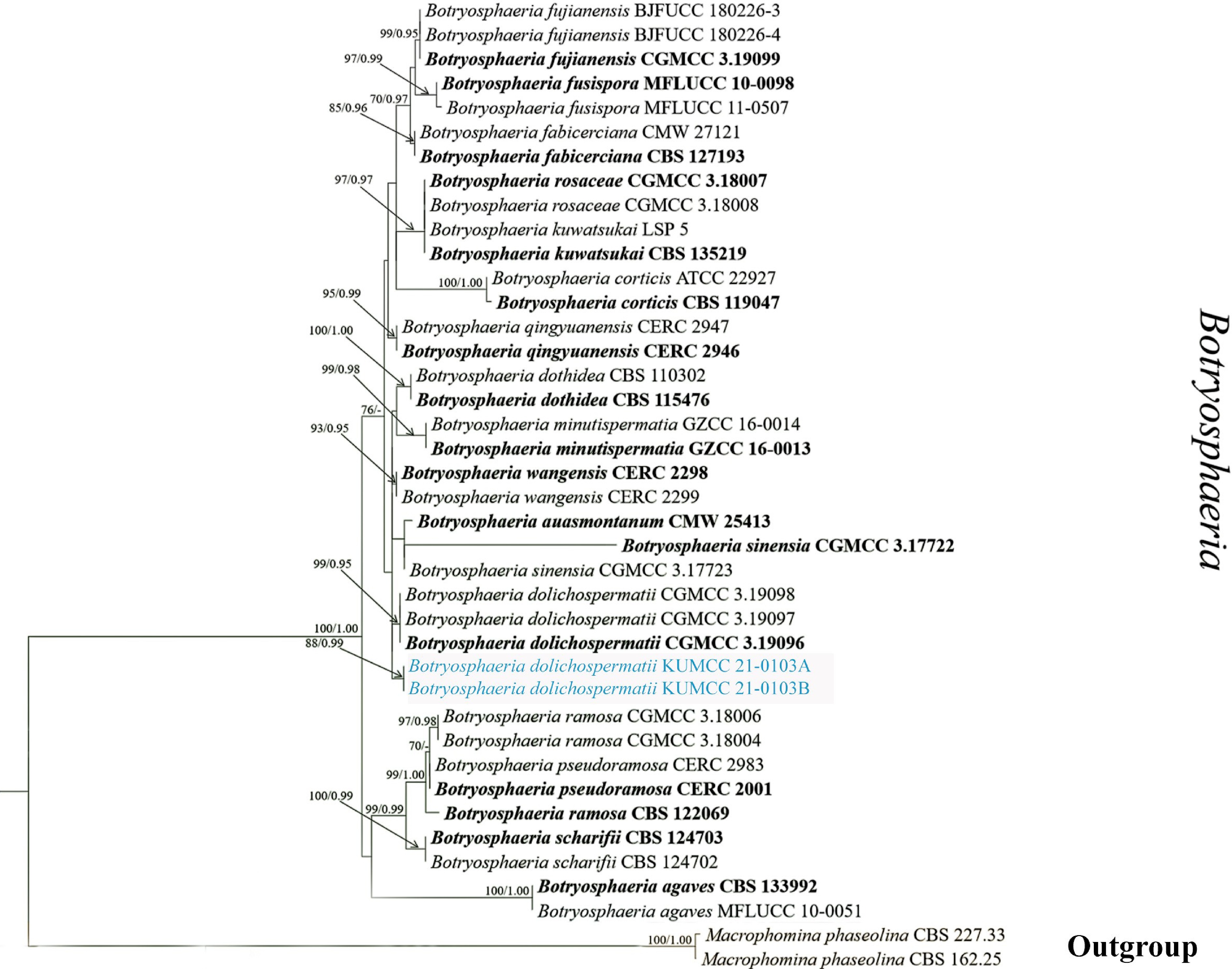
Figure 1.
Phylogram generated from Maximum Likelihood analysis based on ITS, LSU, tef1, and tub2 sequence data representing Botryosphaeria species. Bootstrap values for ML equal to or greater than 60% and BYPP values greater than 0.95 (the rounding of values to two decimal proportions) from BI analysis are labelled on the nodes. A newly generated sequence is in blue, and type species are bold.
-
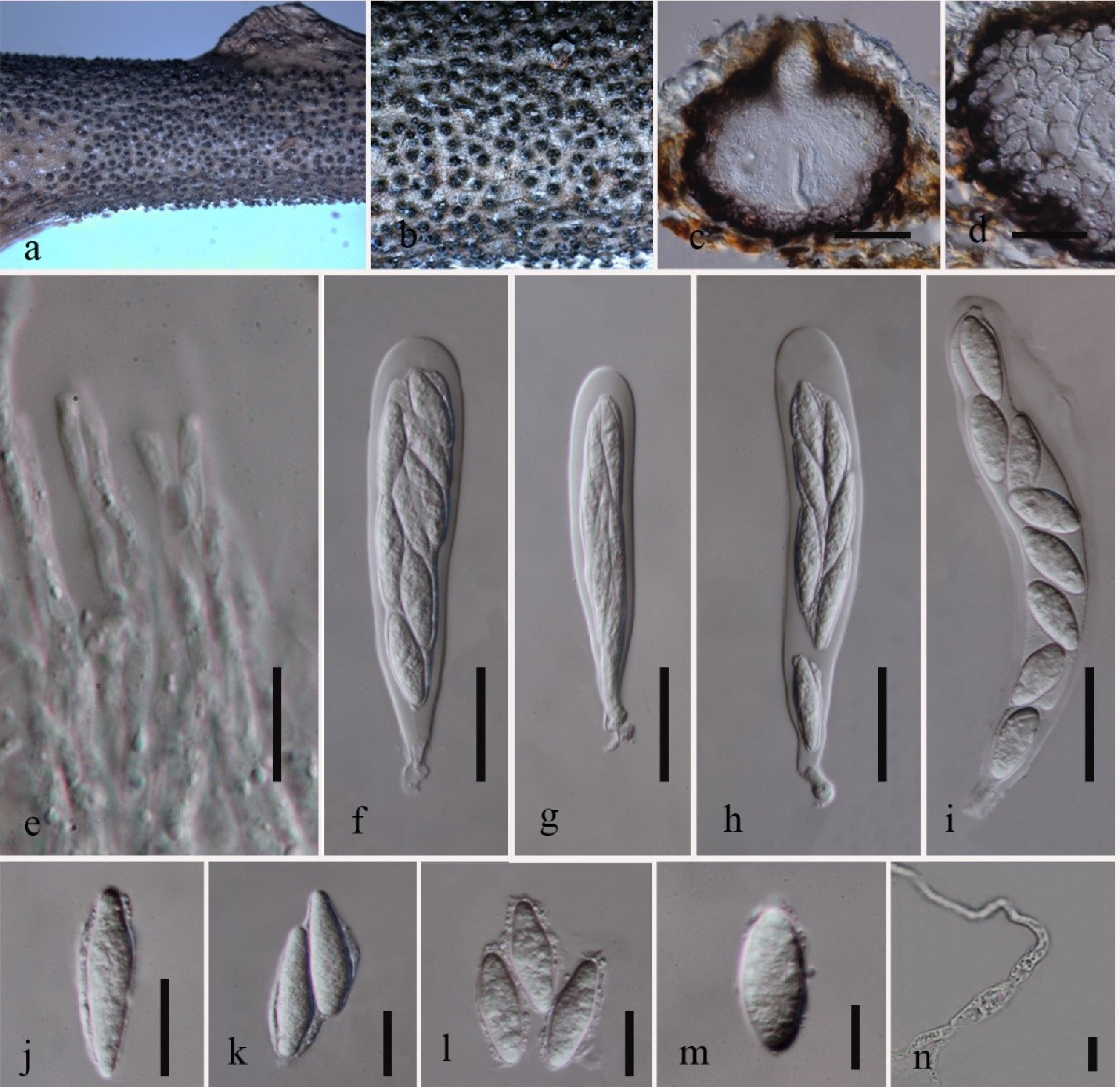
Figure 2.
Botryosphaeria dolichospermatii (KUN-HKAS 115560). (a), (b) Ascomata on host surface. (c) Vertical section of ascoma. (d) Peridium. (e) Pseudoparaphyses. (f)–(i) Asci. (j)–(m) Ascospores. (n) Germinated ascospore. Scale bars: (c) = 50 μm; (d), (f)–(i) = 20 μm; (e), (j)–(n) = 10 μm.
-
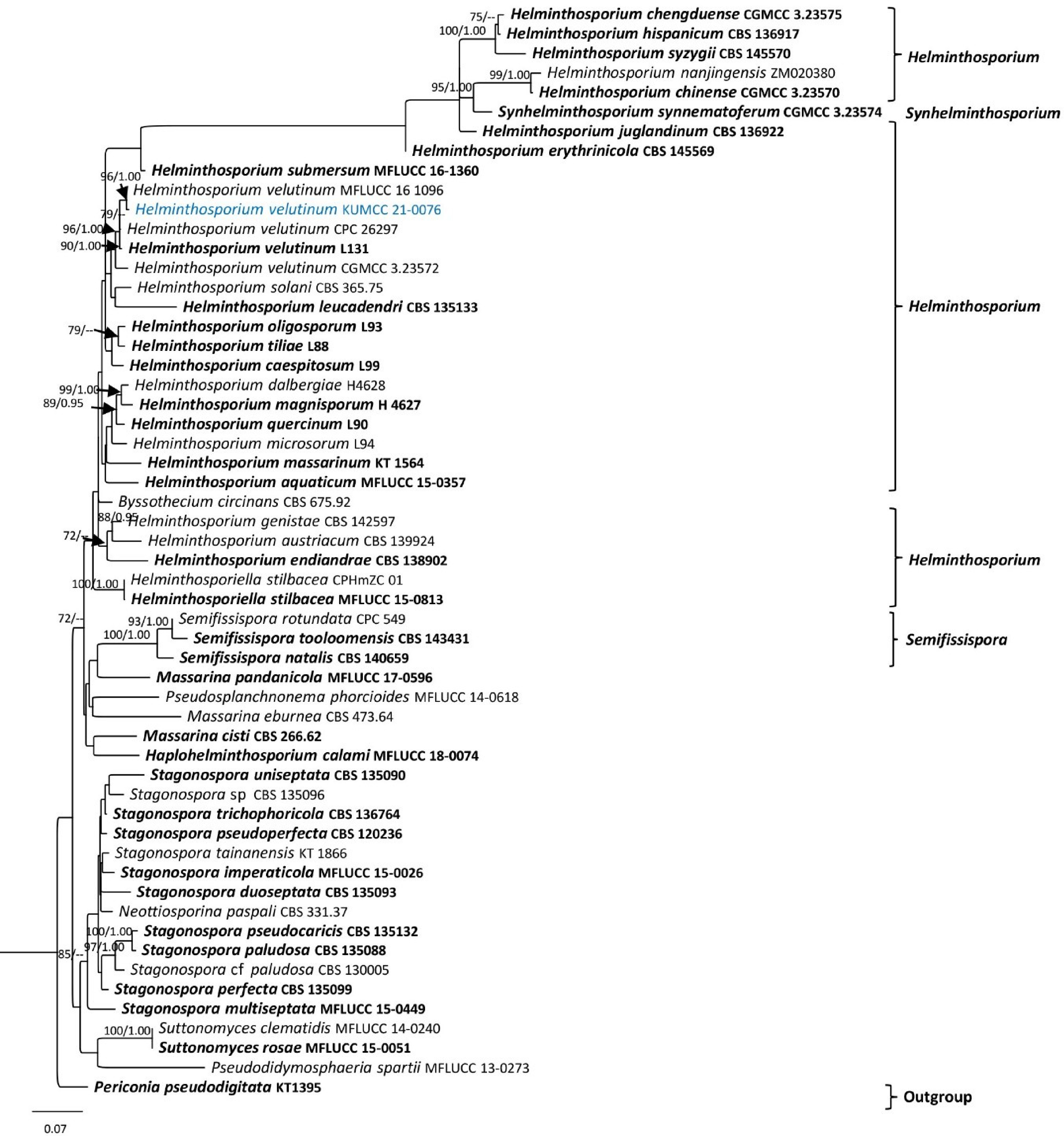
Figure 3.
Phylogram generated from Maximum Likelihood analysis based on LSU, SSU, ITS, and tef1 sequence data. Bootstrap values for ML equal to or greater than 70% and BYPP values greater than 0.95 (rounded to two decimal places) from the BI analysis are labeled on the nodes. A newly generated sequence is in blue, and type species are bold.
-
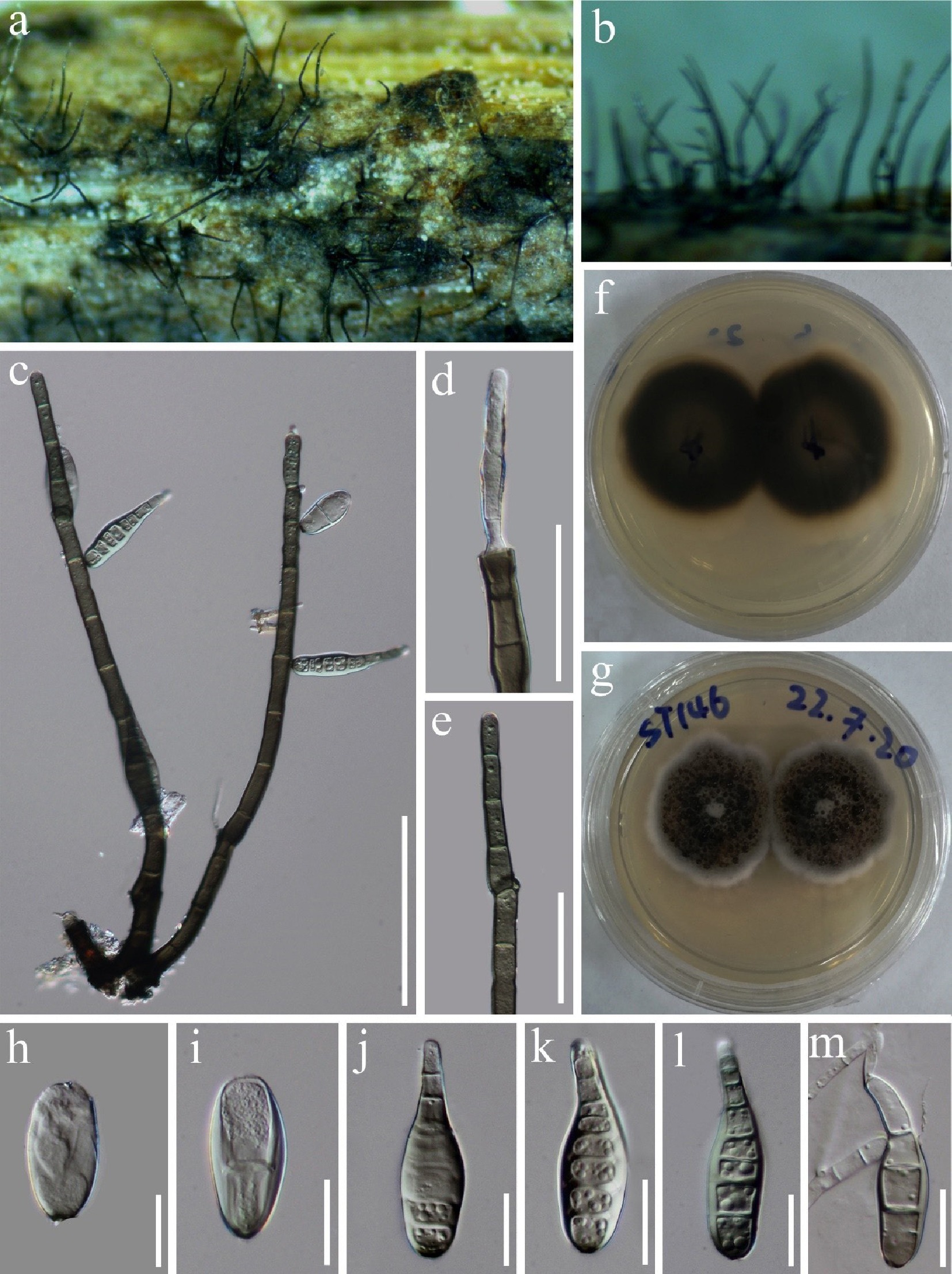
Figure 4.
Helminthosporium velutinum (KUN-HKAS 115606). (a), (b) Colonies on the substrate. (c) Conidiophores and conidia. (d), (e) Conidiogenesis. (f) Reverse view of culture on PDA. (g) Forward a few of the cultures in PDA. (h)–(l) Conidia. (m) Germinating conidium. Scale bars: (c)= 100 μm; (d), (e) = 50 μm; (h)–(m) = 20 μm.
-
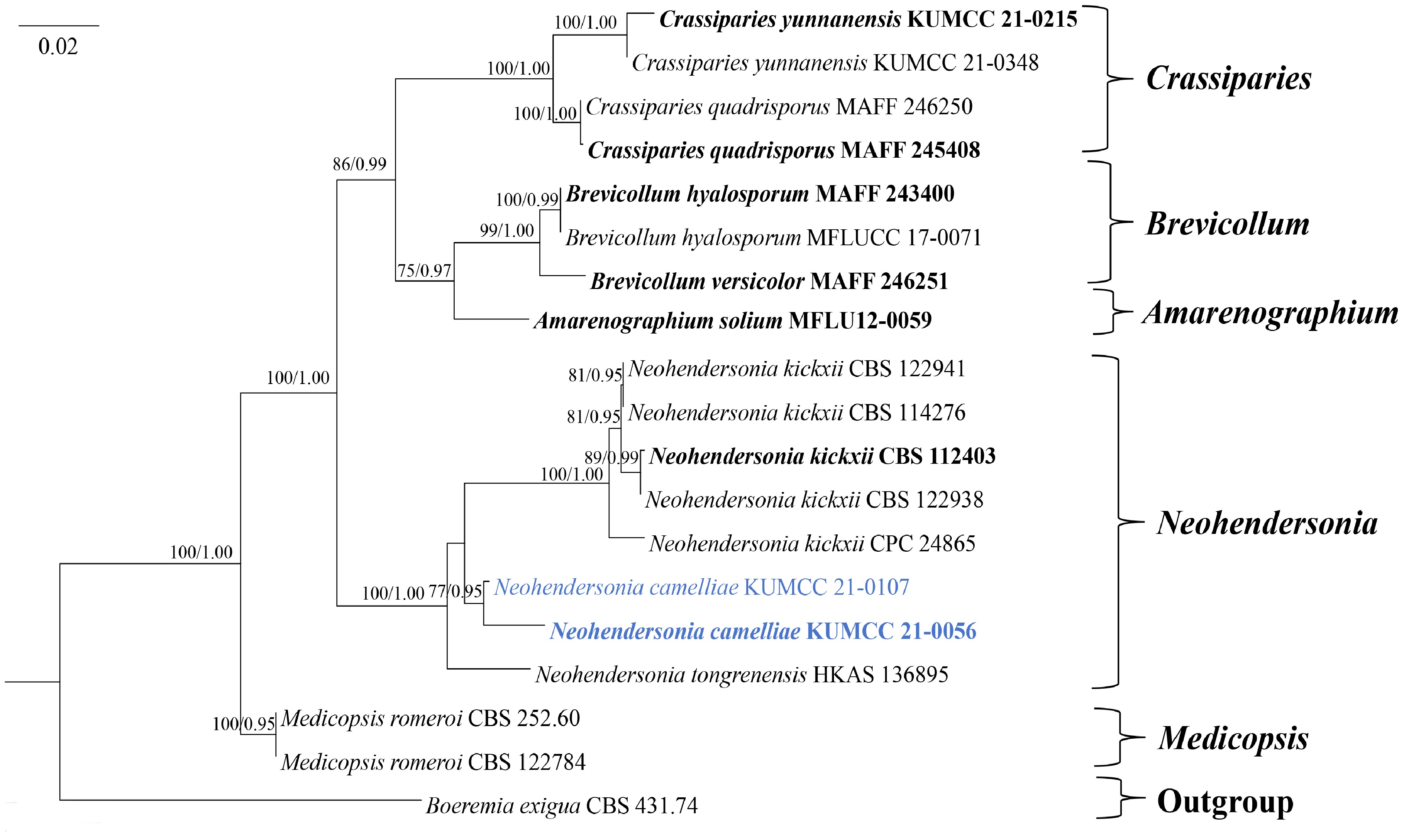
Figure 5.
Phylogram generated from Maximum Likelihood analysis based on SSU, LSU, and ITS sequence data representing Neohendersonia species. Bootstrap values for ML equal to or greater than 70% and BYPP greater than 0.95 (rounded to two decimal places) from the BI analysis are labeled on the nodes. Strains of the newly described species are in blue, while type strains are in bold.
-
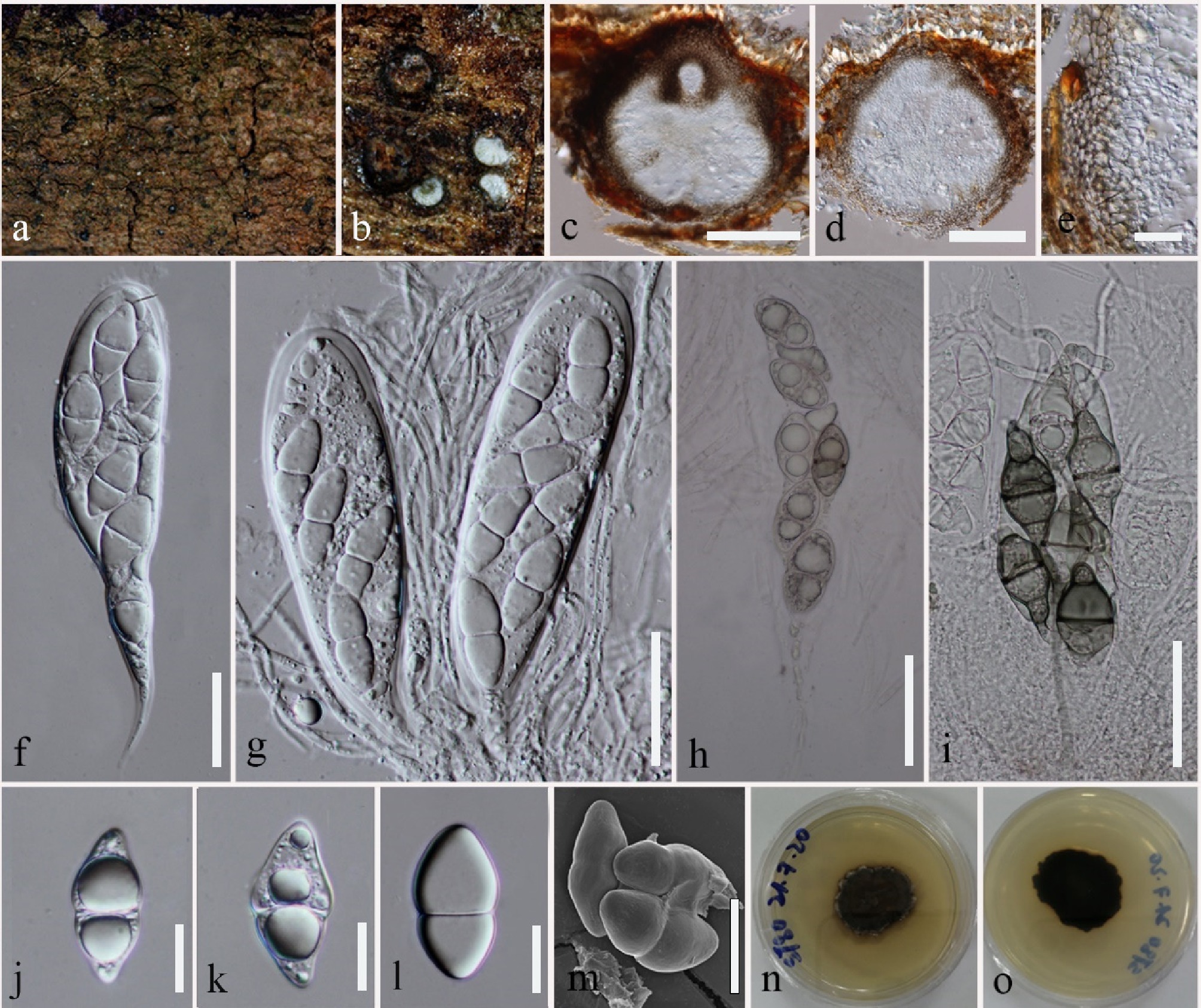
Figure 6.
Neohendersonia camelliae (KUN-HKAS 115578, holotype). (a), (b) Ascomata on host surface. (c), (d) Vertical section of ascomata. (e) Peridium. (f) Ascus. (g) Asci embedded in narrowly cellular pseudoparaphyses. (h) Ascus with mature ascospores. (i) Germinated ascospores. (j)–(m) Ascospores (m): SEM. (n) Upper view on PDA. (o) Reverse view on PDA. Scale bars: (c), (d) = 100 μm; (e), (j)–(m) = 20 μm; (f)–(i) = 50 μm.
-
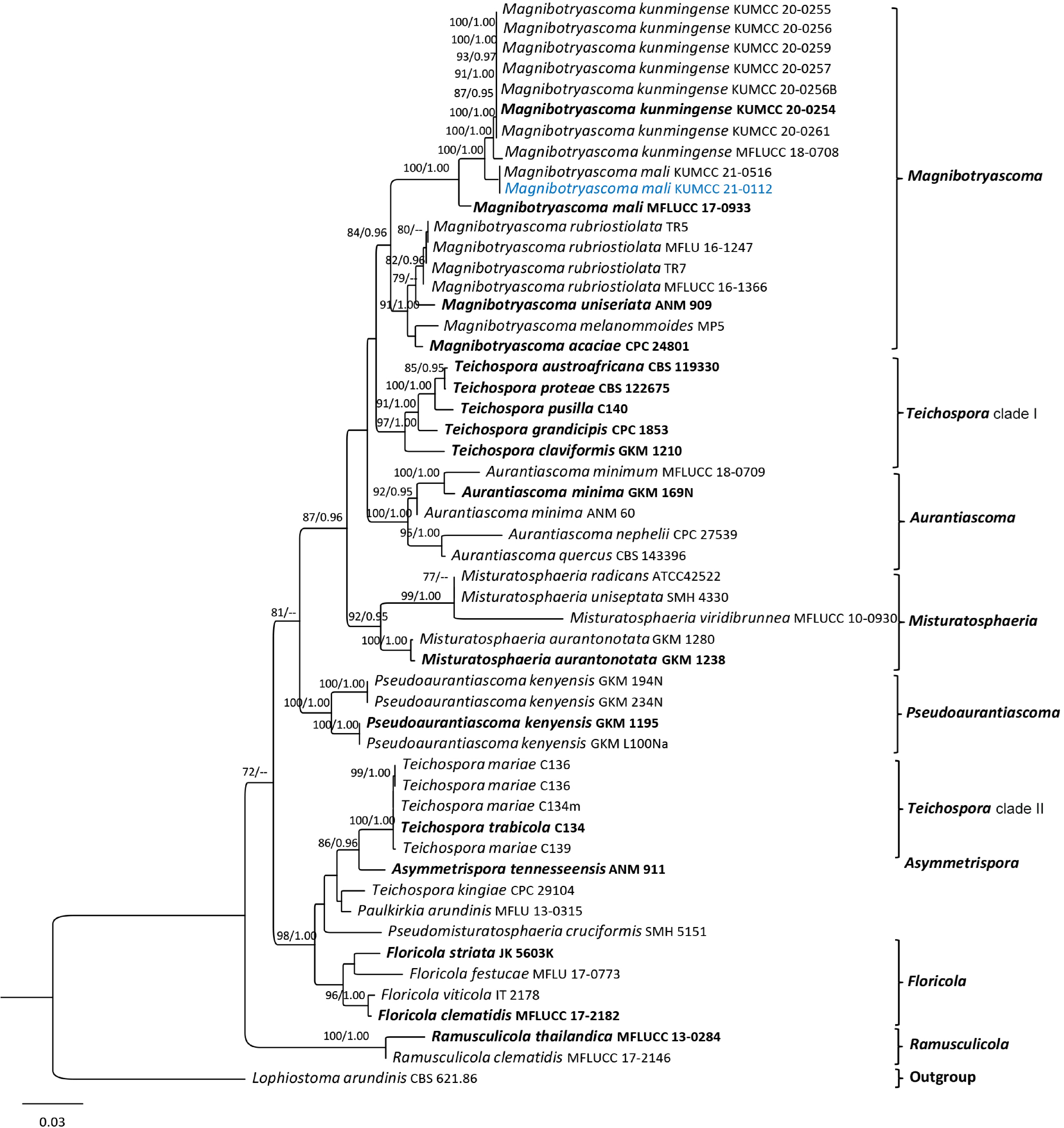
Figure 7.
Phylogram generated from maximum likelihood analysis based on LSU, SSU, ITS, tef1, and rpb2 sequence data. Bootstrap values for ML equal to or greater than 70% and BYPP equal to or greater than 0.95 (rounded to two decimal places) from the BI analysis are labeled on the nodes. A newly generated sequence is in blue, and type strains are bold.
-
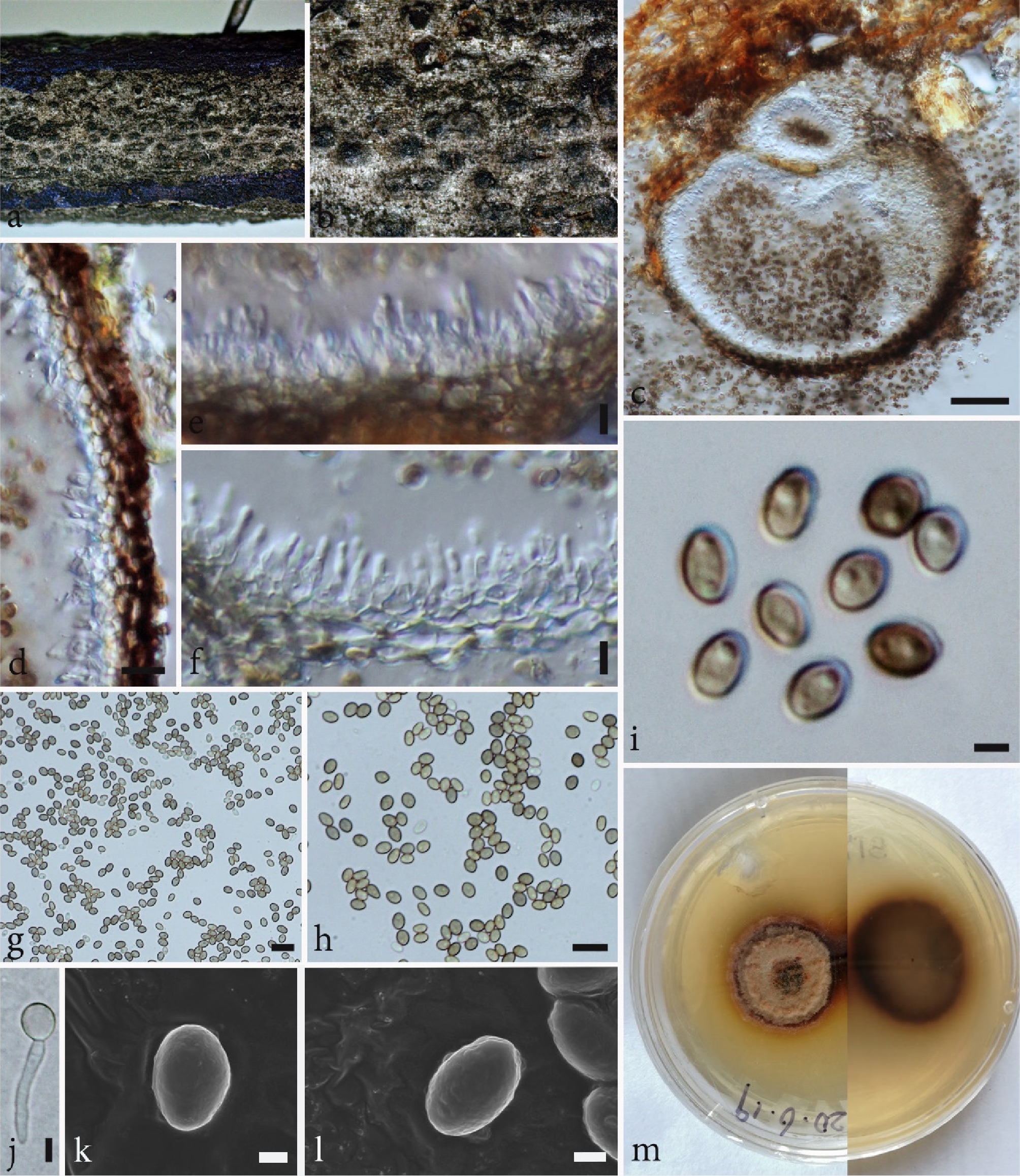
Figure 8.
Magnibotryascoma mali (KUN-HKAS 115583). (a), (b) Conidiomata observed on the host surface. (c) Horizontal section of a conidioma. (d) Pycnidial wall. (e), (f) Conidiogenous cells. (g)–(i), (k), (l) Conidia; (k), (l) SEM photos. (j) Germinated conidium. Scale bars: (c) = 50 µm; (d) = 20 µm; (e)–(h) = 10 µm; (i), (k), (l) = 1 µm; (j) = 2 µm.
-
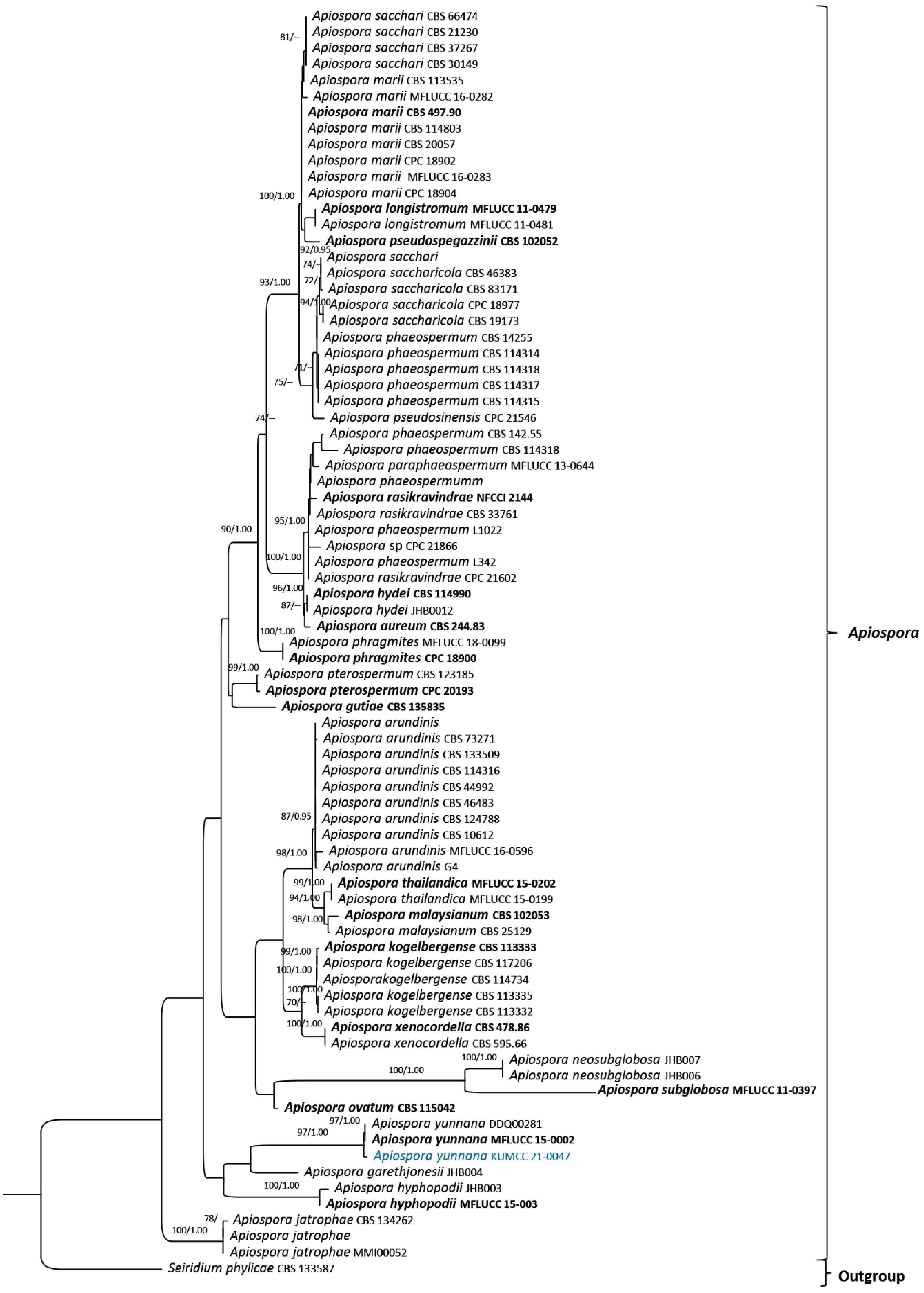
Figure 9.
Phylogram generated from Maximum Likelihood analysis based on ITS sequence data representing Apiospora. Bootstrap values for ML equal to or greater than 70% and BYPP values greater than 0.95 (rounded to two decimal places) from the BI analysis labelled on the nodes. A newly generated sequence is in blue, and ex-type strains are in bold.
-
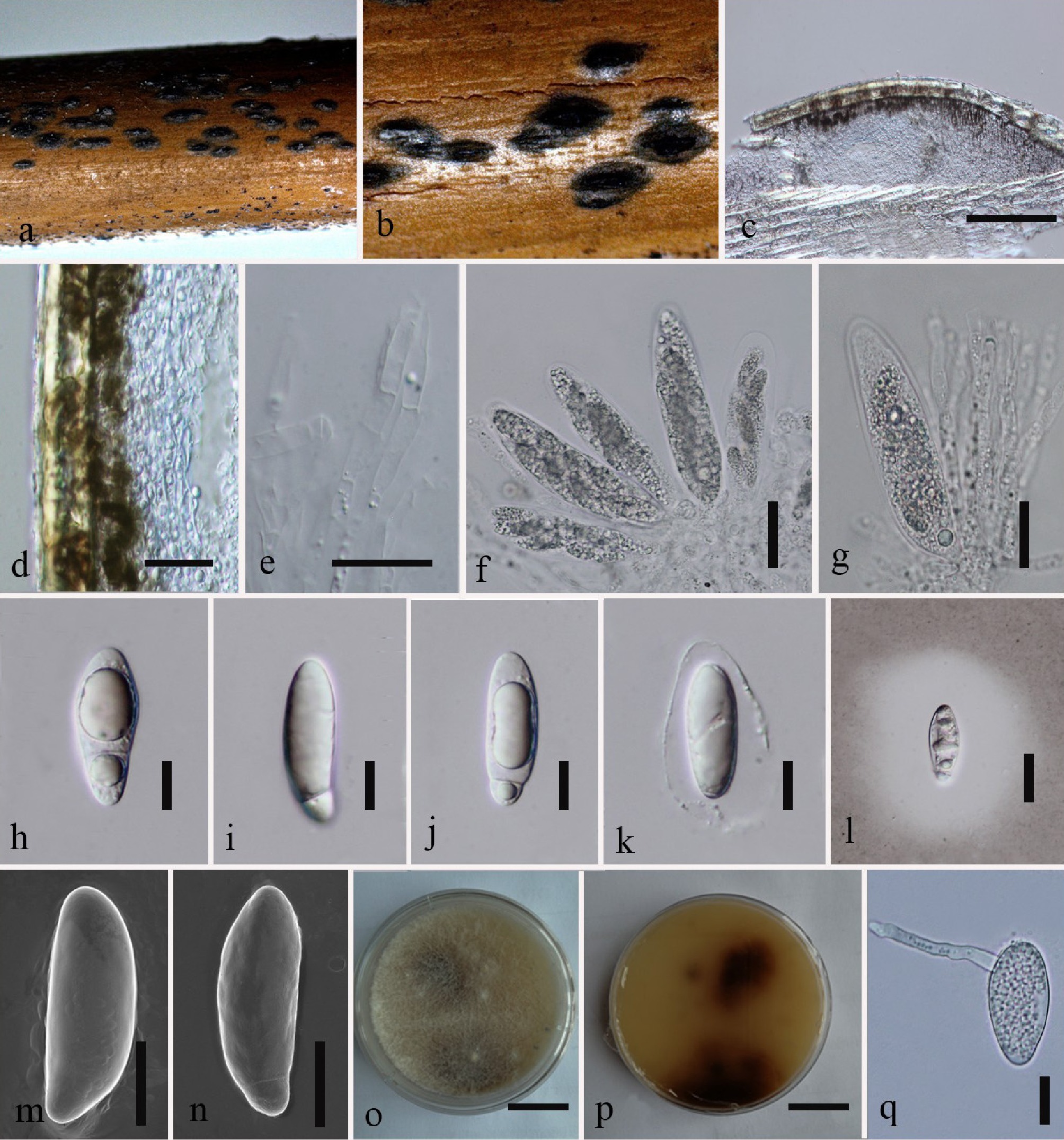
Figure 10.
Apiospora yunnana (HKAS 115564). (a), (b) Ascomata on host surface. (c) Vertical section of ascomata. (d) Peridium. (e) Paraphyses. (f), (g) Asci. (h)–(n) Ascospores; (l) ascospore with mucilaginous sheath in India ink; (m), (n) SEM photos. (o) Upper view on PDA. (p) Reverse view on PDA. (q) Germinated ascospore. Scale bars: (c) = 100 µm; (d), (l) = 20 cm; (e), (h)–(k), (m), (n), (q) = 10 µm; (f), (g) = 30 µm; (o), (p) = 2 cm.
-
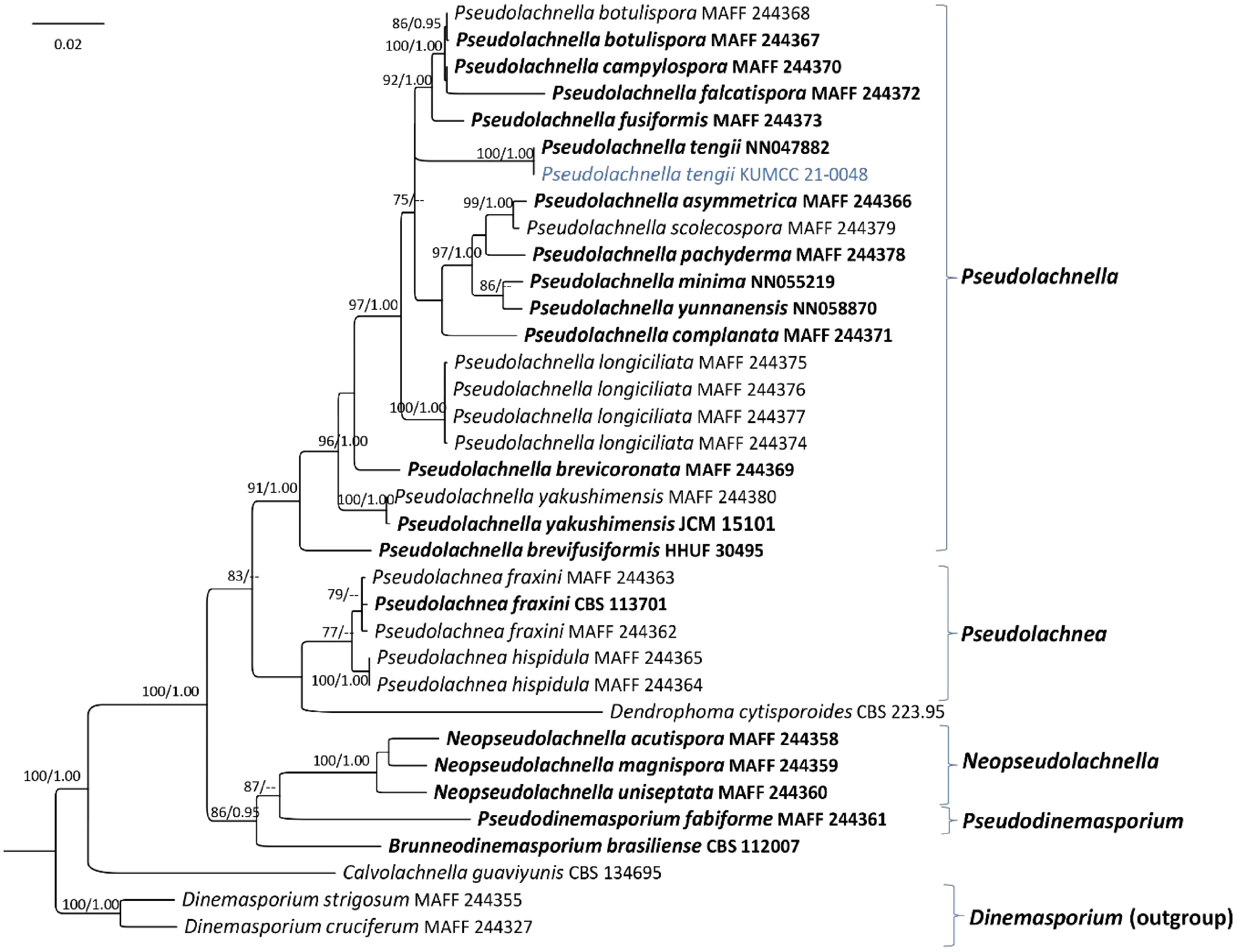
Figure 11.
Phylogram generated from Maximum Likelihood analysis based on LSU, ITS, and tef1 sequence data representing Pseudolachnella and its relatives. Bootstrap values for ML equal to or greater than 70% and BYPP values equal to or greater than 0.95 (rounded to two decimal places) from the BI analysis are labelled on the nodes. A newly generated sequence is in blue, and ex-type strains are in bold.
-
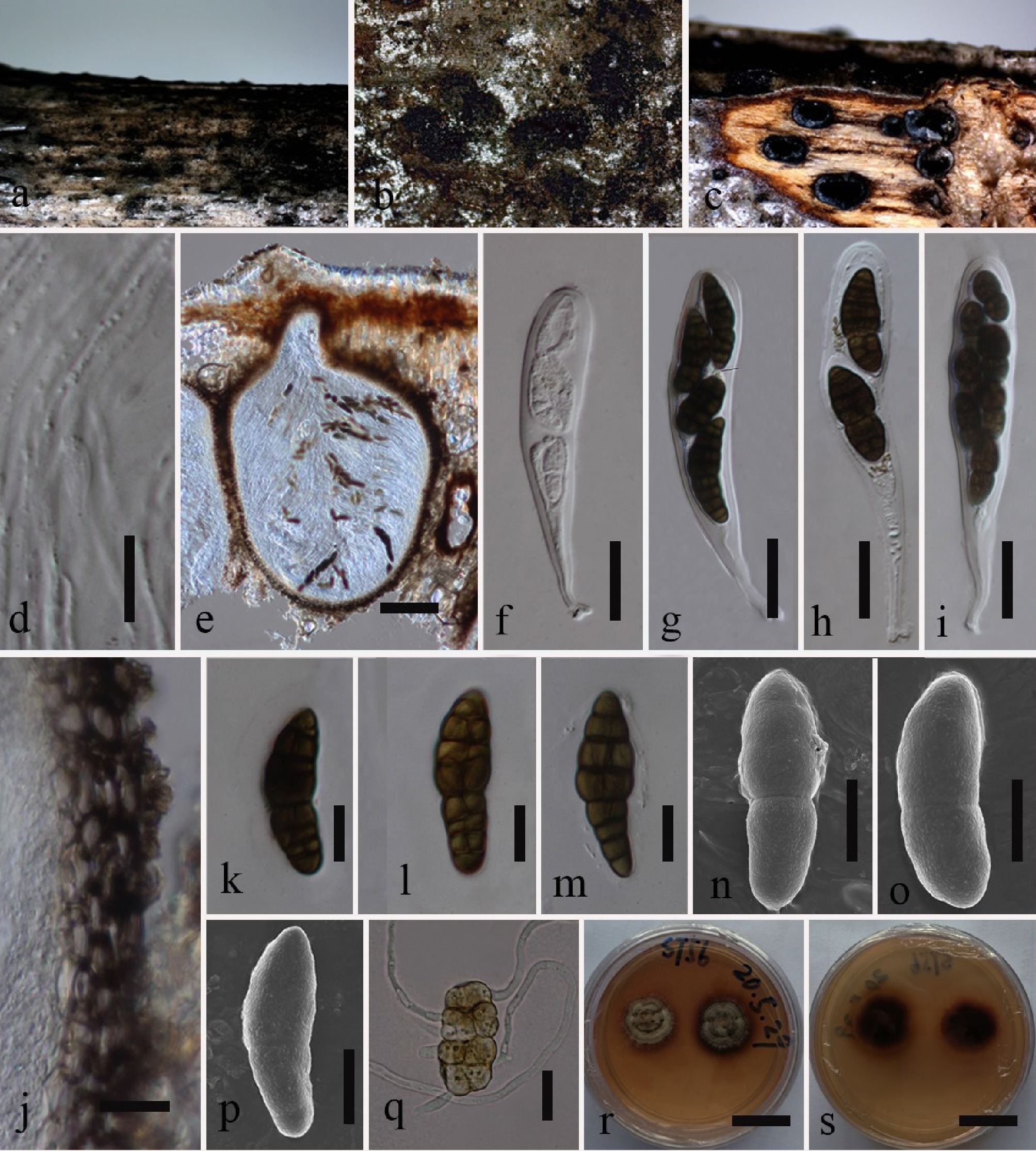
Figure 12.
Pseudolachnella tengii (KUN-HKAS 115565). (a)–(c) Ascomata on host surface. (d) Paraphyses. (e) Vertical section of ascoma. (f)–(i) Asci. (j) Peridium. (k)–(p) Ascospores; (n)–(p) SEM photos. (q) Germinated ascospore. (r) Upper view on PDA. (s) Reverse view on PDA. Scale bars: (d) = 10 µm; (e) = 100 cm; (f)–(j) = 20 µm; (k)–(q) = 10 µm; (r), (s) = 2 cm.
-
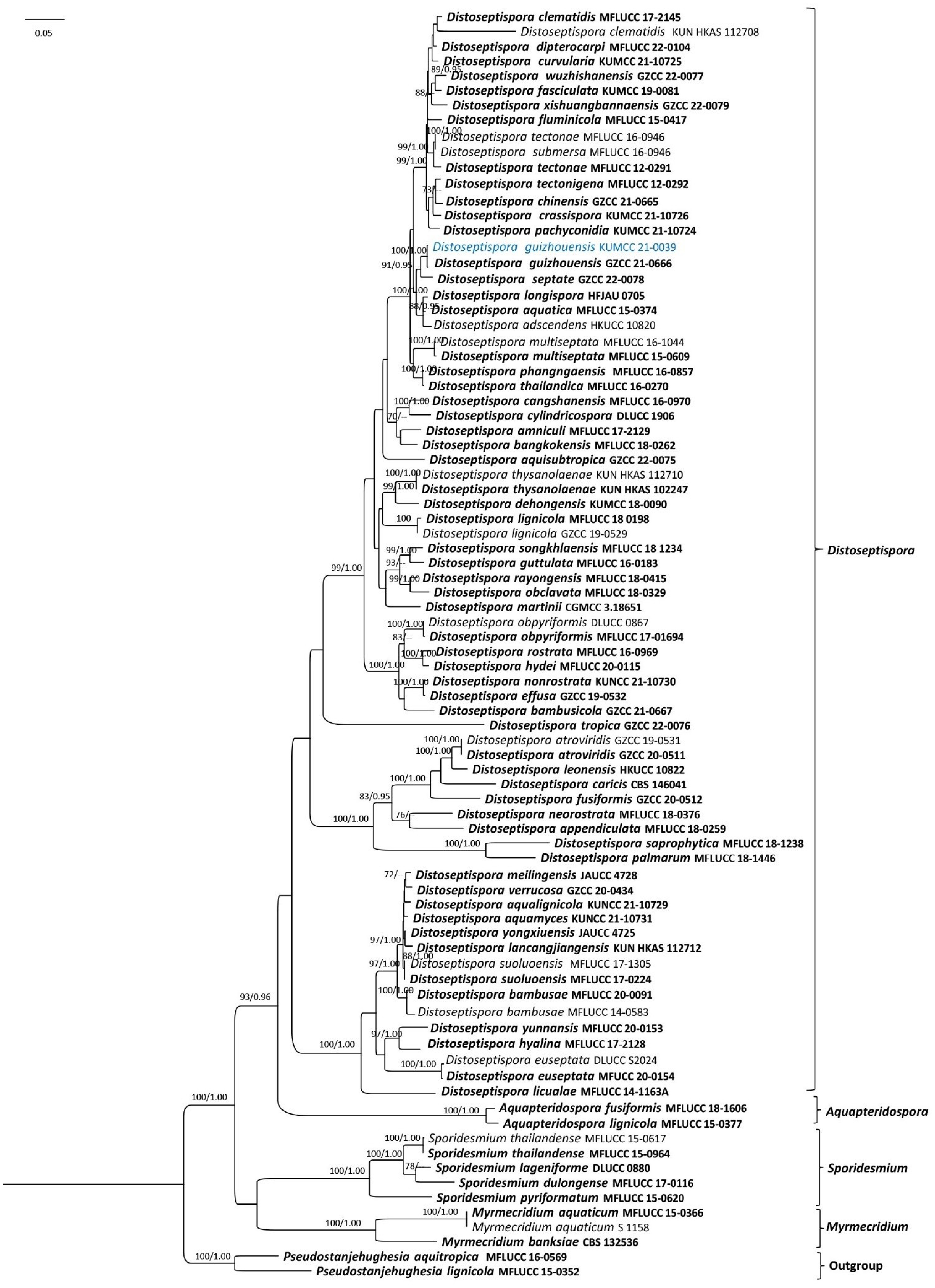
Figure 13.
Phylogram generated from Maximum Likelihood analysis based on ITS, LSU, tef1, and rpb2 sequence data representing Distoseptispora species. Bootstrap values for ML equal to or greater than 70% and BYPP values equal to or greater than 0.95 (rounded to two decimal places) from the BI analysis are labelled on the nodes. A newly generated sequence is in blue, and type species are in bold.
-
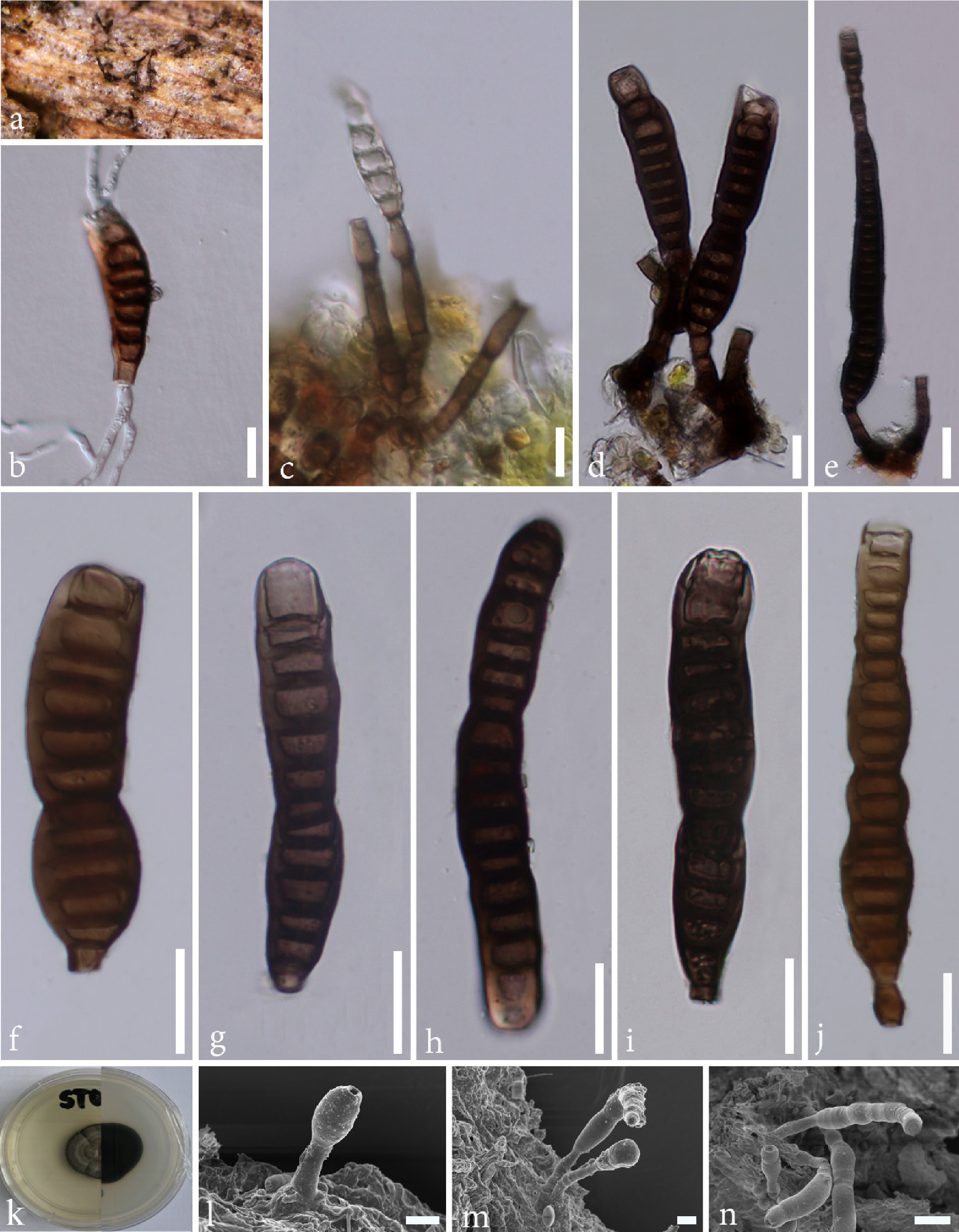
Figure 14.
Distoseptispora guizhouensis (KUN-HKAS 115537). (a) Colonies on host surface. (b) Germinated conidium. (c)–(e) Conidiophores, conidiogenous, and developing conidia. (f)–(j) Conidia. (k) Colony on PDA. (l)–(n) SEM photographs of conidiogenous cells and conidia. Scale bars: (b)–(e), (l), (m) = 10 μm; (f)–(j), (n) = 20 μm.
-
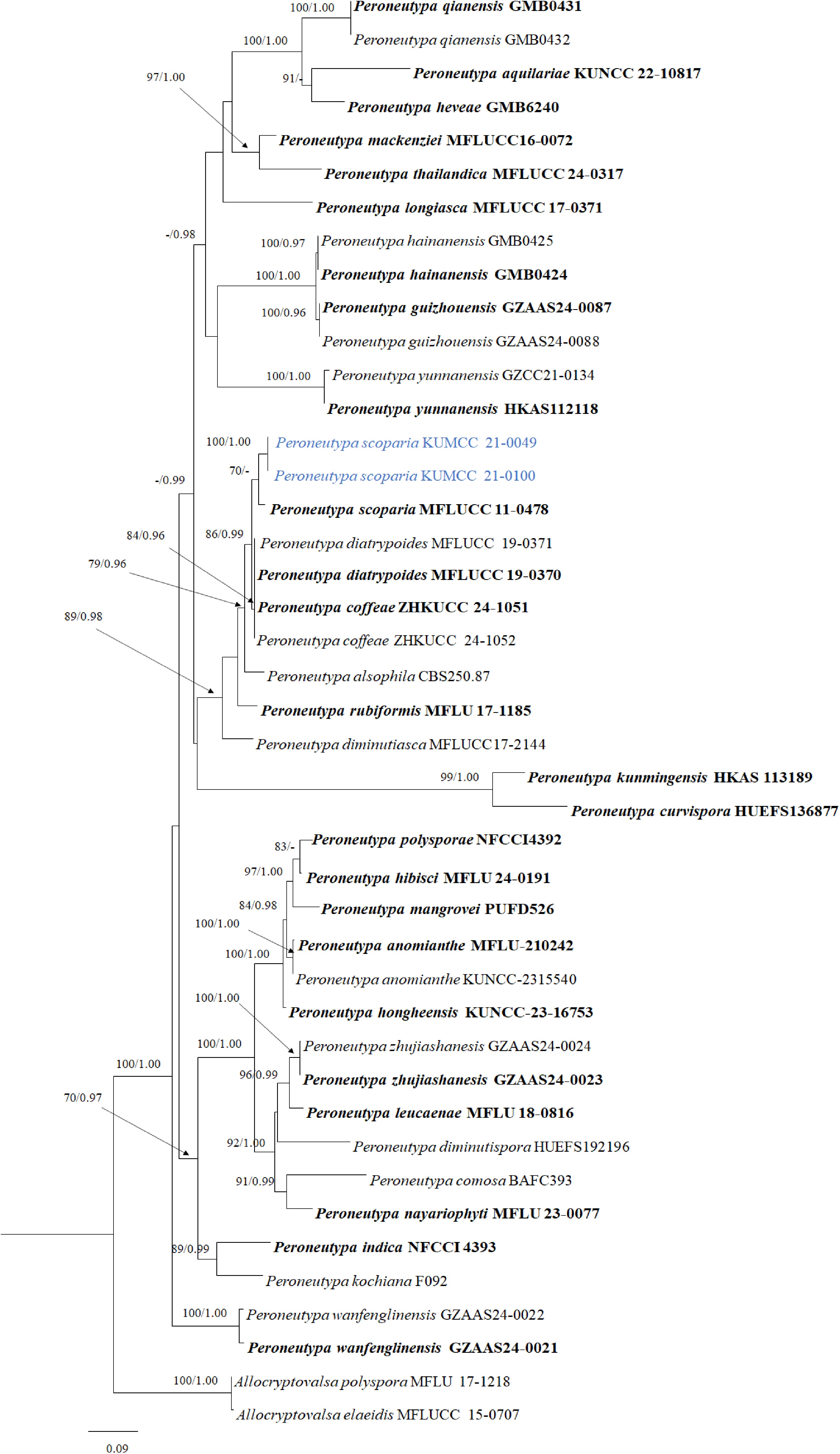
Figure 15.
Phylogram generated from Maximum Likelihood analysis based on ITS and tub2 sequence data representing Peroneutypa. Bootstrap values for ML equal to or greater than 70% and BYPP values equal to or greater than 0.95 (rounded to two decimal places) from the BI analysis are labeled on the nodes. The newly generated sequences are in blue, and the type species and the reference specimens are in bold.
-
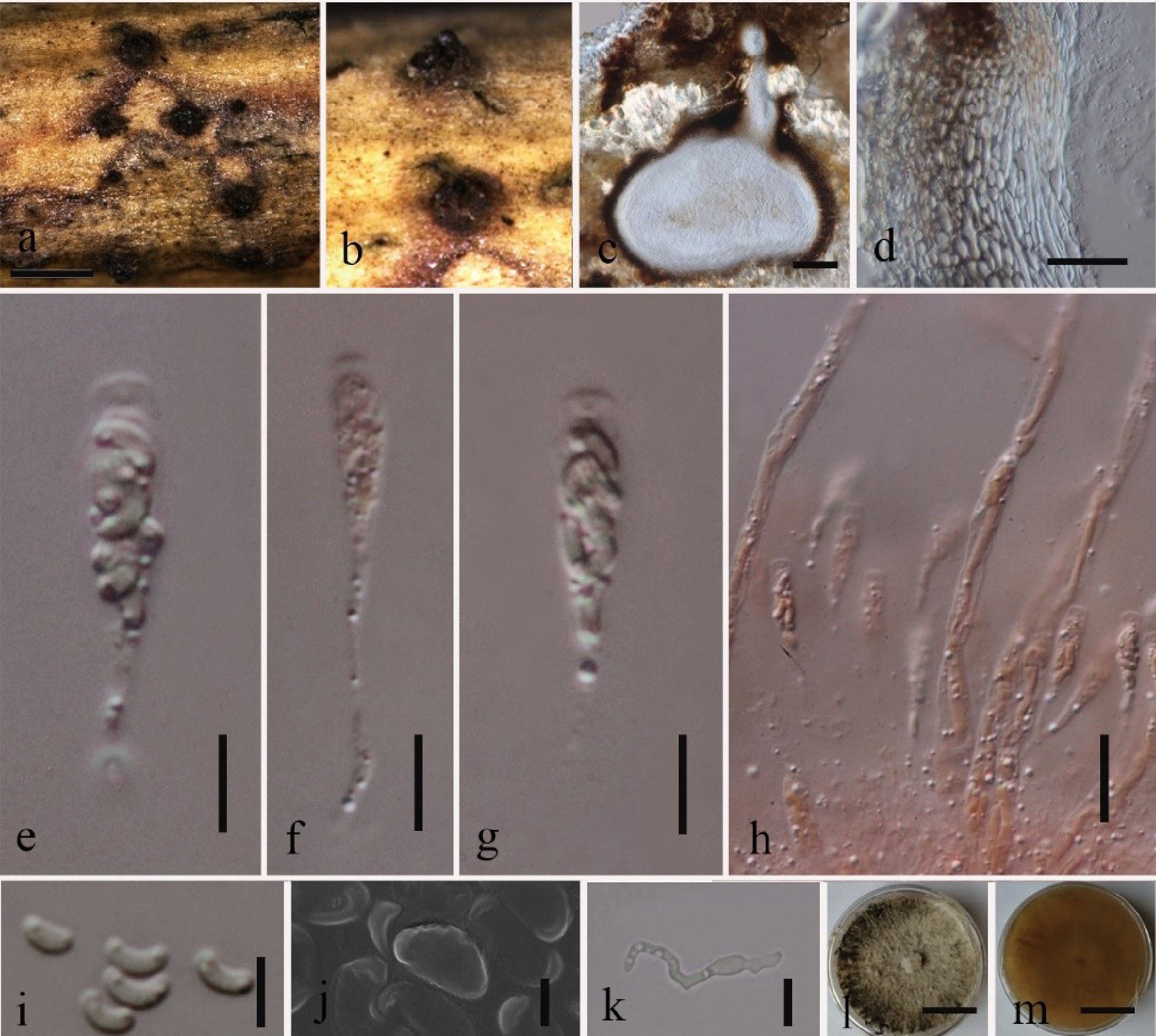
Figure 16.
Peroneutypa scoparia (HKAS 115568). (a), (b) Ascomata on host surface. (c) Vertical section of ascoma. (d) Peridium. (e)–(g) Asci (stained with Congo red). (h) Paraphyses (stained with Congo red). (i), (j) Ascospores; (j) SEM photo. (k) Germinated ascospore. (l) Upper view on PDA. (m) Reverse view on PDA. Scale bars: (a) = 500 µm; (c) = 50 µm; (d) = 10 cm; (e)–(i), (k) = 5 µm, (j) = 2 µm; (l), (m) = 2 cm.
-
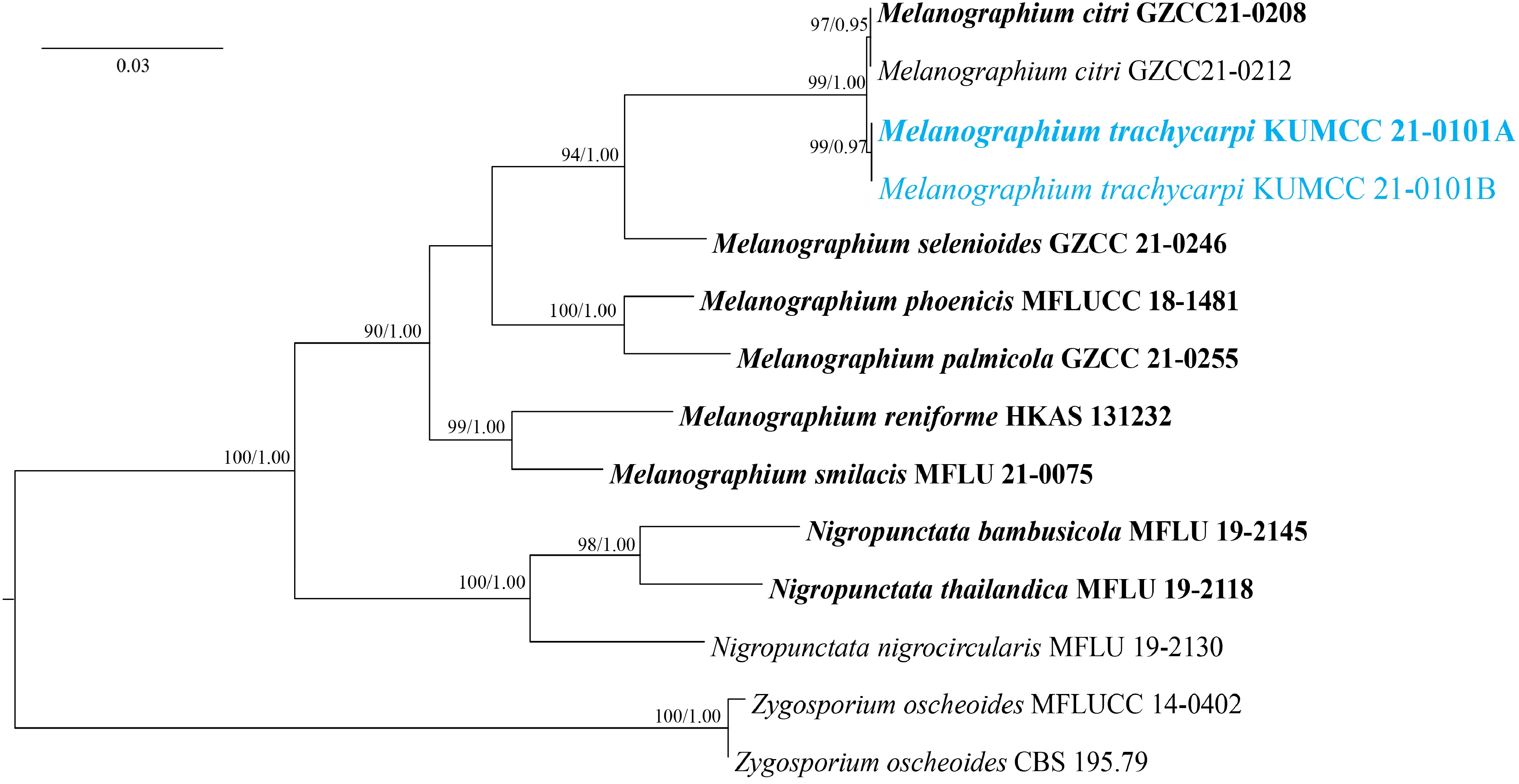
Figure 17.
Phylogram generated from Maximum Likelihood analysis based on LSU, ITS, and rpb2 sequence data representing Melanographium and closely related genera. Bootstrap values for ML equal to or greater than 70% and BYPP values equal to or greater than 0.95 (rounded to two decimal places) from the BI analysis are labelled on the nodes. The newly generated sequences are in blue, and type species are in bold.
-
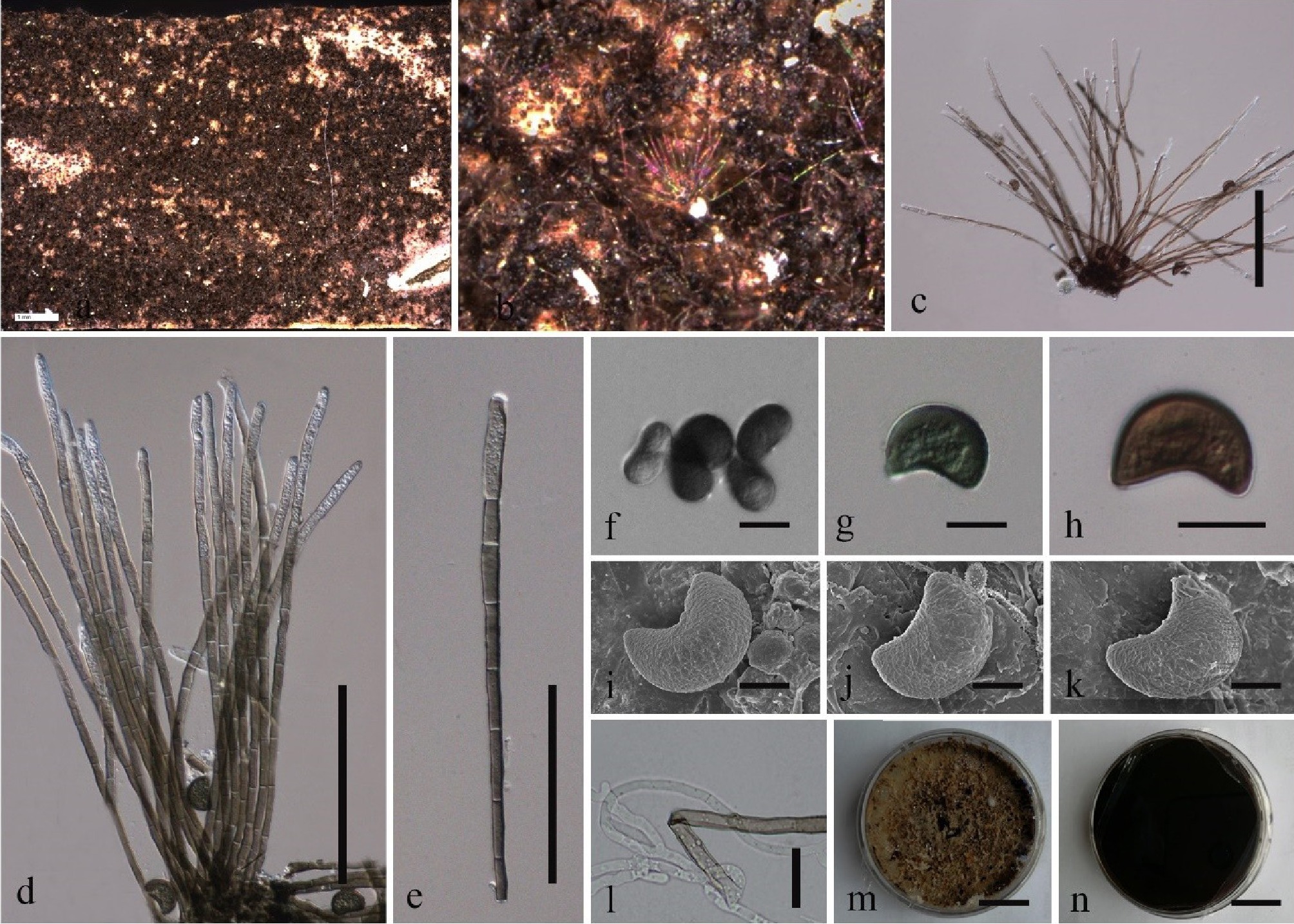
Figure 18.
Melanographium trachycarpi (KUN-HKAS 115558, holotype). (a), (b) Colonies on the host surface. (c)–(e) Conidiophores. (f)–(k) Conidia; (i)–(k) SEM photos. (l) Germinated conidiophore. (m) Upper view on PDA. (n) Reverse view on PDA. Scale bars: (c), (d), (e) = 100 µm; (f)–(h), (l) = 10 cm; (i)–(k) = 5 µm; (m), (n) = 2 cm.
-
Species name New taxa/
known taxaHost/substrate Life mode Ref. Ascomycota Alternaria alternata Known Magnolia grandiflora Saprobic Jayasiri et al.[149] Arthrinium yunnanum New Phyllostachys nigra Saprobic Dai et al.[106] Austropleospora keteleeriae New Keteleeria fortunei Saprobic Jayasiri et al.[149] Bartalinia kunmingensis New Zea mays Saprobic Phookamsak et al.[150] Brunneofusispora sinensis Known Magnolia denudata Saprobic Wanasinghe et al.[139] Brunneomurispora lonicerae New Lonicera maackii Saprobic Phookamsak et al.[150] Camporesiomyces mali New Malus halliana Saprobic Hyde et al.[144] Ceratosphaeria yunnanensis New Heteropanox fregans Saprobic Manawasinghe et al.[151] Cladosporium cladosporioides Known Magnolia grandiflora Saprobic Jayasiri et al.[149] Diatrypella yunnanensis New Unidentified plant Saprobic Hyde et al.[144] Diatrypella yunnanensis New Unidentified plant Saprobic Hyde et al.[144] Didymella coffeae-arabicae Known Leucaena sp. Saprobic Jayasiri et al.[149] Didymella magnoliae New Magnolia grandiflora Saprobic Jayasiri et al.[149] Diplodia magnoliigena New Magnolia grandiflora Saprobic Jayasiri et al.[149] Hysterobrevium constrictum Known Unidentified plant Saprobic Hyde et al.[144] Keissleriella caraganae New Caragana arborescens Saprobic Phookamsak et al.[150] Liua muriformis New Lonicera maackii Saprobic Phookamsak et al.[150] Lonicericola hyaloseptispora New Lonicera maackii Saprobic Phookamsak et al.[150] Montagnula aquilariae Known Unidentified plant Saprobic Wanasinghe et al.[152] Montagnula thevetiae New Thevetia peruviana Saprobic Wanasinghe et al.[152] Murilentithecium lonicerae New Lonicera maackii Saprobic Phookamsak et al.[150] Neofusicoccum parvum Known Magnolia grandiflora Saprobic Jayasiri et al.[149] Neoleptosporella camporesiana New Heteropanax fragrans Saprobic Manawasinghe et al.[151] Neosetophoma lonicerae New Lonicera maackii Saprobic Phookamsak et al.[150] Nigrograna magnoliae New Magnolia denudata Saprobic Wanasinghe et al.[152] Nothophoma quercina Known Keteleeria fortunei Saprobic Jayasiri et al.[149] Paratrimmatostroma kunmingensis New Fern Saprobic Phookamsak et al.[150] Paucispora kunmingense New Malus halliana (Rosaceae) Saprobic Hyde et al.[153] Periconia byssoides Known Prunus armeniaca Saprobic Yang et al.[154] Periconia byssoides Known Magnolia grandiflora Saprobic Jayasiri et al.[149] Periconia chimonanthi New Chimonanthi praecox Saprobic Yang et al.[154] Periconia cortaderiae Known Caragana arborescens Saprobic Phookamsak et al.[150] Periconia kunmingensis New Fern Saprobic Phookamsak et al.[155] Phaeopoacea muriformis New unidentified grass species Saprobic Hyde et al.[153] Phaeosphaeria chinensis New Wisteria sp. Saprobic Jayasiri et al.[149] Phaeoseptum mali New Malus halliana Saprobic Phookamsak et al.[156] Phaeosphaeria cycadis New Cycas sp. Leaf spots Phookamsak et al.[150] Phaeosphaeriopsis aloes Known Yucca elephantipes Saprobic Boonmee et al.[157] Phragmocamarosporium hederae Known Cycas Leaf spots Phookamsak et al.[150] Plectosphaerella kunmingensis New Water agar as a contaminated fungus Unknown Phookamsak et al.[150] Plenodomus artemisiae New Artemisia sp. Saprobic Phookamsak et al.[150] Pseudolachnella tengii New Phyllostachys sp. Saprobic Wu & Diao[64] Pleurotheciella dimorphospora New Malus sp. Saprobic Boonmee et al.[157] Pseudochaetosphaeronema kunmingense New Cerasus pseudocerasus Saprobic Hyde et al.[144] Pseudopithomyces chartarum Known Magnolia grandiflora Saprobic Jayasiri et al.[149] Pseudopithomyces kunmingensis New unidentified grass species Saprobic Abreu et al.[153] Rhytidhysteron camporesii New Unidentified plant Saprobic Hyde et al.[144] Sclerostagonospora rosae New Rosa sp. Saprobic Wanasinghe et al.[158] Septoriella neomuriformis New unidentified grass Saprobic Wanasinghe & Mharachchikumbura[159] Shearia formosa Known Magnolia denudata Saprobic Wanasinghe et al.[139] Sparticola muriformis New unidentified grass Saprobic Karunarathna et al.[160] Sphaerellopsis paraphysata Known Liriope spicata Rust on living leaves Phookamsak et al.[150] Stagonosporopsis pini New Pinus sp. Saprobic Jayasiri et al.[149] Stomiopeltis chinensis New Harpephyllum sp. Saprobic Jayasiri et al.[149] Tetraploa bambusae New Bamboo Saprobic Phookamsak et al.[161] Thyronectria kunmingensis New unidentified plant Saprobic Tun et al.[162] Torula ficus Known Magnolia grandiflora Saprobic Jayasiri et al.[149] Torula gaodangensis Known Malus sp. Saprobic Hyde et al.[144] Torula mackenziei Known Unidentified plant Saprobic Boonmee et al.[157] Vaginatispora fuckelii Known Rosa sp. Saprobic Hyde et al.[153] Wojnowiciella kunmingensis New Lonicera maackii Saprobic Phookamsak et al.[150] Basidiomycota Amanita cingulata New - Liu et al.[163] Amanita exitialis New Soil in forests dominated by Fagaceae Cai et al.[164] Amanita flavipes Known On soil in woodland Cai et al.[165] Amanita fuliginea Known On soil in forests dominated by Fagaceae Cai et al.[164] Amanita fuligineoides Known On soil in forests dominated by Fagaceae Cai et al.[164] Amanita griseorosea New Forests of Fagaceae Cai et al.[164] Amanita manginiana Known - Cai et al.[165] Amanita molliuscula New On soil under trees of Pinus and Quercus Cai et al.[164] Amanita pallidorosea Known On soil in forests of Pinaceae and Fagaceae Cai et al.[164] Amanita parviexitialis New Forests dominated by Fagaceae Cai et al.[164] Amanita pseudoporphyria Known In woodland of Coniferae Cai et al.[165] Amanita rimosa Known Soil in forests dominated by Fagaceae Cai et al.[164] Amanita sp. (Phalloideae) - Cai et al.[165] Amanita subfuliginea New On soil in forests of Fagaceae and Pinus Cai et al.[164] Amanita subpallidorosea Known On soil in forests dominated by Quercus and Cyclobalanopsis Cai et al.[164] Amanita virosa Known On soil in forests of Pinaceae and Fagaceae Cai et al.[164] Apiculospora spartii Known delete (new host and geographical record) Dead leaves of Yucca gigantea Saprobic Wijayawardene et al.[166] Cantharellus phloginus New On soil, associated with Castanopsis and Pinus Shao et al.[167] Cantharellus vaginatus New Under mixed forest dominated by Castanopsis and Pinus Shao et al.[168] Cantharellus zangii New On ground in subalpine mixed forests dominated by Larix potaninii var. macrocarpa, and Picea likiangensis Tian et al.[169] Chiua angusticystidiata New On soil Wu et al.[170] Chiua olivaceoreticulata New On soil Wu et al.[170] Chiua virens New combinations - Wu et al.[170] Chiua viridula New On soil Wu et al.[170] Cibaomyces glutinis New On buried rotten wood in broad-leaved forests dominated by Fagaceae Hao et al.[171] Cyptotrama glabra New On rotten wood of broad-leaved trees Qin & Yang[172] Flammulina velutipes var. filiformis New On base of dead trunk Saprobic Ge et al.[173] Flammulina velutipes var. himalayana New On base of dead trunk of Betulaceae Saprobic Ge et al.[173] Flammulina yunnanensis New On dead trunk of Lithocarpus or Quercus Ge et al.[174] Hymenoboletus filiformis New On soil, associated with Lithocarpus and Castanopsis Li & Yang[175] Hymenoboletus griseoviridis New On soil, associated with Fagaceae Li & Yang[175] Hymenoboletus jiangxiensis New On soil, associated with Fagaceae Li & Yang[175] Hymenoboletus luteopurpureus New On soil Wu et al.[170] Paraxerula ellipsospora New In forests dominated by Pinus Qin et al.[176] Physalacria corneri New On rotten trunk of broad-leaved trees Qin & Yang[172] Physalacria lacrymispora New On dead culm of Chimonobambusa Saprobic Qin & Yang[172] Physalacria sinensis New On rotten wood of Quercus variabilis Qin & Yang[172] Pseudolepiota zangmui New In mixed broadleaved forest of Fagaceae Ge & Yang[177] Rhodotus asperior New On dead trunk in forest dominated by Castanopsis and Lithocarpus Tang et al.[178] Suillus alpinus New On ground under Larix potaninii Shi et al.[179] Tuber baoshanense New - Wan et al.[180] Tuber calosporum New In soil under mixed forest with Pinus yunnanensis Wan et al.[181] Tuber polymorphosporum New In soil Wan et al.[180] Tuber shidianense New In humus soil under mixed forest with Pinus yunnanensis Wan et al.[181] Tuber sinoniveum New In humus soil under Pinus armandii Xu et al.[182] Tylocinum griseolum New On soil Wu et al.[170] Zangia chlorinosma New combinations - Li &Yang[175] Zangia erythrocephala New In mixed forests of Picea, Pinus, and Quercus aquifolioides Li &Yang[175] Zangia olivacea New In mixed forests of Picea, Pinus densata, and Quercus semicarpifolia Li &Yang[175] Zangia olivaceobrunnea New In mixed forests of Keteleeria, Pinus yunnanensis, and Quercus variabilis Li &Yang[175] Zangia roseola New combinations Pinus yunnanensis Li &Yang[175] Remark: all taxa were kept the same name when they were introduced. Table 1.
Checklist of fungi collected from KIB (from 2010–2025).
Figures
(18)
Tables
(1)