-
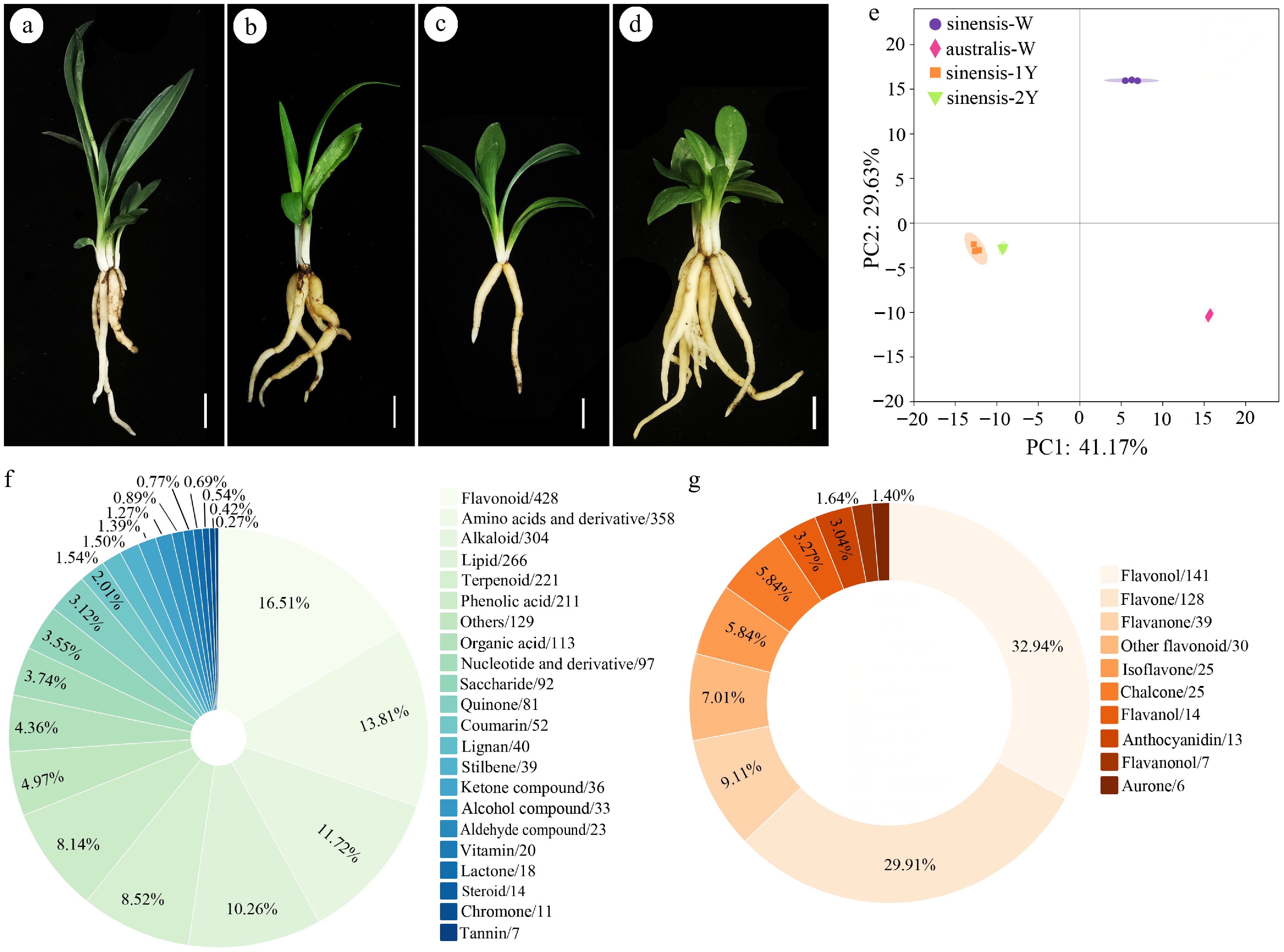
Figure 1.
Spiranthes plants and their metabolite composition. (a) S. sinensis-wild. (b) S. australis-wild. (c) One-year-old S. sinensis cultivated from seed. (d) Two-year-old S. sinensis cultivated from seed. (e) Principal component analysis of the comprehensive metabolomic profiles from the four Spiranthes samples. (f) Different classifications of metabolites in the Spiranthes plants. (g) Different types of flavonoid compounds in the Spiranthes plants. White scale bar = 2 cm.
-
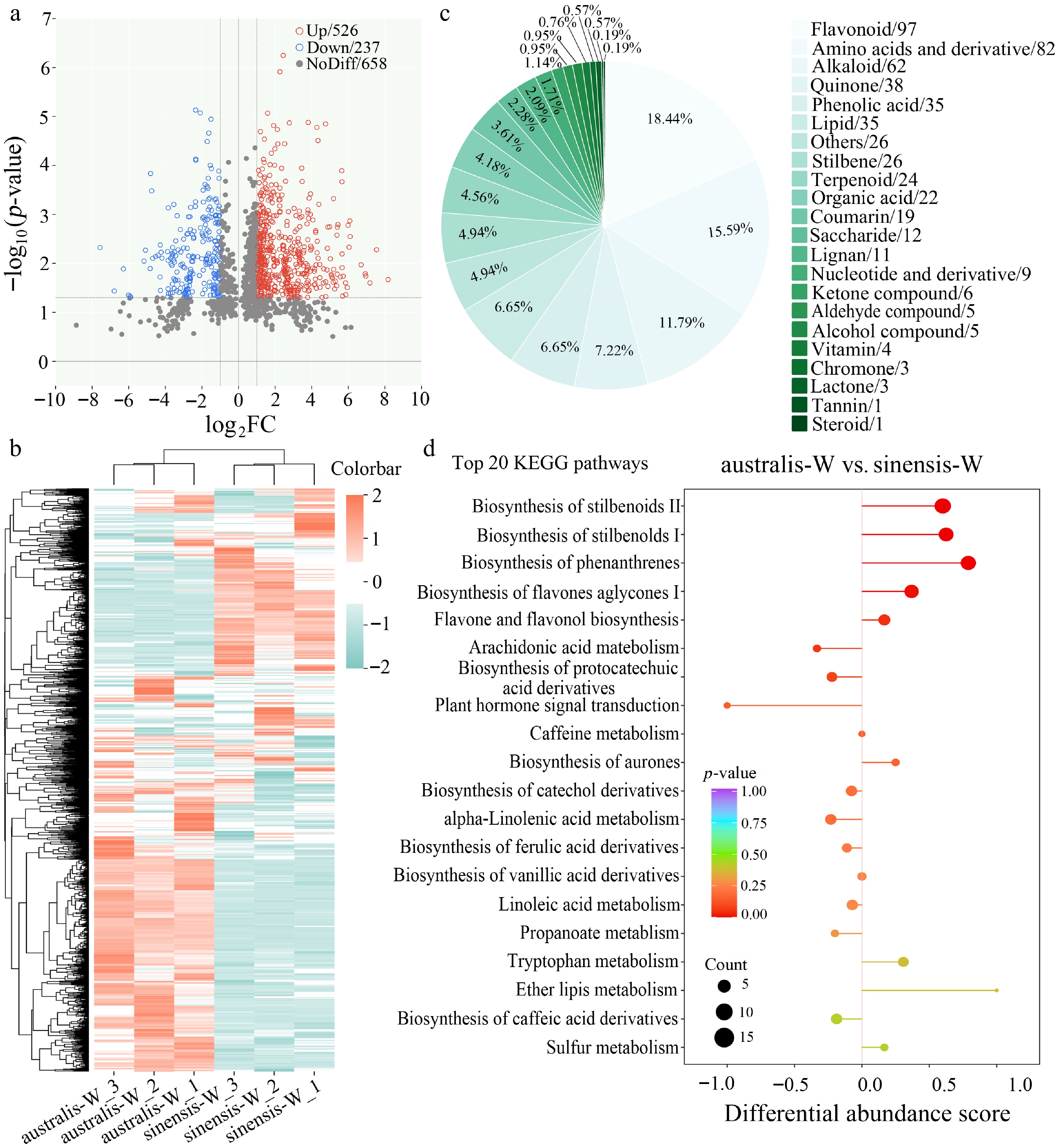
Figure 2.
Metabolites enriched in S. australis. (a) Differentially enriched metabolites in S. australis compared with S. sinensis. (b) Clustered heatmap analysis of metabolites from the two Spiranthes species. (c) Various categories of enriched metabolites in S. australis compared with S. sinensis. (d) KEGG enrichment analysis of differentially enriched metabolites in S. australis compared with S. sinensis.
-
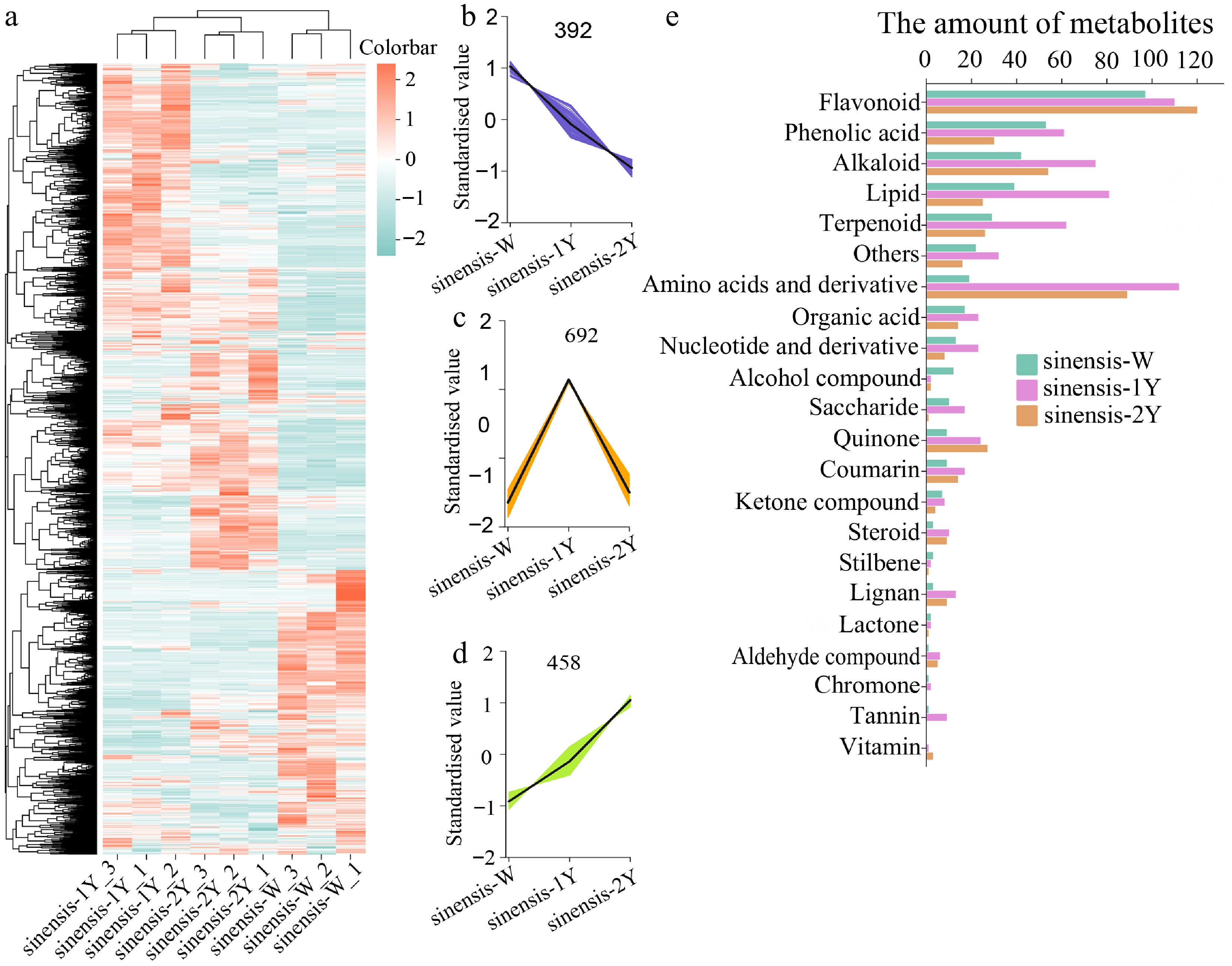
Figure 3.
Comparative metabolite profiling of S. sinensis under different cultivation modes. (a) Clustering heatmap analysis based on all metabolites. (b)–(d) K-means clustering analysis based on metabolite content. (e) Enrichment status of various classes of metabolites under different cultivation modes.
-
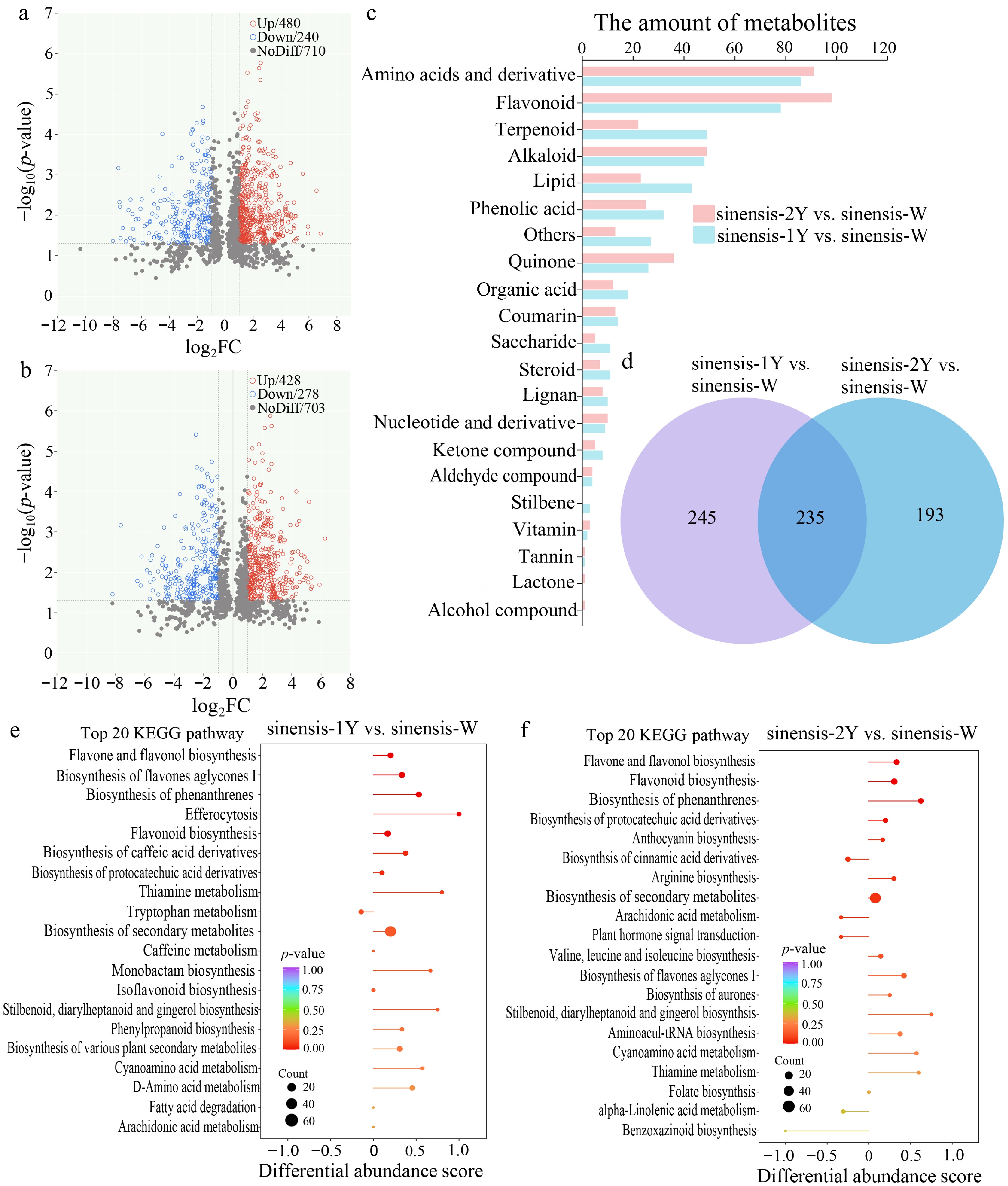
Figure 4.
Comparison of enriched metabolites in S. sinensis under different cultivation modes. (a) Differentially enriched metabolites between one-year-old cultivated S. sinensis and wild S. sinensis. (b) Differentially enriched metabolites between two-year-old cultivated and wild S. sinensis. (c) Different categories of metabolites enriched in cultivated S. sinensis compared with wild S. sinensis. (d) Venn diagram of metabolites enriched in cultivated S. sinensis compared with wild S. sinensis. (e) KEGG enrichment analysis of differentially enriched metabolites in one-year-old cultivated S. sinensis. (f) KEGG enrichment analysis of differentially enriched metabolites in two-year-old cultivated S. sinensis.
-
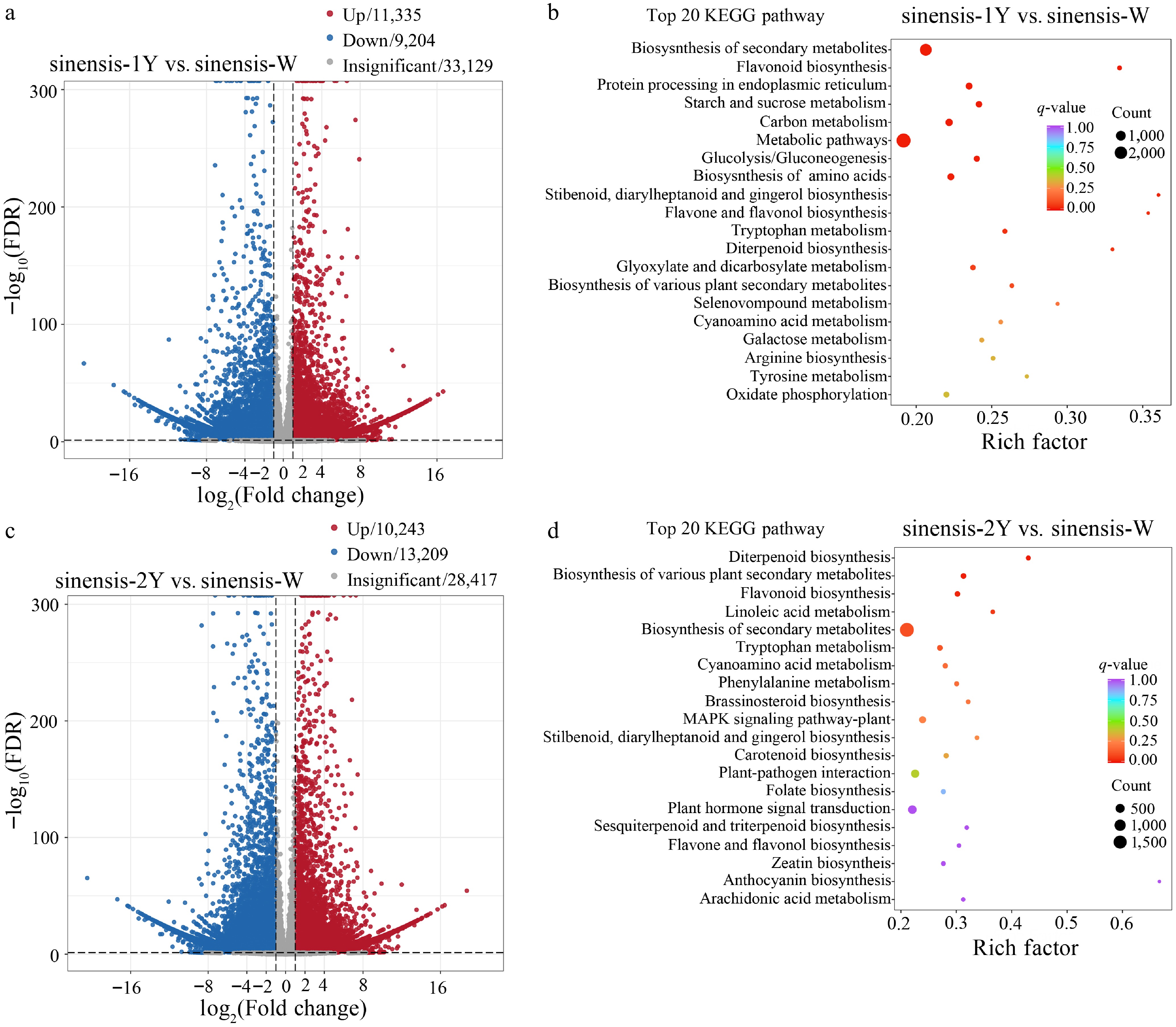
Figure 5.
Comparative transcriptomic analysis of S. sinensis under different habitats. (a) Volcano plot of DEGs between one-year-old cultivated and wild S. sinensis. (b) KEGG enrichment profiles of DEGs between one-year-old cultivated and wild S. sinensis. (c) Volcano plot of DEGs between two-year-old cultivated and wild S. sinensis. (d) KEGG enrichment profiles of DEGs between two-year-old cultivated and wild S. sinensis.
-
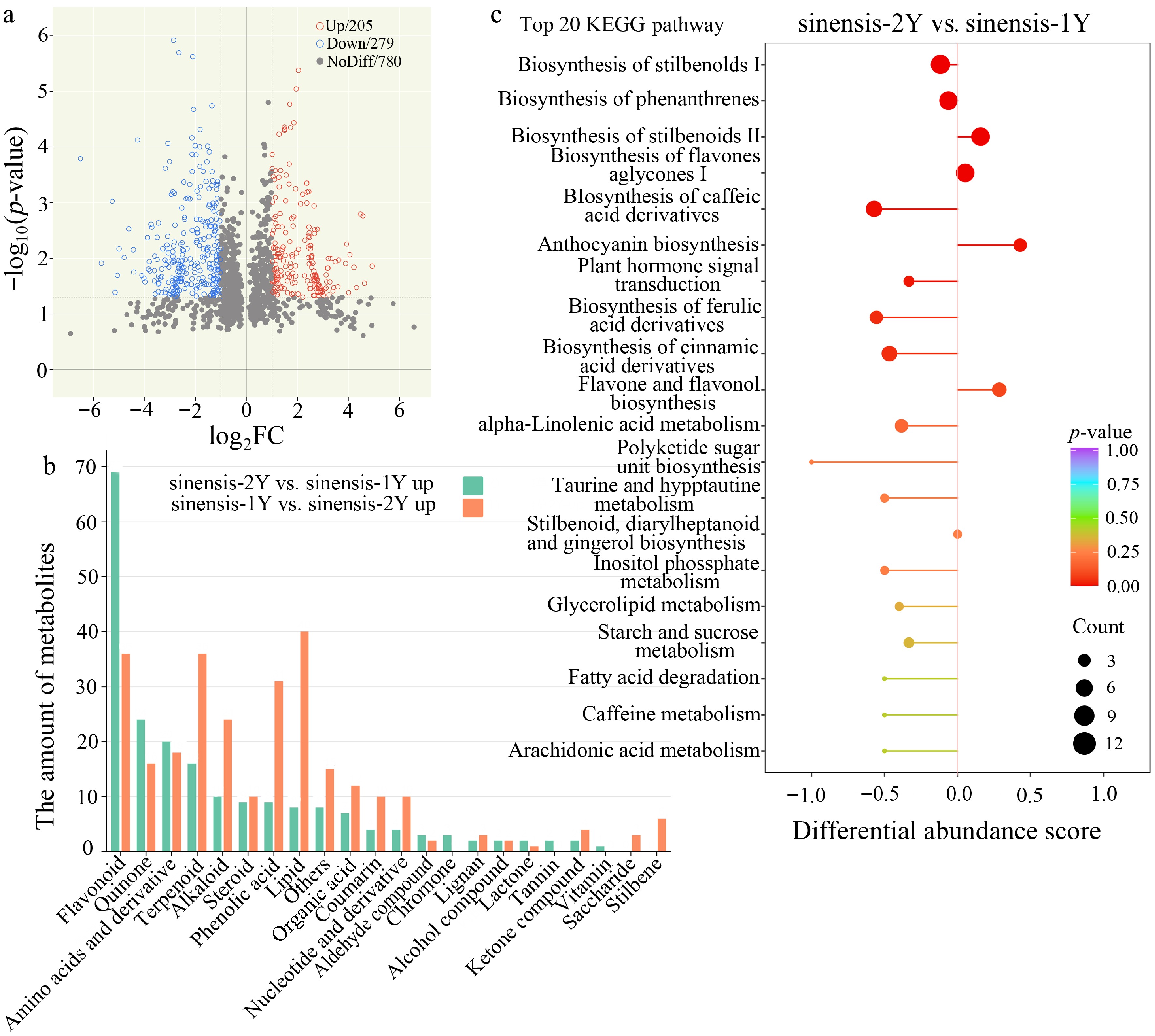
Figure 6.
Comparison of metabolites in cultivated S. sinensis of different ages. (a) Differentially enriched metabolites in cultivated S. sinensis of different ages. (b) Different categories of the enriched metabolites. (c) KEGG enrichment analysis of differentially enriched metabolites in two-year-old cultivated S. sinensis.
-
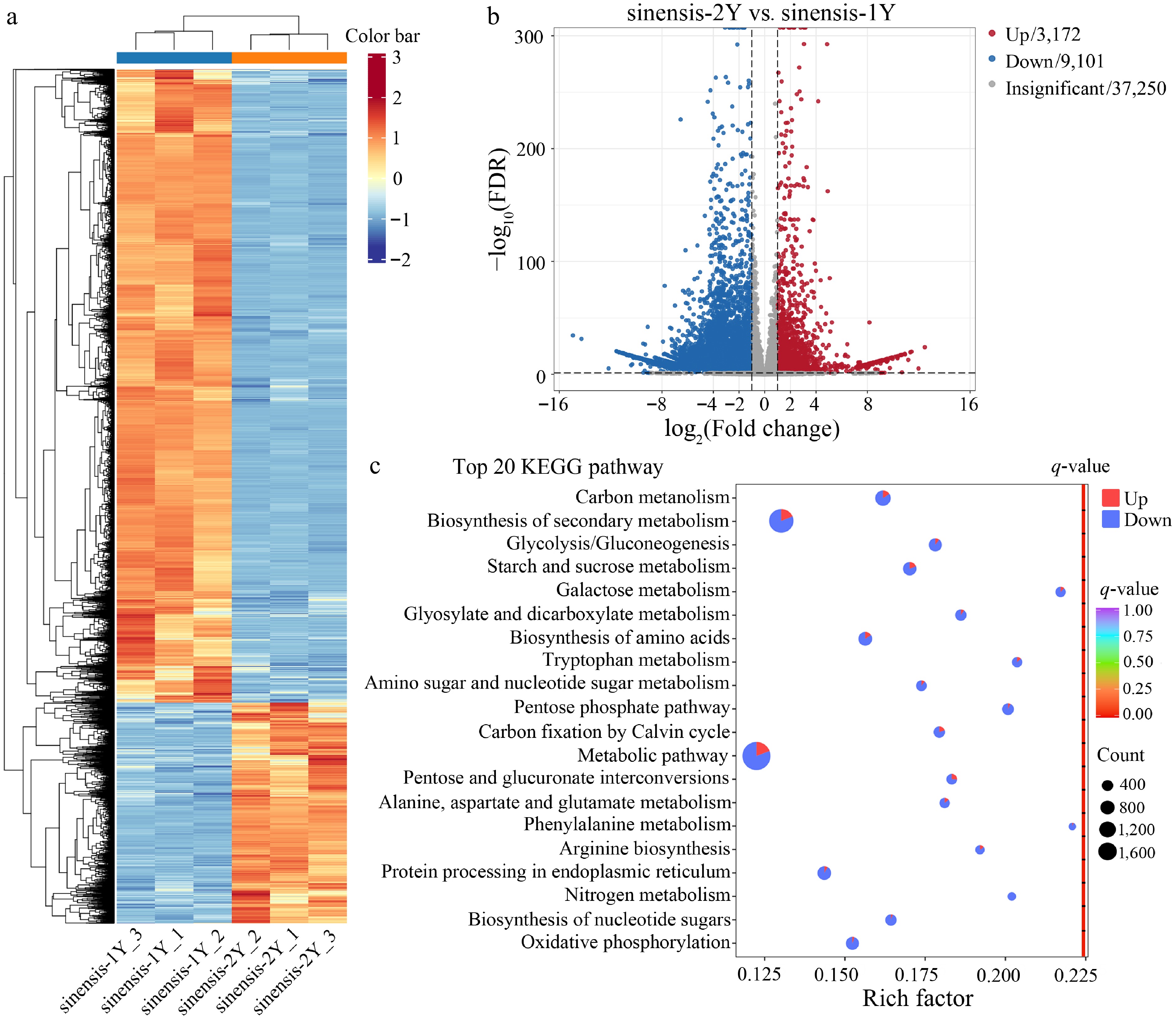
Figure 7.
Comparative transcriptomic analysis of cultivated S. sinensis across different growth years. (a) Heatmap of DEGs among different cultivation years. (b) Volcano plot of DEGs between two-year-old and one-year-old cultivated S. sinensis. (c) KEGG enrichment analysis of DEGs between two-year-old and one-year-old cultivated S. sinensis.
-
Compound Class Formula Molecular
weight (Da)Rank in S.
sinensisRank in S.
australisIsoscutellarein 7-O-glucoside (Isoscutellarein 7-glucoside) Flavone C21H20O11 448.1006 1 1 Amoenin Flavonol C21H20O11 448.1006 2 2 Rhamnetin 5-glucoside Flavonol C22H22O12 478.1111 3 3 Hesperetin-5-O-glucoside Flavone C22H24O11 464.1319 4 8 Quercetin-3,7-Di-O-glucoside Flavonol C27H30O17 626.1483 5 5 Meratin Flavonol C27H30O17 626.1483 6 10 Hypolaetin 7-sophoroside Flavone C27H30O17 626.1483 7 6 6-Hydroxykaempferol 3-methyl ether 6-glucoside Flavonol C22H22O12 478.1111 8 7 Quercetin 3-sambubioside-3'-glucoside Flavonol C32H38O21 758.1906 9 9 Hesperetin-8-C-glucoside-3'-O-glucoside Flavanone C28H34O16 626.1847 10 14 1,3,7-trihydroxy-4-prenylxanthone Other Flavonoid C18H16O5 312.0998 11 15 Cyanidin 3-O-beta-D-sambubioside Anthocyanidin C26H29O15 581.1501 12 13 Cinchonain Ib Flavanol C24H20O9 452.1107 13 6-Hydroxykaempferol 3-methyl ether 6-glucoside Flavonol C27H30O17 626.1483 14 Delphinidin-O-glucoside-O-xyloside-O-glucoside Anthocyanidin C32H39O21 759.1984 15 Eriodictyol 5-O-glucoside Flavanone C21H22O11 450.1162 16 2-(3,4-dihydroxyphenyl)-6,7-dihydroxy-4H-chromen-4-one Flavone C15H10O6 286.0477 17 16 Cyanidin 3-O-(beta-D-xylosyl-[1→2])-beta-D-galactoside) Anthocyanidin C26H29O15 581.1501 18 Luteolin 5-glucoside Flavone C21H20O11 448.1006 19 17 Cyanidin 3-O-glucoside Anthocyanidins C21H21O11 449.1078 20 20 Maesopsin 4-O-glucoside (Hovetrichoside C) Aurone C21H22O11 450.1162 4 Phaseollidin Isoflavone C20H20O4 324.1362 11 2-(4-hydroxyphenyl)-7-methoxy-6-(3-methylbut-2-enyl)chromen-4-one Flavone C21H20O4 336.1362 12 3-{[(2R,3S,4R,5S,6S)-6-({[(2S,3R,4S)-3,4-dihydroxy-4-(hydroxymethyl)
oxolan-2-yl]oxy}methyl)-3,4,5-trihydroxyoxan-2-yl]oxy}-5,7-
dihydroxy-2-(4-hydroxyphenyl)chromen-4-oneFlavonol C26H28O15 580.1428 18 Evolvuside B Flavone C21H20O11 448.1006 19 Numbers in the last two columns denote the rank order of relative abundance for each compound. Table 1.
Top 20 flavonoid metabolites with the highest relative abundances in wild S. sinensis and wild S. australis, respectively.
Figures
(7)
Tables
(1)