-
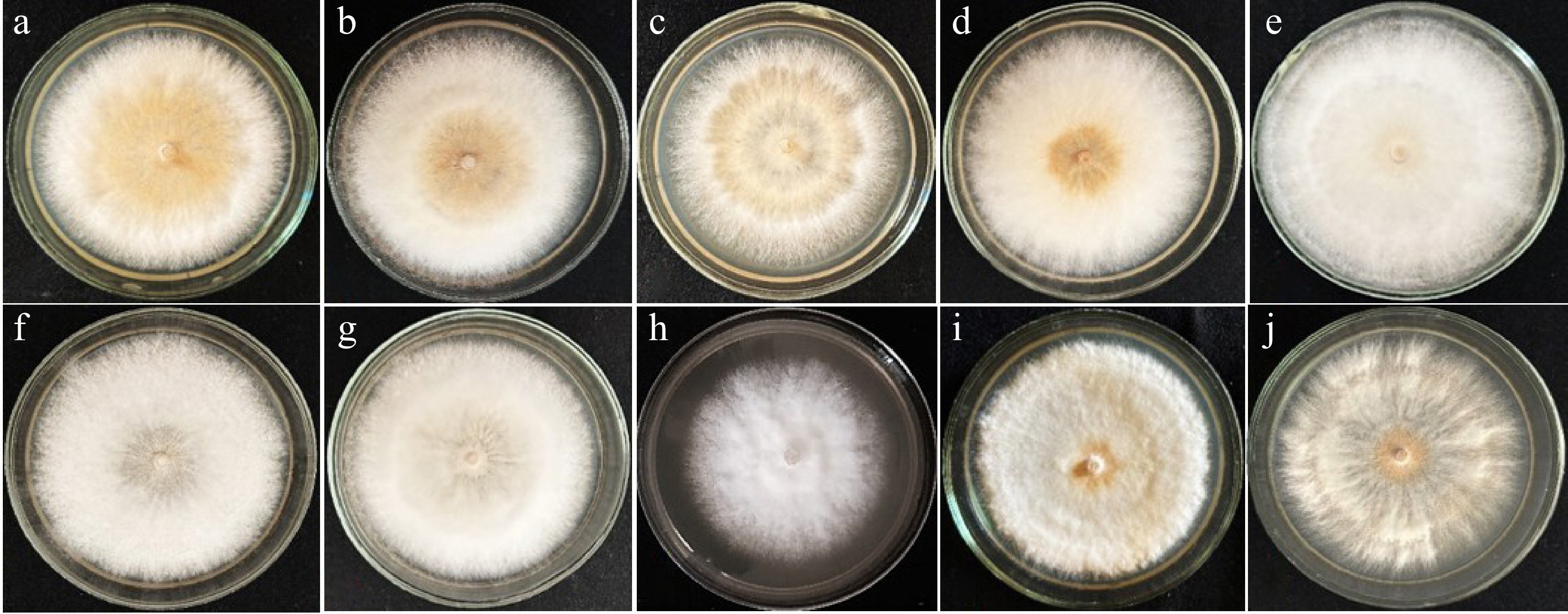
Figure 1.
The colony morphology in studied collections of Fomes inzengae on 1.5% MEA, at 26 °C: (a) Fi/8, (b) Fi/15, (c) Fi/20, (d) Fi/25, (e) Fi/3, (f) Fi/26, (g) Fi/24, (h) Fi/16 on the 7th d; (i) Fi/31, and (j) Fi/30 on the 6th d of growth.
-
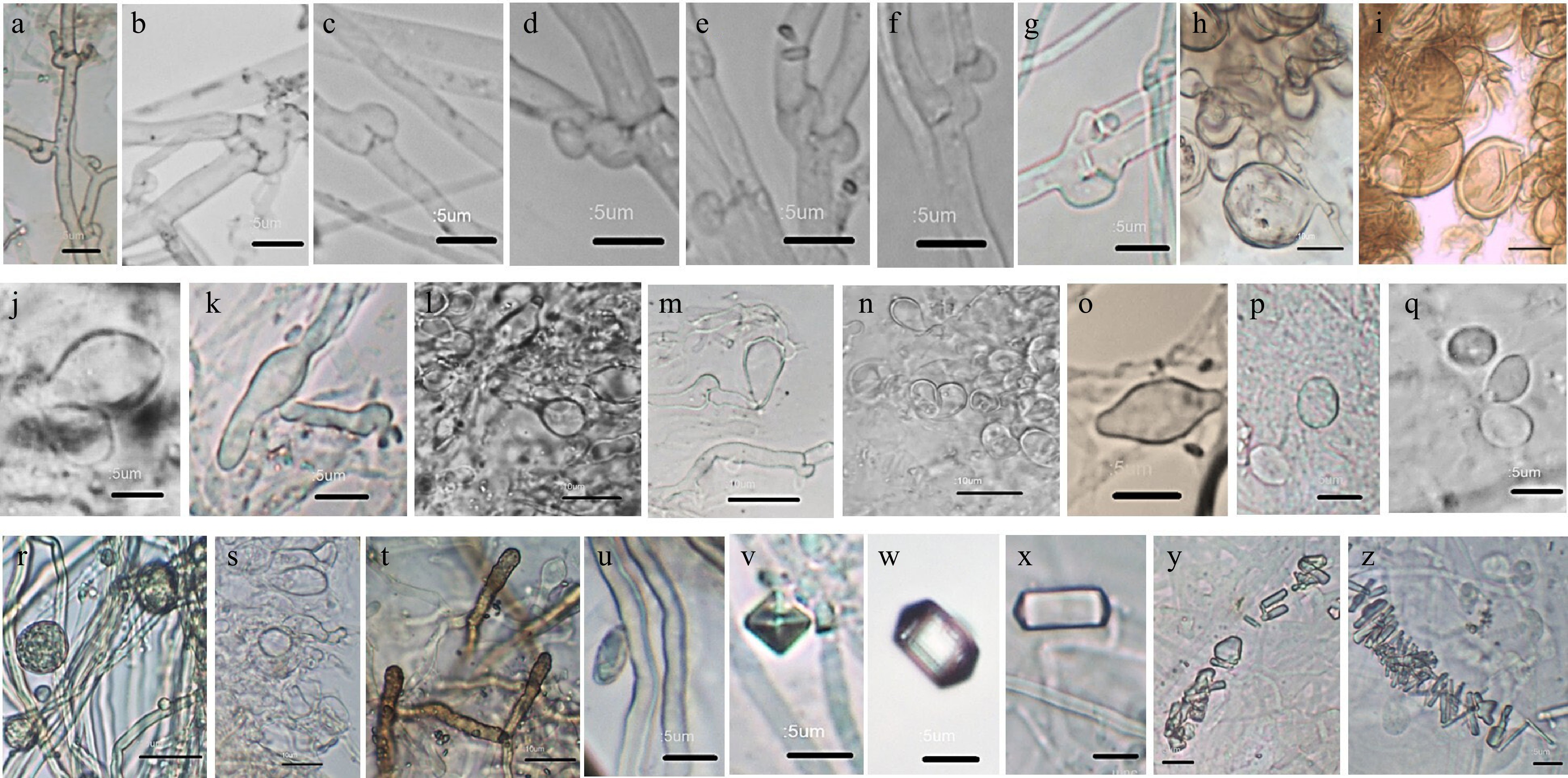
Figure 2.
Mircomorphological observation of studied cultures of Fomes inzengae: hyphal clamp connections in (a) Fi/15; (b) Fi/25; (c) Fi/31; (d), (e) Fi/20; and (f), (g) Fi/3; development of cuticular cells in (h), (i) Fi/30, (j), (k), (l) Fi/20, (m) Fi/24, and (n) Fi/8; chlamydospores in (o) Fi/20, (p) Fi/3, and (q) Fi/25; chlamydospores in (r) Fi/26, (s) Fi/8, (t), cystidiols in Fi/15, and (u) basidiospore in Fi/30 observed in an in vitro developed fruiting body; crystals in (v), (w), (y) Fi/20, (x) Fi/25, and (z) Fi/31 strains. Scale bars = (a)–(g), (j), (k), (o)–(q), (u)–(z) 5 µm, and (h), (i), (l)–(n), (r)–(t) 10 µm.
-
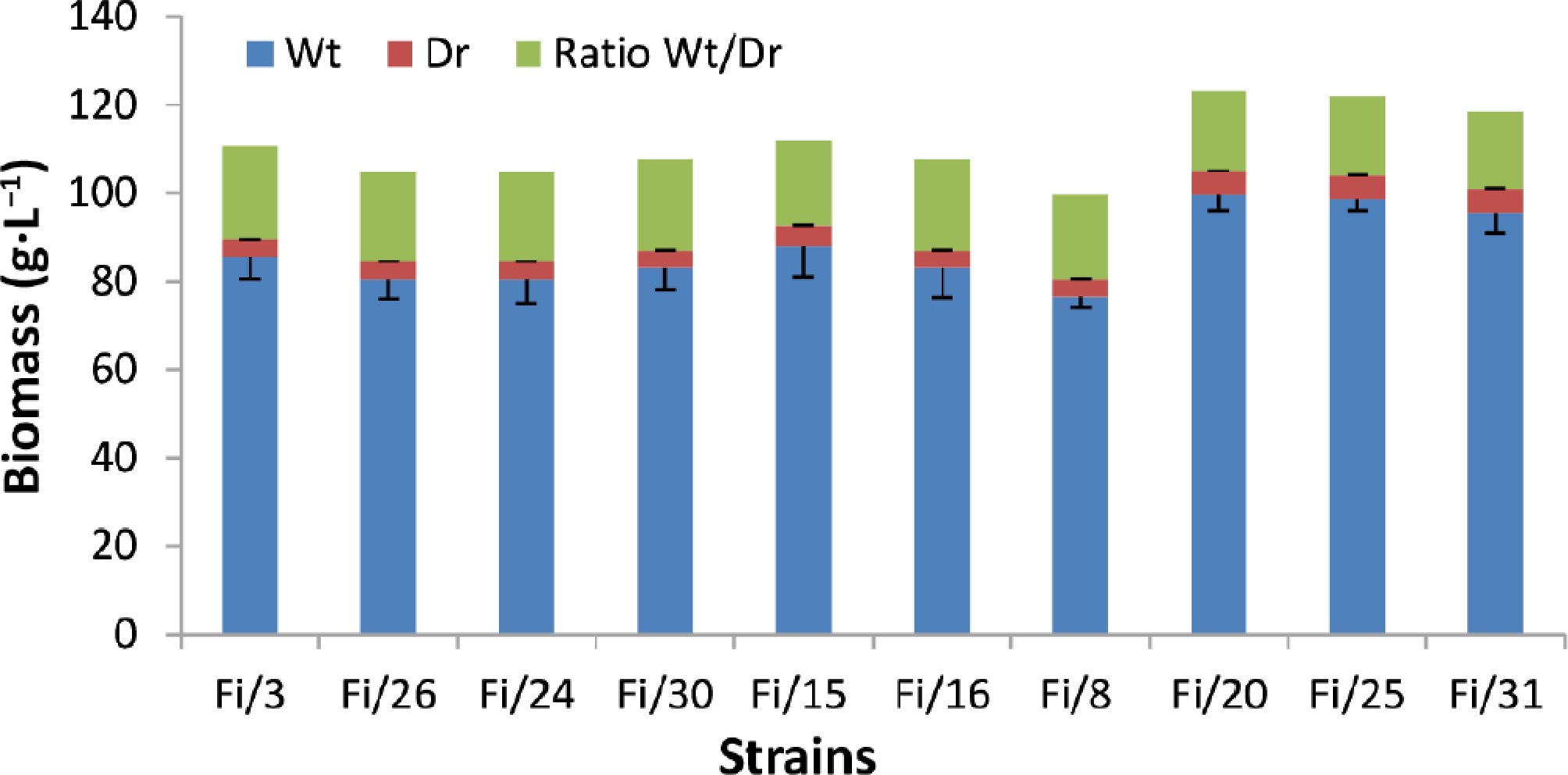
Figure 3.
The biomass formation in Fomes inzengae strains after 21 d of static cultivation on MEM.
-
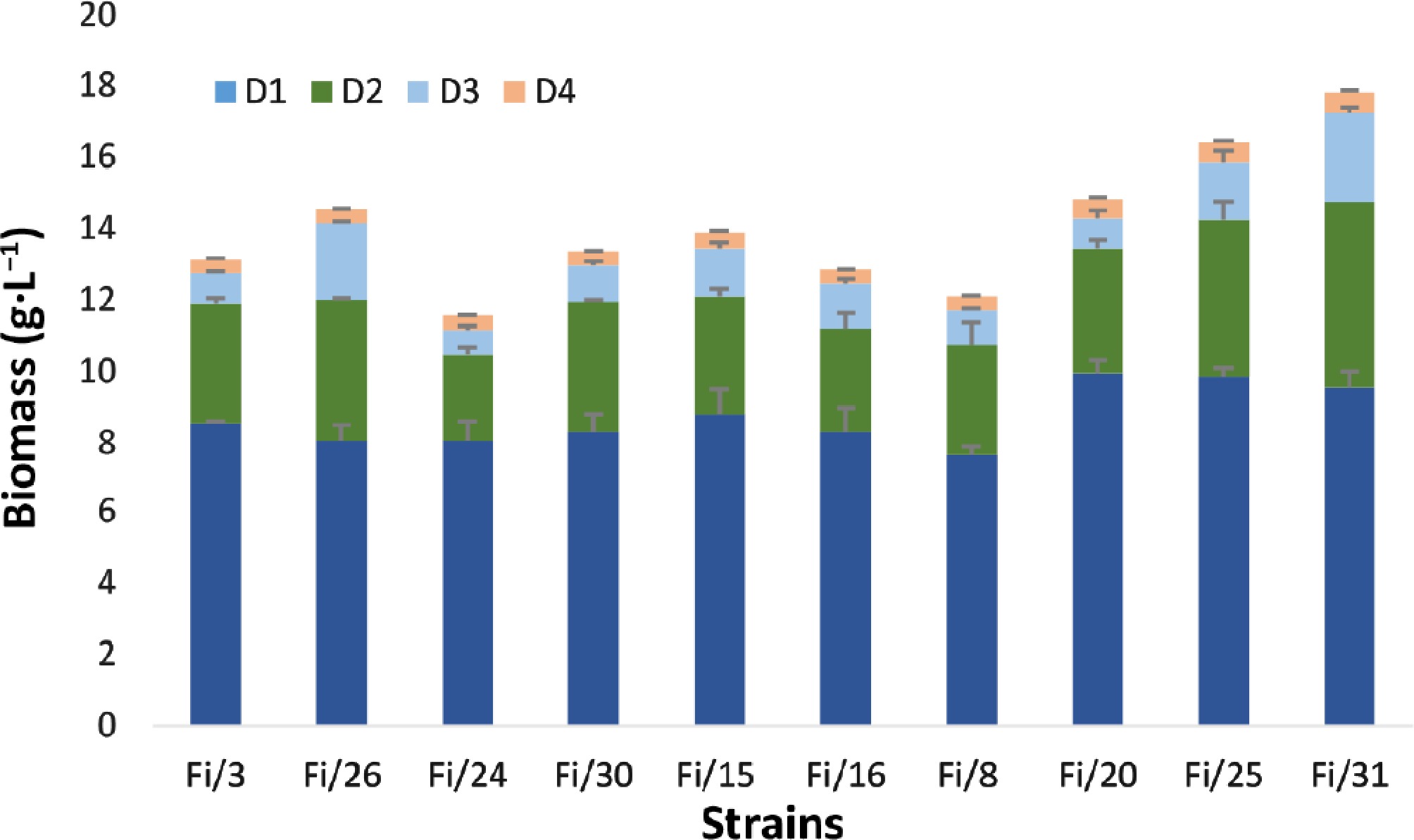
Figure 4.
The drying dynamics of wet biomass in Fomes inzengae strains at room temperature over 4 d.
-
Strain Host tree Type of wood Origin and date of culture isolation, floristic region, and altitude (m a.s.l.) GenBank accession number Fi/3 Carpinus betulus L. Living tree Ijevan, Tavush province, July 2005; IJ, 750 m PP972742 Fi/8 Juglans regia L. Living tree Berdavan, Tavush province, April 2014; IJ, 680 m OL583665 Fi/15 Salix alba L. Stump Solak village, Kotayk province, July 2015; AP, 1,650 m OL583668 Fi/16 Salix alba L. Stump Solak village, Kotayk province, July 2015; AP, 1,650 m OL583669 Fi/20 Populus nigra L. Living tree Yeravan, July 2013; YR, 860 m PP972744 Fi/24 Fagus orientalis Lipsky Living tree Baghanis, Tavush province, July 2016; IJ, 920 m OL583671 Fi/25 Populus nigra L. Living tree Yerevan, July 2016; YR, 860 m OL583672 Fi/26 Carpinus betulus L. Living tree Dilijan, Lake Parz, Tavush province, July 2016; IJ, 1,220 m OL583673 Fi/30 Fagus orientalis Lipsky Trunk Jujevan, Tavush province, March 2023; IJ, 1,050 m PP972741 Fi/31 Acer platanoides L. Living tree Gomshavar, Tavush province, May 2023; IJ, 1,564 m PP972745 Legend: (AP) Aparan, (IJ) Ijevan, and (YR) Yerevan floristic regions of Armenia[5,51]. Table 1.
Metadata of dikaryotic collections of Fomes inzengae used in this study.
-
Strain Host tree Colony morphology,
7 d, at 26 °CGenerative hyphae (µm), n = 90 Skeletal hyphae (µm), n = 80 Clamp connections (µm), n = 80 Cuticular cells (µm),
n = 70Chlamydospores (µm), n = 50 Crystals (µm), n = 50 FB (d) Fi/3 C. betulus Cottony-felt, whitish-yellowish in the center, agar light cinnamon 1.9–4.7 2.8–4.1 1.1(2.9) × 2.0(2.8) 8.2(14.5) × 8.6(18.2) 2.2(4.7) × 2.7(6.1) Rod-shaped (0.5[1.2] × 5.1
[8.8]); cuboid (3.1[3.4]
× 1.5[2.4]); tetragonal (2.6 × 2.8 × 1.3)13** Fi/8 J. regia Felt, cinnamon brown in the center, agar light cinnamon 1.6–1.9 1.9–2.9 1.2(1.7) × 2.3(3.9) 5.1(6.7) × 7.6(7.7) 2.6(3.1) × 2.8(3.5)
6.3(6.7) × 7.8(14.3) (in vitro FB)Hexagonal ([4.1 × 7.7] × 2.2), cuboid (4.3[5.5] × 1.4[2.3]),
rod-shaped (0.4[1.5] ×
5.2[6.8])20 Fi/15 S. alba Cottony-felt, cinnamon brown in the center, agar light cinnamon brown 1.4–2.9 1.4 – 2.9 0.9(1.6) × 2.0(2.9) 5.3(6.4) × 7.0(9.1) 1.8(3.1) × 2.7(4.0) Cuboid (0.8[1.0] × 0.96
2.2[2.9])21 Fi/16 S. alba Cottony, yellowish in the center, agar light cinnamon 1.3–2.5 1.6–2.7 1.2(1.4) × 2.0(2.5) 4.8(5.7) × 6.8(10.1)* 3.0(9.1) × 3.3(13.1) Rod-shaped (0.3[1.2] × 5.9[9.8]), cuboid (3.3[3.5] × 1.5[2.1]), tetragonal (6.2 × 9.5 × 3.2) NS Fi/20 P. nigra Cottony-felt, cinnamon in the center, agar light cinnamon brown 1.6–2.6 1.3–2.5 1.1(1.7) × 2.5(3.2) 7.8(13.4) × 8.3(13.8) 5.0(5.2) × 10(10.4)
4.2(4.6) × 5.2(5.6)Rod-shaped
(0.3[2.2] × 1.5[7.7]), cuboid (1[1.9] × 1.6[2.5]), octagonal (5.4[8.5] × 8.5[9.6] × 3.2[4.4]),
tetragonal (2.5 × 2.9 × 1.3)NS Fi/24 F. orientalis Cottony-felt, whitish-creamy in the center, agar pinkish 1.2–2.6 1.4–2.2 1.0(1.3) × 1.9(2.5) 4.9(6.0) × 6.7(9.5) 4.1(4.5) × 5.6(5.7) Rod-shaped [0.5(1.1) × 4.9(7.8)] 21 Fi/25 P. nigra Cottony-felt, cinnamon brown in the center, agar cinnamon brown 1.1–3.3 1.2–3.2 1.3(2.5) × 2.5(4.5) 2.1(2.3) × 5.7(5.8) 3.7(4.5) × 4.3(6.0) Rod-shaped (1.3[1.7] ×
9.2[9.8]), hexa- (4.9 × 11.7
× 3.2), tetragonal (4.3 × 5.4 × 2.4)21 Fi/26 C. betulus Cottony-felt, whitish-creamy, agar unchanged 1.4–2.4 1.6–2.8 1.2 (1.8) × 2.7(4.2) 6.0(9.0) × 8.2(12.0) 2.4(11.9) × 2.6(12.4) (in vitro FB) Rod-shaped (1.2[1.5] ×
7.2[8.8])14 Fi/30 F. orientalis Cottony-felt, yellowish in the center, agar light cinnamon brown 1.9–2.5 1.5–3.1 1.4(2.0) × 3.0(3.2) 4.5(4.6) × 19.8(21.5) 2.7(3.5) × 3.9(5.3) Tetra- (4.3 × 4.3 × 1.6)) and hexagonal (6.0 × 4.1 × 2.2) 17 Fi/31 A. platanoides Cottony-felt, light cinnamon brown
in the center, agar unchanged1.2–2.4 1.2–2.9 1.3(2.1) × 2.8(4.4) 2.2(2.4) × 8.1(10.0) 3.1(4.2) × 3.5(6.3) Rod-shaped (0.3[1.3] × 6.4
[7.0]), tetra- (4.5 × 5.5 ×
2.2), hexagonal (4.0 × 2.3
× 1.2)10** Legend: * [15]; ** during antagonistic interaction in dual culture on PDA (Badalyan et al., unpublished); day of FB initiation; (NS) not seen. Table 2.
The cultural characteristics of studied collections of Fomes inzengae.
-
Strain Host tree 26 °C 30 °C 4/30 °C ΔGRavr ΔGRavr, % Fi/3 C. betulus 9.0 ± 0.3 10.0 ± 0.3 6.7 ± 0.2 3.3 ± 0.2 33.0 ± 2.1 Fi/26 C. betulus 9.0 ± 0.2 9.8 ± 0.3 7.4 ± 0.4 2.4 ± 0.5 24.5 ± 2.2 Fi/24 F. orientalis 8.9 ± 0.05 9.8 ± 0.4 7.4 ± 0.6 2.4 ± 0.5 24.5 ± 3.1 Fi/30 F. orientalis 9.2 ± 0.1 10.6 ± 0.3 8.2 ± 0.5 2.4 ± 0.5 22.6 ± 3.9 Fi/15 S. alba 8.1 ± 0.1 9.2 ± 0.4 7.1 ± 0.6 2.2 ± 0.5 23.9 ± 3.3 Fi/16 S. alba 7.5 ± 0.2 8.7 ± 0.3 6.8 ± 0.5 1.9 ± 0.5 21.8 ± 3.4 Fi/8 J. regia 8.4 ± 0.1 9.8 ± 0.2 6.9 ± 0.2 2.9 ± 0.3 29.6 ± 2.1 Fi/20 P. nigra 7.6 ± 0.1 9.2 ± 0.4 6.5 ± 0.2 2.7 ± 0.5 29.3 ± 1.9 Fi/25 P. nigra 8.8 ± 0.1 10.7 ± 0.3 7.8 ± 0.4 2.9 ± 0.4 27.1 ± 3.2 Fi/31 A. platanoides 10.0 ± 0.04 11.5 ± 0.2 8.4 ± 0.2 3.1 ± 0.3 26.9 ± 2.1 Legend: values are expressed in means ± SD, n = 12: ΔGRavr is the difference between GRavr values without stress, and with stress at 30 °C. The strains specificity among the GRavr indicators at 26 and 30 °C, as well as after stress at 30 °C are very highly significant (*** p < 0.001). Table 3.
The mycelial GRavr (mm·d−1) of Fomes inzengae strains on 1.5% MEA at different temperatures.
-
Strain Host tree pHavr ΔpH ΔpH, % Fi/3 C. betulus 5.2 ± 0.05 0.8 ± 0.04 13.3 ± 0.8 Fi/26 C. betulus 4.9 ± 0.01 1.1 ± 0.01 18.3 ± 0.04 Fi/24 F. orientalis 5.3 ± 0.04 0.8 ± 0.04 13.3 ± 0.8 Fi/30 F. orientalis 5.1 ± 0.01 0.9 ± 0.01 15.0 ± 0.1 Fi/15 S. alba 5.2 ± 0.04 0.8 ± 0.04 13.3 ± 0.7 Fi/16 S. alba 5.0 ± 0.05 1.0 ± 0.8 16.7 ± 0.8 Fi/8 J. regia 5.3 ± 0.04 0.7 ± 0.1 11.7 ± 0.8 Fi/20 P. nigra 5.0 ± 0.04 1.0 ± 0.04 16.7± 0.7 Fi/25 P. nigra 4.9 ± 0.01 1.1 ± 0.01 18.3 ± 0.1 Fi/31 A. platanoides 5.0 ± 0.01 1.0 ± 0.01 16.7 ± 0.1 Legend: (ΔpH) difference between pHavr of MEM (control) and cultural broth. The values are expressed as mean ± SD, n = 3. The strain specificity of pHavr was highly significant (** p < 0.01). A positive correlation was very weak between GRavr and ΔpH (r = 0.12) and moderate between Dr (r = 0.53) and Wt (r = 0.6) biomass and ΔpH. Table 4.
The pHavr of cultural broth samples after 21 d of static cultivation of Fomes inzengae at 30 °C on MEM (pH 6).
Figures
(4)
Tables
(4)