-
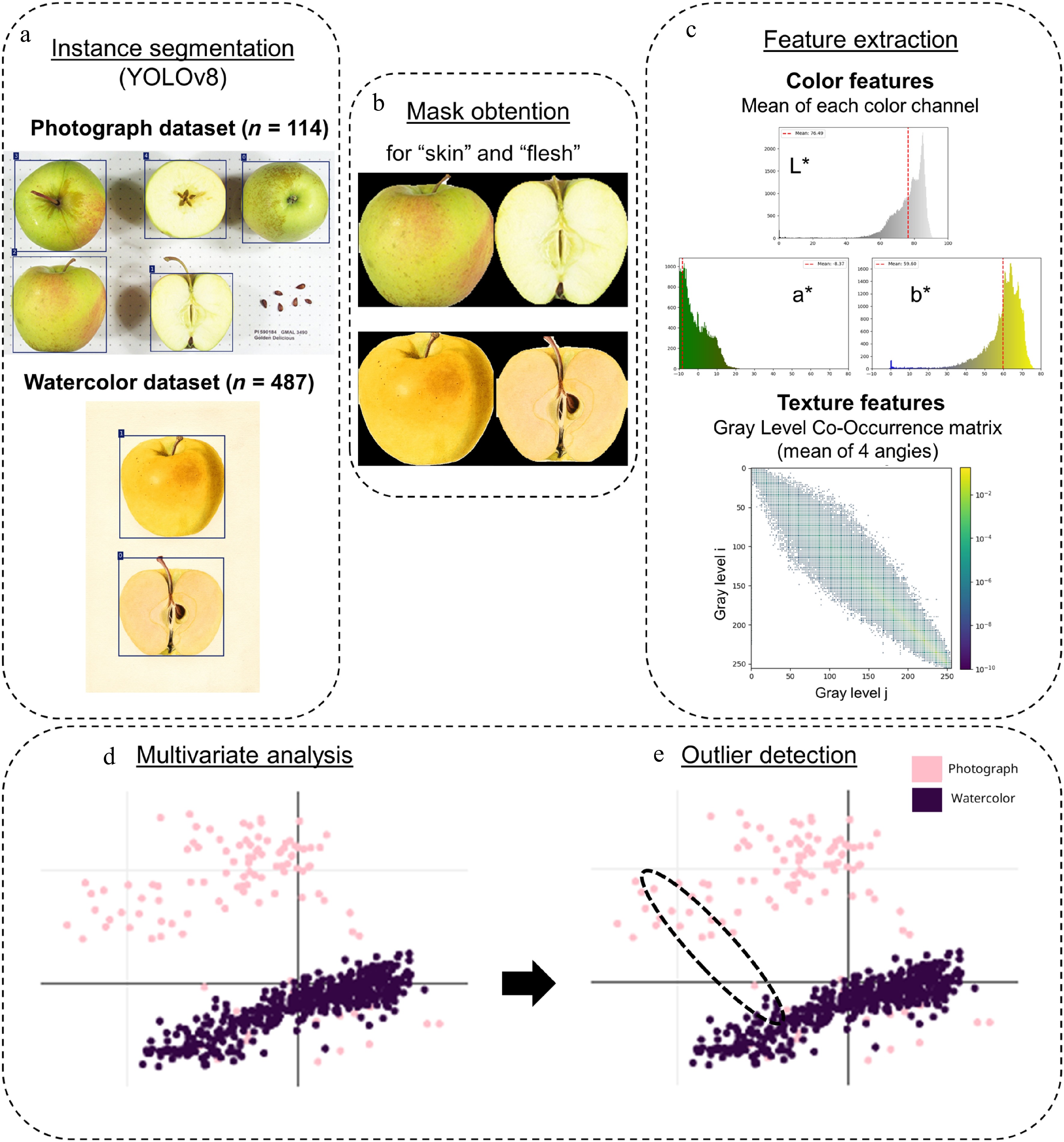
Figure 1.
Workflow for image segmentation and analysis. (a) Example images from GRIN photographs and USDA watercolors. (b) YOLOv8 segmentation masks for apple skin and flesh. (c) Extraction of color features in CIELab* space and texture features using gray-level co-occurrence matrices (GLCMs). (d) Principal component analysis was performed using these 14 features on both photographs and watercolors. (e) Outliers were detected using watercolor-photograph distance in the multivariate space. Euclidean distances of each photograph-watercolor pair of a same accession were calculated as
$ d=\sqrt{{\left({x}_{1P}-{x}_{1W}\right)}^{2}+{\left({x}_{2P}-{x}_{2W}\right)}^{2}} $ $ {x}_{1P},{x}_{2P} $ $ {x}_{1W},{x}_{2W} $ -
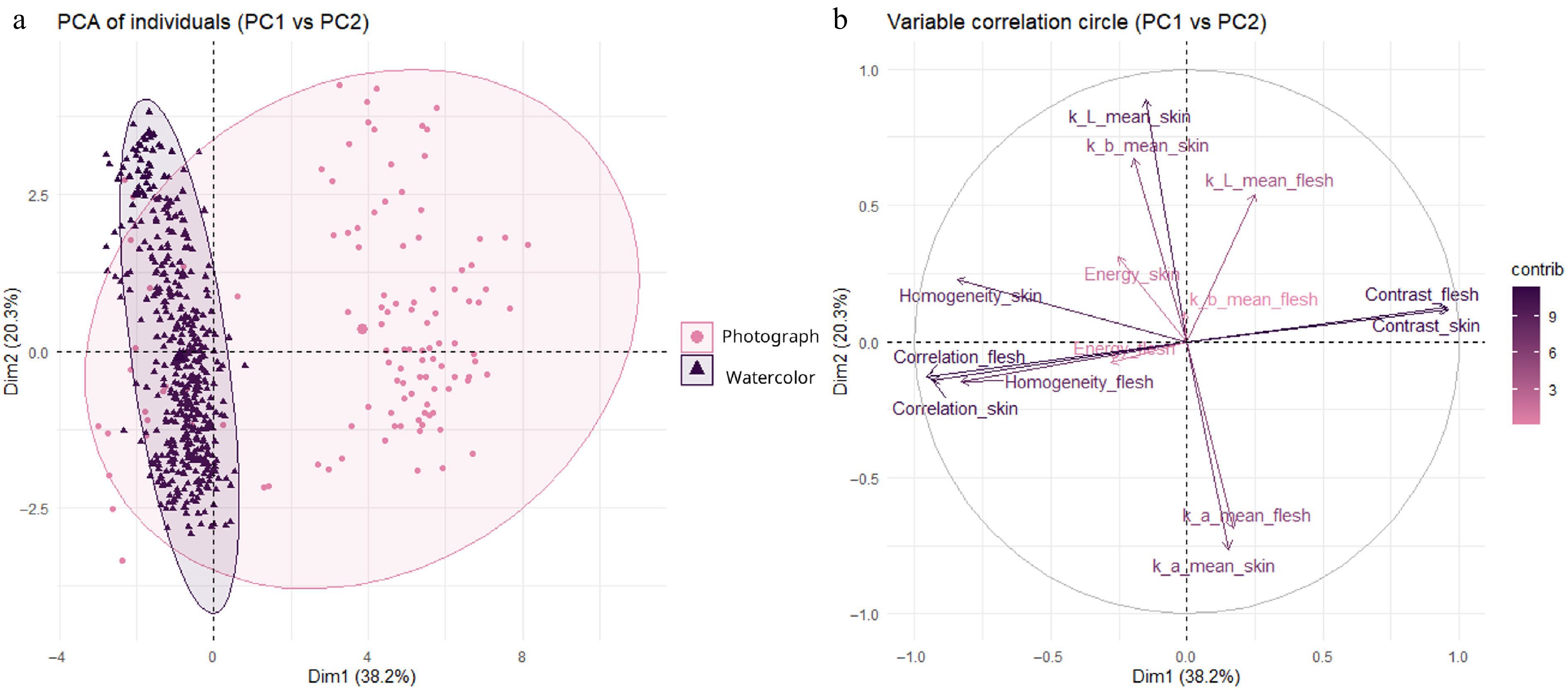
Figure 2.
Principal component analysis (PCA) of color and texture features for apple watercolors and photographs. Watercolors and photographs are projected onto the first two principal components, with (a) a scores plot showing photographic (pink) and watercolor (blue) individuals, and (b) a variable correlation circle indicating the contribution and direction of color and texture features to PC1 and PC2.
-
Photograph–Watercolor pair Notes 
Hawkeye
PI 590026
POM00002281 (1938)
'Hawkeye' is a synonym for Delicious, which was later renamed as 'Red Delicious' to distinguish it from 'Golden Delicious'. The Red Delicious is known as a large, round to conic apple with smooth skin, washed red, and often ranging to dark red in many mutations and seedlings.
Photograph and watercolor depict two fruits with different skin colors and shapes.
Strong probability that the watercolor represents a different genotype.
Clarke
PI 392306
POM00001705 (1921)
Photograph does not match watercolor or written description. Watercolor (1921, Mary Daisy Clarke; Arlington Farm, VA) matches historical descriptions recorded in GRIN and contemporary pomological sources.
Mismatch is likely due to homonymy (two cultivars named 'Clarke'), possibly NY origin vs Tasmanian re-donation (GRIN Passport data and HP Gould[30] do not resolve this).
Milton
PI 588956
POM00002637 (1933)
HP Gould[30] does not list 'Milton', limiting historical cross-validation.
Five watercolors exist; four are consistent with each other and with the photograph. This watercolor differs strongly in color but shares a similar shape with the photograph.
Mismatch explained by a non-representative watercolor specimen rather than misidentification.
Lodi
PI 588878
POM00002719 (1937)
POM00002720 (1935)
Photograph and watercolor differences likely due to fruit maturity.
No strong evidence for cultivar mismatch; differences attributable to fruit maturity and watercolor technique rather than identity error.
Bedford Red
PI 589121
POM00001466 (1913)
HP Gould[30] does not include this cultivar (likely not observed at Arlington Farm).
Photograph shows underripe, poorly colored fruit. Watercolor shows red, striped fruit consistent with GRIN Passport description.
Mismatch explained by fruit maturity, not mislabeling.
Barry
PI 589428
POM00001203 (1901)
HP Gould[30] explicitly states 'Checks with painting #22549 very well' and cross-references[31]. Historical descriptions[31] match the watercolor closely.
GRIN pedigree data indicates a McIntosh × Cox's Orange Pippin cross (released 1957), incompatible with the 1901 watercolor.
Mismatch is a clear case of homonymy: same name, different genotypes.
Margil
PI 264558
POM00000475 (1913)
HP Gould[30] does not list Margil or its synonym 'Reinette Musquée'.
Photograph is overexposed, particularly for flesh color. Watercolor likely depicts slightly yellow/cream flesh.
Mismatch driven by photographic exposure artifacts.
Tom Putt
PI 125271
POM00004235
Morphology of GRIN photograph and USDA watercolor matches historical descriptions and modern imagery[32].
Photograph and watercolor differences are likely due to environment and fruit maturity.
Mismatch explained by phenological stage, not mislabeling.
French Crab
PI 588908
POM00001901 (1905)
Photograph from an accession donated in 1984 and classified as Malus sylvestris.
Watercolor notes indicate material from England (Garcia Jacobs & Co., London), likely not grown at Arlington Farm (explaining absence from[30]).
Mismatch is uninformative, as 'French Crab' may not represent a stable cultivar name.Table 1.
Photograph–watercolor pairs identified as outliers based on PCA distance analysis. Notes indicate possible causes of inconsistency.
Figures
(2)
Tables
(1)