-
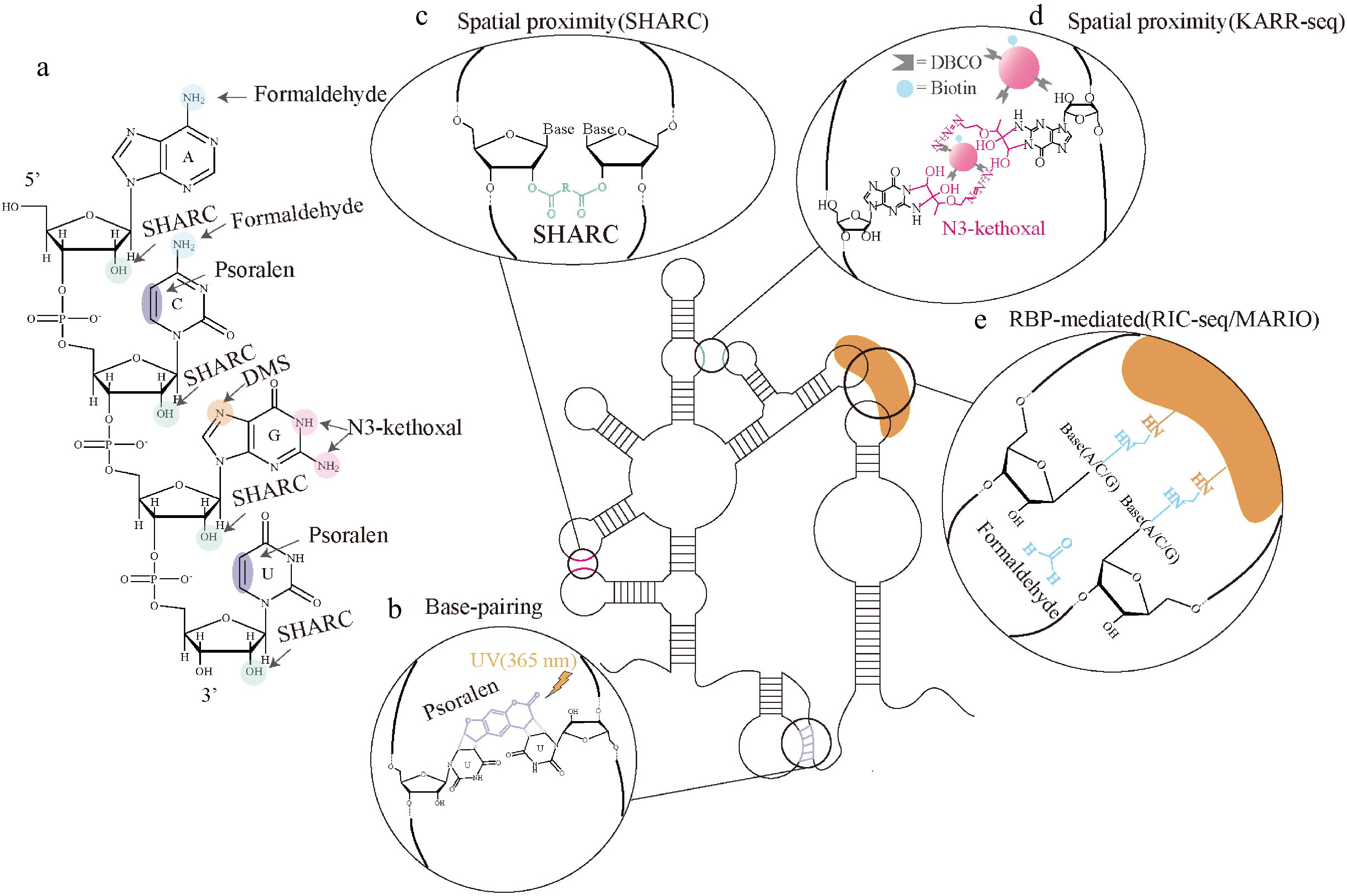
Figure 1.
Experimental approaches to structural information in RNA higher-order structures. (a) Formaldehyde reacts with amino groups of nucleic acid bases (A, C, G) to form cross-links (blue)[49–51]. The SHARC reagent mediates reversible acylation of the RNA 2'-OH (cyan)[48]. Psoralen intercalates into double-stranded regions and induces covalent cross-linking of pyrimidines (U, C) (purple)[43–47]. Dimethyl sulfate (DMS) methylates the N7 position of guanines (G)[52,53]. KARR technology exploits N3-kethoxal to selectively methylate the N1 and exocyclic N2 positions of unpaired guanine (G)[50]. (b) Psoralen preferentially intercalates into RNA duplex regions and forms covalent cross-links between opposing strands of RNA upon UV (365 nm) activation[43–47]. (c) SHARC reagents react with the 2'-OH groups of ribose on spatially proximal nucleotides, generating reversible cross-links to capture higher-order structural proximity[48]. (d) KARR-seq method labels unpaired G with N3-kethoxal in living cells, then uses DBCO-PAMAM dendrimers and copper-free SPAAC click chemistry to covalently connect spatially close RNA segments[50]. (e) Formaldehyde crosslinking or dual crosslinking (formaldehyde and EGS) stabilizes RBP-bridged spatial RNA–RNA contacts[49,51].
-
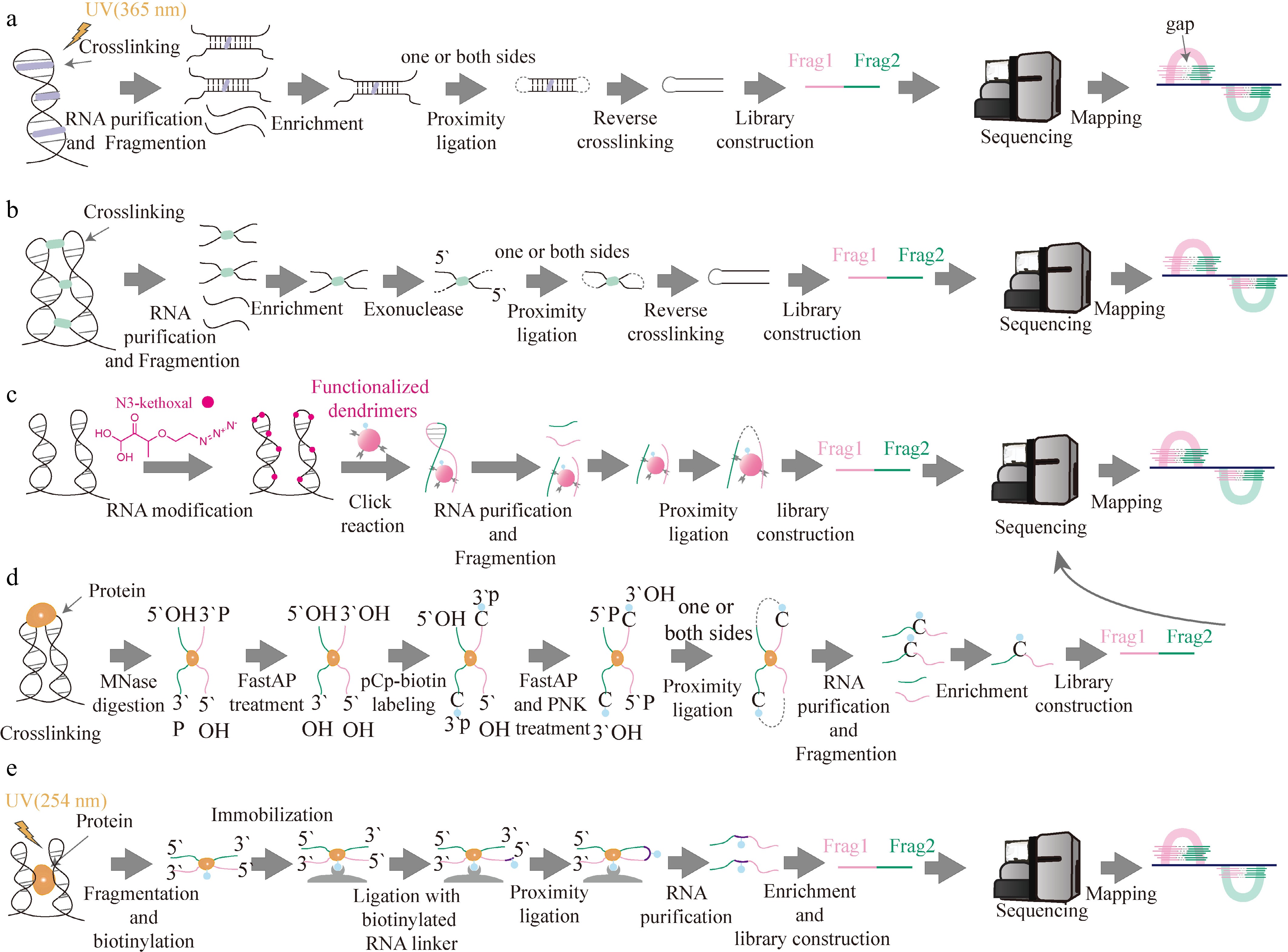
Figure 2.
High-throughput experimental methods for resolving RNA higher-order structures. (a) Approaches for capturing RNA tertiary structures[43−47]. RNA molecules are crosslinked in vivo using 365 nm UV-activated psoralen. After fragmentation and enrichment of crosslinked RNA fragments, proximity ligation is performed, followed by crosslink reversal. Ligated RNA fragments are constructed into sequencing libraries to map base-paired duplex regions. (b) SHARC[48]: cellular RNA is subjected to bifunctional reversible acylating crosslinking. After crosslink formation, RNA undergoes purification and enrichment, followed by exonuclease trimming of RNA termini. Proximity ligation is carried out prior to alkaline-triggered crosslink hydrolysis. Libraries built from chimeric fragments identify spatially proximal RNA regions independent of canonical base pairing. (c) KARR-seq[50]: cells are incubated with membrane-permeable N3-kethoxal to label unpaired G residues. Spatially proximal RNA segments are crosslinked via DBCO-conjugated PAMAM dendrimers through SPAAC click chemistry. After RNA fragmentation, proximity ligation and purification, chimeric RNA templates are enriched for library construction to detect protein-independent spatial contacts between RNA regions. (d) RIC-seq[49]: RNA–protein complexes are fixed via formaldehyde crosslinking in situ, and cells are permeabilized. Accessible RNA regions are mildly digested with MNase. Samples are sequentially treated with FastAP (Thermosensitive Alkaline Phosphatase) for dephosphorylation, pCp-biotin labeling of RNA 3′ termini, and additional FastAP and PNK (T4 polynucleotide kinase) treatments for end repair. Proximity ligation proceeds inside fixed cells. Purification, fragmentation, and enrichment of chimeric RNA are implemented prior to library construction to capture RBP-mediated RNA–RNA spatial contacts. (e) First, UV crosslinking is used to capture direct RNA-protein contacts; MARIO[51] then relies on dual crosslinking (formaldehyde and EGS) to trap RBP-bridged RNA spatial contacts, including intramolecular or intermolecular RNA interactions. Distinctly, proximity ligation is carried out post-cell lysis. Subsequent enrichment and library construction follow analogous workflows to decipher RNA tertiary and quaternary interactions.
-
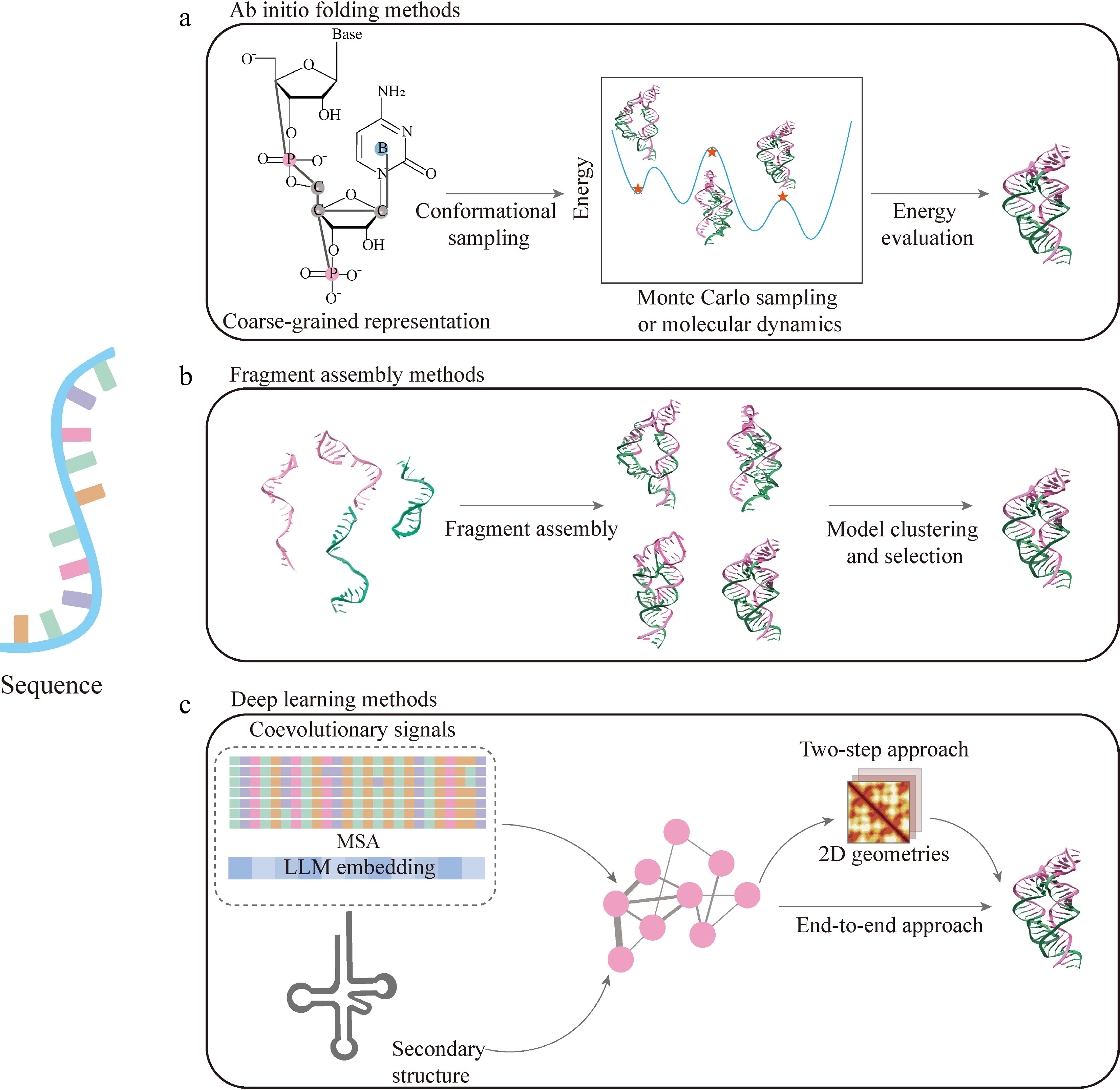
Figure 3.
Computational methods for RNA tertiary structure modeling. (a) Ab initio folding methods[58–72]. RNA molecules are represented using coarse-grained models, followed by exploration of the conformational space through sampling of the energy landscape, typically using Monte Carlo or molecular dynamics approaches. Candidate conformations are evaluated using energy functions to identify low-energy RNA structures. (b) Fragment assembly methods[75–81]. Structural fragments are selected from libraries derived from known RNA structures and assembled into full-length models. The resulting candidate structures are subsequently clustered and evaluated to identify representative conformations. (c) Deep learning methods[85–90]. Deep learning approaches integrate co-evolutionary signals and secondary structure information as inputs, and use neural network architectures to predict RNA structures. These methods generally follow either a two-step strategy, in which intermediate geometric constraints are first predicted and then used to reconstruct three-dimensional structures, or an end-to-end strategy that directly predicts RNA three-dimensional conformations from sequence-derived features.
-
Category Method Probe/principle Structural information Resolution/scale Main strengths Main limitations Psoralen duplex capture PARIS[43] AMT, 365 nm UV, ND2D enrichment and proximity ligation Direct intra-/intermolecular RNA duplexes and long-range base pairing Near-base-pair, transcriptome-wide Direct evidence of base pairing, unbiased toward specific RNAs or RBPs, captures long-range and alternative duplexes Labor-intensive 2D-gel purification, relatively low recovery, psoralen sequence/duplex bias PARIS2[44] Amotosalen, UV, optimized extraction, RNase III fragmentation and DD2D purification Direct RNA duplexes and alternative pairing conformations Near-base-pair, transcriptome-wide or target-enriched More than 4,000-fold more efficient than PARIS, improved recovery and reduced photodamage Retains psoralen bias, still requires UV and 2D-gel purification SPLASH[45] Biotinylated psoralen, UV, streptavidin enrichment Intra/intermolecular base-paired RNA interactions Duplex-region, transcriptome-wide Simple affinity enrichment; avoids 2D-gel purification, genome-wide mapping Limited cellular penetration of biotinylated psoralen, monoadduct/background and fragment-length biases LIGR-seq[46] AMT, UV, proximity ligation followed by RNase R enrichment Intra-/intermolecular RNA duplexes Duplex-region, transcriptome-wide Relatively simple enrichment; matched controls facilitate background estimation RNase R may retain highly structured uncrosslinked RNAs, background chimeras, psoralen bias COMRADES[47] Azide-psoralen, UV, antisense capture and click enrichment Base-paired interactions and alternative conformations of selected RNAs Duplex-region, target-enriched Very high depth for defined RNAs, suitable for long RNAs and structural ensembles Requires predefined targets and antisense probes; not unbiased transcriptome-wide, retains psoralen bias Protein-independent spatial proximity capture SHARC[48] Reversible bifunctional 2′-OH acylation, exonuclease trimming Pairing-independent spatial proximity and approximate 3D-distance constraints Near-nucleotide after trimming, transcriptome-wide Provides spatial restraints for 3D modeling, detects noncanonical contacts and alternative conformations Accessibility bias toward flexible/solvent-exposed 2′-OH groups, complex purification, resolution depends on trimming KARR-seq[50] N3-kethoxal, DBCO-PAMAM SPAAC crosslinking Stable/transient, non-duplex intra-/intermolecular spatial contacts Contact/fragment level, transcriptome-wide RBP-independent capture, tunable spatial range, captures transient and non-duplex interactions Requires accessible G residues, contact frequency does not directly equal physical distance, proximity may not indicate direct interaction RBP-mediated spatial proximity capture RIC-seq[49] Formaldehyde fixation, MNase fragmentation, pCp-biotin 3'-end labeling and in situ proximity ligation RBP-associated intra-/intermolecular RNA contacts and RNP topology High-resolution contact map, transcriptome-wide Preserves native cellular organization, global mapping of RNP-mediated RNA networks Cannot generally distinguish direct RNA–RNA contacts from protein-bridged proximity; low-abundance RNAs require deeper sequencing MARIO[51] Formaldehyde/EGS dual crosslinking (with a UV route for direct RNA-protein contacts), protein biotinylation and streptavidin enrichment RBP-assisted intra-/intermolecular RNA proximity Interaction-site/fragment level, transcriptome-wide No specific antibody, tagged RBP or anchor RNA required, applicable to tissues, linker aids chimera identification Does not directly demonstrate base pairing; contacts may be protein-mediated, post-lysis ligation may introduce non-native proximity DMS-based N7-G probing BASH MaP[52] DMS, KBH4 reduction, acid depurination converts m7G into RT-detectable AP sites N7-G accessibility/protection, Hoogsteen interactions and tertiary contacts Single-nucleotide and single-molecule, mainly targeted Converts otherwise RT-invisible m7G into robust mutation signals, integrates Watson–Crick- and Hoogsteen-face information Requires extra chemical conversion steps, N7-G-centered; protection does not identify the interaction partner or 3D distance msDMS-MaP[53] Optimized MaP RT directly detects N7-methyl-G together with N1/N3 modifications Secondary, tertiary, and RNP/quaternary-state information Single-nucleotide and single-molecule, targeted/rRNA Multiple structural layers from one DMS experiment; no m7G chemical conversion required N7-G protection has multiple possible causes; interpretation requires controls; G-centered and not a direct pairwise contact map Table 1.
Comparison of high-throughput experimental approaches for probing RNA higher-order structures in vivo.
-
Category Representative method Input/representation Modeling/sampling Experimental restraints Strengths Limitations Physics-/knowledge-based CG NAST[58] Sequence, SS, 1 bead/nt Knowledge-based CG sampling Direct Large-RNA modeling integrates sparse structural data Coarse structural resolution iFoldRNA v2[59,60] Sequence, 3 beads/nt Replica-exchange DMD Direct Native base-pairing/solvent-accessibility restraints, all-atom reconstruction Sampling and force-field accuracy limit long unconstrained RNAs Ernwin[61] Sequence and SS, helix-based CG representation MCMC sampling of helix arrangements None Efficient global-shape sampling for large RNAs Produces coarse-grained topology with limited local detail BARNACLE[62] RNA backbone/local structured dihedral-angle representation Dynamic Bayesian network sampling None Efficient sampling of realistic local backbone conformations Long-range interactions require a separate global energy function oxRNA[63] Sequence, rigid-body nucleotide MC/MD, thermodynamic model Generic RNA thermodynamics, folding pathways, and free-energy landscapes Experimental contacts require conversion into generic external forces/restraints SimRNA[64, 65] Sequence, optional SS, 5 interaction centers/nt MC/REMC Direct Supports pseudoknots and native SS/distance restraints Conformational sampling becomes difficult for long RNAs IsRNA family[66–69] Sequence or SS, 5 beads/nt REMD with statistical potentials Limited Models canonical and noncanonical base pairs applicable to large-RNA refinement Accuracy remains limited by CG force fields and conformational sampling HiRE-RNA[70] Sequence, high-resolution CG representation MD/REMD Limited Detailed noncanonical and multiple base-pair interactions, folding dynamics Validation in the original study focused mainly on 1276 nt systems RNAJP[71] Sequence, SS, CG representation Global topology sampling, refinement Direct Multiway junctions, noncanonical interactions, and global topology Requires an input 2D structure primarily optimized for junction-rich RNAs TiRNA[72] Sequence, optional SS, 3 beads/nt MC, temperature-/ion-dependent force field None Explicit temperature/ion effects, predicts pseudoknots, multiway junctions and thermal stability Native experimental-probing restraint integration was not reported Template-/fragment-based ModeRNA[73] Target–template alignment, homologous template Comparative modeling None Efficient and accurate when close homologous templates are available Strongly dependent on template availability and alignment quality RNABuilder[74] Sequence, structural constraints Multibody dynamics Direct Flexible integration of user-defined experimental constraints scales to large RNAs Requires substantial prior structural/contact information Vfold series[75] Sequence, SS, motif/template library Template/motif assembly, refinement Direct Automated modeling of pseudoknots, loops, and multiway junctions Accuracy is limited by availability of suitable structural templates FebRNA[76] Sequence SSCG fragment ensembles Fragment-ensemble assembly all-atom reconstruction Limited Reliable modeling of pseudoknots and multiway junctions Fragment-library gaps; tertiary motifs not explicitly modelled, validation mainly ≤ ~390 nt RNAComposer[77] Sequence, SS, motif library Automated fragment/motif assembly Direct Fast automated modeling; accepts experimental atom-distance restraints Depends on accurate SS and availability of appropriate structural motifs 3dRNA[78] Sequence, SS, structural fragments Fragment assembly, scoring/refinement Direct Can refine models using experimental/evolutionary contact restraints Fragment/template coverage limits accurate modeling of novel global folds FARFAR2[80] Sequence, optional SS, atomic fragments Rosetta MC, all-atom refinement Generic High-resolution all-atom modeling of complex RNA folds De novo sampling becomes a major bottleneck above ~80 nt; scoring-function limitations remain MC-Sym[81] Sequence, SS/NCM constraints, motif library Motif assembly stochastic/MC search Limited Explicit representation of canonical and noncanonical nucleotide motifs Limited motif-library coverage; best suited to relatively short RNAs RNAthreader[82] Sequence profile, SS topology Template identification and threading None Fast and accurate remote-template detection, including pseudoknotted RNAs Performs template alignment rather than independent full 3D reconstruction Deep learning, restraint-first trRosettaRNA[85] Sequence, MSA, predicted SS Pairwise geometry prediction and optimization None Automated prediction with competitive global-topology accuracy Sensitive to SS quality and structural homology; performance decreases on novel RNAs DeepFoldRNA[86] Sequence, MSA-derived features, predicted SS Geometric-potential prediction and gradient-based optimization None Fast atomic-level prediction compared with MC-based approaches Relies on homologous-sequence/MSA-derived evolutionary information epRNA[87] RNA sequence Euclidean-invariant neural network and distance-matrix prediction None Rapid sequence-only prediction of RNA 3D backbone geometry Limited availability of experimental RNA structures constrains training RhoFold+[88] Sequence, RNA language-model features, MSA when available End-to-end 3D prediction None Strong automated single-chain prediction, RNA language-model integration Accuracy remains sensitive to MSA quality and depth NuFold[89] Sequence, MSA, predicted SS Evoformer-like end-to-end prediction None Direct full-atom output, accurate local nucleotide geometry Sensitive to MSA/SS quality; limited RNA structural training data DRfold2[90] Single sequence, pretrained RNA language-model features End-to-end denoising, post-optimization Limited MSA-independent single-sequence; prediction-efficient inference Performance decreases for larger RNAs (> ~200 nt); benchmarks focus on monomeric RNAs Generative modeling RNAbpFlow[91] Sequence, base-pair map SE(3)-equivariant flow matching Limited MSA/template-independent all-atom conformational-ensemble generation Strongly dependent on input base-pair accuracy, not optimized for very large RNAs, probing restraints are not yet implemented DynaRNA[92] RNA sequence, no MSA required Diffusion model, equivariant GNN None Rapid generation of dynamic RNA conformational ensembles PDB-biased training data underrepresent extended/disordered conformations Complex modeling RoseTTAFoldNA[93] Protein/nucleic-acid sequences, MSA Three-track/SE(3)-equivariant complex prediction None Direct prediction of protein–RNA and other nucleic-acid-containing complexes RNA-only accuracy is unevenlarge/synthetic RNA targets remain difficult AlphaFold 3[94] Protein, RNA, DNA, ligand and ion components Diffusion-based all-atom complex prediction None Broad multimolecular modeling scope in a unified framework Non-Watson–Crick interactions, orphan RNAs, and alternative conformations remain challenging ProRNA3D-single[95] Single protein with RNA sequences pretrained language-model features Interaction-map prediction, geometric restraints and optimization None ProteinRNA complex prediction without paired MSA/co-evolutionary input Specialized for proteinRNA complexes rather than general RNA monomer prediction Direct: native support for experimental restraints. Generic: generic distance, contact, base-pairing, or structural restraints can be incorporated, but experimental data must first be converted into the format accepted by the modeling framework. Indirect: experimental information is not accepted as a native structural restraint during prediction but can be incorporated through secondary-structure conditioning, downstream filtering, model selection, or refinement. None: no publicly documented mechanism for incorporating experimental probing restraints. Custom: experimental restraints may be incorporated through user-defined or manually implemented restraint terms rather than a standardized native interface. Limited: only restricted forms of structural information or specific restraint types are supported. SS, secondary structure; MSA, multiple sequence alignment; CG, coarse-grained; MC, Monte Carlo; MCMC, Markov chain Monte Carlo; MD, molecular dynamics; DMD, discrete molecular dynamics; REMC, replica-exchange Monte Carlo; REMD, replica-exchange molecular dynamics; GNN, graph neural network; NCM, nucleotide cyclic motif; nt, nucleotide. Table 2.
Comparison of representative computational approaches for RNA higher-order structure modeling and their compatibility with experimental restraints.
Figures
(3)
Tables
(2)