








Search
2021 Volume 8
Article Contents
RESEARCH ARTICLE   Open Access    

Does Radiation Dose to Gastric Fundus during Neoadjuvant Chemoradiotherapy for Esophageal Carcinoma Have an Impact on Postoperative Anastomotic Leak?

More Information
  • Corresponding author: Shyama Prem Sudha Department of Radiation Oncology, Jawaharlal Institute of Post Graduate Medical Education & Research (JIPMER), Dhanvantrinagar, Gorimedu Puducherry 605006 (India) shyamaprems1@gmail.com 
  • Background: Radiation dose received by the gastric fundus (GF) in neoadjuvant chemoradiotherapy (NACRT) may influence the development of postoperative anastomotic leak (AL) in the management of resectable esophageal carcinoma (EC) by trimodality therapy. The present study aims to evaluate dose-volume parameters of the GF and their association with occurrence of AL in EC.
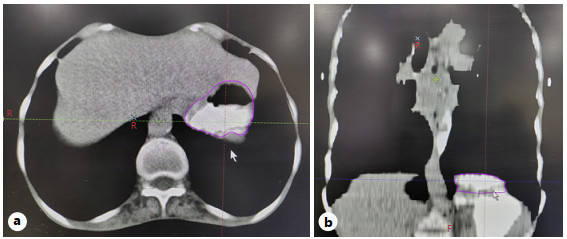
    Materials and Methods: A retrospective analysis was performed of 27 patients with EC who underwent NACRT followed by esophagectomy with cervical esophagogastric anastomosis between January 2015 and July 2018. The GF was retrospectively contoured; dose-volume parameters of the GF were recorded. Postoperative AL was identified from surgical records. Logistic regression analysis was used to identify risk factors associated with AL.
    Results: The mean age of the patients was 51 ± 10.5 years; 56% (15/27) had involvement of lower 1/3 esophagus, 10/27 (37%) midthoracic esophagus, and 2/27 (7%) upper thoracic esophagus; 40% (11/27) patients developed postoperative AL and 7/11 had distal and 4/11 had mid thoracic esophageal lesions. Four of five (80%) patients treated by 3-dimensional conformal radiotherapy versus 7/22 (32%) patients treated by volumetric modulated arc therapy developed AL (p = 0.12). Univariate logistic regression revealed no significant correlation between Dmean, Dmax, V20, V25, V30, V35, D50, and AL. 8/27 patients underwent ischemic preconditioning of gastric conduit, and 2/8 had AL; 19/27 did not undergo preconditioning, and 9/19 patients experienced AL (p = 0.4).
    Conclusion: There was no significant negative impact of the dose received by the GF in NACRT upon AL rates. Further studies with a larger sample size are required to clarify this issue.
  • Cite this article

    Nikhila Radhakrishna, Shyama Prem Sudha, Raja Kalayarasan, Prasanth Penumadu. 2021. Does Radiation Dose to Gastric Fundus during Neoadjuvant Chemoradiotherapy for Esophageal Carcinoma Have an Impact on Postoperative Anastomotic Leak?. Gastrointestinal Tumors. 8: doi: 10.1159/000513929
    Nikhila Radhakrishna, Shyama Prem Sudha, Raja Kalayarasan, Prasanth Penumadu. 2021. Does Radiation Dose to Gastric Fundus during Neoadjuvant Chemoradiotherapy for Esophageal Carcinoma Have an Impact on Postoperative Anastomotic Leak?. Gastrointestinal Tumors. 8: doi: 10.1159/000513929

Figures(1)  /  Tables(5)

Article Metrics

Article views(692) PDF downloads(472)

Research Article   Open Access    

Does Radiation Dose to Gastric Fundus during Neoadjuvant Chemoradiotherapy for Esophageal Carcinoma Have an Impact on Postoperative Anastomotic Leak?

  • Corresponding author: Shyama Prem Sudha Department of Radiation Oncology, Jawaharlal Institute of Post Graduate Medical Education & Research (JIPMER), Dhanvantrinagar, Gorimedu Puducherry 605006 (India) shyamaprems1@gmail.com 
Gastrointestinal Tumors  8 Article number: 10.1159/000513929  (2021)  |  Cite this article

Abstract: 

Background: Radiation dose received by the gastric fundus (GF) in neoadjuvant chemoradiotherapy (NACRT) may influence the development of postoperative anastomotic leak (AL) in the management of resectable esophageal carcinoma (EC) by trimodality therapy. The present study aims to evaluate dose-volume parameters of the GF and their association with occurrence of AL in EC.
Materials and Methods: A retrospective analysis was performed of 27 patients with EC who underwent NACRT followed by esophagectomy with cervical esophagogastric anastomosis between January 2015 and July 2018. The GF was retrospectively contoured; dose-volume parameters of the GF were recorded. Postoperative AL was identified from surgical records. Logistic regression analysis was used to identify risk factors associated with AL.
Results: The mean age of the patients was 51 ± 10.5 years; 56% (15/27) had involvement of lower 1/3 esophagus, 10/27 (37%) midthoracic esophagus, and 2/27 (7%) upper thoracic esophagus; 40% (11/27) patients developed postoperative AL and 7/11 had distal and 4/11 had mid thoracic esophageal lesions. Four of five (80%) patients treated by 3-dimensional conformal radiotherapy versus 7/22 (32%) patients treated by volumetric modulated arc therapy developed AL (p = 0.12). Univariate logistic regression revealed no significant correlation between Dmean, Dmax, V20, V25, V30, V35, D50, and AL. 8/27 patients underwent ischemic preconditioning of gastric conduit, and 2/8 had AL; 19/27 did not undergo preconditioning, and 9/19 patients experienced AL (p = 0.4).
Conclusion: There was no significant negative impact of the dose received by the GF in NACRT upon AL rates. Further studies with a larger sample size are required to clarify this issue.

  • About this article
    Cite this article
    Nikhila Radhakrishna, Shyama Prem Sudha, Raja Kalayarasan, Prasanth Penumadu. 2021. Does Radiation Dose to Gastric Fundus during Neoadjuvant Chemoradiotherapy for Esophageal Carcinoma Have an Impact on Postoperative Anastomotic Leak?. Gastrointestinal Tumors. 8: doi: 10.1159/000513929
    Nikhila Radhakrishna, Shyama Prem Sudha, Raja Kalayarasan, Prasanth Penumadu. 2021. Does Radiation Dose to Gastric Fundus during Neoadjuvant Chemoradiotherapy for Esophageal Carcinoma Have an Impact on Postoperative Anastomotic Leak?. Gastrointestinal Tumors. 8: doi: 10.1159/000513929

Catalog

    /

    DownLoad:  Full-Size Img  PowerPoint
    Return
    Return