







Search
2021 Volume 8
Article Contents
RESEARCH ARTICLE   Open Access    

Prognostic and Clinicopathologic Significance of Discoidin Domain Receptors in Different Human Malignancies: A Meta-Analysis

    Fund Project: This study is supported by grants awarded by Shahrekord University of Medical Sciences (Grant No. 5595)
More Information
  • Background: Discoidin domain receptors (DDRs) belong to the receptor tyrosine kinases family and are activated by different types of collagens, which play roles in various physiological processes. An abnormal expression of DDRs is reported in different types of cancers. Despite many reports about the association and roles of high DDR expression levels in cancers, the prognostic values of DDRs are still unclear. This meta-analysis was performed to evaluate the prognostic effect of DDRs in different tissue cancers.
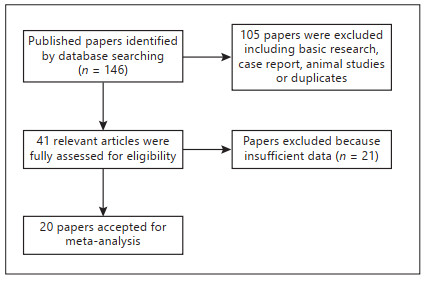
    Method: A literature search was performed in several related databases to find eligible English articles. Based on our research, 20 appropriate studies with 2,602 patients were selected till October 5, 2020. The pooled hazard ratio (HR) with a corresponding 95% confidence interval (CI) was computed to evaluate the strength of correlation between DDRs and survival of cancer patients.
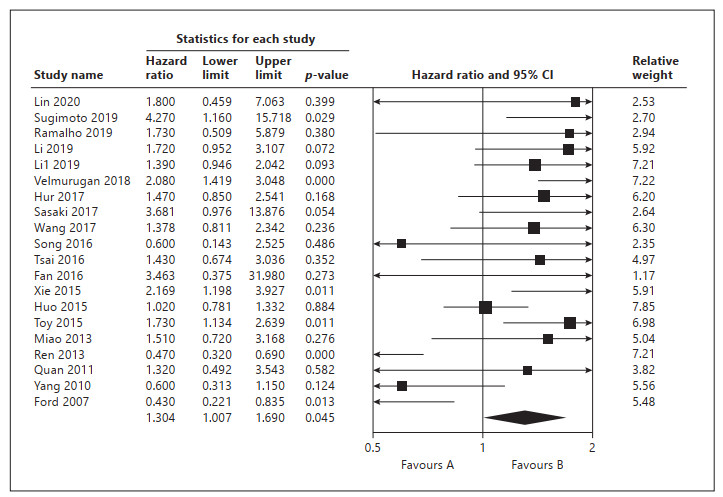
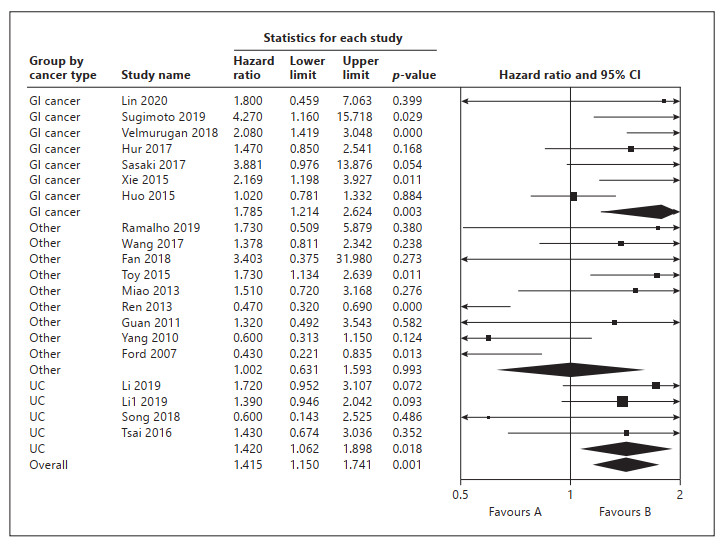
    Result: Pooling results showed that a high DDR expression was significantly associated with poorer overall survival (OS) (HR = 1.304, 95% CI 1.007–1.69, p = 0.04). Subgroup analysis based on cancer type revealed a significant link between a high DDR expression level and poor OS both in gastrointestinal (pooled HR = 1.78, 95% CI 1.214–2.624, p = 0.003) and urological cancers (pooled HR = 1.42, 95% CI 1.062–1.82, p = 0.018).
    Conclusion: Our meta-analysis results suggest that high DDRs expression has the potential to be used as a biomarker of poor prognosis in cancers.
  • Cite this article

    Gordon A. Ferns, Sheida Shabanian, Milad Shahini Shams Abadi, Ahmadshah Farhat, Mohammad-Hassan Arjmand. 2021. Prognostic and Clinicopathologic Significance of Discoidin Domain Receptors in Different Human Malignancies: A Meta-Analysis. Gastrointestinal Tumors. 8:3 doi: 10.1159/000517503
    Gordon A. Ferns, Sheida Shabanian, Milad Shahini Shams Abadi, Ahmadshah Farhat, Mohammad-Hassan Arjmand. 2021. Prognostic and Clinicopathologic Significance of Discoidin Domain Receptors in Different Human Malignancies: A Meta-Analysis. Gastrointestinal Tumors. 8:3 doi: 10.1159/000517503

Figures(5)  /  Tables(3)

Article Metrics

Article views(795) PDF downloads(555)

Research Article   Open Access    

Prognostic and Clinicopathologic Significance of Discoidin Domain Receptors in Different Human Malignancies: A Meta-Analysis

    Fund Project: This study is supported by grants awarded by Shahrekord University of Medical Sciences (Grant No. 5595)
Fund Project:  This study is supported by grants awarded by Shahrekord University of Medical Sciences (Grant No. 5595)
Gastrointestinal Tumors  8 Article number: 10.1159/000517503  (2021)  |  Cite this article

Abstract: 

Background: Discoidin domain receptors (DDRs) belong to the receptor tyrosine kinases family and are activated by different types of collagens, which play roles in various physiological processes. An abnormal expression of DDRs is reported in different types of cancers. Despite many reports about the association and roles of high DDR expression levels in cancers, the prognostic values of DDRs are still unclear. This meta-analysis was performed to evaluate the prognostic effect of DDRs in different tissue cancers.
Method: A literature search was performed in several related databases to find eligible English articles. Based on our research, 20 appropriate studies with 2,602 patients were selected till October 5, 2020. The pooled hazard ratio (HR) with a corresponding 95% confidence interval (CI) was computed to evaluate the strength of correlation between DDRs and survival of cancer patients.
Result: Pooling results showed that a high DDR expression was significantly associated with poorer overall survival (OS) (HR = 1.304, 95% CI 1.007–1.69, p = 0.04). Subgroup analysis based on cancer type revealed a significant link between a high DDR expression level and poor OS both in gastrointestinal (pooled HR = 1.78, 95% CI 1.214–2.624, p = 0.003) and urological cancers (pooled HR = 1.42, 95% CI 1.062–1.82, p = 0.018).
Conclusion: Our meta-analysis results suggest that high DDRs expression has the potential to be used as a biomarker of poor prognosis in cancers.

  • About this article
    Cite this article
    Gordon A. Ferns, Sheida Shabanian, Milad Shahini Shams Abadi, Ahmadshah Farhat, Mohammad-Hassan Arjmand. 2021. Prognostic and Clinicopathologic Significance of Discoidin Domain Receptors in Different Human Malignancies: A Meta-Analysis. Gastrointestinal Tumors. 8:3 doi: 10.1159/000517503
    Gordon A. Ferns, Sheida Shabanian, Milad Shahini Shams Abadi, Ahmadshah Farhat, Mohammad-Hassan Arjmand. 2021. Prognostic and Clinicopathologic Significance of Discoidin Domain Receptors in Different Human Malignancies: A Meta-Analysis. Gastrointestinal Tumors. 8:3 doi: 10.1159/000517503

Catalog

    /

    DownLoad:  Full-Size Img  PowerPoint
    Return
    Return