











-
In recent years, the prevalence of gluten-related disorders has increased, contributing to the expansion of the gluten-free products market. The increased diagnosis rates of celiac disease, along with greater awareness of non-celiac gluten sensitivity (NCGS), have significantly increased the consumer demand for gluten-free food options[1,2]. Gluten, a protein found in wheat, barley, and rye, triggers an autoimmune response in individuals with celiac disease. It can cause severe gastrointestinal symptoms, loss of nutrients, and potential long-term problems, such as an increased chance of developing other autoimmune diseases[3]. Furthermore, individuals who have NCGS may suffer symptoms comparable to celiac disease, such as abdominal pain, bloating, and fatigue upon consuming gluten-containing foods[2]. This growing health concern, combined with the rising prevalence of obesity and related conditions, has created a pressing need for gluten-free alternative food products, low on the glycemic index, that maintain satisfactory taste, texture, and nutritional value[4]. Pasta, a widely consumed and beloved food worldwide[5], presents a unique challenge in developing gluten-free substitutes.
Gluten, a protein found in wheat, plays a crucial role in providing the desired textural qualities and cooking behavior to traditional pasta. Removing gluten from pasta formulations can compromise the sensory and structural integrity, making it difficult to replicate the familiar taste and texture that consumers expect[6]. Jackfruit seeds possess a low glycemic index, making them a suitable ingredient for developing pasta formulations that could benefit individuals aiming to manage conditions like obesity and diabetes[7]. Jackfruit seeds are known for their strong antioxidant properties and have also been shown to improve digestive health. They are also a rich source of dietary fiber, which aids in weight management and lowers cholesterol levels. The incorporation of jackfruit seed powder can, therefore, contribute to a balanced diet while addressing gluten-free dietary needs[8]. Jackfruit is an incredibly versatile fruit, with numerous studies highlighting a variety of value-added products derived from its bulbs. These include nectar, juice, wine, yoghurt, powder, fruit leather, crisps, and preserved forms such as dehydrated, frozen, and canned products. Additionally, jackfruit seeds have been utilized to produce flour, extract starch, and obtain oil and protein[9].
Jackfruit seed emerges as a promising ingredient with the possibility to address the challenges of developing gluten-free pasta. Jackfruit (Artocarpus heterophyllus), a native of India's Western Ghats, is a member of the Moraceae family and is regarded as the largest fruit in the world. Emerging research indicates that the jackfruit tree is highly productive, yielding an average of 25.71 tons per ha. Mature trees can bear 10 to 200 fruit each, presenting a valuable opportunity to enhance socioeconomic livelihoods[8]. Its seeds, which account for 8%–15% of the fruit's weight[10], are a rich source of nutrients, including protein, carbohydrates, dietary fiber, and essential minerals[11]. Furthermore, jackfruit seeds possess significant antioxidant properties and contain bioactive compounds such as flavonoids, phenolic acids, and lignans. Research has indicated that these substances offer various health benefits, including reducing the risk of developing chronic conditions and potentially exhibiting anticancer properties[12].
Pasta is widely consumed worldwide. It is essentially a type of noodle made using flour, water, and sometimes eggs, and is available in various shapes and sizes, including spaghetti, penne, and fusilli[5]. While pasta has been a staple in many countries, such as Italy, for a long time, cultural adaptations have led to its widespread appeal worldwide. Despite the known nutritional benefits of jackfruit seeds and chickpeas, their synergistic effect on pasta microstructure remains unexplored. Therefore, this study aims to develop a fibre-rich, gluten-free alternative that supports food sustainability. It is a popular choice due to its affordability, versatility, and ease of preparation[13]. The incorporation of jackfruit seed powder into pasta formulations not only addresses the gluten-free requirement but also enhances the nutritional profile, incorporating valuable proteins, fibers, and antioxidants from both ingredients[14,15]. Recently, Ziena & Ziena[16] have focused on producing gluten-free pasta from only lentil legumes to enhance nutritional properties and improve poor-quality properties. However, by combining jackfruit seed powder with other gluten-free flours, such as chickpea flour, researchers aim to develop pasta products that provide for individuals with gluten-related disorders, while also delivering desirable sensory attributes and nutritional benefits. This innovation could open up new market opportunities for gluten-free pasta products that not only meet dietary restrictions but also offer enhanced nutritional value, potentially leading to improved health outcomes.
-
A fresh, ripe, and intact full jackfruit (varikka chakka) was purchased from a local market in Jalandhar city of Punjab state, and chickpea flour (Cicer arietinum L.) Kabuli JGK 1, and DPPH, gallic acid standard stock from HiMedia, Mumbai city of Maharashtra state, India, and CDH-Central Drug House (P) Ltd., New Delhi, India, respectively. In this study, all other chemicals used for the experiment are of analytical reagent grade (CDH-Central Drug House (P) Ltd., New Delhi, India.
Jackfruit seed powder (JSP) preparation
-
Jackfruit seed powder (JSP) was prepared following the method outlined by Kushwaha et al.[17], with some slight modifications. Fresh seeds were extracted from mature jackfruit, cleaned thoroughly, and the white aril layer was manually removed. The seeds were peeled using a solution of 2.5% sodium hydroxide and 2.5% citric acid. To eliminate chemical residues, the seeds were rinsed extensively with distilled water. Following this, the seeds were sliced and dried in an oven (Hot Air Oven, Imperial Biotech IHAO-01, India) at 45 °C for 8 h. The dried seed slices were then pulverized using a laboratory-grade high-speed grinder (CGOLDENWALL). The resulting powder was passed through a 300-mesh sieve to ensure uniformity. For storage, the refined JSP was sealed in airtight zip-lock bags and further contained within low-density polyethylene (LDPE) containers to maintain freshness and prevent moisture absorption.
Pasta preparation
-
The pasta was made using a combination of jackfruit seed powder and chickpea flour at different proportions, 50:50, 60:40, 70:30, and 80:20 (Fig. 1) as per preliminary trials and established methods[18,19]. The control sample (B0) consisted of 100 g semolina flour without guar gum (Table 1a), while the experimental formulations replaced semolina with a combination of jackfruit seed powder and chickpea flour in different ratios: B50 (50 g jackfruit seed powder and 50 g chickpea flour), B60 (60 g jackfruit seed powder and 40 g chickpea flour), B70 (70 g jackfruit seed powder and 30 g chickpea flour), and B80 (80 g jackfruit seed powder and 20 g chickpea flour). All formulations included guar gum (1.5 g), salt (3 g), and water in varying amounts (35–50 ml)[17,18]. The dry ingredients, i.e., the flour blend at 45 °C for 8 h and guar gum, were thoroughly pre-mixed. Afterwards, water and salt were gradually incorporated to form a uniform dough. The dough was kneaded and processed using a pasta press fitted with a large macaroni plate (KENT 16009 Spaghetti and Pasta Maker). The pasta was then dried at 55–60 °C in a tray dryer for 2 h, cooled to room temperature, and stored in airtight plastic containers until further analysis.
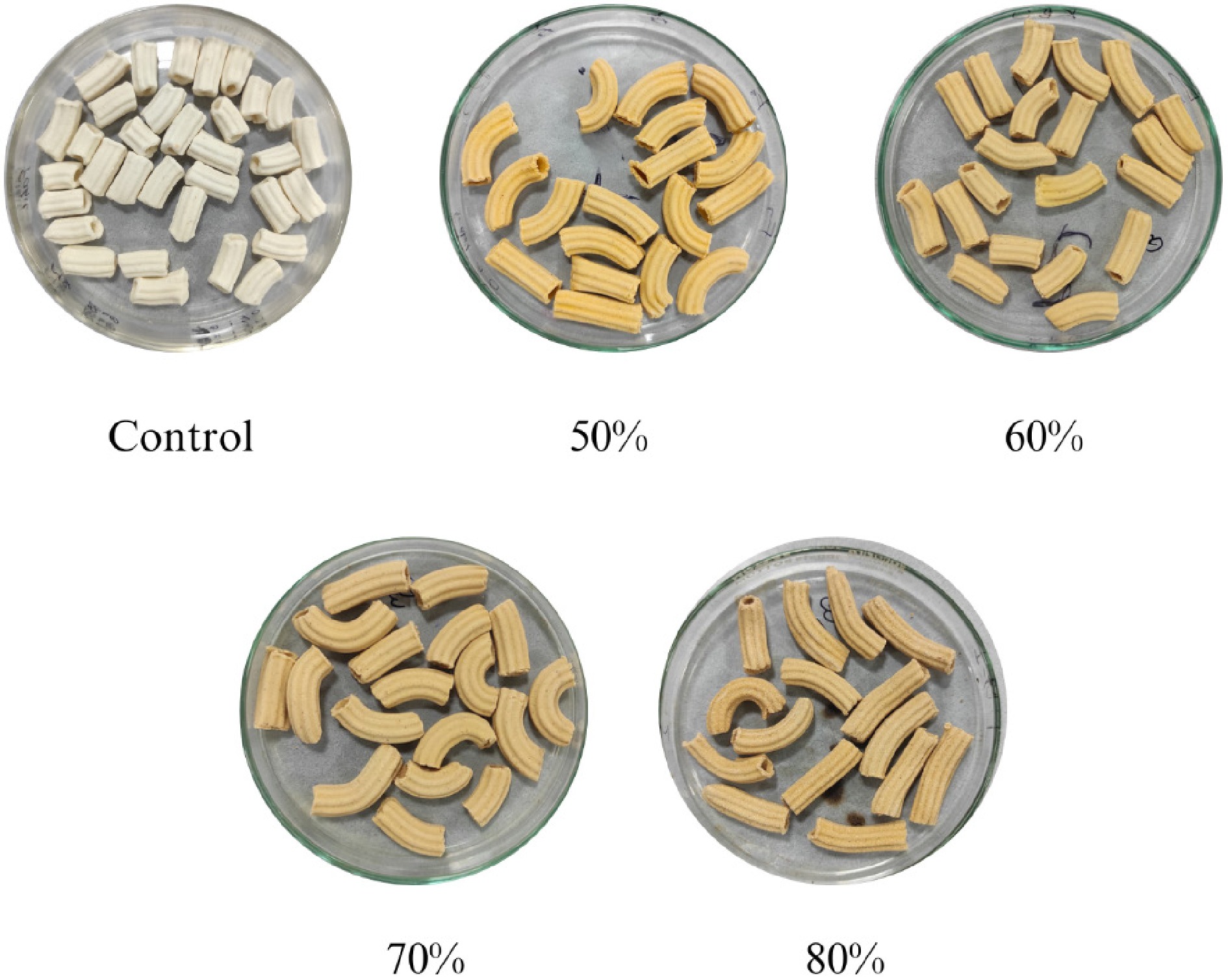
Figure 1.
Pasta prepared by different formulations. B0 (100% semolina, control); B50 (50% JSP + 50% CP); B60 (60% JSP + 40% CP); B70 (70% JSP + 30% CP); and B80 (80% JSP + 20% CP). JSP: jackfruit seed powder; CP: chickpea flour.
Table 1. Experimental design and standardized proportions of control and composite flours for pasta production.
Ingredients Formulations (g) B0 B50 B60 B70 B80 Semolina 100 − − − − Jackfruit seed powder − 50 60 70 80 Chickpea flour − 50 40 30 20 Guar gum − 1.5 1.5 1.5 1.5 Salt 3 3 3 3 3 Proximate analysis
-
The moisture (Hot Air Oven, Imperial Biotech IHAO-01, India) (method number 44-19), ash (Muffle Furnace, Narang Scientific Works Pvt. Ltd., model NSW-101, India) (method number 8-01), fat, crude fiber (Narang Scientific Works Pvt. Ltd., model NSW-101), and protein (Kjeldahl, Pelican Kelplus, model KES 12L VA DLS-TS, India) (method number 960.52) contents of various pasta samples (proportions 50:50, 60:40, 70:30, 80:20, and control) were measured using standard AOAC methods (AOAC, 2005). The protein conversion factors used to calculate the protein content in each sample were as follows: semolina (5.95), chickpea flour (6.25), and jackfruit seed powder (6.38). The calculation procedure followed the method outlined by Garcia-Valle et al.[20], and Dubey et al.[21]. The carbohydrate content was determined using the formula given in Eq. (1). Amylose concentration in starch samples was measured using the technique of Huang et al.[22] with optical density measurement at 620 nm. The total calorie content was calculated accordingly. Each analysis was performed three times to ensure accuracy.
$ \begin{split} & \mathrm{\rm{T}otal\; carbohydrates}\; (\text{%})=100\text{%}\; - \\ &\quad\rm{(}\mathrm{Moisture+Protein+Fat+Crude\; fiber+Ash\; contents)} \end{split} $ (1) $ \begin{split} & \rm{Energy\; value\; (kcal/100\; g)}=((\mathrm{Protein}\times 4)\; + \\ &\quad(\mathrm{Total\; carbohydrates}\times 4)+(\mathrm{Fat}\times 9))\end{split} $ (2) Determination of DPPH radical scavenging ability
-
The samples' DPPH radical scavenging capacity was tested using the procedure described by Kumar et al.[23]. Briefly, sample extracts (50 μL) at varying concentrations were combined with 2 mL of 0.1 mM DPPH in methanol. The mixtures were vortexed and incubated in the dark at ambient temperature for 20 min. Absorbance readings were taken at 520 nm with a UV-visible spectrophotometer. DPPH radical scavenging activity was quantified and expressed as a percentage using the following calculation, Eq. (3):
$\begin{split}&\rm DPPH\; radical\; scavenger\; activity\; ({\text{%}}) =\\&\quad \rm\frac{(\mathrm{Absorbance}\;\mathrm{control}\;-\;\mathrm{Absorbance}\;\mathrm{sample})}{\mathrm{Absorbance}\;\text{control}}\times 100 \end{split}$ (3) Total phenolic content (TPC)
-
The total phenolic content was calculated using a method reported by Sumczynski et al.[24]. Briefly, extract aliquots (200 μL) were mixed with 1.5 mL of 1:10 diluted Folin–Ciocalteu reagent and 1.5 mL of 6% Na2CO3. After incubation for 90 min at room temperature, the absorbance was measured at 725 nm. Results were quantified using a standard curve prepared with gallic acid and expressed as milligrams of gallic acid equivalents per gram of the analyzed sample (mg GAE/g).
Cooking quality
-
The optimal cooking quality was established in the study by Baah et al.[25]. The ideal cooking time for pasta is when the starch has turned into a gel, and no white core is visible. To ensure that the core is completely gone, the cooked pasta is pressed between two glass slides. Additionally, the cooking loss is determined by weighing the cooking water from each sample and then evaporating it in an oven set at 105 °C. The residue is then weighed and determined using the following Eq. (4):
$ \mathrm{Cooking\; loss=\frac{\mathrm{Dried\; residue\; in\; cooking\; water}}{Pasta\; weight\; before\; cooking}}\times100 $ (4) Water holding capacity (WHC) and oil holding capacity (OHC)
-
The method for evaluating WHC or OHC was described in[26]. One gram of powder was mixed with 25 ml of water or oil and left at room temperature for 15 min. The mixture was then centrifuged for 20 min at 4,000 rpm in a REMI R-8C BL centrifuge (Delhi, India). After draining the supernatant, the residue was weighed to determine the sample's WHC and OHC, expressed as grams of water or oil per gram. The computations were performed according to Eq. (5):
$ \begin{split}& \mathrm{WHC/OHC\; (mL/gm)}= \\ &\quad \rm \frac{Weight\; of\; hydrated\; sample-Weight\; of\; dry\; sample}{Weight\; of\; dry\; sample} \end{split} $ (5) Color analysis
-
The raw pasta's color (L*, a*, and b* values) was analyzed using the method provided by Panghal et al.[27]. A Hunter colourimeter (MiniScan XE Plus, CIPHET, Ludhiana, India) with a 25 mm aperture was employed, using D65 light and a typical observer angle of 10 degrees. The L* value represents the brightness from black to white, the a* value shows the range from reddish to greenish, and the b* value indicates the range from yellowish to blue, indicating the color components studied. Total color difference (∆E) was calculated for each sample according to the following Eq. (6):
$ \Delta E=\sqrt{\left(\Delta L^*\right)^2+\left(\Delta a^*\right)^2+\left(\Delta b^*\right)^2} $ (6) Texture profile analysis
-
The texture of cooked pasta was examined using the technique outlined by Aranibar et al.[28]. The pasta was boiled at approximately 98 °C for the specified time. In 5 min of cooking, five samples were examined with a texture analyzer (TA-HDplus, ICAR-CIPHET, Ludhiana, India). The texture analyzer employed a 25mm diameter aluminium probe (P/25) with a strain height of 9.647 mm, a stress area of 490.870 mm2, and a 10 kg load cell. During the analysis, several texture characteristics were estimated, including hardness, springiness, adhesiveness, fracturability, cohesiveness, chewiness, gumminess, and resilience.
Scanning electron microscope (SEM) examination
-
The pasta microstructure was examined using scanning electron microscopy (SEM). Double-sided tape was used to securely bind the pasta samples to the aluminium stubs before applying a thin gold coating. The pasta was further examined using the SEM at a magnification of 2,500×[29].
Fourier transform infrared spectroscopy (FTIR)
-
FTIR spectrophotometer (PerkinElmer Spectrum IR v10.6.1, CIF, LPU, India) was used to investigate the influence of the functional groups in control and formulated pasta. FTIR spectra were collected from powdered pasta samples at wavelengths ranging from 400 to 4,000 cm−1[20].
Sensory evaluation
-
Sensory evaluation was conducted at Lovely Professional University by a semi-trained panel of 20 members (students and staff) who were pre-screened for familiarity with gluten-free products. To ensure reproducibility and eliminate bias, samples were coded with random three-digit numbers and presented to each panellist in a randomised order in individual booths. Panellists were instructed to rinse their mouths with mineral water between sample evaluations to prevent sensory carry-over. Five variants—a 100% semolina control and four jackfruit seed-incorporated formulations—were assessed using a nine-point hedonic scale (1 = 'dislike extremely', 9 = 'like extremely') across attributes of appearance, color, flavor, texture, taste, and overall acceptability[30,31].
Statistical analysis
-
Statistical analyses were performed using Minitab 17 software, following the methodology described by Dubey et al.[21]. Data are presented as mean ± standard error from triplicate measurements (n = 3). After verifying the assumptions of normality and homogeneity of variance, a one-way Analysis of Variance (ANOVA) was employed to compare the control and formulated pasta samples. Significant differences between means were determined using Tukey's HSD (honestly significant difference) post-hoc test at a 95% confidence level (p < 0.05).
-
The results indicate that incorporating jackfruit seed powder significantly enhances the pasta's nutritional profile. Table 2 presents the proximate analysis of the formulated composite pasta compared to the control made from semolina. As the jackfruit seed content increased from 50% to 80%, several key nutritional shifts were observed. The moisture content (on a dry basis) rose slightly from 9.50% to 9.79%, likely due to the superior water absorption capacity of jackfruit seeds, which is associated with their high fibre content[32]. Notably, all formulated samples remained below the 12.5% maximum moisture threshold required for shelf-stable pasta. Significant increases were also recorded in protein (11.10%−14.20%), fiber (1.35%−2.01%), and ash content (1.36%−2.08%). The elevated ash content reflects the dense mineral profile of jackfruit seeds, particularly their high concentrations of potassium, calcium, and magnesium[33]. Total carbohydrates and starch followed a similar upward trend, reaching 74.54% and 78.46%, respectively. The nutritional enhancement is attributed to the dense protein and fiber profile of jackfruit seeds. The increase in fiber likely caused a 'dilution effect' of the starch matrix, while the non-gluten proteins from JSP and chickpea flour created a complex but less elastic network compared to traditional semolina[34].
Table 2. Nutritional composition of formulated pasta.
Formulation Moisture
(g/100 g)Ash
(g/100 g)Fat
(g/100 g)Protein
(g/100 g)Crude fiber
(g/100 g)Carbohydrate (g/100 g) Amylose
(g/100 g)Starch
(g/100 g)Energy
(kcal/100 g)B0 11.43 ± 0.14a 0.75 ± 0.11d 2.67 ± 0.36a 11.06 ± 0.20c 1.47 ± 0.40a 72.77 ± 0.31b 25.73 ± 0.65a 74.26 ± 0.65d 402.57 ± 0.42a B50 9.50 ± 0.30b 1.36 ± 0.08c 1.99 ± 0.30ab 11.10 ± 0.20a 1.35 ± 0.28a 70.38 ± 0.18d 24.17 ± 0.74b 75.82 ± 0.74c 386.97 ± 0.53c B60 9.71 ± 0.01b 1.67 ± 0.14b 1.76 ± 0.26b 11.43 ± 0.10b 1.38 ± 0.32a 71.64 ± 0.39c 23.49 ± 0.37bc 76.51 ± 0.37bc 389.74 ± 0.72bc B70 9.74 ± 0.12b 1.93 ± 0.08ab 1.29 ± 0.23bc 12.90 ± 0.20c 1.49 ± 0.23a 74.12 ± 0.30a 22.70 ± 0.38cd 77.54 ± 0.28ab 388.67 ± 1.66c B80 9.79 ± 0.01b 2.08 ± 0.05a 0.96 ± 0.24c 14.20 ± 0.20c 2.01 ± 0.29a 74.54 ± 0.23a 21.54 ± 0.41d 78.46 ± 0.41a 392.42 ± 1.49b The sample size is three (n = 3). Results are presented as percentages and represented as mean values along with standard deviations. Different subscript letters within the same column indicate statistically significant differences (p < 0.05). Conversely, reductions were observed in fat content (1.99%−0.96%) and amylose content (24.17%−21.54%). The decrease in amylose is consistent with previous findings that chickpea flour contains a higher amylose fraction than jackfruit seed powder[35,36]. In comparison, the semolina control pasta exhibited higher fat (2.67%) and amylose (25.73%) levels but lower protein (11.06%), fiber (1.47%), and ash (0.75%) than the jackfruit-enriched samples. These findings align with previous research demonstrating the nutritional enrichment of pasta through the addition of functional ingredients, such as Syzygium cumini pulp[27]. Furthermore, the successful application of jackfruit seed powder for enhancing fiber and mineral content mirrors similar results achieved in bakery products such as bread and cakes[37,38].
Antioxidant activity and total phenol content
-
The addition of jackfruit seed powder to pasta formulations significantly enhanced antioxidant properties and phenol content. As the proportion of jackfruit seed powder increased, the antioxidant potential increased from 13.11 to 44.03 and total phenolic content (30.36 to 95.01 mg GAE/g) in pasta samples (Table 3). Notably, the antioxidant capacity of the product approximately doubled with jackfruit seed incorporation, attributable to the higher concentrations of bioactive compounds such as polyphenols, including 5-caffeoylquinic acid, lignans, and flavones[11]. Similar results were observed in pasta made from egg white protein and soy protein isolates, both incorporated with banana powder[39]. Panghal et al.[27] also reported that pasta incorporating Syzygium cumini pulp demonstrated an inverse relationship between gluten levels and total phenolic content. According to the study by Burci et al.[40]. Various extraction methods of jackfruit seed were evaluated, demonstrating significant antioxidant activity. This suggests the potential use of jackfruit seeds as a functional ingredient in dietary applications, particularly to enhance antioxidant intake and improve health outcomes. Such findings underscore the versatility of jackfruit seeds in developing innovative and nutritionally beneficial food products.
Table 3. Antioxidant, total phenol content, color, water holding, and oil holding characteristics of formulated pasta.
Formulation Antioxidant activity (%) TPC (mg GAE/g) L* a* b* ΔE WHC (g/g) OHC (g/g) B0 13.11 ± 0.15d 30.36 ± 0.11e 79.17 ± 0.09a 1.06 ± 0.02a 5.70 ± 0.12e 0.00 1.59 ± 0.14b 1.15 ± 0.14a B50 31.93 ± 0.11c 74.43 ± 0.15d 76.38 ± 0.41b −1.24 ± 0.17d 37.57 ± 0.10a 32.06 2.32 ± 0.20ab 1.17 ± 0.08a B60 32.51 ± 0.77c 83.07 ± 0.05c 72.94 ± 0.23c −0.84 ± 0.19c 34.33 ± 0.02b 29.35 2.52 ± 0.19a 1.29 ± 0.18a B70 39.47 ± 0.15b 87.30 ± 0.10b 68.52 ± 0.17d 0.14 ± 0.08b 32.59 ± 0.07c 28.94 2.54 ± 0.39a 1.34 ± 0.28a B80 44.03 ± 0.10a 95.01 ± 0.26a 61.91 ± 0.06e 0.37 ± 0.09b 25.23 ± 0.04d 26.08 2.78 ± 0.37a 1.36 ± 0.32a The sample size is three (n = 3). Results are presented as percentages and represented as mean values along with standard deviations. Different subscript letters within the same column indicate statistically significant differences (p < 0.05). Cooking quality of pasta
-
The variations in cooking time, cooking weight, and cooking loss among the different formulations can be attributed to several factors. The cooking times and weights of various pasta formulations were investigated to better understand their cooking characteristics. Cooking time decreased gradually as the jackfruit seed content in the formulations increased (Fig. 2). The cooking time decreased significantly from 8.78 to 6.24 min. Reduced gluten levels and fiber create a weak network, allowing water to penetrate the pasta core and reduce cooking time[41]. Gluten-free pasta requires less cooking time than commercial durum wheat pasta due to its looser structure, which allows for a faster water penetration rate[42].
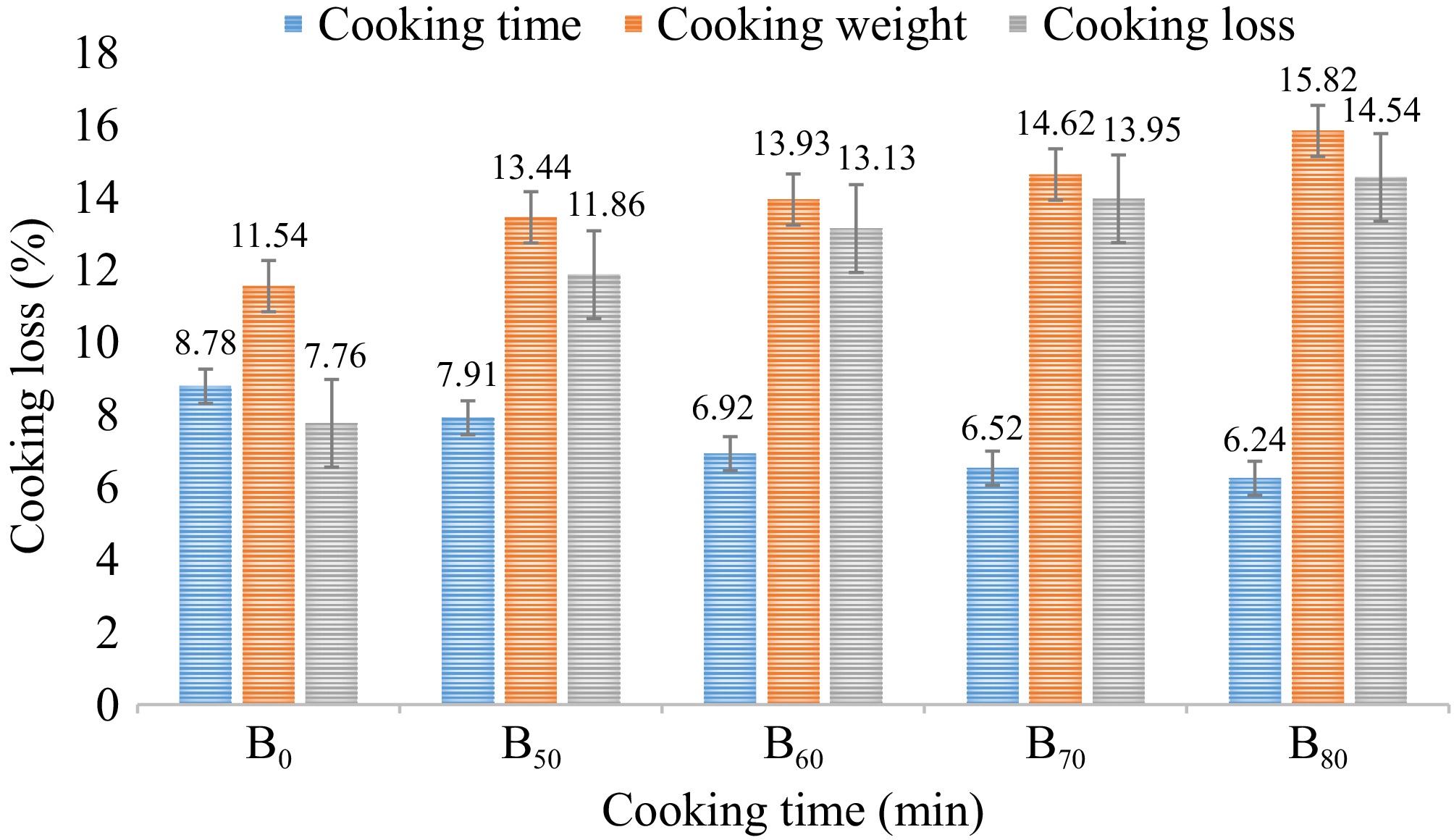
Figure 2.
Relationship between cooking time, cooking loss, and cooking weight of control sample B0 and different pasta formulations B50, B60, B70, and B80.
The study examined the impact of jackfruit seed addition on the cooking properties of pasta formulations. Results revealed a notable increase in cooking weight and loss with higher jackfruit seed percentages in the formulations. This suggests that formulations containing a greater proportion of jackfruit seed may exhibit increased water absorption during cooking, likely due to the higher fibre content present in jackfruit seed powder. Specifically, the cooking weight increased from 11.54 to 15.82 g, while the cooking loss increased from 7.76% to 14.54% as jackfruit seed content increased. These findings underscore the influence of component composition on pasta formulation, cooking behavior, and characteristics, offering valuable insights for product development and optimization. The increasing cooking loss in pasta was reported for higher amounts of pulse flour due to fiber presence, which weakens the starch network[37,43]. Similarly, gluten-free pasta formulations containing new bean flour also exhibit elevated cooking loss[44]. Additionally, enrichment with moringa has been associated with increased cooking loss[45].
The WHC and OHC of various pasta samples are shown in Table 3. As the proportion of jackfruit seed increased, both water-holding and oil-holding capacities showed a progressive increase from 1.59 to 2.78, and 1.15 to 1.36, respectively. These findings suggest that incorporating jackfruit seed and chickpea flour enhances the pasta's WHC and OHC properties. Jackfruit seed powder is known for its effective binding properties with both water and oil[32]. Moreover, the gluten network may weaken, allowing water to penetrate more easily and increase water absorption[46,47]. WHC was positively correlated with the cooking weight (r = 0.981) and negatively correlated with amylose content (r = −0.946).
Color values
-
Color values are crucial to identifying product aspects, such as showing what materials are utilized and how they are processed. As the level of jackfruit seed powder incorporation increased, there was a decrease in lightness (L*) (82.51−61.91), yellowness (b*) (5.70−25.23), and an increase in redness (a*) (1.06 to −2.94).
$ \Delta E $ Texture profile
-
Texture factors are crucial to consumer acceptance of products. The texture profile of different formulations was compared in Table 4. Pasta texture is mostly determined by its gluten network, which consists of carbohydrates, proteins, and other components[49]. Pasta exhibited a progressive decrease in hardness from B0 (2.76) to B80 (2.09), indicating a softer texture as the jackfruit seed content increases. Fracturability also shows a consistent decline from B0 to B80, indicating reduced brittleness. Springiness decreases significantly from B0 (2.94) to B50 (0.07), with a similar pattern observed in cohesiveness and gumminess. Similar findings were previously reported with chickpea-incorporated pasta[29]. Chewiness was also significantly altered in the control and in other pasta proportions. Similar findings have been reported in studies examining gluten-free pasta[49]. This trend suggests that incorporating jackfruit seed powder results in a softer, more tender, less elastic, less cohesive, less gummy, less chewy, and slightly less resilient texture. The absence of gluten contributes to the softening effect, which typically contributes to the firmness and structural integrity of traditional pasta[50]. The lack of gluten, which typically contributes to conventional pasta's elastic and cohesive properties, could be responsible for these changes[51]. Similar findings were obtained with chickpea-incorporated pasta[20].
Table 4. Texture profile of formulated pasta.
Formulation Hardness (N) Fracturability (N) Adhesiveness (N.s) Springiness Cohesiveness Gumminess (N) Chewiness (N) Resilience B0 2.76 ± 0.68a 1.79 ± 0.03a −0.01 ± 0.01a 2.94 ± 0.45a 0.26 ± 0.00a 0.71 ± 0.17a 2.06 ± 0.26a 0.04 ± 0.01a B50 2.66 ± 0.78a 1.69 ± 0.03a −0.01 ± 0.01a 0.07 ± 0.01b 0.07 ± 0.01b 0.20 ± 0.09b 0.01 ± 0.01b 0.02 ± 0.00a B60 2.29 ± 0.86a 1.54 ± 0.01b −0.01± 0.01a 0.13 ± 0.01b 0.08 ± 0.01b 0.20 ± 0.09b 0.02 ± 0.01b 0.03 ± 0.00a B70 2.16 ± 0.87a 1.46 ± 0.03bc −0.02 ± 0.01a 0.18 ± 0.02b 0.08 ± 0.01b 0.19 ± 0.10b 0.03 ± 0.02b 0.03 ± 0.01a B80 2.09 ± 0.90a 1.41 ± 0.07c −0.02 ± 0.01a 0.20 ± 0.02b 0.09 ± 0.01b 0.19 ± 0.10b 0.04 ± 0.02b 0.03 ± 0.01a The sample size is three (n = 3). Results are presented as percentages and represented as mean values along with standard deviations. Different subscript letters within the same column indicate statistically significant differences (p < 0.05). Microstructure of pasta
-
The scanning electron microscope (SEM) analysis of the pasta samples revealed distinct structural differences between the gluten-containing pasta and the gluten-free formulations (Fig. 3). The SEM image of the control exhibited a continuous, smooth, and uniform matrix structure, characteristic of the gluten network formed during dough development. In contrast, the gluten-free pasta samples displayed more heterogeneous, porous, and fragmented structures, reflecting a transition from smooth to fragmented morphology. This transition can be mechanistically explained by the disruption of the starch–protein interface. In the control, gluten proteins form a continuous film that encapsulates starch granules. In gluten-free formulations, the globular proteins (albumins and globulins) lack the long-chain cross-linking capacity of glutenin, leading to phase separation. This results in a 'filler-matrix' system where the starch granules act as non-adherent fillers, creating the observed pores and structural discontinuities[52]. This physical fragmentation is a direct consequence of the molecular disordering in the protein's secondary structure, as evidenced by glutenin's inability to cross-link and form a cohesive film around the starch granules.
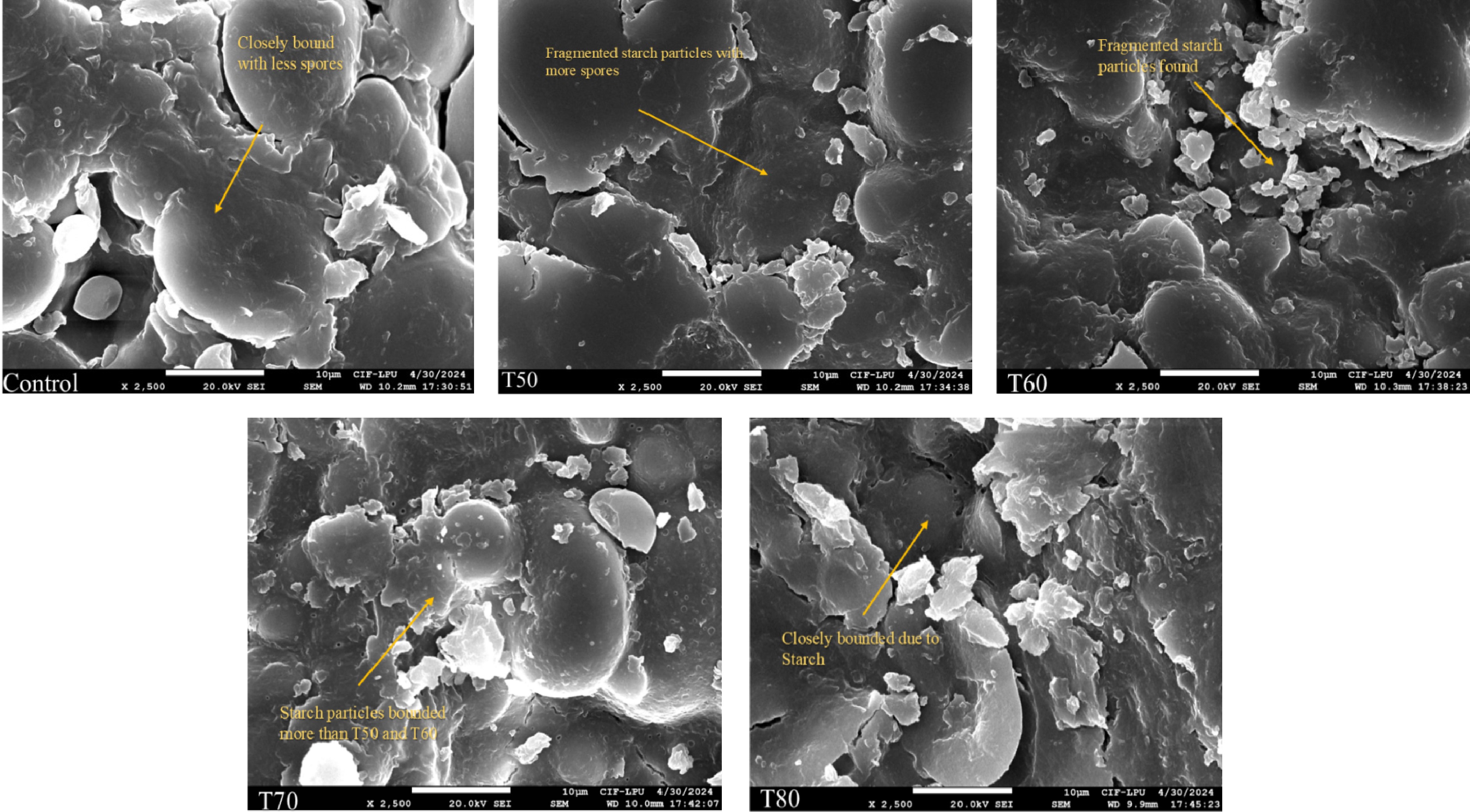
Figure 3.
Scanning electron microscope (SEM) images of control sample B0 and different pasta formulations B50, B60, B70, and B80.
Note that gluten-free jackfruit seed powder and chickpea flour contain other types of proteins such as globulins and albumins. However, these proteins do not form the same extensive network as gluten, leading to a less cohesive structure[15]. Notably, among the gluten-free samples, jackfruit seed powder appeared to promote a more compact, continuous matrix, potentially due to its unique ability to form a structural network or interact with other components. Jackfruit seed starch has a distinct structure characterised by a large number of short chains, which correlates with its pasting viscosity[7]. These studies underscore the importance of optimizing the ratio and interactions between alternative powders and flours in developing gluten-free pasta formulations with desirable structural and textural properties.
FTIR spectra
-
The FTIR spectra of the raw pasta formulations shown in Fig. 4 and Table 5 provide valuable insights into the functional groups present within the samples. Analysis of the FTIR spectra revealed distinct vibrational modes associated with various functional groups present in the pasta formulations. Specifically, the peak at 3,274.13−3,279.64 cm−1 observed in the control (gluten) corresponds to a strong O–H hydroxyl stretching vibration[53], while a similar peak is observed in B80 (gluten-free) with slightly lower intensity. This difference is likely attributed to the presence of gluten in the control pasta, which contributes to the observed molecular structure and vibrational modes. The signals detected in the C–H stretch region (2,925.76−2,923.98 cm−1) of the pasta formulations' spectra could provide insight into the presence of exposed starch. In the control containing gluten, variations in the intensity of these signals may indicate differences in starch exposure compared to gluten-free formulations[54]. The presence of a stretch in the region of (1,633.95−1,644.74 cm−1) indicates the presence of a cyclic alkene group[55]. Also, the variations in the 1633–1644 cm−1 region (Amide I) are particularly significant as they represent the secondary structure of the protein matrix. The shift in these peaks suggests a transition from organized α-helical structures in the gluten control to a higher proportion of β-sheets or random coils in the jackfruit/chickpea blends. The molecular disordering is responsible for creating the non-cohesive structure and fragmented nature of the protein, as evidenced by the SEM images. Variations in the peak intensity were observed in the range of 1,402.92−1,405.03 cm−1, and the related functional group is C–H, suggesting differences in lipid or carbohydrate composition[20]. Additionally, the peaks at 1,148.60−1,148.93 cm−1 vibrations show that the examined samples correspond to the alkyl-amine functional group[21]. In the pasta formulation, the presence of carbohydrates, primarily starch, is indicated by the peak between 950 and 1,100 cm−1. The higher intensity of the starch-related peaks in the gluten-free samples suggests greater exposure of starch. Mechanistically, as evidenced by the non-cohesive structure of the protein (as confirmed by the SEM images), there are more 'naked' starch granules on the surface, as opposed to the control, where the gluten sheath covers the starch granules. This is the primary reaction observed in the pasta samples, indicating that starch significantly affects the structure of the pasta molecules[25]. Control pasta containing gluten exhibits a more stable, consistent peak intensity than formulated pasta, where variations may arise from the absence of gluten and the use of different flour blends in gluten-free formulations. The increased compactness observed with higher jackfruit seed powder may be due to the high amylopectin branching of jackfruit starch, which enhances physical entanglement within the chickpea protein matrix, partially compensating for the absence of gluten through improved particle packing. These comparisons underscore the significant influence of gluten presence or absence and flour choice on the molecular composition and structural characteristics evident in the FTIR spectra of the pasta formulations.
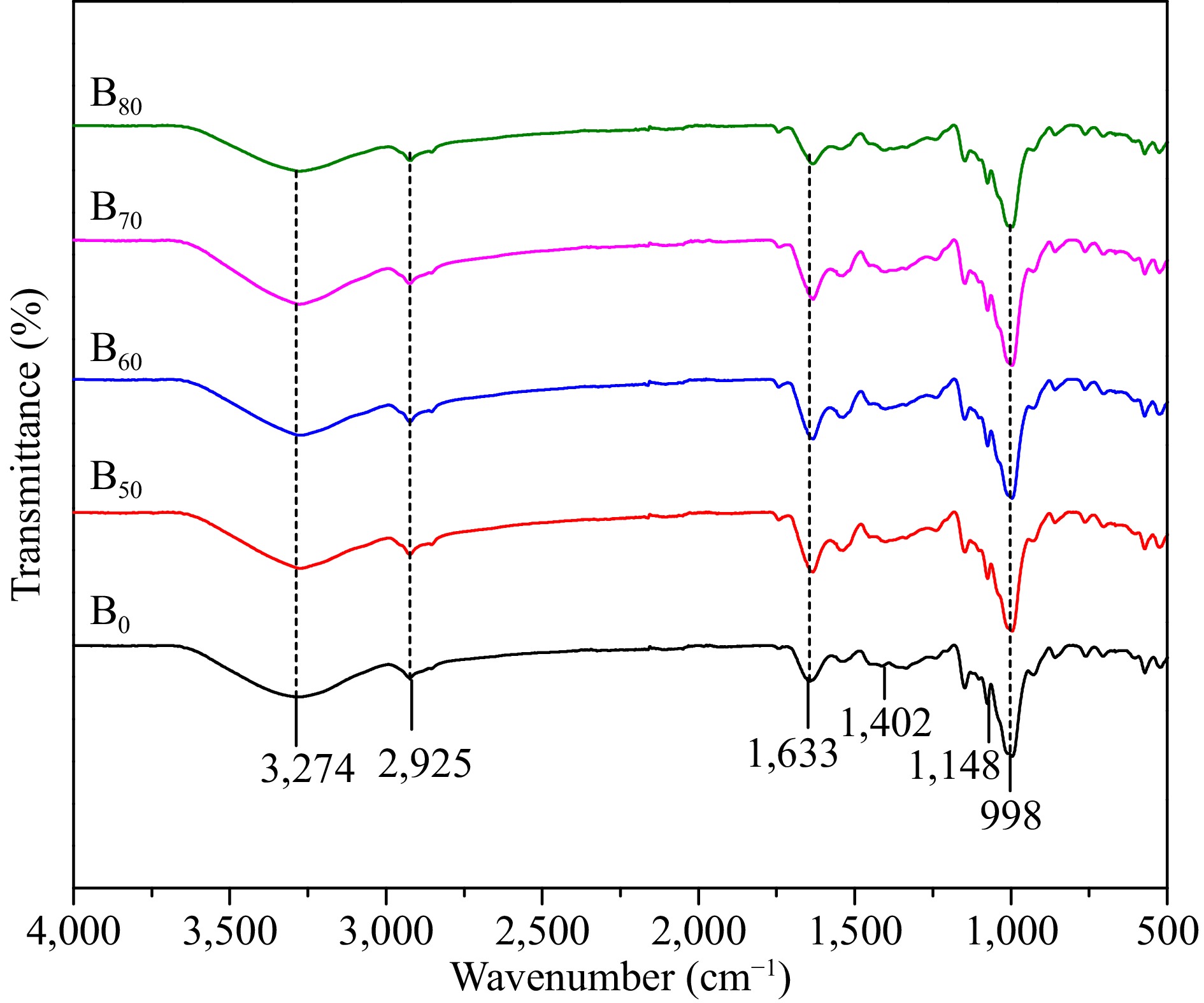
Figure 4.
FTIR spectra of control sample B0 and different pasta formulations B50, B60, B70, and B80.
Table 5. FTIR peaks and functional group of control sample (B0) and different pasta formulations B50, B60, B70, and B80.
Peak B0 B50 B60 B70 B80 Functional groups Compounds 1 3,279.35 3,275.41 3,276.42 3,279.64 3,274.13 O–H (stretching, strong) N–H (stretching, medium) Hydroxyl 2 2,925.76 2,925.39 2,924.32 2,925.70 2,923.98 C–H (stretching, medium) N–H (stretching, strong) O–H (stretching, weak) Alkane 3 1,644.74 1,634.00 1,634.34 1,633.95 1,634.90 C=O (stretching, strong) C=N (stretching, strong) Cyclic alkene 4 1,336.12 1,402.93 1,402.92 1,403.28 1,405.03 C–H (stretching, strong) Alkane 5 1,148.93 1,148.60 1,148.64 1,148.68 1,148.84 C–N (stretching, medium) C–O (stretching, strong) Alkyl amine Note: FTIR peak assignments were used to identify functional groups and corresponding compounds in pasta formulations, highlighting structural variations across treatments. Sensory acceptability scores
-
The sensory acceptability scores of pasta formulations were aligned with findings from Reddy et al.[26]. Overall, the formulations received favourable scores (Fig. 5). The control formulation (100% semolina) received the highest mean score of 7.95, followed by formulations B50 and B60, which showed similar but slightly lower scores. The high acceptability of the control formulation aligns with previous studies, which found that semolina-based pastas are generally preferred for their familiar taste and texture[18]. The B50 formulation, containing 50% jackfruit seed powder, demonstrated competitive acceptance. These results suggest that B50 could be a promising alternative to conventional semolina pasta, offering desirable sensory characteristics while utilising more sustainable and novel ingredients. This is consistent with studies exploring the incorporation of alternative flours, such as jackfruit seed, which have been shown to maintain or even enhance sensory attributes, such as texture and flavour.
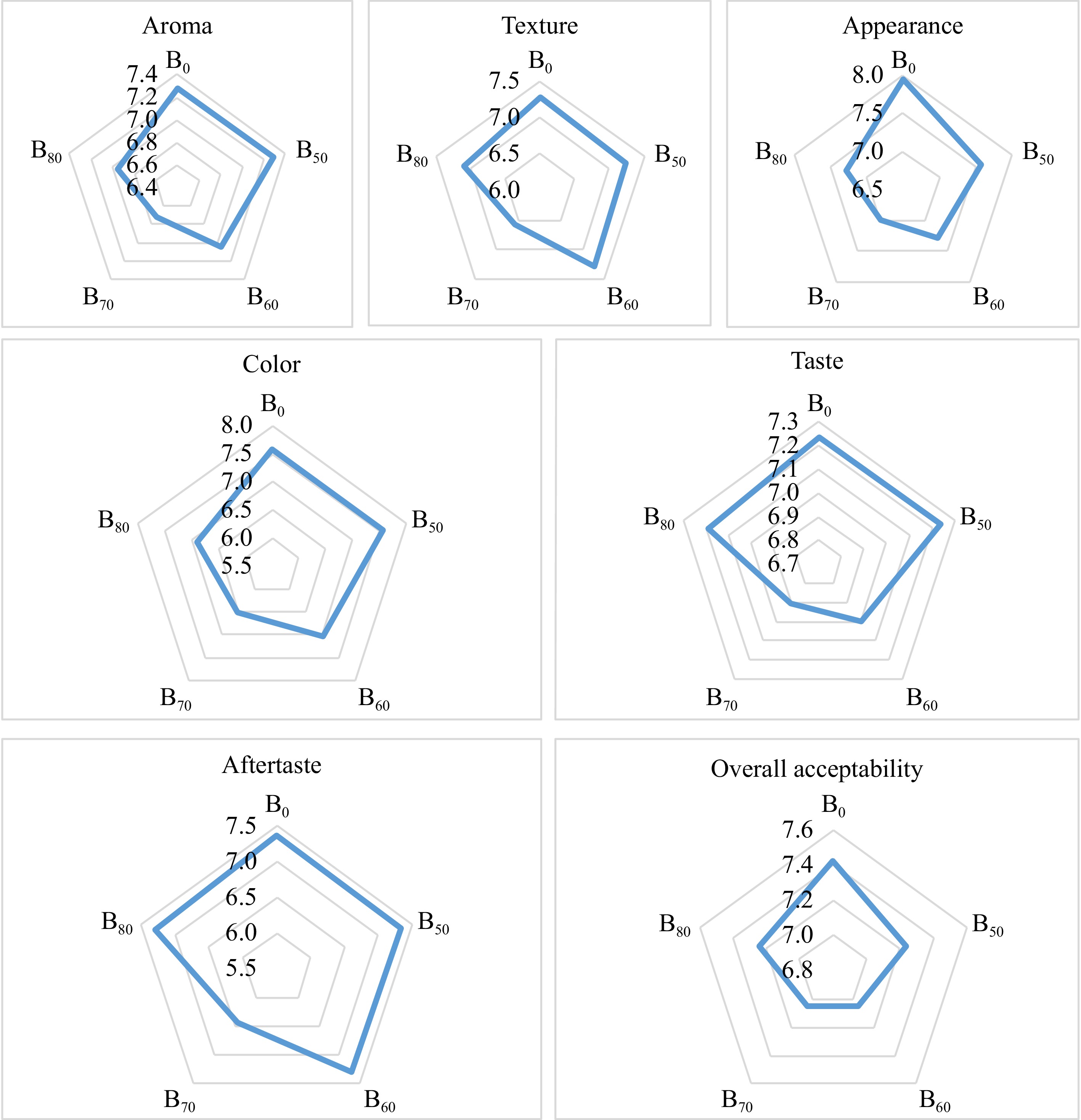
Figure 5.
Sensory characteristics of control sample B0 and different pasta formulations B50, B60, B70, and B80.
In this regard, the instrumental texture profile shown in Table 4 aligns with the sensory evaluations, which found that formulations B70 and B80 had lower sensory values due to their softer texture. This is quantified by the significant reduction in the hardness values of B70 (2.16 N) and B80 (2.09 N) relative to B0 (2.76 N). These structural changes, manifested as reduced cohesiveness and chewiness, indicate weakening of the gluten-free matrix. This could be attributed to the differences in starch composition and gluten content, which affect the pasta's firmness and mouthfeel. The lower acceptability of these formulations is consistent with previous research, which indicates that high levels of non-wheat flours can lead to undesirable textural properties[19]. Overall, all pasta formulations received high acceptability scores, indicating that the panel members found them generally acceptable for consumption. These findings are consistent with the broader literature, which shows that when appropriately balanced, pasta formulations with alternative flours can be well-received by consumers.
-
This study demonstrates the feasibility of combining jackfruit seed powder with chickpea flour to develop nutritionally enhanced gluten-free pasta. Increasing jackfruit seed powder levels progressively increased protein, ash content, crude fiber, antioxidant activity, and total phenolic content while reducing fat content. SEM revealed a more compact and integrated microstructure as jackfruit seed content increased, while FTIR spectra confirmed the structural stability of the functional groups within the composite matrix. Although an increase in bioactive compounds was observed with a higher proportion of jackfruit seed and chickpea flour, the B50 sample exhibited the best sensory and textural properties. This validates that jackfruit seed waste can be upcycled into a nutrient-rich cereal product that meets consumer demands. Overall, this research highlights the value of jackfruit seed powder as a novel, cost-effective, functional ingredient that meets consumer demand for healthier alternatives while contributing to food sustainability. Valorization of jackfruit seeds into nutritious pasta products represents an efficient approach to minimizing food losses. The above findings present significant potential. Industrial-scale production of the product may be affected by its hardness and sensory profile at higher levels of substitution. Therefore, to make the product viable in the market, emphasis should be given in the future to optimize the parameters such as temperature and moisture content in the extruder, as well as the use of binding agents such as hydrocolloids. The drying properties should be examined in the future to avoid cracking in the product. Stability in terms of shelf life under different packaging conditions should be examined to scale up.
The authors extend their gratitude to the Indian Institute of Packaging under the Ministry of Commerce and Industry, Government of India, for their valuable support and resources that facilitated the completion of this research paper.
-
The sensory evaluation was conducted in accordance with the guidelines for sensory studies as outlined by the Department of Food Technology and Nutrition, School of Agriculture, Lovely Professional University. Informed consent was obtained from all participants, ensuring they were aware of the study’s purpose, procedures, confidentiality, and the voluntary nature of their participation. No human ethics committee or formal documentation process is available. No coercion to participate, full disclosure of study requirements and risks, written or verbal consent of participants, no release of participant data without their knowledge, and the ability to withdraw from the study at any time. All participants were aged 18 years or older.
-
The authors confirm their contributions to the paper as follows: conceptualisation, project administration, writing − review and editing, supervision: Dubey PK; investigation: Fabil M, Roy S; writing − original draft: Dubey PK, Fabil M; resources, validation, visualisation: Dubey PK, Roy S. All authors reviewed the results and approved the final version of the manuscript.
-
The datasets generated during and/or analysed during the current study are available from the corresponding author upon reasonable request.
-
The authors declare that they have no conflict of interest.
- Copyright: © 2026 by the author(s). Published by Maximum Academic Press on behalf of China Agricultural University, Zhejiang University and Shenyang Agricultural University. This article is an open access article distributed under Creative Commons Attribution License (CC BY 4.0), visit https://creativecommons.org/licenses/by/4.0/.
-
About this article
Cite this article
Dubey PK, Fabil M, Roy S. 2026. Development of gluten-free pasta by incorporating jackfruit seed powder in chickpea flour. Food Innovation and Advances 5(2): 341−350 doi: 10.48130/fia-0026-0028 

Development of gluten-free pasta by incorporating jackfruit seed powder in chickpea flour
- Received: 03 September 2025
- Revised: 03 April 2026
- Accepted: 03 April 2026
- Published online: 24 July 2026
Abstract: Given the growing demand for gluten-free food options, this study explores the development of gluten-free pasta formulations by incorporating jackfruit seed powder into chickpea flour. Different ratios of jackfruit seed to chickpea flour (50:50, 60:40, 70:30, and 80:20) were evaluated relative to a 100% semolina control. The results showed that the gluten-free pasta had a significant increase (p ≤ 0.05) in protein content (11.10%–14.20%), ash content (1.36%–2.08%), crude fiber content (1.35%–2.01%), carbohydrate content (70.38%–74.54%), 2,2-diphenyl-1-picrylhydrazy (DPPH) radical scavenging activity (31.93%–44.03%), and total phenolic compounds (TPC) (74.43–95.01 milligrams of gallic acid equivalent per gram GAE/g) compared to the control. However, there was a significant decrease in fat content (1.99%–0.96%) and amylose content (24.17%–21.54%) compared with the control group. Moreover, the cooking time decreased significantly from 8.78 to 6.24 min. Incorporating jackfruit seed reduced the product's L* and b*, while increasing its a* values. The microstructure images showed that the control pasta is more closely bound, with fewer spores, whereas the formulated pasta shows fragmented starch particles with more spores. However, Fourier-transform infrared analysis (FTIR) revealed that control pasta containing gluten exhibited more stable, consistent peak intensities than formulated pasta. Sensory evaluation showed the B50 formulation received competitive acceptance scores. Incorporating jackfruit seed powder enhanced the nutritional properties while altering the structure, texture, and cooking behaviour of gluten-free pasta. The results suggest the potential of scaling up the value-added, nutritionally enhanced, gluten-free pasta.
-
Key words:
- Jackfruit seed /
- Chickpea /
- Semolina /
- Cooking quality /
- FTIR /
- SEM