












-
The accelerating pace of global warming poses a growing threat to crop productivity and food security. By 2050, with the global population projected to reach 10 billion, it is estimated that nearly 10% of the population may remain affected by food shortages[1]. Heat-tolerant plants exhibit remarkable high-temperature resilience, and investigating their responses to heat stress, along with deciphering the underlying heat resistance mechanisms, will enhance our understanding of plants' heat tolerance[2]. Pearl millet [Pennisetum glaucum (L.) R. Br.], a typical C4 plant species known for its remarkable heat tolerance, thrives under temperatures up to 48 °C and serves as a crucial crop for millions of farmers worldwide[3,4]. Understanding the specific response mechanisms of various organs, especially those of leaves, is a key to revealing the mechanisms of heat tolerance in pearl millet. However, gene expression in the leaf is highly heterogeneous across cell types. This cellular diversity poses a challenge to understanding and utilizing the mechanisms behind its heat tolerance. A recent study reported the single-cell atlas of pearl millet leaves, and analyzed the transcriptional heterogeneity among different types of leaf cells under heat stress[5] (Fig. 1).
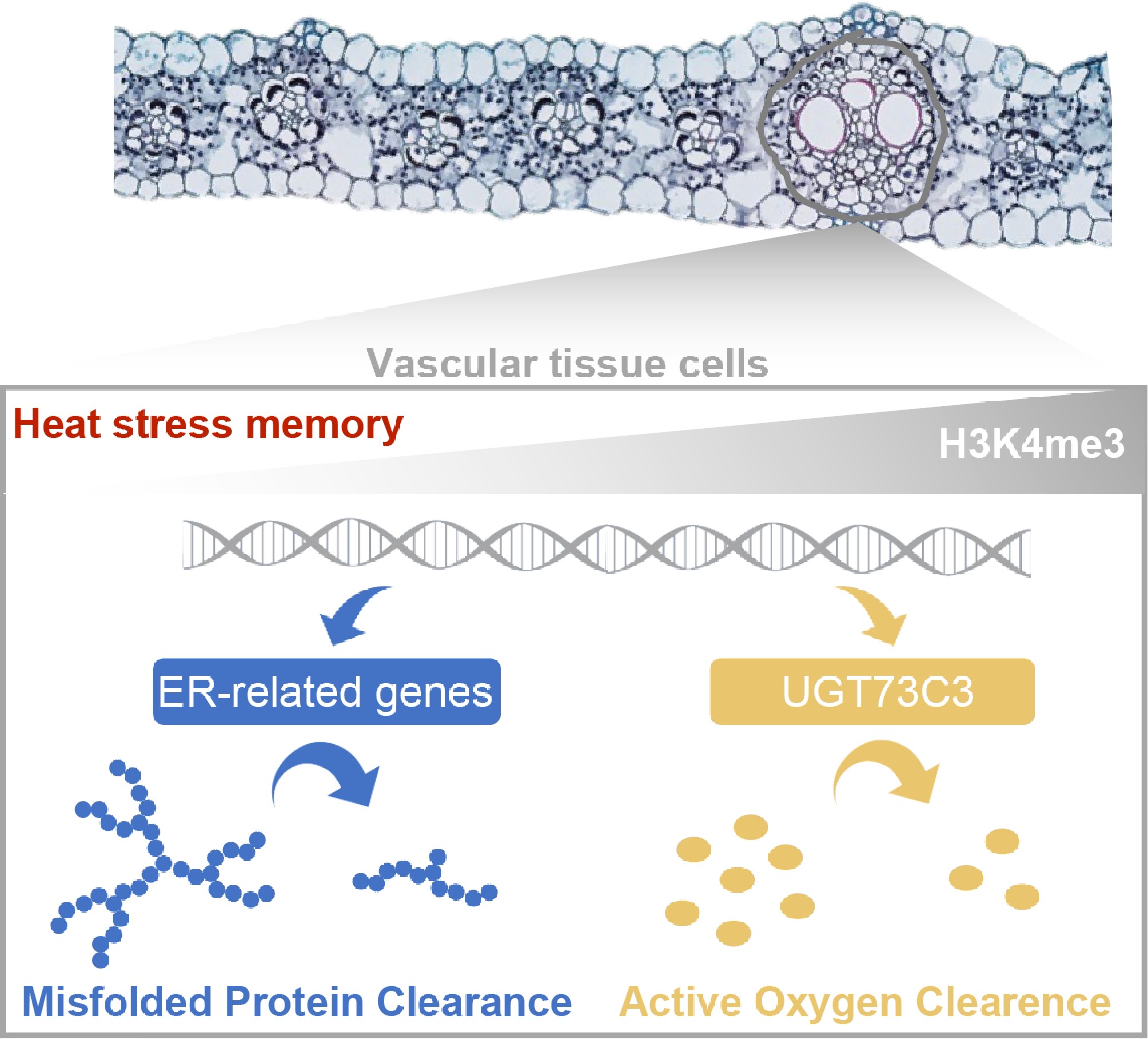
Figure 1.
Construction of the single-cell transcriptomic atlas of pearl millet leaves under heat stress and functional analysis of key heat-tolerance genes.
By isolating leaf protoplasts of pearl millet at three leaf stages and performing single-cell RNA sequencing (scRNA-seq), the authors successfully obtained 12,415 high-quality cells and identified eight cell clusters through dimensionality reduction and clustering methods. These clusters were annotated as five cell types, namely mesophyll cells, proliferating cells, epidermal cells, bundle sheath cells, and vascular tissue cells, according to previously reported cell type marker genes and RNA in situ hybridization validation (Fig. 1a). After heat stress, the number of cell-type-specific expressed genes increased to varying extents in all cell types, indicating that cell-type-specific genes involved in heat response were activated. Among these genes, 434 genes were found to exhibit altered expression in specific cell types, suggesting that heat stress not only triggers general responses but also activates cell-type-specific adaptation mechanisms. Notably, vascular tissue cells exhibited the highest number of differentially expressed genes, indicating the crucial role of this cell type in heat adaptation. Furthermore, genes associated with enhanced heat tolerance, such as SERK1, CYP72A15, and ALFIN-LIKE 7/8, showed significantly increased expression in vascular tissue cells. Further subclustering analysis of vascular tissue cells revealed that the proportion of xylem and phloem cells increased under heat stress, indicating that heat stress may promote the differentiation of vascular tissue cells. Pseudotime analysis and RNA in situ hybridization results further revealed that heat stress memory-related genes, HSP18.8 and HSP70, were primarily expressed in vascular tissue cells, suggesting that these genes may play a key role in regulating the differentiation of vascular tissue cells.
To analyze the role of heat stress memory in vascular tissue's response to heat stress, the authors identified heat stress memory genes in pearl millet at the whole-genome level. The expression levels of heat stress memory genes were highest in vascular tissue cells, further indicating that these genes play a critical role in the heat stress response of vascular tissues. Cleavage under targets and tagmentation (CUT&Tag) analysis of the distribution of H3K4me3 around the transcription start sites (TSS) of heat stress memory genes revealed that the formation of heat stress memory in Pennisetum glaucum was closely associated with H3K4me3. Through single-cell weighted correlation network analysis (WGCNA) analysis, the authors found that Type I heat stress memory genes, such as UGT73C3, HSP70, and NAC48, were significantly positively correlated with the heat response in vascular tissue cells. The authors performed phenotype identification and physiological measurements of heat tolerance in rice (Oryza sativa L.) heterologously overexpressing UGT73C3, revealing that its overexpression enhances plants' heat tolerance. Through RNA in situ hybridization and leaf cell structure analyses of rice overexpression lines (UGT73C3_OE) and mutant lines (UGT73C3_Mut), UGT73C3 was found to potentially enhance plants' heat tolerance by regulating reactive oxygen species (ROS) levels, and may also be involved in the differentiation of vascular tissue cells.
This study, for the first time, reveals the spatiotemporal dynamics of heat stress responses at the single-cell level in pearl millet leaves and clarified the core role of vascular tissues and the epigenetic regulation mechanism of memory genes in heat adaptation. These findings can provide targets for molecular design breeding of heat-tolerant crops (such as through editing UGT73C3), contributing to addressing the issue of global warming. On the technology side, the single-cell transcriptome technology in this work identified 60% more stress response genes than traditional transcriptome technology, highlighting its resolution advantage.
HTML
-
The authors confirm their contributions to the paper as follows: writing the manuscript: Zhang J, Jones CS. Both authors reviewed the results and approved the final version of the manuscript.
-
Data sharing is not applicable to this article as no datasets were generated or analyzed during the current study.
-
The authors thank Dr. Linkai Huang from Sichuan Agricultural University for his assistance in writing this manuscript.
-
The authors declare that they have no conflict of interest.
- Copyright: © 2025 by the author(s). Published by Maximum Academic Press, Fayetteville, GA. This article is an open access article distributed under Creative Commons Attribution License (CC BY 4.0), visit https://creativecommons.org/licenses/by/4.0/.
Zhang J, Jones CS. 2025. Single-cell landscape of leaves reveals the roles of vascular tissue cells in the heat tolerance of pearl millet. Grass Research 5: e023 doi: 10.48130/grares-0025-0020


|