











-
The Wireless Power Transfer (WPT) system is an emerging energy transmission technology that has garnered significant attention in recent years. This technology utilizes electromagnetic fields or electromagnetic induction to transfer energy, offering convenience and high efficiency. It holds great potential for applications in electric vehicle charging, medical device power supply, consumer electronics, and other fields. However, in practical applications, the presence of metal foreign bodies can degrade system performance and pose safety risks, such as localized overheating and short circuits.
Lei et al.[1] describe a strategy for identifying metal impurities based on the principles of electromagnetic induction. The core of this approach is leveraging the law of electromagnetic induction to detect metal impurities. However, in complex scenarios, the accuracy of this method is limited, and there is a high likelihood of false alarms when detecting metal impurities of varying specifications and material characteristics. Wang & Wang[2] proposes detecting metal impurities by monitoring the temperature rise at the wireless energy-receiving terminal, effectively addressing the issue of local overheating. Nonetheless, this approach lacks instantaneous response and broad applicability. Marano et al.[3] introduces frequency detection technology, which exploits differences in the electromagnetic response of metal materials to specific frequency bands, thereby improving impurity identification accuracy. However, when multiple metal impurities coexist, the detection efficiency within the frequency domain diminishes. Weichuang & Baiqiang[4] advocates the use of convolutional neural network (CNN)-based recognition schemes, integrating image analysis technology to classify and identify metal impurities, thereby achieving higher recognition accuracy in specific scenarios. Nevertheless, this method requires extensive labeled data for training and exhibits weak adaptability in complex environments. Li & Zhang[5] establishes an unsupervised learning framework based on autoencoders, which learns the electromagnetic field distribution patterns in standard transmission environments to identify anomalies. Although this method enhances the model's anti-interference capability, the extraction of features in complex scenarios remains challenging.
Generative adversarial networks (GANs), a recently emerging generative model, have demonstrated significant potential in data generation and feature learning. Ma et al.[6] was the first to apply adversarial learning networks to anomaly detection, using generators to simulate the distribution patterns of normal data and discriminators to distinguish between simulated and real data, thus achieving anomaly detection. This method does not require a large amount of labeled data and exhibits strong feature learning capabilities, delivering excellent detection accuracy and generalization performance. Therefore, this approach is expected to provide an effective solution for detecting metal impurities in wireless power transfer systems.
-
Generative adversarial networks are a two-layer network structure, which includes a generator and a discriminator. This method deceives the discriminator by constructing more realistic samples while allowing the discriminator to continuously enhance its discrimination ability[7]. The learning objective of this method can be summarized as an optimization problem of two networks. Its mathematical expression is the adversarial loss function between the generator G and the discriminator D:
$ \underset{G}{\mathrm{m}\mathrm{i}\mathrm{n}} \underset{D}{\mathrm{m}\mathrm{a}\mathrm{x}} V\left(D,G\right)={\mathbb{E}}_{x\sim {p}_{\text{data}}\left(x\right)}\left[\mathrm{log}D\left(x\right)\right]+{\mathbb{E}}_{z\sim {p}_{z}\left(z\right)}\left[\mathrm{log}\left(1-D\left(G\left(z\right)\right)\right)\right] $ (1) The role of GANs in metal foreign body detection
-
Assume that the average transmission signal of the system is Snormal and the abnormal signal caused by a metal foreign body is Sabnormal . The generator G generates a forged signal
$ \hat{S}=G\left(z\right) $ $ D\left(S\right)=P\left(S={S}_{\text{normal}}\right) $ (2) The discrimination method can well identify standard signals from abnormal signals. If the output value is small, an abnormal signal has appeared, and metal impurities should be excluded[8]. In addition, the application of generative adversarial networks based on unsupervised learning in identifying metal foreign bodies is of great significance. Compared with traditional guided learning methods, GANs do not require many labels during the training process. In particular, GANs can effectively identify them without many abnormal samples and labeled data. For GANs, the unsupervised training objectives can be as follows:
$ \underset{G}{\mathrm{m}\mathrm{i}\mathrm{n}} \underset{D}{\mathrm{m}\mathrm{a}\mathrm{x}} {\mathbb{E}}_{{S}_{\text{normal}}\sim {p}_{\text{data}}}\left[\mathrm{l}\mathrm{o}\mathrm{g}D\left({S}_{\text{normal}}\right)\right]+{\mathbb{E}}_{z\sim {p}_{z}}\left[\mathrm{log}\left(1-D\left(G\left(z\right)\right)\right)\right] $ (3) By continuously optimizing G and D, the model can generate a pseudo signal close to a standard signal and use the discriminator to identify abnormal signals that are different from standard signals.
Combination of data enhancement and GANs
-
Assuming the real metal foreign body signal is Smetal, through the generator G, people can generate a variety of pseudo-metal foreign body samples
$ {\hat{S}}_{\text{metal}}=G\left({z}_{\text{metal}}\right) $ $ {S}_{\text{augmented}}=\left\{{S}_{\text{metal}},{\hat{S}}_{\text{metal}}\right\} $ (4) In complex engineering environments, objects vary in type, shape, material, etc. The data enhancement method based on GANs can effectively improve the model's generalization performance[9]. This method can fuse the fake signal generated by GANs with the actual signal in many cases, so it can have a high recognition rate. The specific content is as follows:
$ {S}_{\text{augmented}}=\left\{{S}_{\text{metal}},G\left({z}_{\text{metal}},\theta \right)\right\} $ (5) θ is the environmental condition parameter, and the forged signal generated by the generator is analyzed. The constructor is combined with the discriminator to identify metal impurities in multiple scenarios[10]. In addition, GANs can also simulate abnormal signals caused by noise, improving the anti-interference performance of the system. For example, the generator G generates different types of noise signals G(znoise) by inputting noise signals znoise, and then combines them with standard signals to form an extended data set:
$ {S}_{\text{noise}}=G\left({z}_{\text{noise}}\right)\;\text{such that}\;{S}_{\text{augmented}}=\left\{{S}_{\text{normal}},{S}_{\text{noise}}\right\} $ (6) This method can not only improve the robustness of the model to various noise interferences, but also improve its stability and detection accuracy in complex environments. WGAN has the following objective functions:
$ {L}_{WGAN}={\mathbb{E}}_{x\sim {p}_{\text{data}}}\left[D\right(x\left)\right]-{\mathbb{E}}_{z\sim {p}_{z}\left(z\right)}\left[D\right(G\left(z\right)\left)\right] $ (7) In addition, for metal impurities, the detection results of GANs also depend on the type and quality of the collected data. Although GANs can expand the sample, the generated pseudo data still needs to meet the actual data distribution[11]. However, achieving high-quality pseudo sample generation in practical applications is still a problem to be solved.
-
Through a series of experiments, this project intends to verify the application effect of generative adversarial networks (GANs) in wireless power supply systems. The hardware used in this study is a high-performance GPU server with an NVIDIA TeslaV100 graphics card, 64 G memory, and Xeon E5. This study uses Python to write and run experimental programs[12]. This project will expand the model built based on the existing wireless power supply experimental data through a self-built wireless power supply simulation platform. This project intends to use metal impurities of various materials (such as iron, aluminum, copper, etc.), shapes (round, square, irregular), and positions (different distances from the energy transfer channel). These impurities will interfere with electromagnetic signals to a certain extent, thereby affecting the regular operation of the power transmission system. The GANs model is used to detect signal anomalies caused by different types of metal impurities. The various types of metallic foreign bodies used in the experiment and their respective effects are listed in Table 1.
Table 1. Different types of metallic foreign bodies used in the experiment and their corresponding effects.
Metal foreign body type Material Shape Distance from transmitter (cm) Interference level Foreign body 1 Iron Round 5 High Foreign body 2 Aluminum Square 10 Medium Foreign body 3 Copper Irregular 15 Low The GANs model was preprocessed. The effects of different materials, shapes, and positions on signal interference were studied and compared with other conventional methods.
Results and performance evaluation
-
In terms of performance evaluation, the paper evaluated the detection capabilities of GANs in terms of detection accuracy, recall rate, and F1 score. Table 2 shows the performance comparison between the proposed method and other conventional detection methods.
Table 2. The proposed algorithm with other traditional detection algorithms.
Algorithm Accuracy Recall rate F1 score GANs algorithm in this article 98.5% 96.8% 97.6% Electromagnetic detection algorithm 91.2% 88.5% 89.8% Image detection algorithm 87.6% 85.3% 86.4% Compared with the conventional electromagnetic and image methods, the GANs algorithm has greatly improved the recognition accuracy and F1 value of metal foreign bodies and has good robustness (Table 2)[13]. Table 3 compares the false alarm rate and missed alarm rate of various algorithms in the same test scenario.
Table 3. Comparison results of false and missed alarm rates of different algorithms in the same test scenario.
Algorithm False alarm rate Missing report rate GANs algorithm in this article 1.5% 2.3% Electromagnetic detection algorithm 5.8% 6.4% Image detection algorithm 7.3 8.1 As shown in Table 3, the GANs algorithm is better than other methods in terms of false and missed alarm rates and has good robustness, especially in complex situations. Figures 1, 2, and 3 show the changes in detection accuracy, false alarm rate, and missed alarm rate of different detection methods[14]. The results show that when the complexity of the test environment increases, the GANs algorithm can still maintain good detection results, while the detection effect of conventional methods is constantly decreasing.
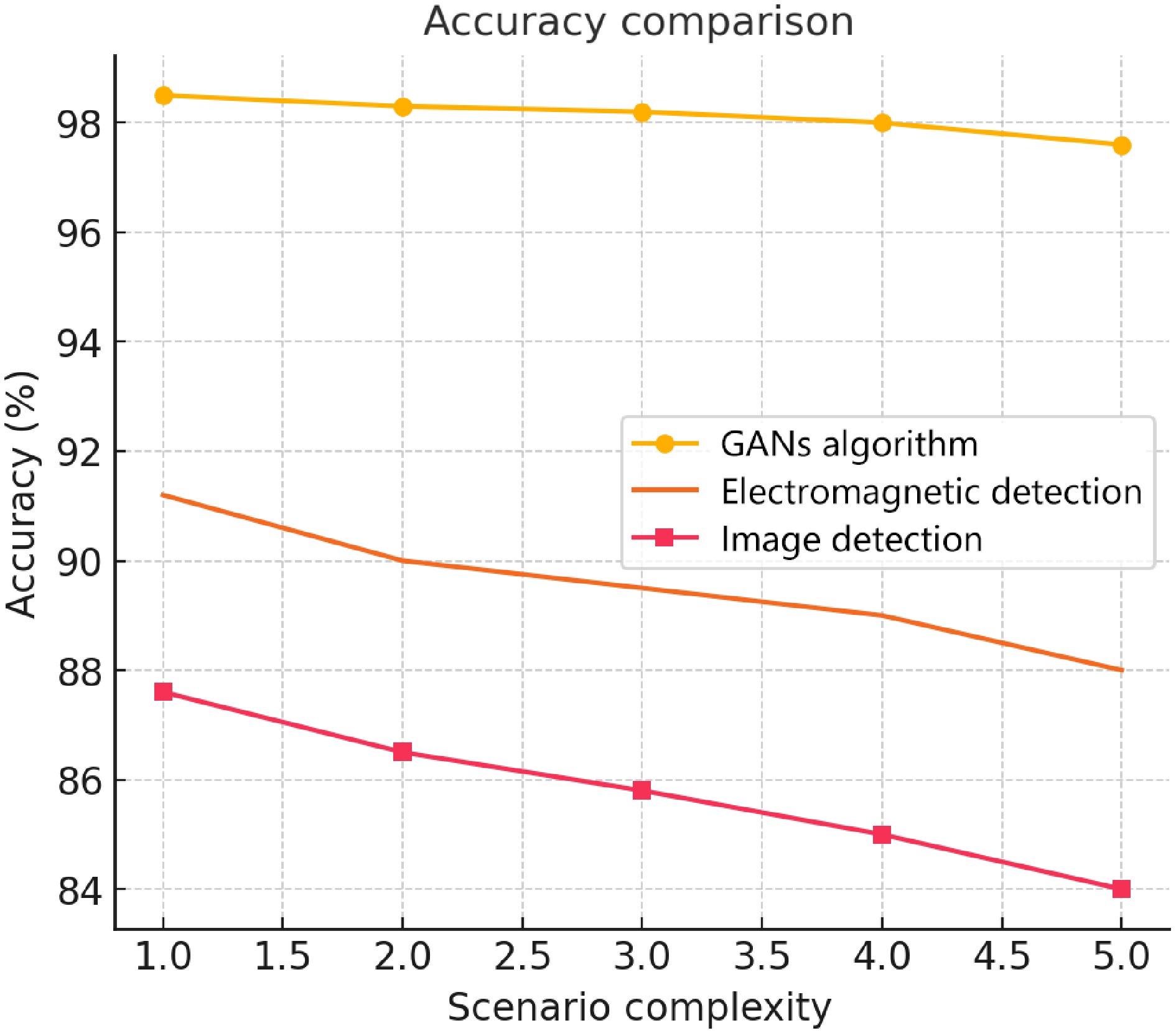
Figure 1.
Comparison of detection accuracy of different algorithms.
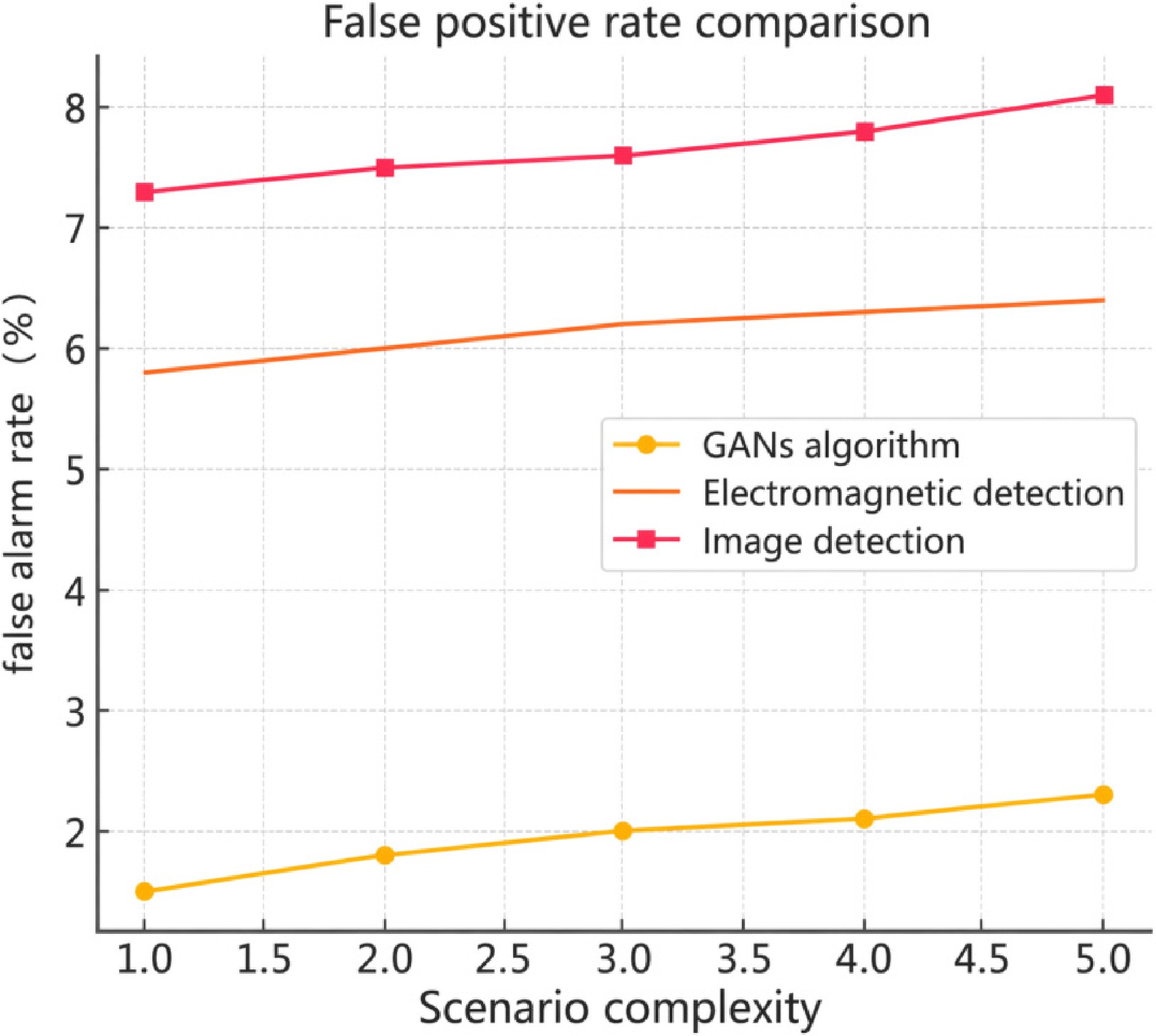
Figure 2.
Comparison of false alarm rate of different algorithms.
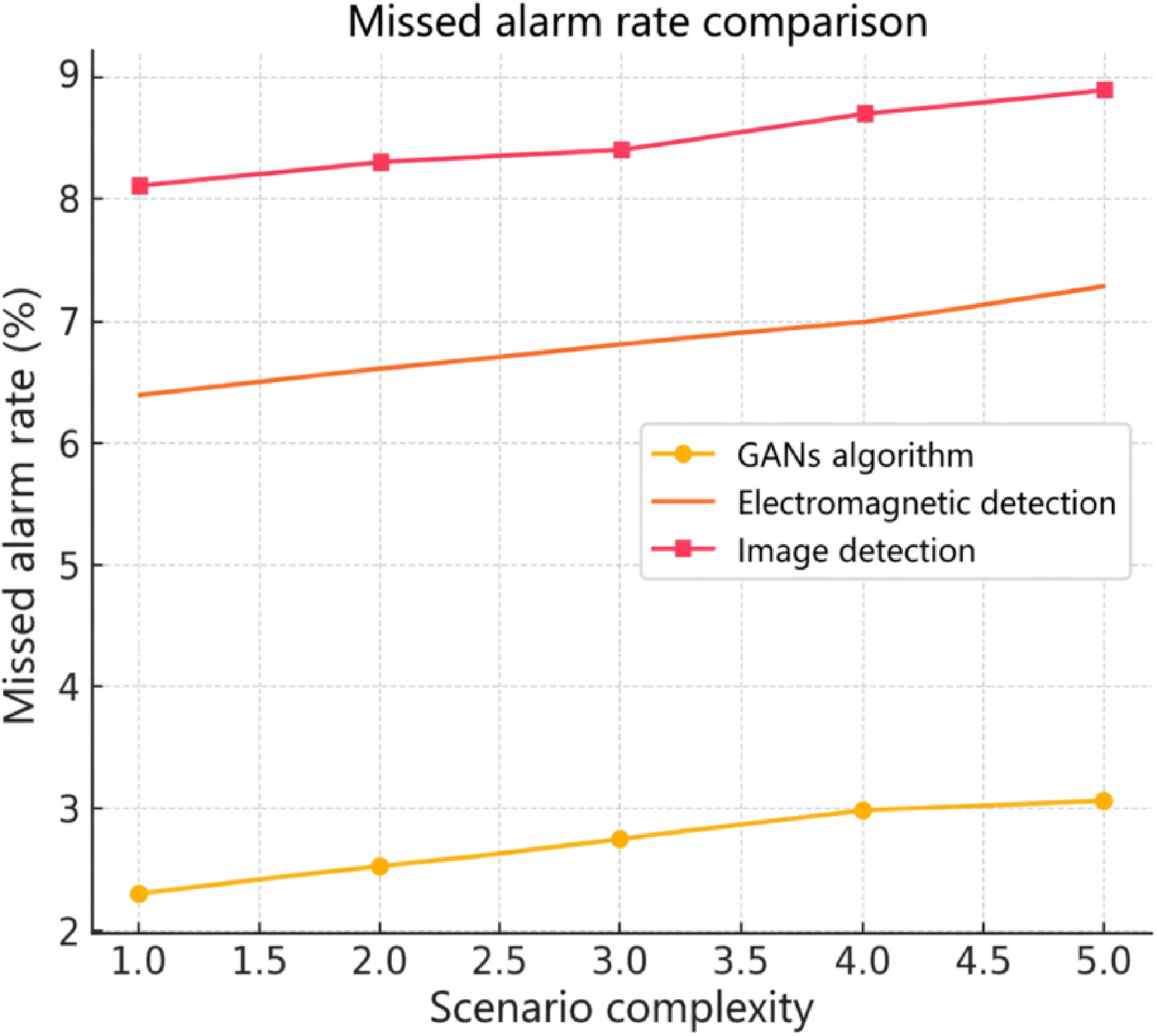
Figure 3.
Comparison of missed alarm rate of different algorithms.
In general, GANs have good application prospects in detecting metal impurities. The GAN algorithm proposed in this paper has apparent improvements over the traditional GAN algorithm[15].
Ablation experiment and model improvement
-
To further explore the contribution of each component of the GANs model in metal foreign body detection, this project intends to study the impact of each component of the GANs model on the detection effect by changing the structure between the generator and the discriminator[16]. First, the paper examined the impact of various algorithm structures on performance, focusing on improving the algorithm's efficiency by increasing the number of algorithms and adjusting the size of the convolution kernel. Table 4 shows the performance of the generator in different configurations.
Table 4. Performance of the generator under different configurations.
Generator architecture Accuracy Recall rate F1 score Original architecture 98.5% 96.8% 97.6% Increase the number of layers 98.9% 97.2% 98% Adjust the convolution kernel size 98.2% 96.5% 97.3% The detection performance of the model improves, while the change in the number of convolution kernels does not significantly impact the performance (Table 4)[17]. This project will further study the performance of the discriminator framework in this model, especially the depth of the discriminator. Table 5 shows the detection performance for different discriminator depths.
Table 5. Detection performance at different discriminator depths.
Discriminator depth Accuracy Recall rate F1 score Original depth 98.5% 96.8% 97.6% Increase depth 99% 97.5% 98.2% Decrease depth 97.8% 95.4% 96.6% Appropriately increasing the depth of the discriminative operator can effectively improve the classification accuracy and F1 score (Table 5); finally, the model was further studied. By improving the joint framework of the generating function and the discriminative operator, the detection efficiency and accuracy of the GANs model can be further optimized[18]. This project plans to use a variety of variant models such as Wasserstein GAN (WGAN) and deep convolutional generative adversarial network (DCGAN). Studies have shown that WGAN has better robustness in high-noise environments. Figure 4 compares the detection capabilities of the improved WGAN and the original GAN under various conditions.
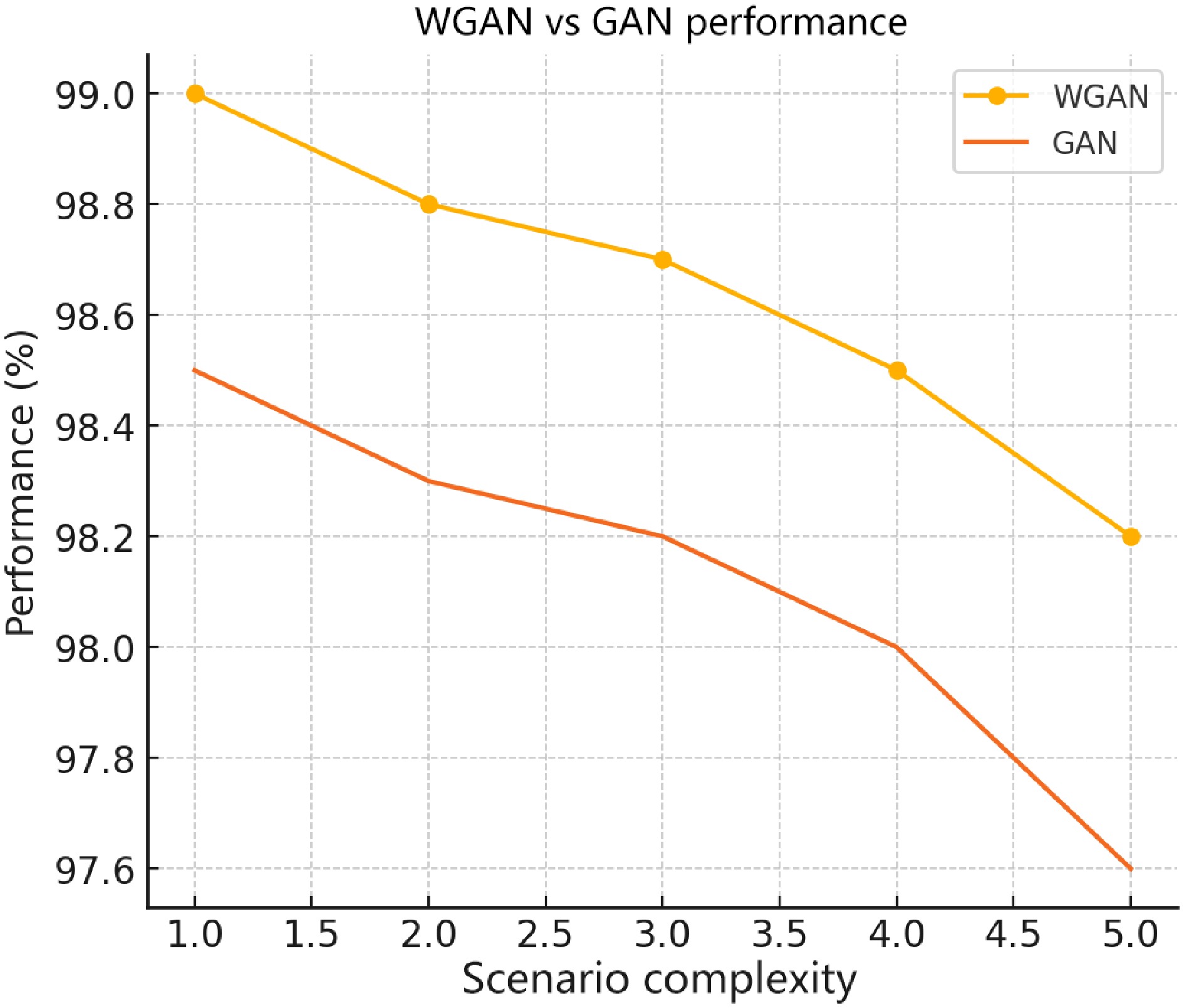
Figure 4.
Comparison of detection performance between WGAN and GAN.
-
In terms of detection accuracy, recall rate, F1 score, and other performance metrics, the GANs algorithm significantly outperforms traditional electromagnetic and image-based detection technologies. The recognition accuracy of the GANs model reaches 98.5%, which is substantially higher than that of electromagnetic detection (91.2%) and image detection (87.6%). Similarly, the F1 score demonstrates comparable advantages. Experimental results indicate that the GANs method is more effective in capturing the subtle interference caused by metal impurities, especially in complex backgrounds, while still maintaining high detection precision. Owing to the adversarial mechanism between the generator and discriminator in GANs, the algorithm is capable of learning complex patterns more effectively.
Ensuring robust model performance in complex environments is crucial. By analyzing the false alarm rate and missed alarm rate, it has been demonstrated that the GANs method exhibits strong robustness in wireless communication environments, even in the presence of high noise and severe interference. This robustness ensures that the abnormal signals generated by metal foreign bodies can be reliably identified, thereby significantly reducing both false alarm and missed alarm rates. As such, the GANs algorithm is particularly well-suited for real-world wireless power supply systems, enhancing system stability and safety.
This study also investigates the impact of the generator and discriminator substructures within the GANs model on detection performance. Experimental findings show that increasing the number of structural units improves detection accuracy from 98.5% to 98.9%. Furthermore, increasing the depth of the discriminator operator markedly improves discrimination accuracy, indicating that a deeper discriminator operator has a greater capacity to detect weak signals in complex environments. Conversely, reducing the discriminator depth results in diminished performance, suggesting that a shallow discriminator is insufficient for capturing the signal's complexity.
The GANs model developed in this project effectively addresses existing limitations in electromagnetic and image detection technologies, enabling the accurate detection of metal foreign bodies. This model has the potential to resolve current challenges and offers promising applications in wireless power transmission systems, smart grids, and related fields.
-
This study proposes a strategy based on Generative Adversarial Networks (GANs) for metal impurity detection. In wireless power transmission systems, the presence of metal impurities can degrade power conversion efficiency, damage devices, and pose safety risks. Consequently, the need for precise and rapid detection of metal impurities is critical. By utilizing GANs, a model is developed that can differentiate between normal conditions and scenarios containing metal impurities. The generator simulates an electromagnetic environment without impurities, while the discriminator analyzes synthetic data to detect anomalies in the electromagnetic environment. Experimental results demonstrate that this approach offers both high accuracy and robustness. For metal impurities of varying sizes and materials, the method proposed in this study delivers excellent identification performance, achieving an accuracy rate of up to 98.5% and a false positive rate of less than 1.5%. The results show that this novel method accelerates the identification process while maintaining high accuracy, highlighting its significant application value. The findings from this research provide a strong foundation for enhancing the safety and efficiency of wireless power transmission systems.
-
The author confirms sole responsibility for the following: study conception and design, data collection, analysis and interpretation of results, manuscript preparation, and approval for the final version of the manuscript.
-
The data that support the findings of this study are available from the author upon reasonable request.
-
The author received no financial support for the research, authorship, and/or publication of this article.
-
The authors declare that they have no conflict of interest.
- Copyright: © 2026 by the author(s). Published by Maximum Academic Press, Fayetteville, GA. This article is an open access article distributed under Creative Commons Attribution License (CC BY 4.0), visit https://creativecommons.org/licenses/by/4.0/.
-
About this article
Cite this article
Cai W. 2026. The deep learning algorithm for metal foreign body detection in wireless energy transmission system. Wireless Power Transfer 13: e009 doi: 10.48130/wpt-0024-0018 

The deep learning algorithm for metal foreign body detection in wireless energy transmission system
- Received: 16 October 2024
- Revised: 22 November 2024
- Accepted: 09 December 2024
- Published online: 23 April 2026
Abstract: This paper presents a metal foreign body detection method based on a Generative Adversarial Network (GAN). The proposed approach utilizes a generator to simulate the electromagnetic field distribution in an environment free of foreign bodies, while the discriminator is trained to differentiate between a typical environment and one containing foreign metal objects. Additionally, an electromagnetic signal detection method based on wavelet transform is introduced. By increasing the convolutional depth and adjusting the learning rate, the model's accuracy in detecting metal foreign bodies in complex environments is significantly enhanced. Simulation results demonstrate that this method achieves a high detection accuracy for metal foreign bodies composed of various materials, with an accuracy rate of 98.5% and a false alarm rate of less than 1.5%.