-
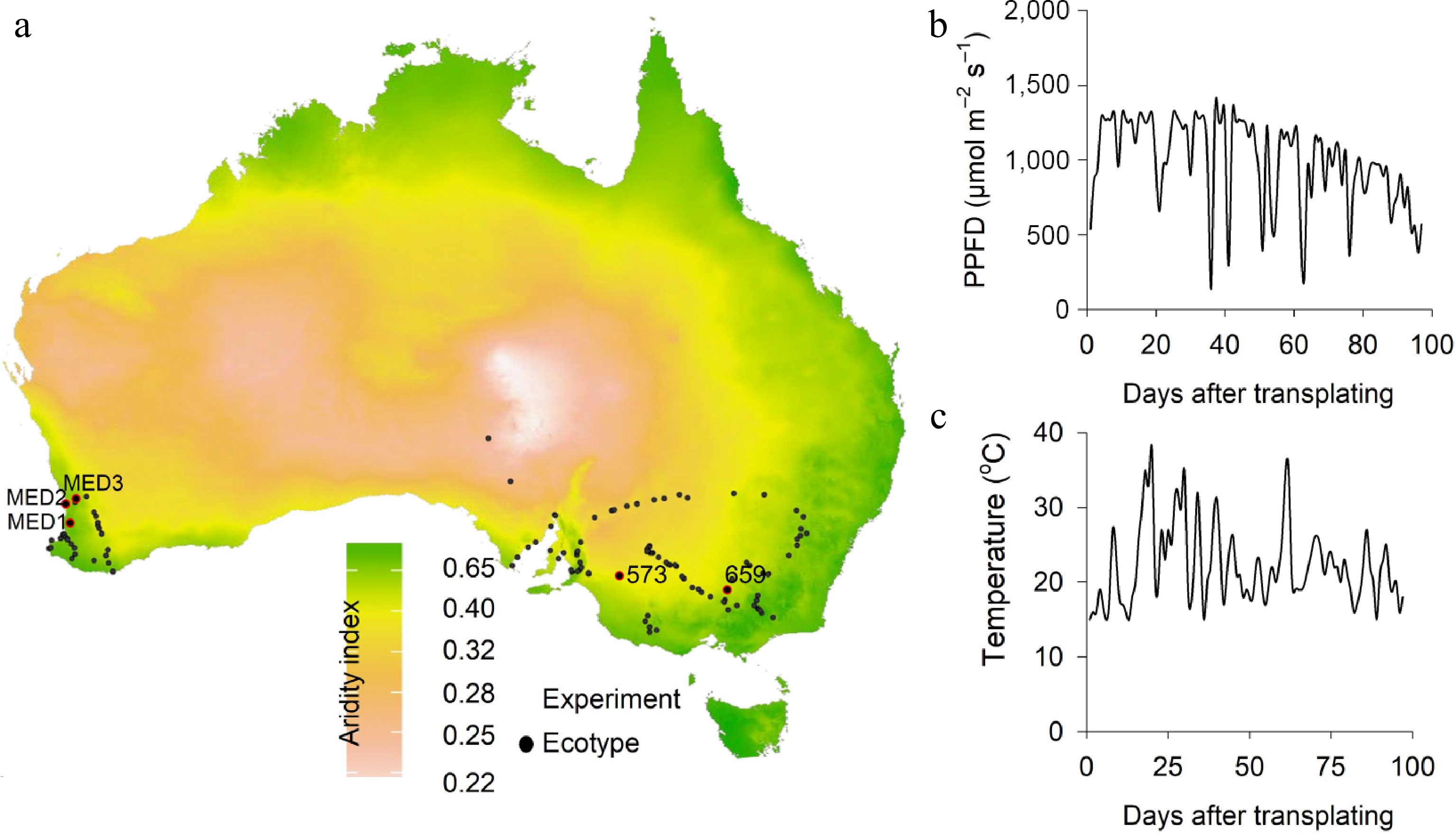
Figure 1.
(a) Geographical distribution of bermudagrass ecotypes. Environmental conditions during the experiment: (b) sunlight measured as photosynthetic photon flux density (PPFD), and (c) daily temperature. The aridity index map was adapted from Casadebaig et al.[14]. Climatic data were obtained from the Roseworthy SA station[15].
-
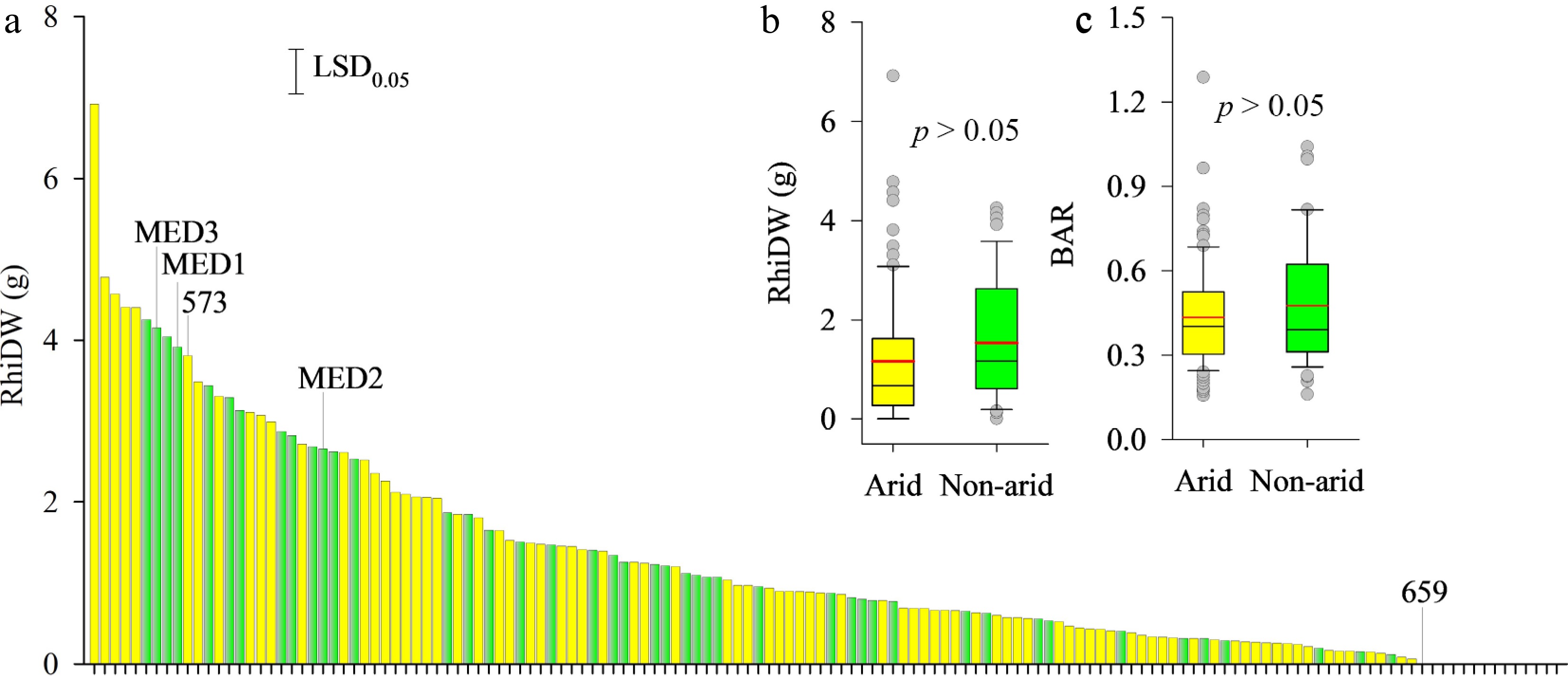
Figure 2.
(a) Variation in rhizome dry weight (RhiDW) of 142 bermudagrass ecotypes, and the comparison of bermudagrass ecotypes collected from arid (yellow) and non-arid (green) regions for (b) RhiDW, and (c) belowground-to-aboveground biomass ratio (BAR).
-
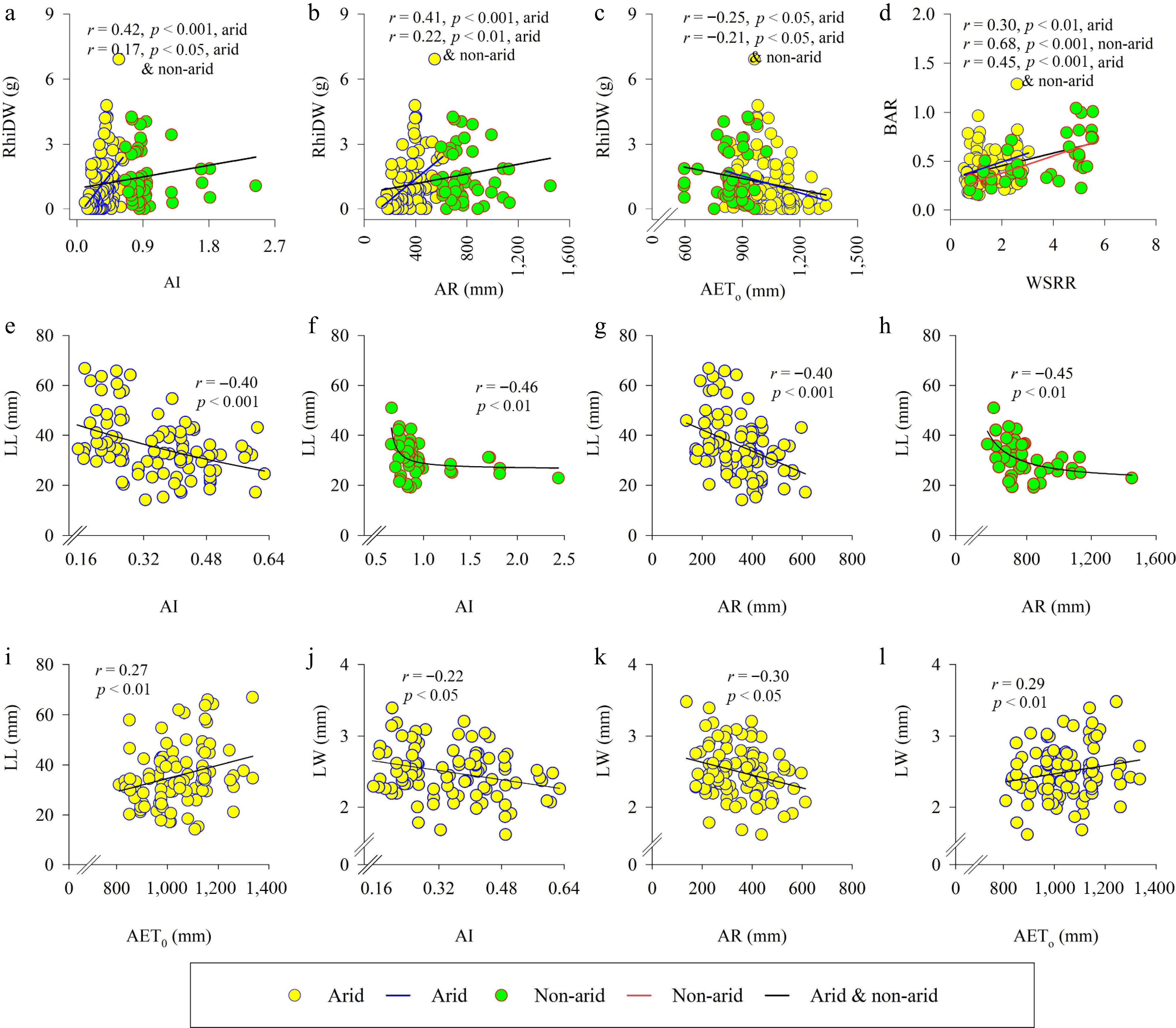
Figure 3.
Rhizome growth and leaf dimensions of bermudagrass ecotypes in arid and non-arid regions in response to the climatic conditions of their native habitats: relationships between (a) rhizome dry weight (RhiDW) and aridity index (AI), (b) annual rainfall (AR), (c) annual reference evapotranspiration (AETo), and (d) belowground-to-aboveground biomass ratio (BAR) and winter to summer rainfall ratio (WSRR); relationships between leaf length (LL) and (e), (f) AI, (g), (h) AR, and (i) AETo; relationships between leaf width (LW), and (j) AI, (k) AR, and (l) AETo. Leaf dimensions in (e)–(l) were measured in the first leaf at the first node.
-
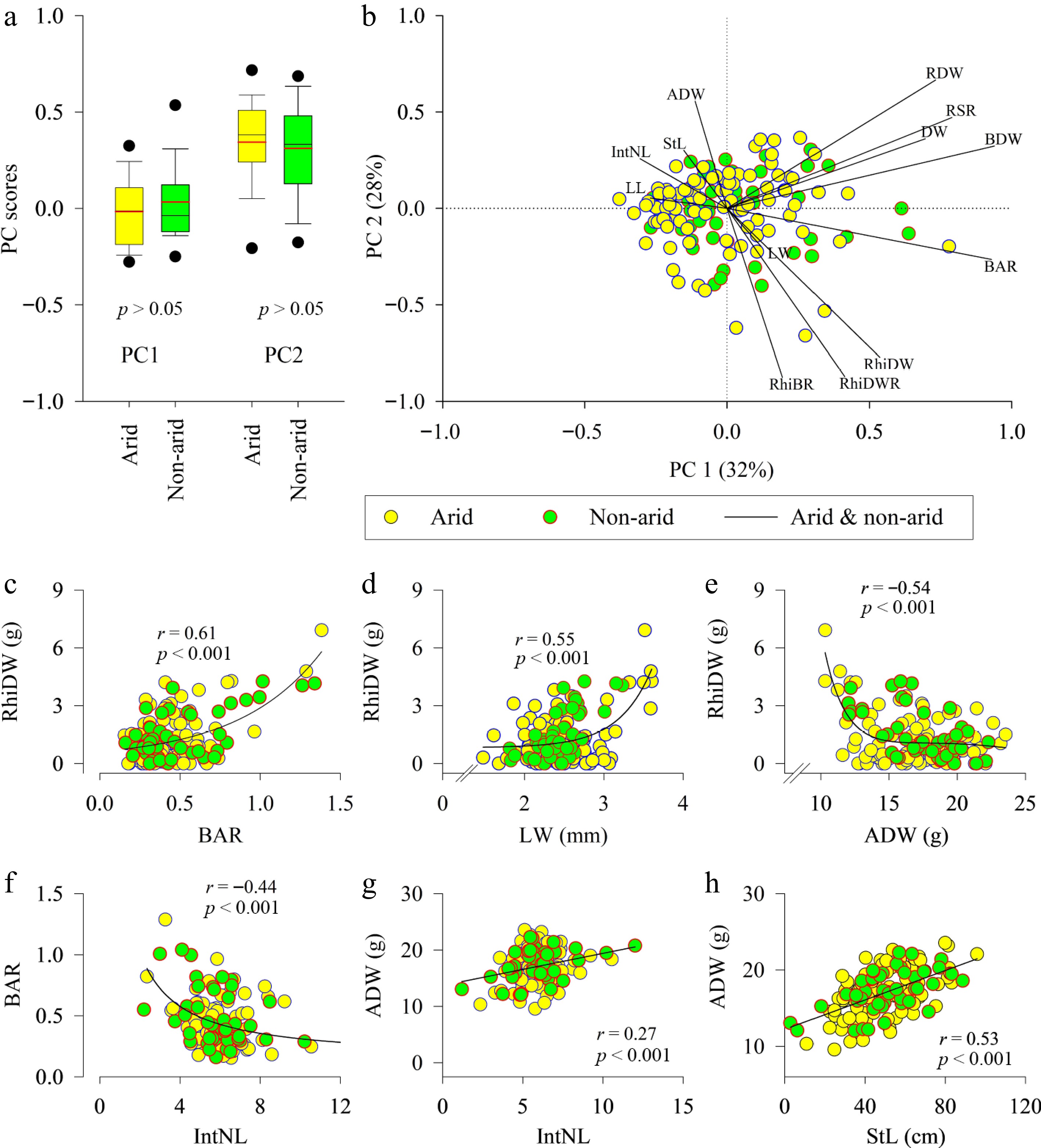
Figure 4.
Correlations of the measured traits among bermudagrass ecotypes. PCA analysis was conducted using the traits of stolon length (StL), internode length (IntNL), leaf width (LW), leaf length (LL), belowground to aboveground dry weight (ADW), belowground dry weight (BDW), rhizome dry weight (RhiDW), root dry weight (RDW), total dry weight (DW), belowground-to-aboveground biomass ratio (BAR), root to shoot ratio (RSR), rhizome to belowground ratio (RhiBR), and rhizome to total dry weight ratio (RhiDWR). Relationships between rhizome dry weight (RhiDW) and belowground to aboveground dry weight ratio (BAR). (a) the PC scores comparison and (b) PCA biplot of grasses from arid region (aridity indices less than 0.65) and non-arid region. The regression of RhiDW vs (c) BAR, vs (d) LW, and vs (e) ADW, (f) BAR vs IntNL, and (g) ADW vs IntNL and vs (h) StL.
Figures
(4)
Tables
(0)