-
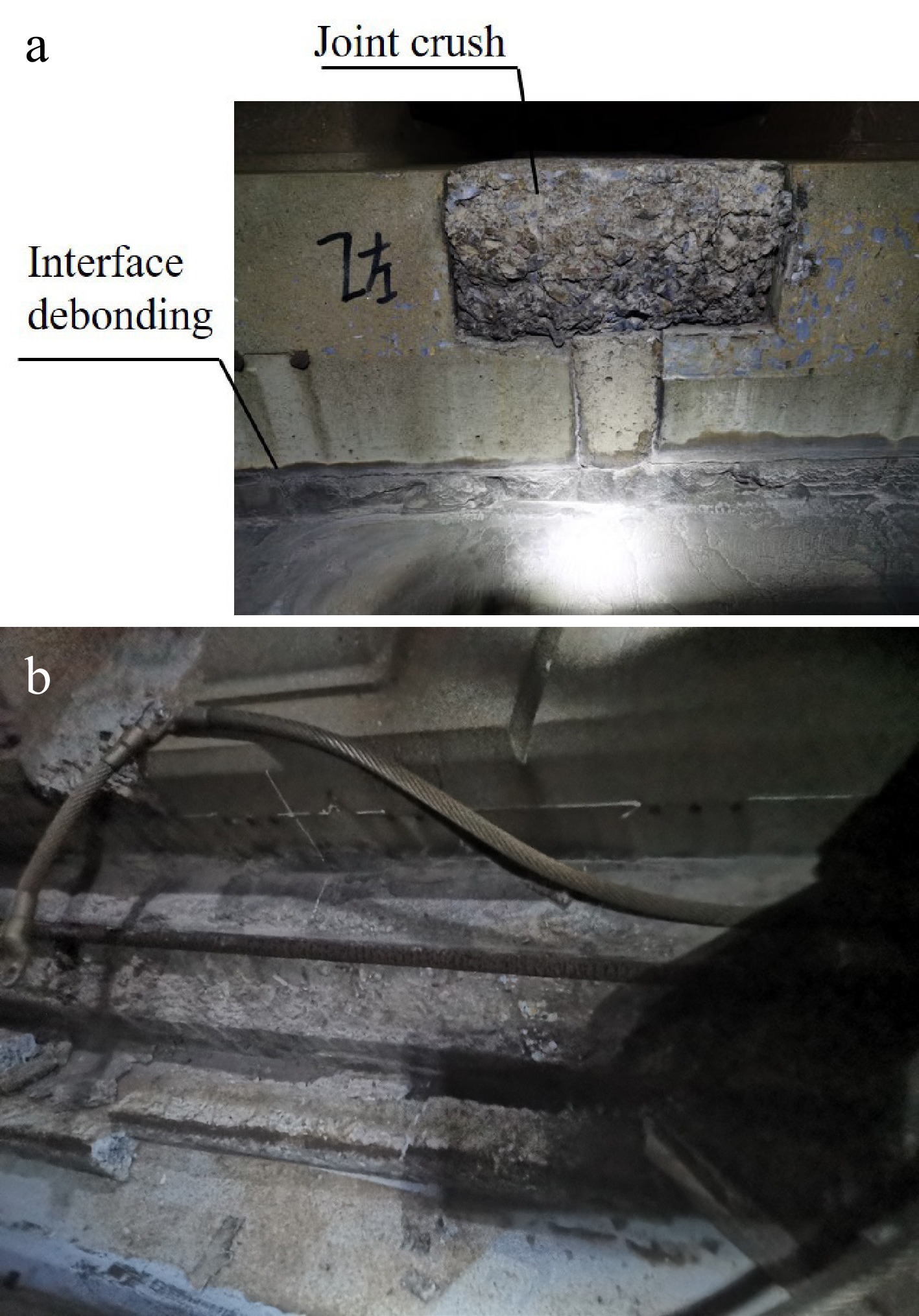
Figure 1.
CRTS II slab track defects.
-
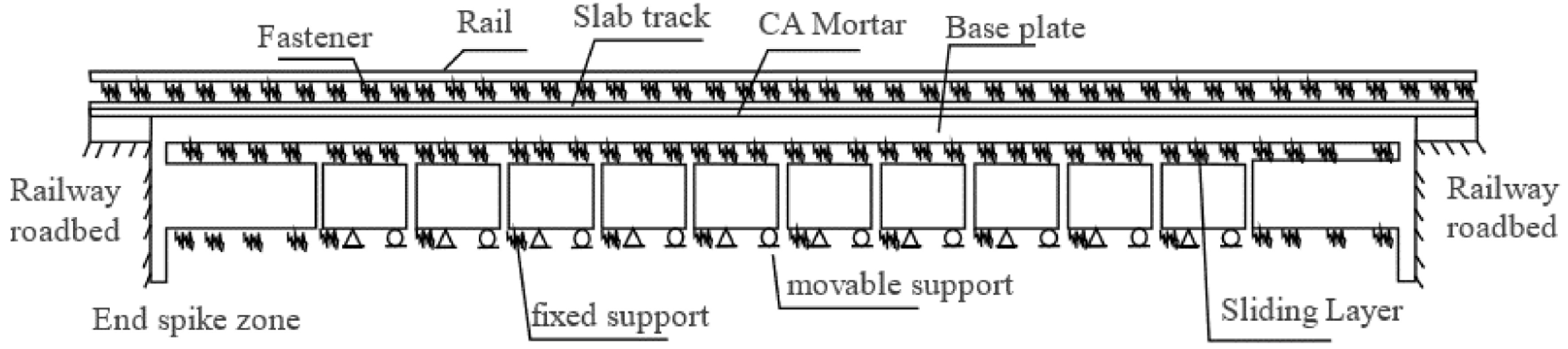
Figure 2.
Mechanical model of the CRTS II slab track system.
-
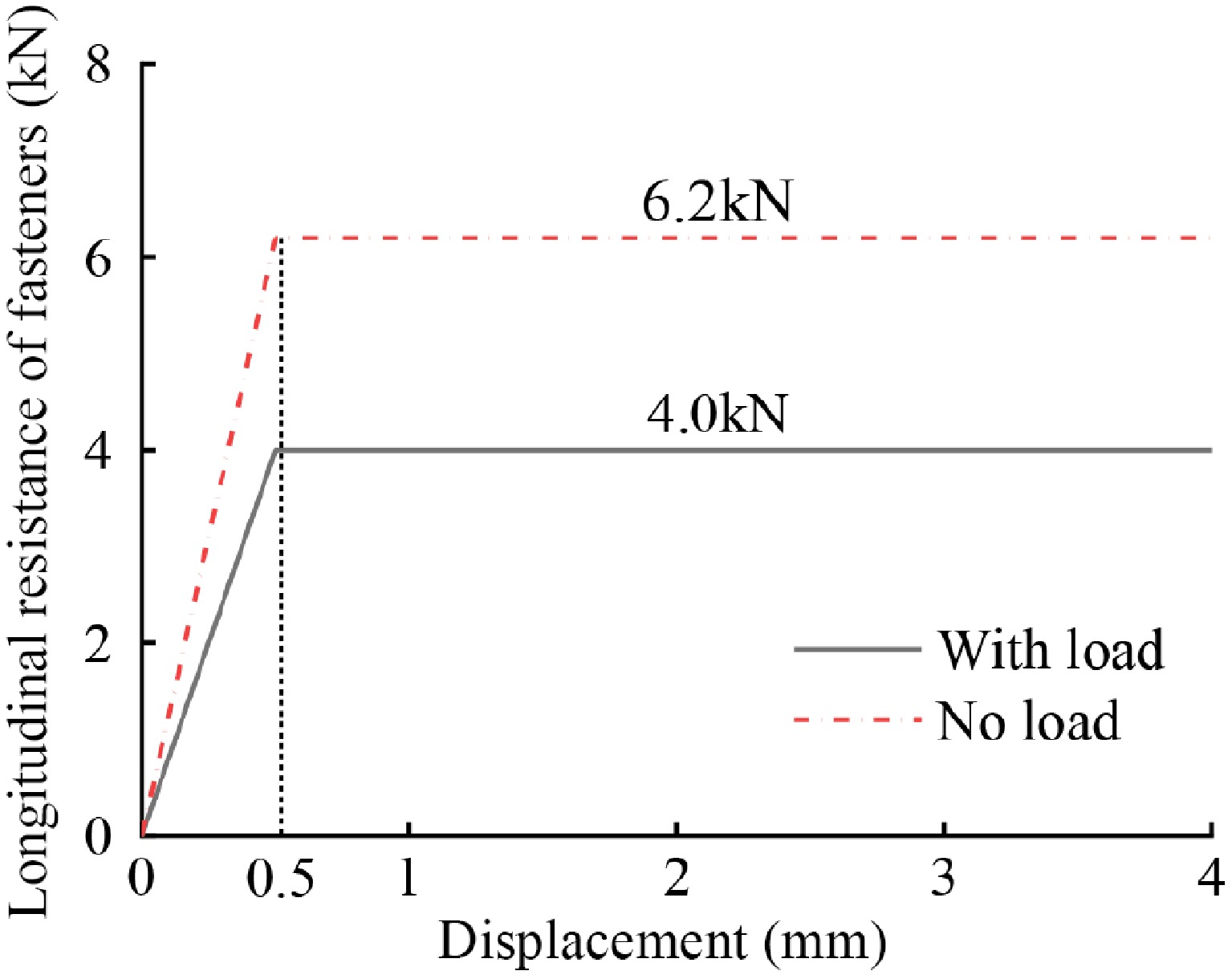
Figure 3.
Low-resistance fastener of WJ-8.
-
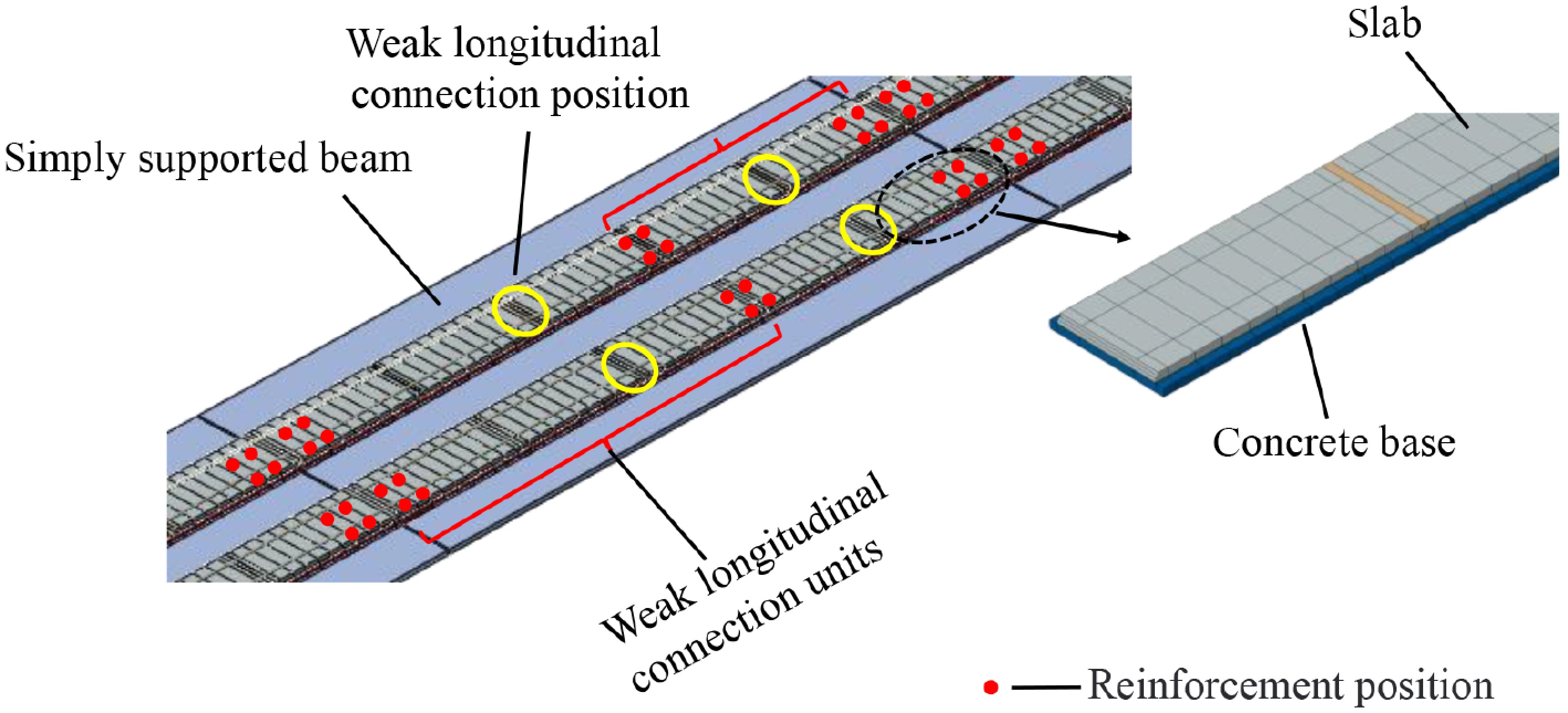
Figure 4.
Weak longitudinal connection scheme.
-
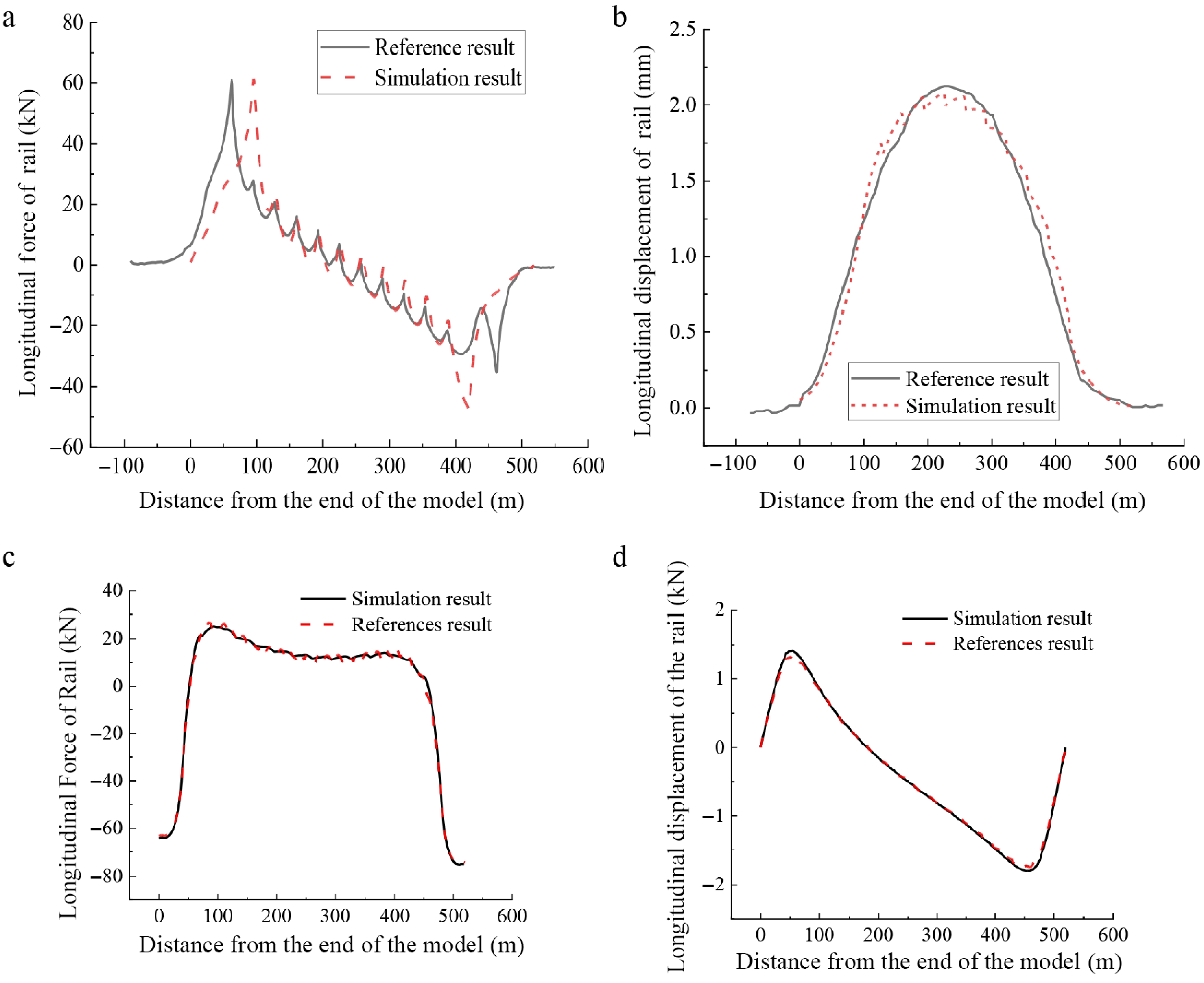
Figure 5.
Model calculation results: (a) additional rail expansion force; (b) rail expansion displacement; (c) results of rail force under high temperature, and (d) results of rail displacement under high temperatures.
-
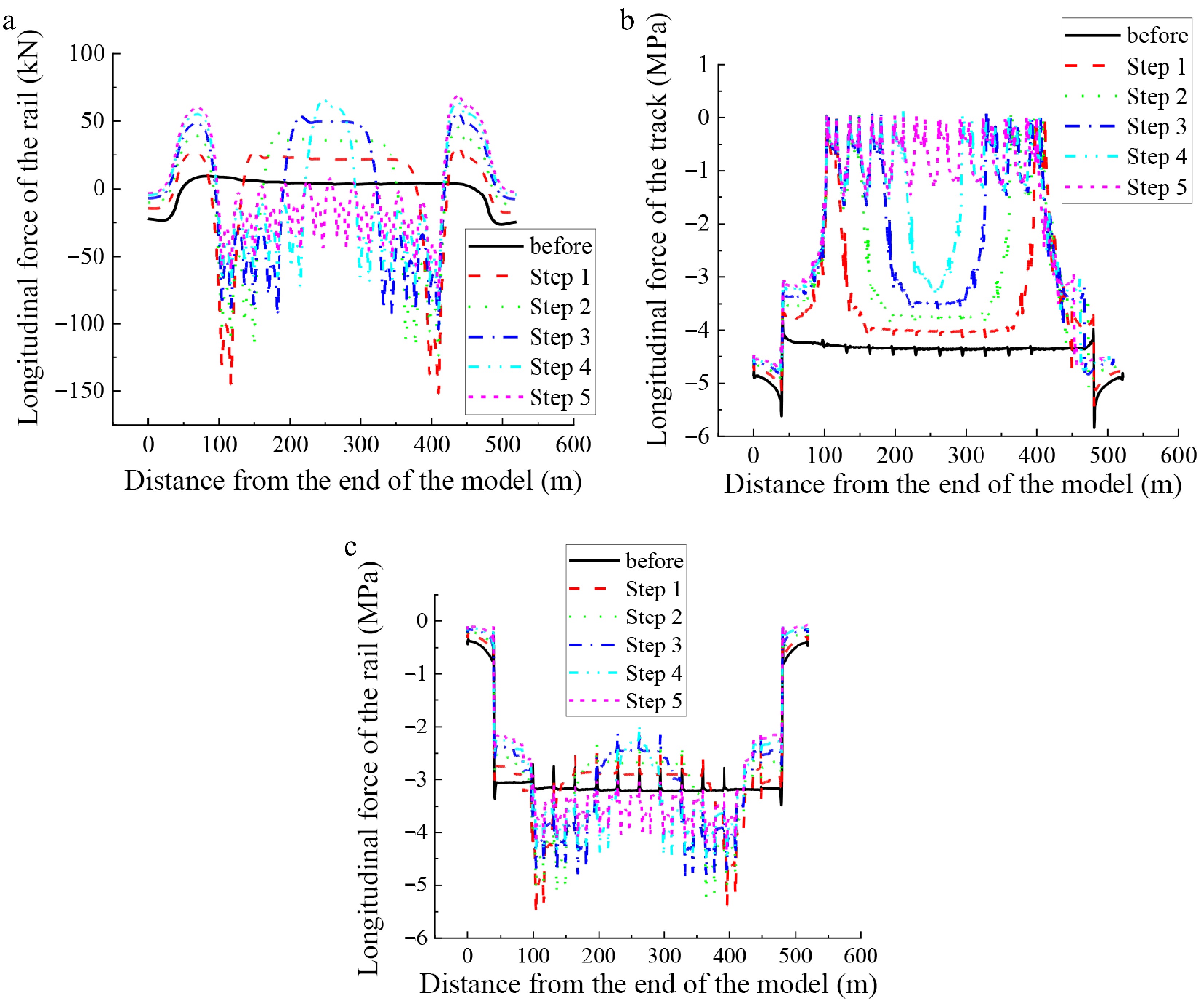
Figure 6.
Longitudinal force situation of the track structure during the unlocking process. (a) Unlocking process rail longitudinal force; (b) unlocking process track slab longitudinal stress; (c) unlocking process base slab longitudinal stress.
-
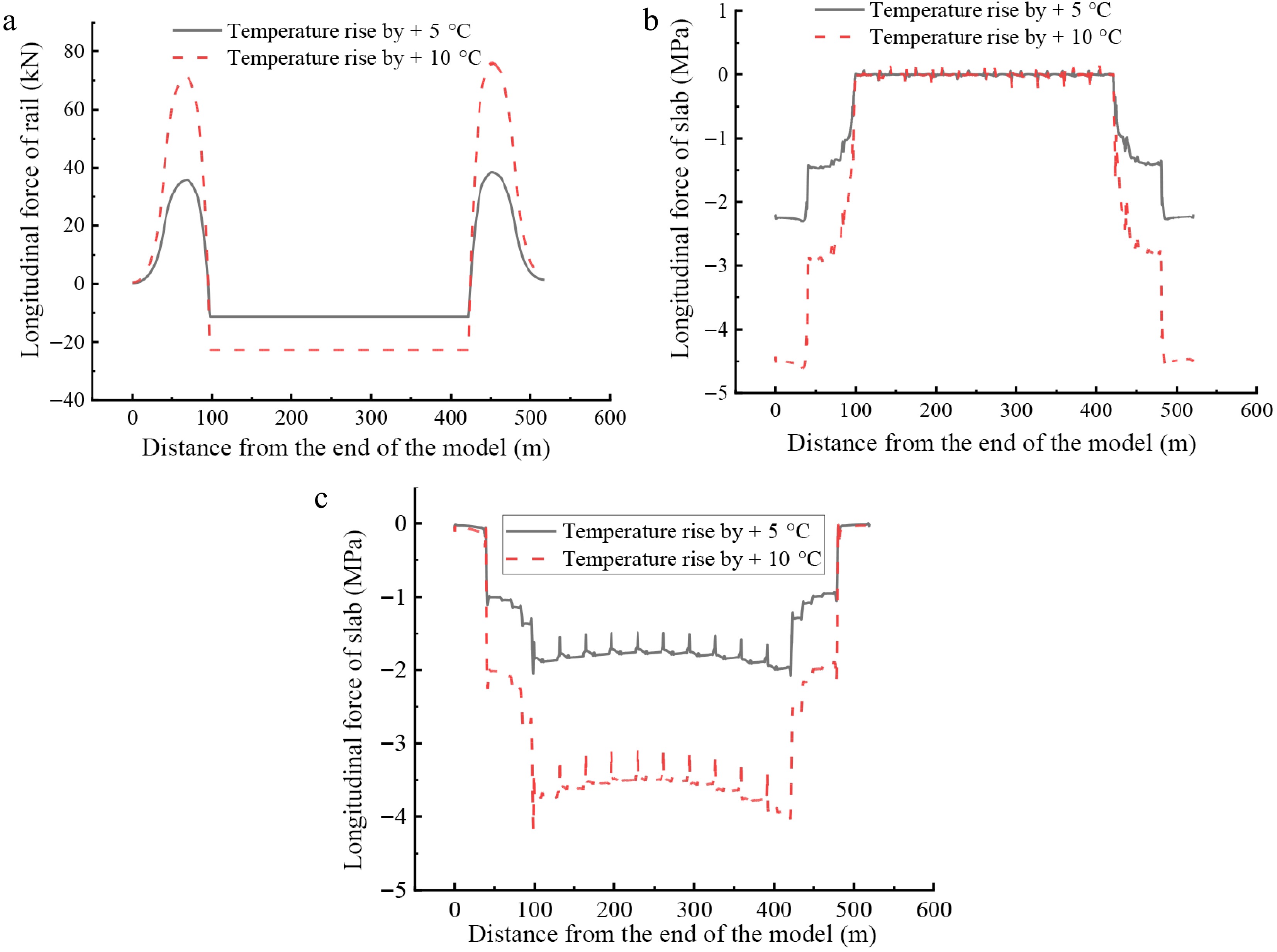
Figure 7.
Longitudinal force of track slab after unlocking. (a) Longitudinal force of rail; (b) longitudinal force of track slab after unlocking; (c) longitudinal force of base slab.
-
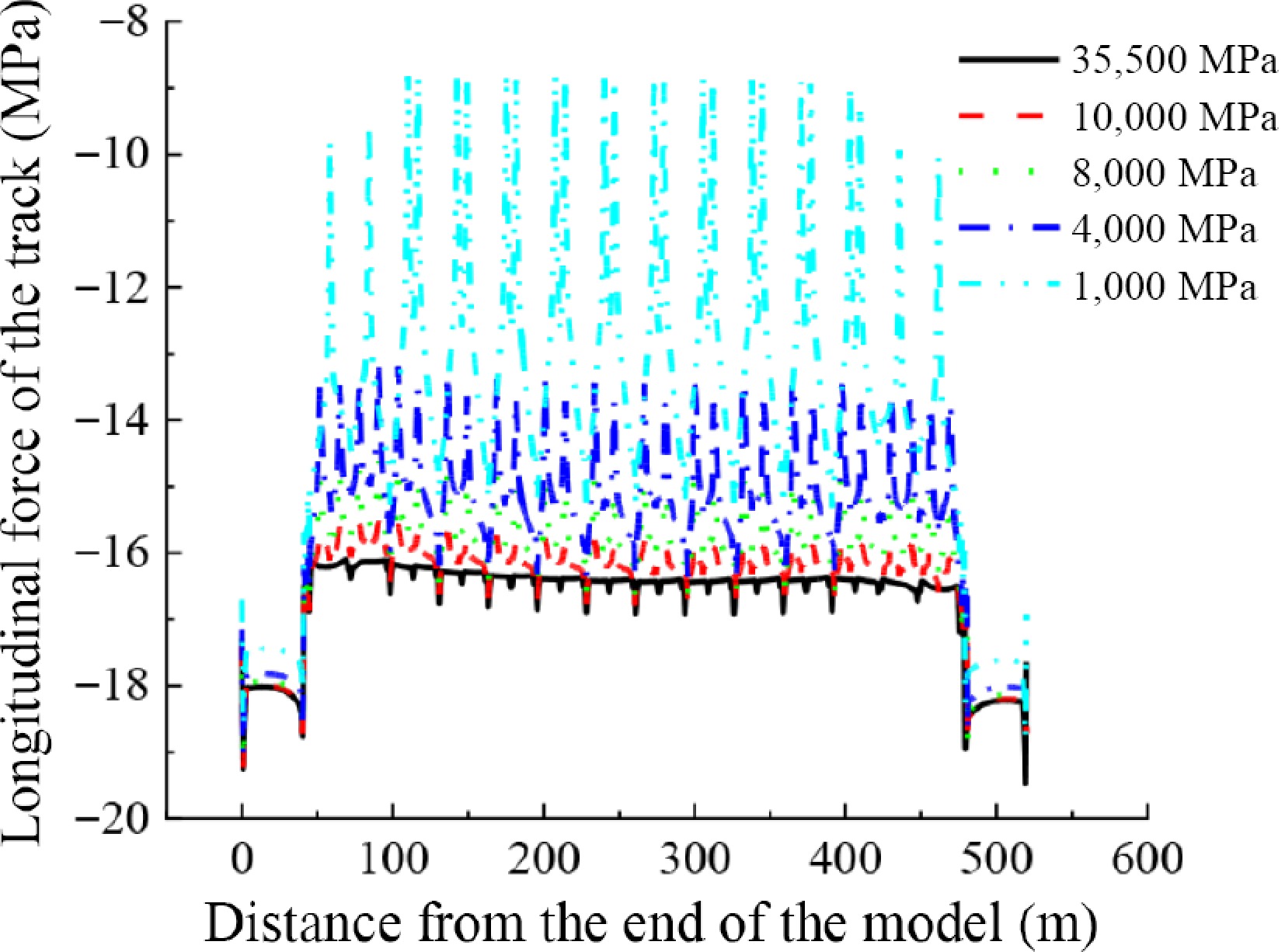
Figure 8.
Longitudinal force of track slab under different elasticity modulus.
-
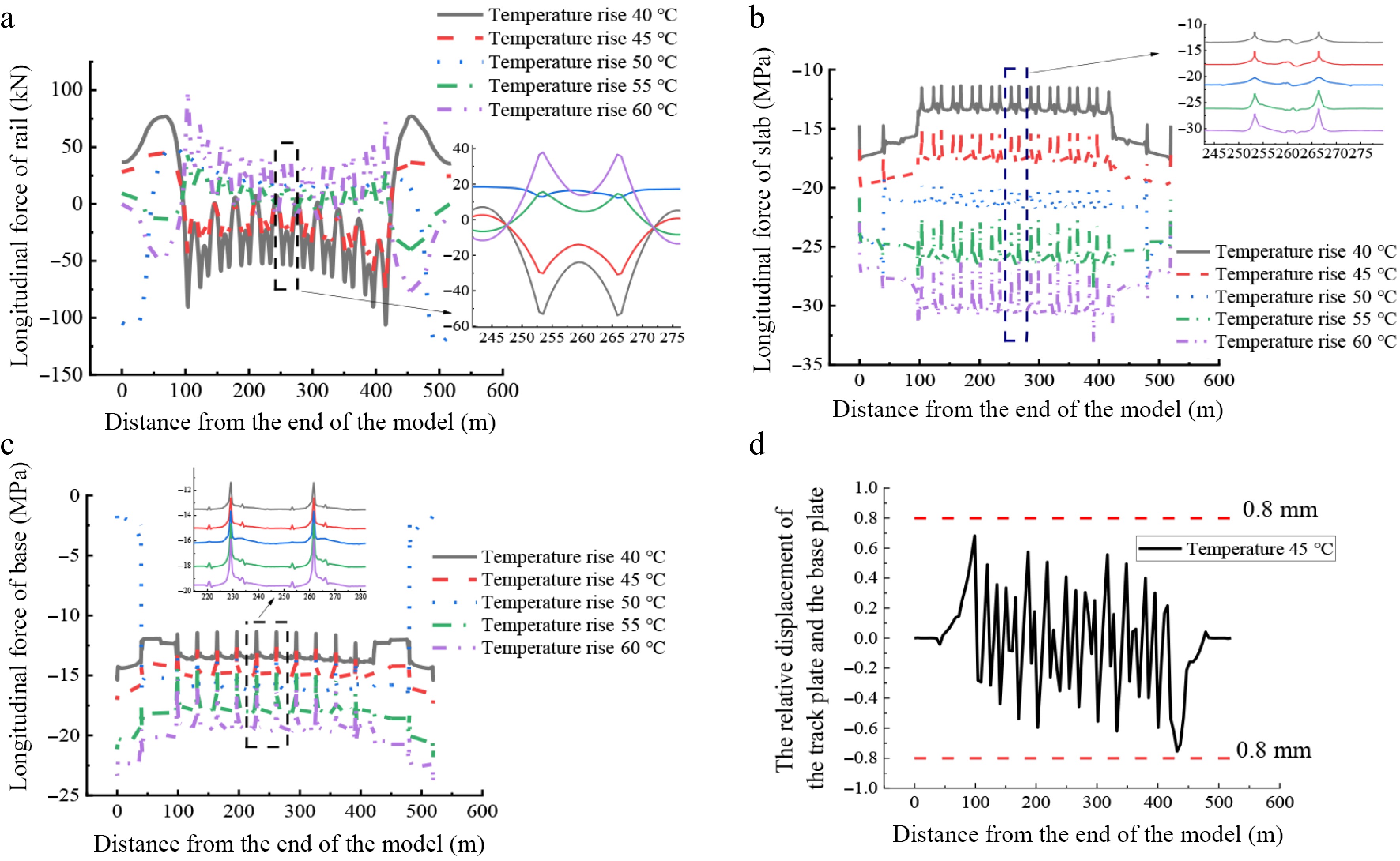
Figure 9.
Force-deformation of the track structure under different unlocking and relocking. (a) Longitudinal force of the rail; (b) longitudinal stress of the track slab; (c) the longitudinal force of the base plate, and (d) relative displacement between slab and the plate.
-
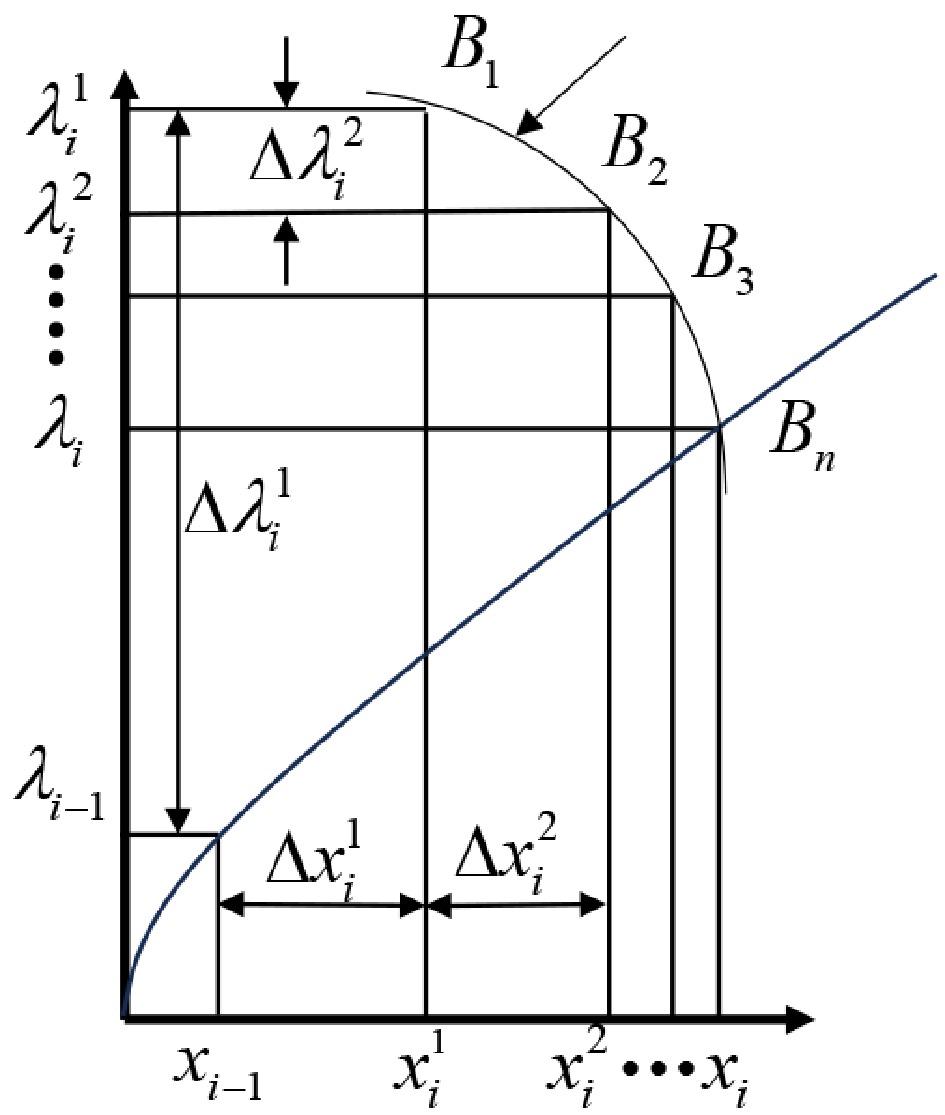
Figure 10.
Risk method iteration curve.
-
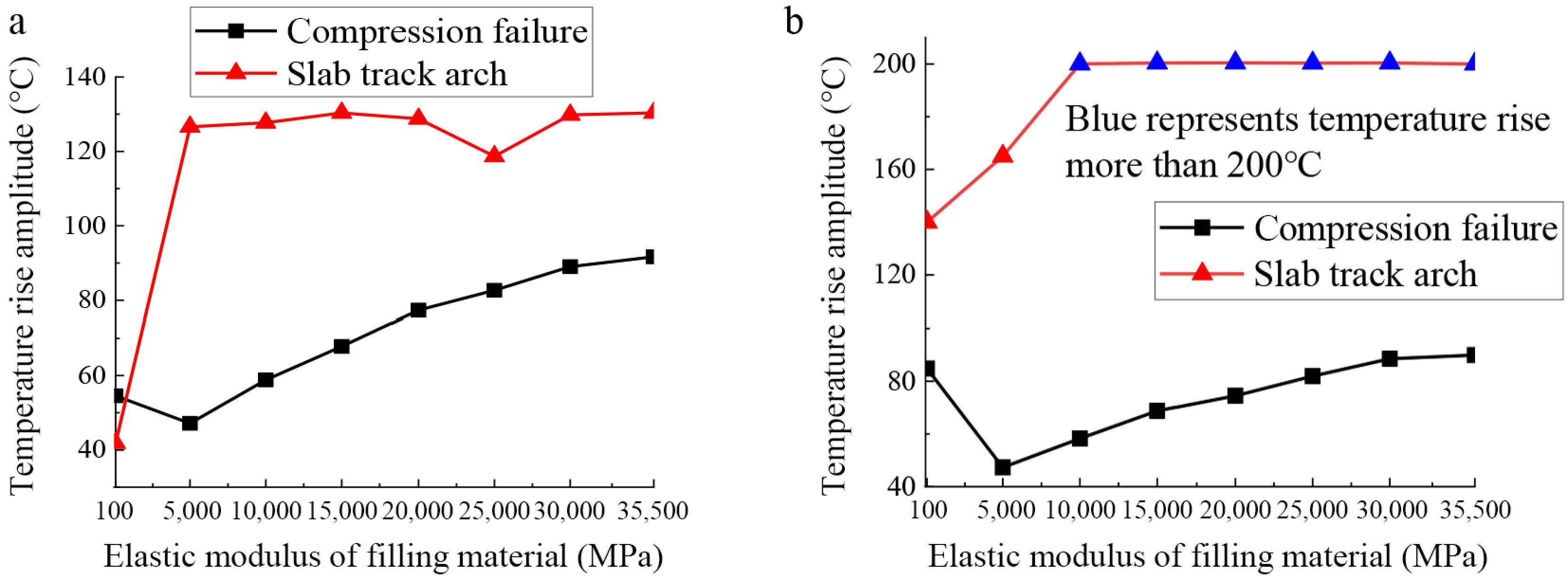
Figure 11.
Critical instability temperature of track slab. (a) Bridge upward deflection; (b) bridge settlement.
-
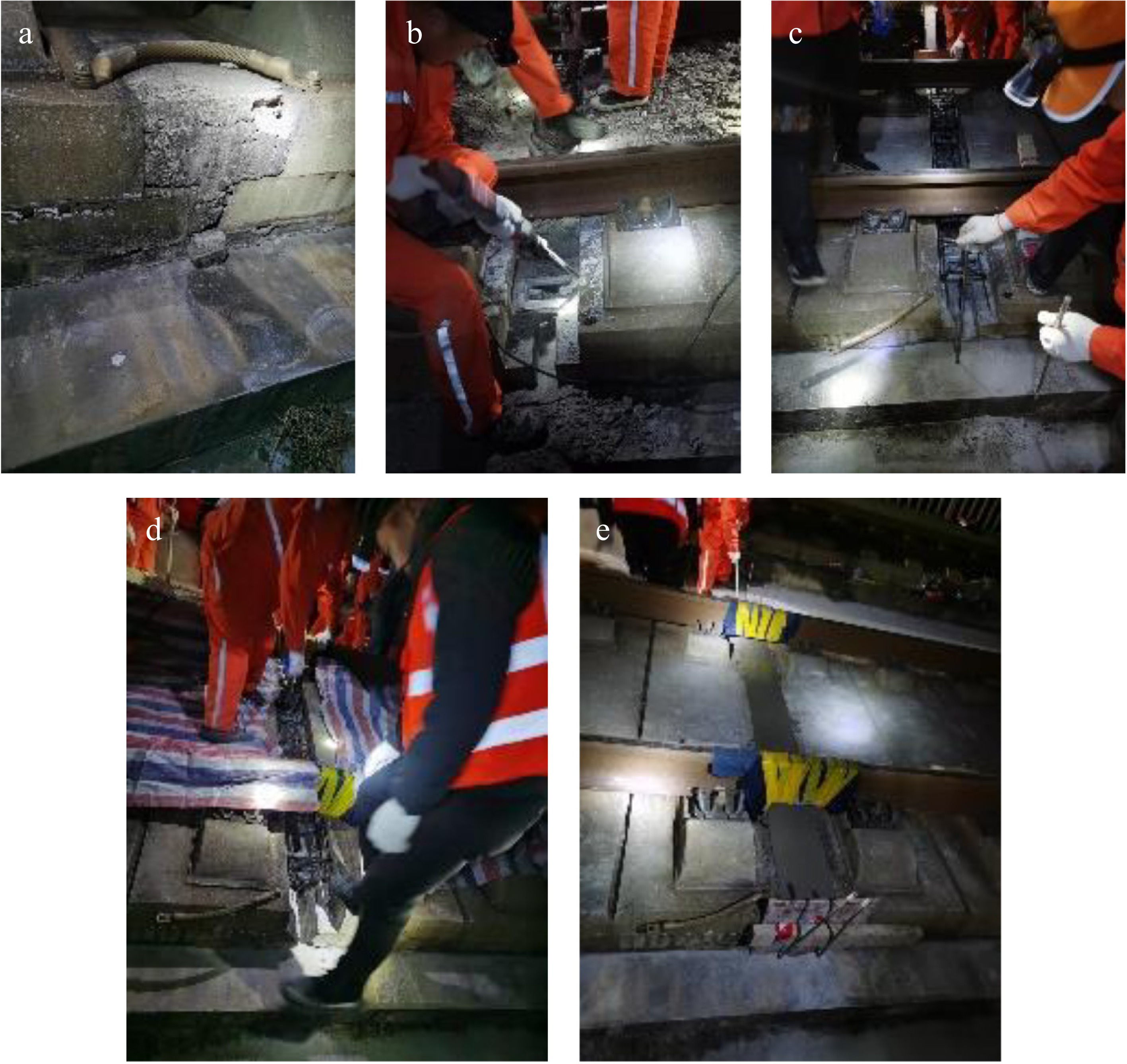
Figure 12.
Track slab unlocking and relocking construction process. (a) Preparatory work; (b) concrete removal; (d) protective measures; (e) concrete backfilling.
-
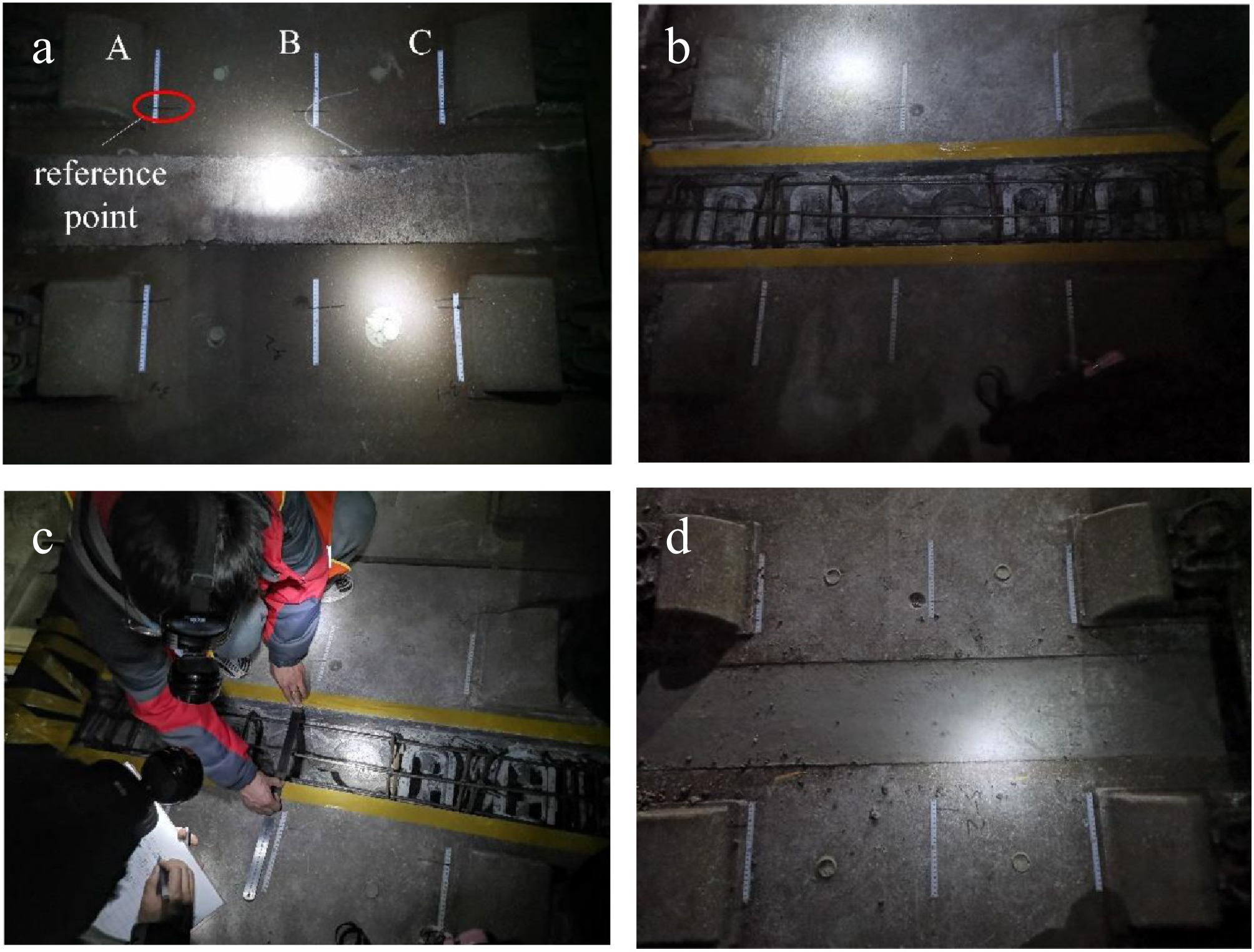
Figure 13.
Relative displacement measurement process. (a) Attaching a scale; (b) measuring distance; (c) measuring distance again; (d) measuring finished.
-
Components Materials Elastic modulus (GPa) Poisson ratio Thermal expansion coefficient (°C−1) Rail Steel 210 0.2 1.18e-5 Slab Concrete 35.5 0.2 1.18e-5 Joint Concrete 35.5 0.2 1.18e-5 CA mortar[31] − 7 0.2 1.18e-5 Concrete base Concrete 32 0.2 1.18e-5 End spikes Concrete 32 0.2 − Abutment Concrete 34.5 0.2 − A/B fillers[31] − 0.12 0.2 − Cement-stabilized crushed stone 0.19 0.2 − Table 1.
Material parameters of the CRTS II slab track system on bridges.
-
Unlocking temperature of track slab Temperature drop 10 °C Temperature drop 5 °C Temperature rise 5 °C Temperature rise 10 °C N Y N Y N Y N Y Maximum longitudinal force of rail (kN) 108.57 76.61 54.73 38.87 47.58 38.35 105.92 76.19 Maximum longitudinal displacement of rail (mm) 1.89 2.00 0.94 1.02 0.79 0.92 1.85 2.00 Maximum longitudinal force of track slab (MPa) 0.36 0.05 0.14 0.02 −0.20 −0.22 −0.40 −0.45 Maximum longitudinal displacement of track slab (mm) 3.84 4.49 1.82 2.27 1.78 2.26 3.74 4.50 Maximum longitudinal force of base plate (MPa) 3.54 3.49 1.77 1.75 −1.77 −1.75 −3.55 −3.5 Maximum longitudinal displacement of base plate (mm) 1.50 1.94 0.68 0.93 0.71 1.12 1.54 2.00 N represents unlocking the rail fastener, Y represents not unlocking the rail fastener. Table 2.
Force-deformation characteristics of the track slab under released and fixed fastener conditions at various unlocking temperatures.
-
Temperature rise (°C) Maximum longitudinal
force of rail (kN)Rail deformation
value (mm)Maximum longitudinal
force of slab (MPa)Maximum longitudinal
force of base (MPa)Maximum relative displacement
of base and track (mm)Temperature rise to 40 °C −106.2 0.87 −17.6 −15.4 1.34 Temperature rise to 45 °C −76.3 0.83 −20.0 −17.5 0.75 Temperature rise to 50 °C −122.9 2.58 −28.5 −17.1 0.18 Temperature rise to 55 °C 48.7 0.96 −28.6 −21.8 0.56 Temperature rise to 60 °C 99.7 1.10 −33.2 −23.9 1.25 Temperature drop to 50 °C −94.8 0.82 26.9 20.0 1.12 Temperature drop to 45 °C −48.2 0.66 22.5 17.9 0.56 Temperature drop to 40 °C 88.3 2.10 21.1 13.2 0.16 Temperature drop to 35 °C 61.3 0.79 15.7 13.6 0.77 Temperature drop to 30 °C 104.8 0.92 15.5 13.4 1.62 Temperature drop to 30 °C 104.8 0.92 15.5 13.4 1.62 The rail deformation value and the maximum relative displacement are absolute values; the rail deformation value refers to the displacement before and after re-locking; the positive values of the longitudinal force of the rails, the maximum stresses of the track slab and the base plate represent tension, while negative values represent compression. Table 3.
Force conditions of track structure under different unlocking and relocking temperatures.
-
Before pouring
the jointAfter pouring
the jointRelative displacement
changeTime 1:39 2:32 Air temperature (°C) 19.8 19.7 Plate temperature (°C) 19.5 19.4 1-A (cm) 47.90 47.90 0.00 1-B (cm) 49.95 49.95 0.00 1-C (cm) 48.66 48.66 0.00 2-A (cm) 45.70 45.71 0.01 2-B (cm) 44.00 43.99 0.01 2-C (cm) 46.50 46.50 0.00 3-A (cm) 48.10 48.11 0.01 3-B (cm) 47.65 − − 3-C (cm) 49.00 49.01 0.01 4-A (cm) 47.61 47.61 0.00 4-B (cm) − − − 4-C (cm) 46.15 46.15 0.00 5-A (cm) 46.53 46.53 0.00 5-B (cm) 48.50 48.50 0.00 5-C (cm) 47.63 47.62 0.01 6-A (cm) 46.36 46.36 0.00 6-B (cm) − 45.2 − 6-C (cm) − 45.9 − During the process of removing the wide and narrow seams, some of the attached rulers were damaged. The measurement data was not obtained after unlocking and is marked as –. Table 4.
Measurement data for joints 1#–6#.
-
Different conditions Before pouring
the jointAfter pouring
the jointRelative
displacement
changeTime 3:00 3:45 Air temperature (°C) 16.7 16.9 Plate temperature (°C) 17.2 17.8 7-A (cm) 47.90 48 0.00 8-A (cm) 49.95 49.95 0.00 9-A (cm) 48.66 48.66 0.00 Table 5.
Measurement data for 7#−9# joints.
Figures
(13)
Tables
(5)