-
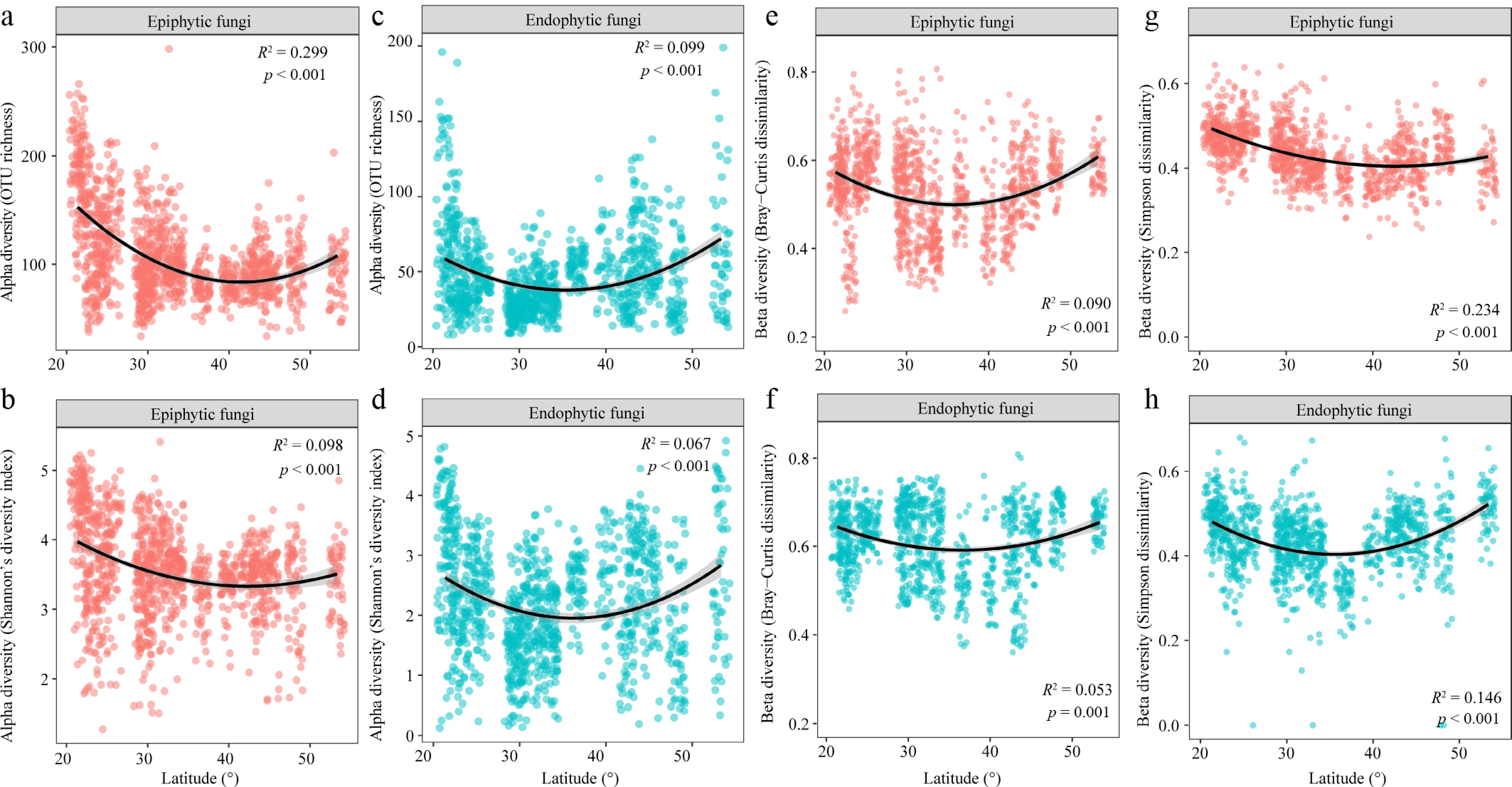
Figure 1.
Latitudinal patterns of the alpha and beta diversity of phyllosphere epiphytic and endophytic fungi.
-
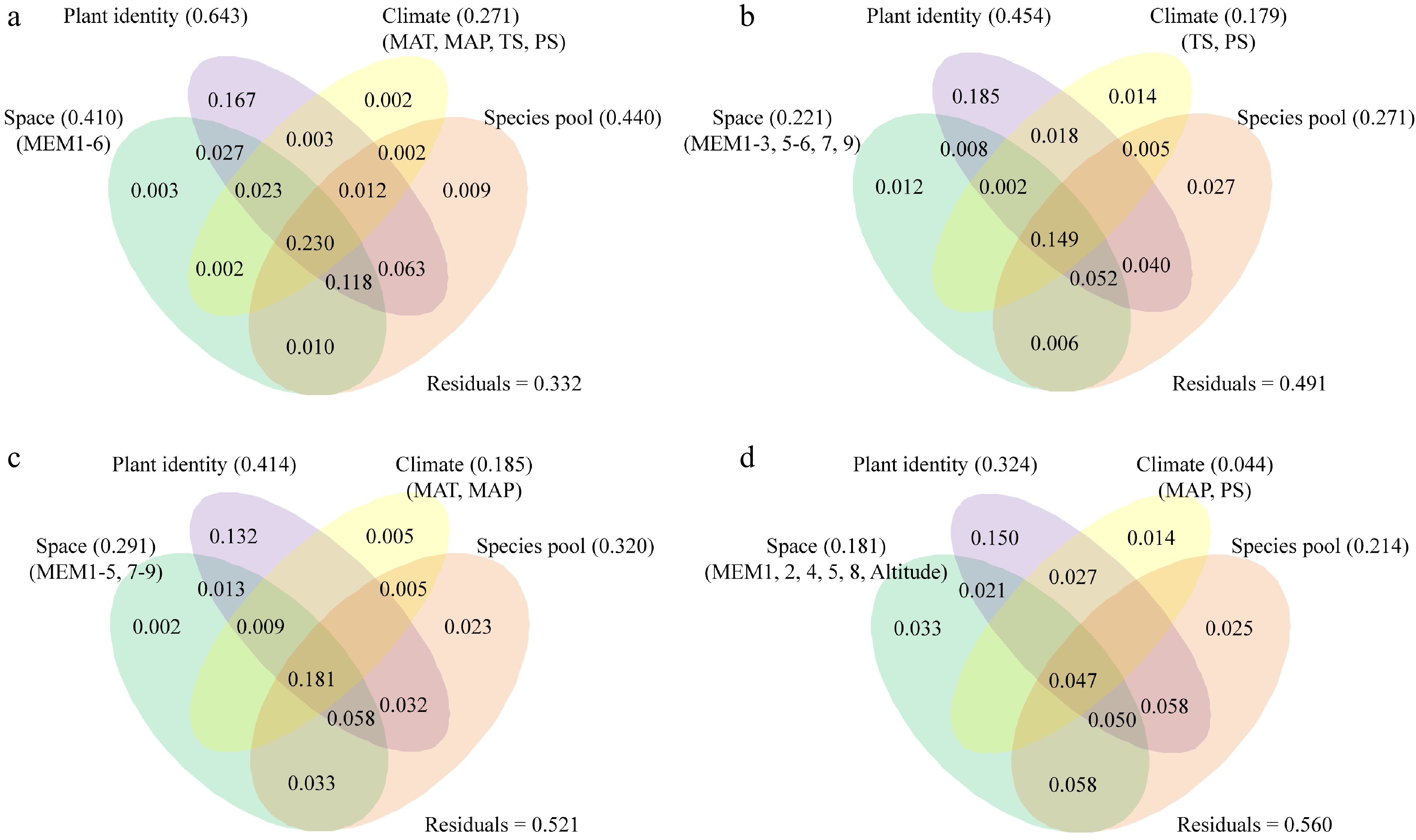
Figure 2.
Result of variation partitioning analysis showing the pure and shared effects of plant identity, species pool, space, and climatic variables on phyllosphere fungal diversity. (a) Richness of epiphytic fungal operational taxonomic units (OTUs). (b) Richness of endophytic fungal OTUs. (c) Beta diversity (Simpson dissimilarity) of epiphytic fungi. (d) Beta diversity (Simpson dissimilarity) of endophytic fungi. Numbers indicate proportions of explained variation (adjusted R2 values). MAT, mean annual temperature; MAP, mean annual precipitation; TS, Temperature seasonality; PS, precipitation seasonality; MEM, Moran's eigenvector maps.
-
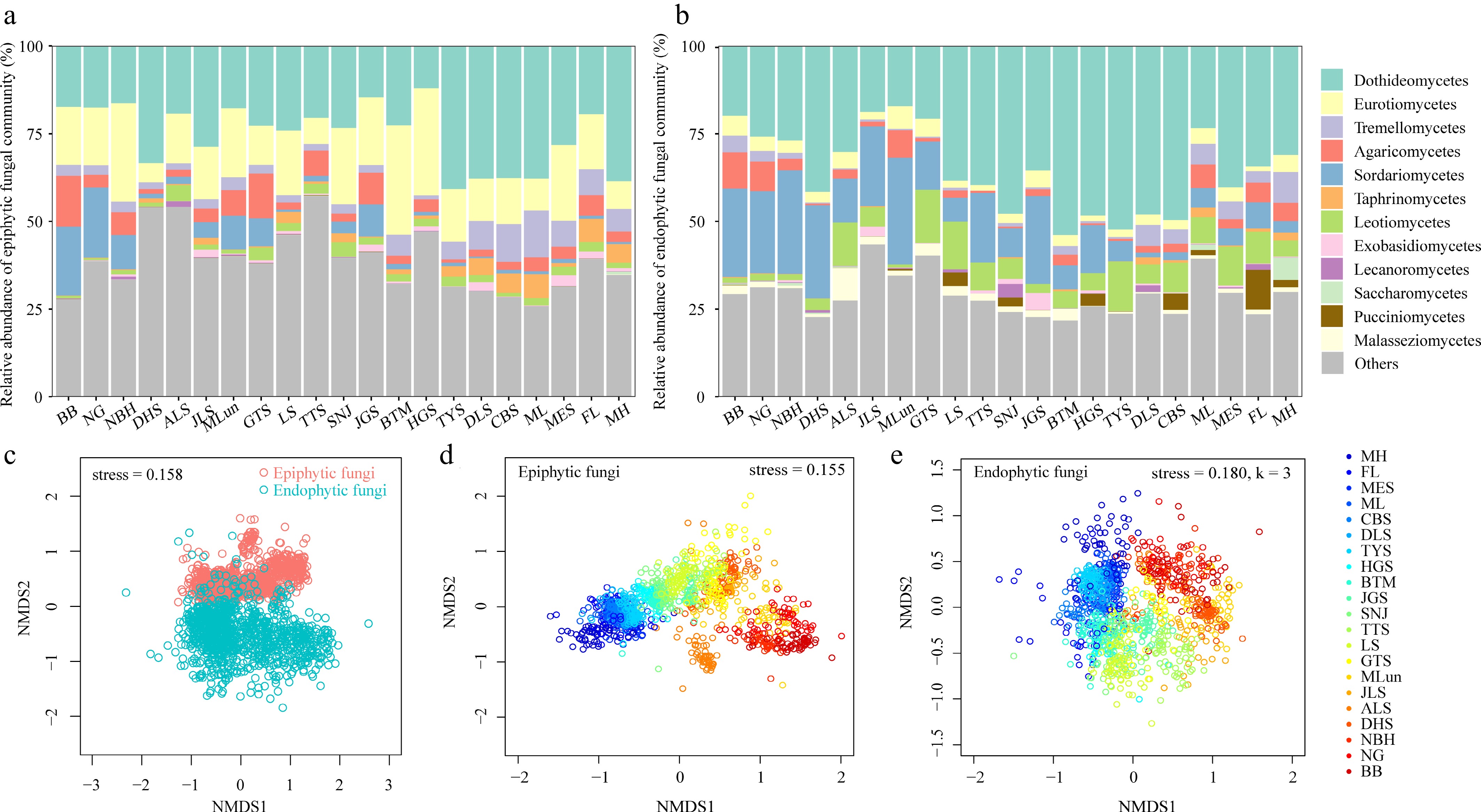
Figure 3.
Community composition of the phyllosphere epiphytic and endophytic fungi in different forest sites. Relative abundance of (a) epiphytic, and (b) endophytic fungi at the class level. (c)–(e) Non-metric multidimensional scaling (NMDS) ordination of the community composition (Bray–Curtis dissimilarity) of epiphytic and endophytic fungi in different sites. 'Others' includes the fungal classes with < 0.5% of the total epiphytic and endophytic fungal reads and operational taxonomic units unclassified to fungal class level. The sites are ranked from lowest to highest latitude. BB, Bubeng; NG, Nonggang; NBH, Nabanhe; DHS, Dinghushan; ALS, Ailaoshan; JLS, Jiulianshan; MLun, Mulun; GTS, Gutianshan; LS, Lushan; TTS, Tiantongshan; SNJ, Shennongjia; JGS, Jigongshan; BTM, Baotianman; HGS, Huangguanshan; TYS, Taiyueshan; DLS, Donglingshan; CBS, Changbaishan; ML, Muling; MES, Maoershan; FL, Fenglin; MH, Mohe.
-
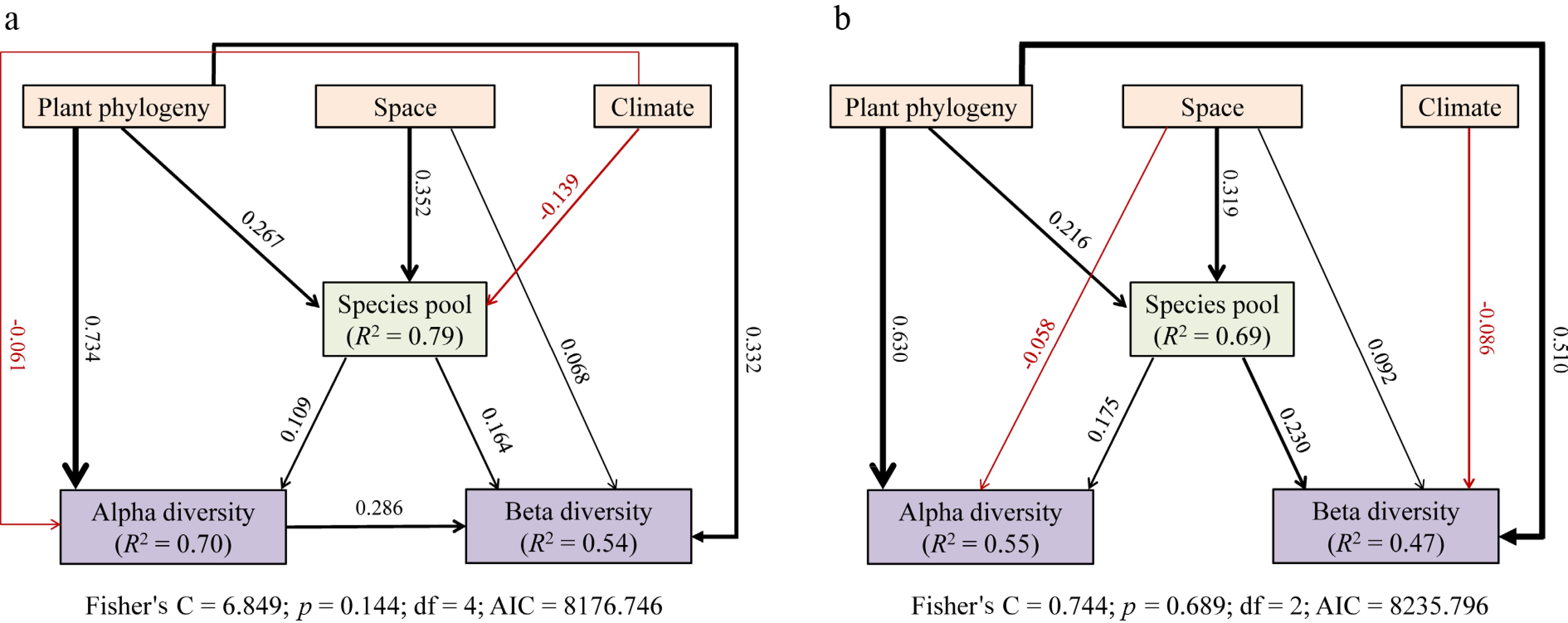
Figure 4.
Structural equation models (SEMs) showing the hypothesized relationships between plant phylogeny, species pool, space, climate, and fungal diversity. (a) Epiphytic fungi. (b) Endophytic fungi. The width of the lines represents the strength of the relationship (p < 0.05). Black and red solid lines indicate significant positive or negative correlations, respectively. Numbers above the lines indicate path coefficients. R2 is the proportion of variance explained by the model. df, degree of freedom; AIC, akaike information criterion. The detailed information of plant phylogeny, space, and climate is listed in Supplementary Table S5.
-
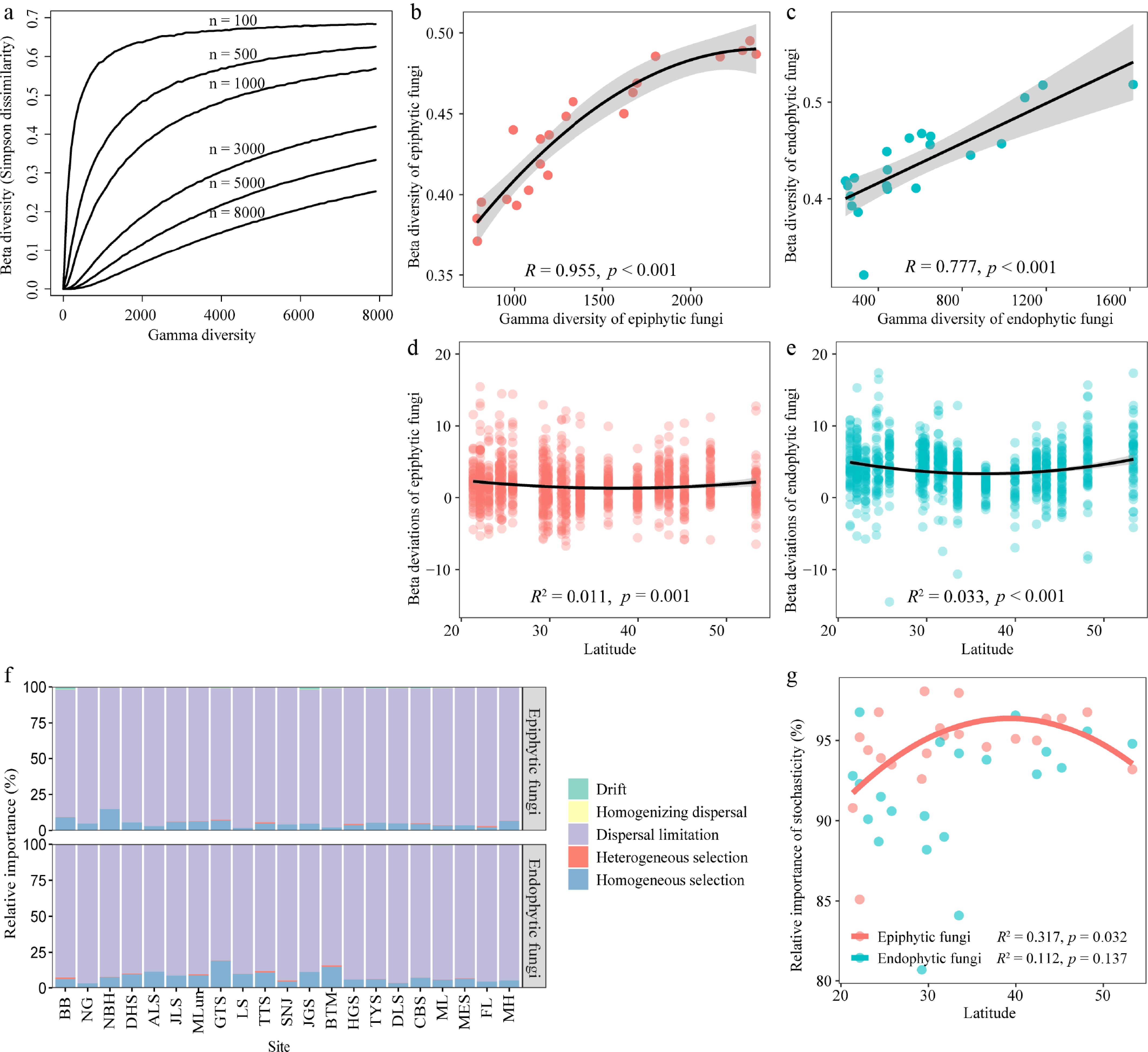
Figure 5.
Community assembly of phyllosphere epiphytic and endophytic fungi. (a) The expected beta diversity increased with increasing gamma diversity produced by a simple sampling simulation, using a lognormal species abundance distribution, and 'n' represented the number of individuals in each sample. Relationship between the observed beta diversity (Simpson dissimilarity) and gamma diversity in (b) epiphytic, and (c) endophytic fungi. Latitudinal pattern of beta deviation of (d) epiphytic, and (e) endophytic fungi. (f) Phylogenetic-bin-based null model analysis (iCAMP) showing the relative importance of each process on community assembly of epiphytic and endophytic fungi in each site, and the sites are ranked from lowest to highest latitude. (g) Latitudinal pattern of the relative importance of stochastic processes on epiphytic and endophytic fungal community assembly. BB, Bubeng; NG, Nonggang; NBH, Nabanhe; DHS, Dinghushan; ALS, Ailaoshan; JLS, Jiulianshan; MLun, Mulun; GTS, Gutianshan; LS, Lushan; TTS, Tiantongshan; SNJ, Shennongjia; JGS, Jigongshan; BTM, Baotianman; HGS, Huangguanshan; TYS, Taiyueshan; DLS, Donglingshan; CBS, Changbaishan; ML, Muling; MES, Maoershan; FL, Fenglin; MH, Mohe.
-
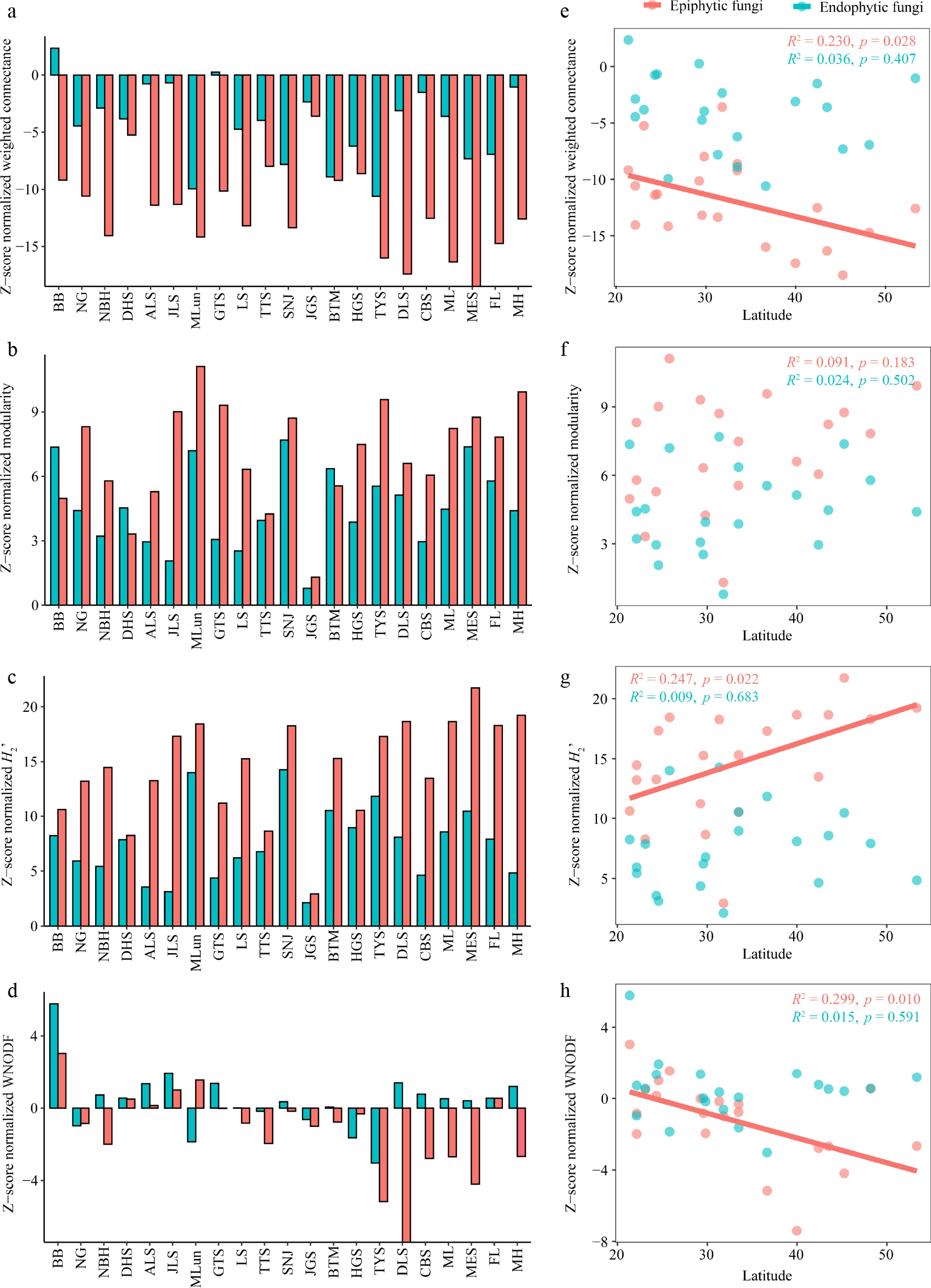
Figure 6.
Structure of plant-epiphytic and endophytic fungus networks. (a)–(d) Z-score-normalized properties of epiphytic and endophytic fungus networks. (e)–(h) Latitudinal pattern of plant-epiphytic and endophytic fungus networks. H2', H2' metric of the network-level interaction specialization; Modularity, Barber's metric of modularity; WNODF, weighted nestedness metric based on overlap and decreasing fill. BB, Bubeng; NG, Nonggang; NBH, Nabanhe; DHS, Dinghushan; ALS, Ailaoshan; JLS, Jiulianshan; MLun, Mulun; GTS, Gutianshan; LS, Lushan; TTS, Tiantongshan; SNJ, Shennongjia; JGS, Jigongshan; BTM, Baotianman; HGS, Huangguanshan; TYS, Taiyueshan; DLS, Donglingshan; CBS, Changbaishan; ML, Muling; MES, Maoershan; FL, Fenglin; MH, Mohe.
Figures
(6)
Tables
(0)