-
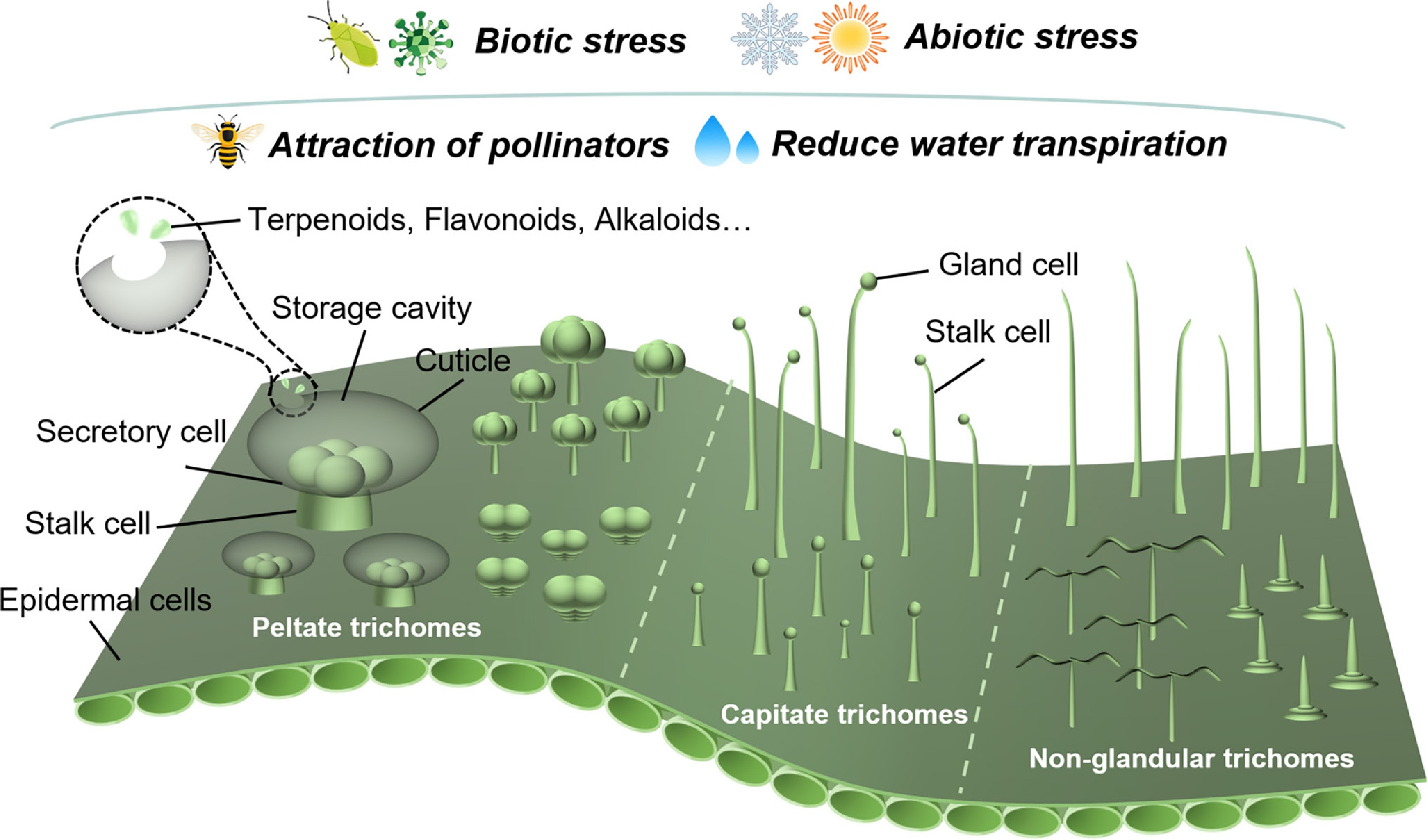
Figure 1.
Schematic comparison of different types of trichomes on the leaf surfaces of various plant species. Trichomes are classified into three categories: peltate GTs, capitate GTs, and NGTs. Examples for these are shown from M. piperita, A. annua, S. lycopersicum, Nicotiana spp., and C. sativus. The major biological functions of trichomes, including defense against biotic and abiotic stress, pollinator attraction, and reduced transpiration, are illustrated at the top of the figure.
-
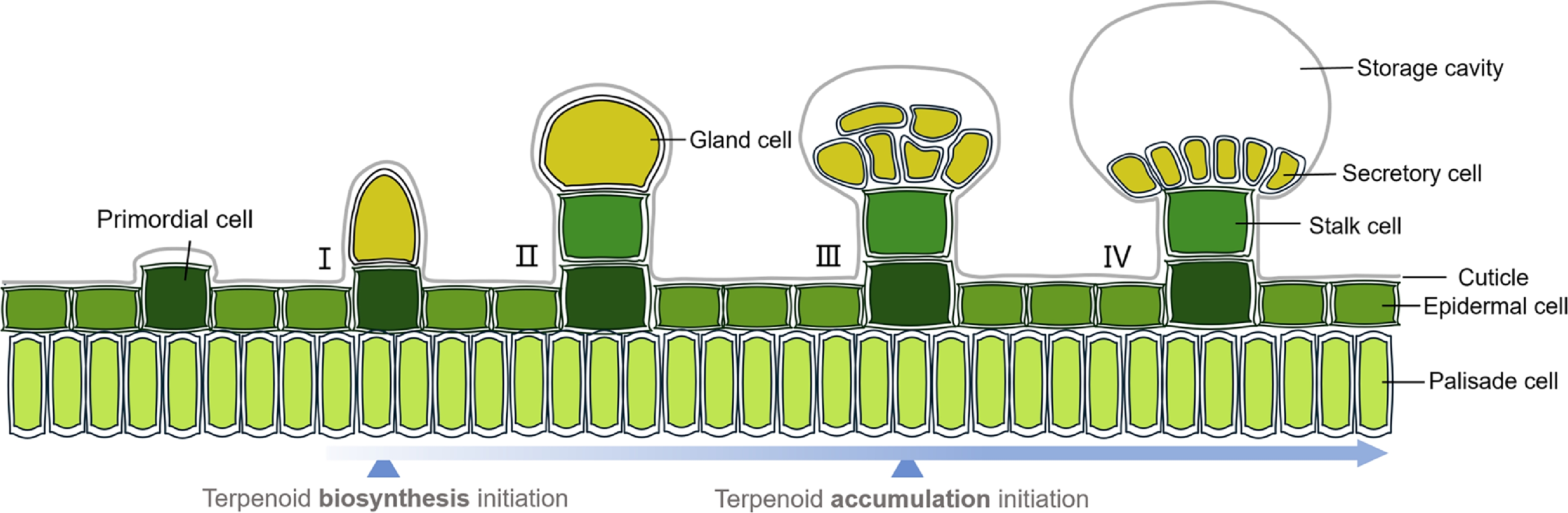
Figure 2.
Schematic diagram of the glandular trichome developmental process. GT primordial cells originate from protodermal cells of leaf primordia or young leaves. I. Epidermal cells first undergo directional differentiation and protrude outward. II. GT primordia form, followed by the differentiation of basal, stalk, and head cells. III. Head cells continue to divide and specialize into secretory cells. IV. Secretions accumulate in the subcuticular cavity, ultimately producing mature GT with swollen heads.
-
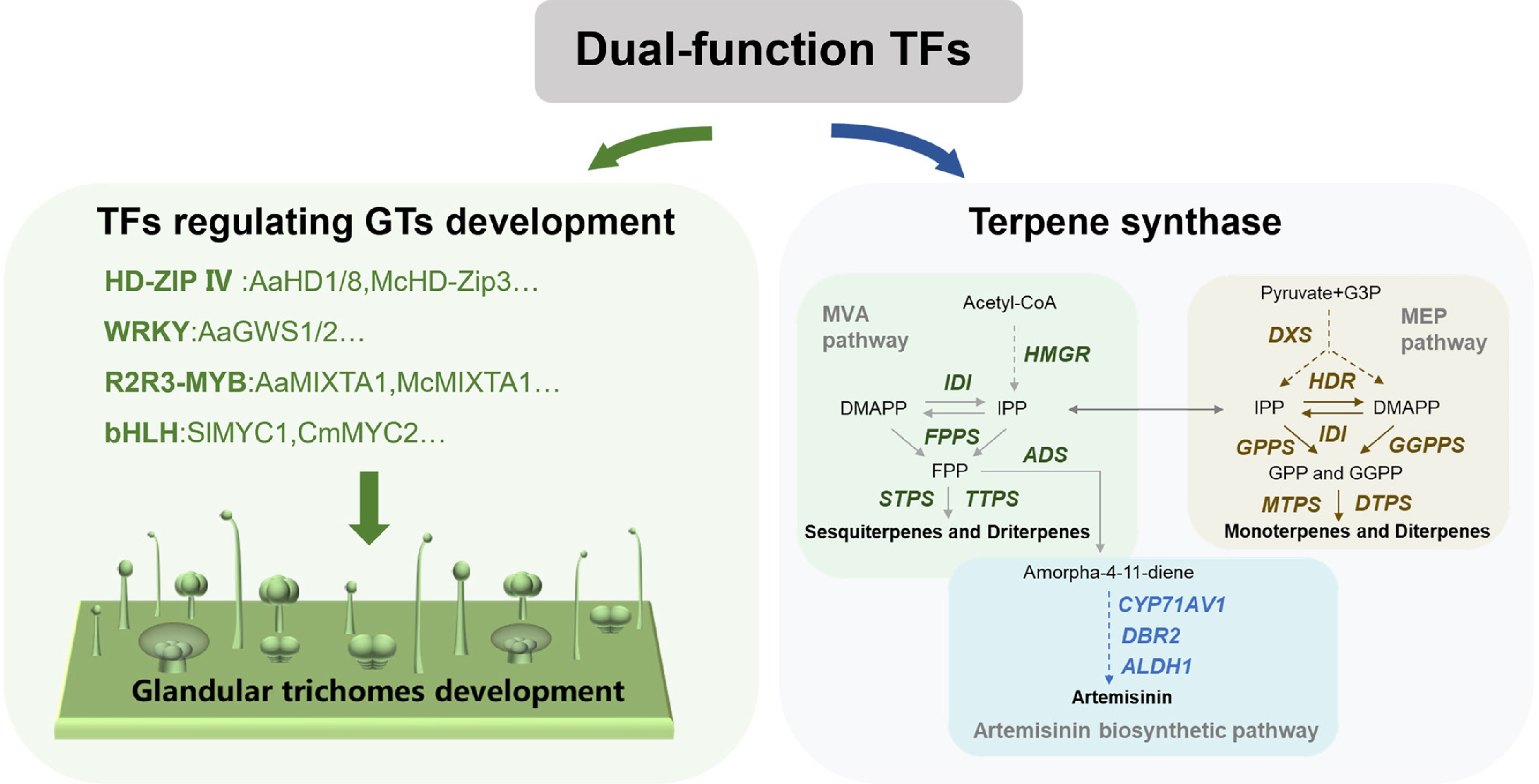
Figure 3.
Synergistic regulation of glandular trichome development and terpenoid biosynthesis by dual-function transcription factors. Dual-function TFs act as central regulators that simultaneously control GT morphogenesis and the terpenoid biosynthetic network, including MVA/MEP pathways, terpene synthases, and the artemisinin pathway, linking cellular differentiation to specialized metabolite production in plants.
-
Gene name TF family Key target genes of terpene biosynthesis Terpenoid type Evidence type Key target genes of GT development GT type Evidence type Gene function identification Ref. AaMYC3 (+) bHLH AaCYP71AV1/
AaALDH1Artemisinin Y1H/DLR/EMSA AaHD1 (+) GST Y1H/DLR/EMSA OE/RNAi [8] AaMYC2 (+) bHLH AaCYP71AV1/
AaALDH1Artemisinin Y1H AaHD1(+)/
AaGWS2 (+)GST RT-qPCR OE/RNAi [52] AaWRKY9 (+) WRKY AaDBR2 Artemisinin Y1H/EMSA AaGSW1 (+) GST Y1H/EMSA OE/RNAi [53] AaTLR1 (−) R2R3-MYB AaADS Artemisinin DLR AaMIXTA1 (+) GST DLR OE/RNAi/ectopic expression [54] SlWoolly (+) HD-Zip IV SlTPSs Monoterpenes/sesquiterpenes Y1H/Biotin-
DNA IPSlMYC1 (+) VI Y2H/Pull-down/
BiFC/LCAMutant/CRISPR-Cas9 [9] SlMYC1 (+) bHLH SlTPSs Monoterpenes/sesquiterpenes RT-qPCR SlTOR1 (+) VI Y1H/GUS RNAi/Mutant/
VIGS[55,56] SlMYB75 (−) R2R3-MYB SlTPS12/31/35 Sesquiterpene EMSA/ChIP-qPCR SlCycB2 (−) II/V/VI DLR/EMSA/
ChIP-qPCROE/RNAi [57] *(+): Positive regulation of GT development and terpenoid synthesis. (−): Negative regulation of GT development and terpenoid synthesis. Y1H: yeast one-hybrid; GST: glandular secretory trichome; DLR: dual-luciferase reporter; GUS: β-glucuronidase; EMSA: electrophoretic mobility shift assay; Biotin-DNA IP: biotin-labelled DNA IP assays; Y2H: yeast two-hybrid; pull-down: pull-down assay; LCA: luciferase complementation assay; BiFC: bimolecular fluorescence complementation; OE: overexpression; RNAi: RNA interference; VIGS: virus-induced gene silencing; ChIP-qPCR: chromatin immunoprecipitation qPCR. Table 1.
Synergistic regulation of GT development and terpenoid biosynthesis by dual-function transcription factors.
-
Gene name TF family Species Key target genes of terpene biosynthesis Terpenoid type Evidence type Key target genes of GT development GT type Evidence type Gene function identification Ref. CmMYBML1 (+) R2R3-MYB C. morifolium CmTPS9/12 Monoterpenes/
sesquiterpenesY1H/DLR/EMSA/ChIP-qPCR CmMYC2 (+) GST/TST Y2H/pull-down/BiFC OE [58] CbMYB108 (+) R2R3-MYB C. blinii CbDXS/
CbGGPPSBlinin Y1H/DLR/GUS CbTTG1 (+) Capitate GT Y1H/DLR/
GUSOE/VIGS [59] McLTPII.9 (+) nsLTP M. canadensis StL3OH/
StIPD/StGPPSMonoterpenes/
sesquiterpenesRT-qPCR McMIXTA1 (+)/McHD-Zip3(+) Peltate GT RT-qPCR OE [60] StMYC2 (+) bHLH S. tenuifolia StL3OH/StPR Monoterpenes Y1H/DLR/EMSA − Peltate GT − OE/RNAi [61] *(+): Positive regulation of GT development and terpenoid synthesis. (−): Negative regulation of GT development and terpenoid synthesis. Table 2.
Cross-species comparison of the dual regulatory modes of transcription factors.
Figures
(3)
Tables
(2)