-
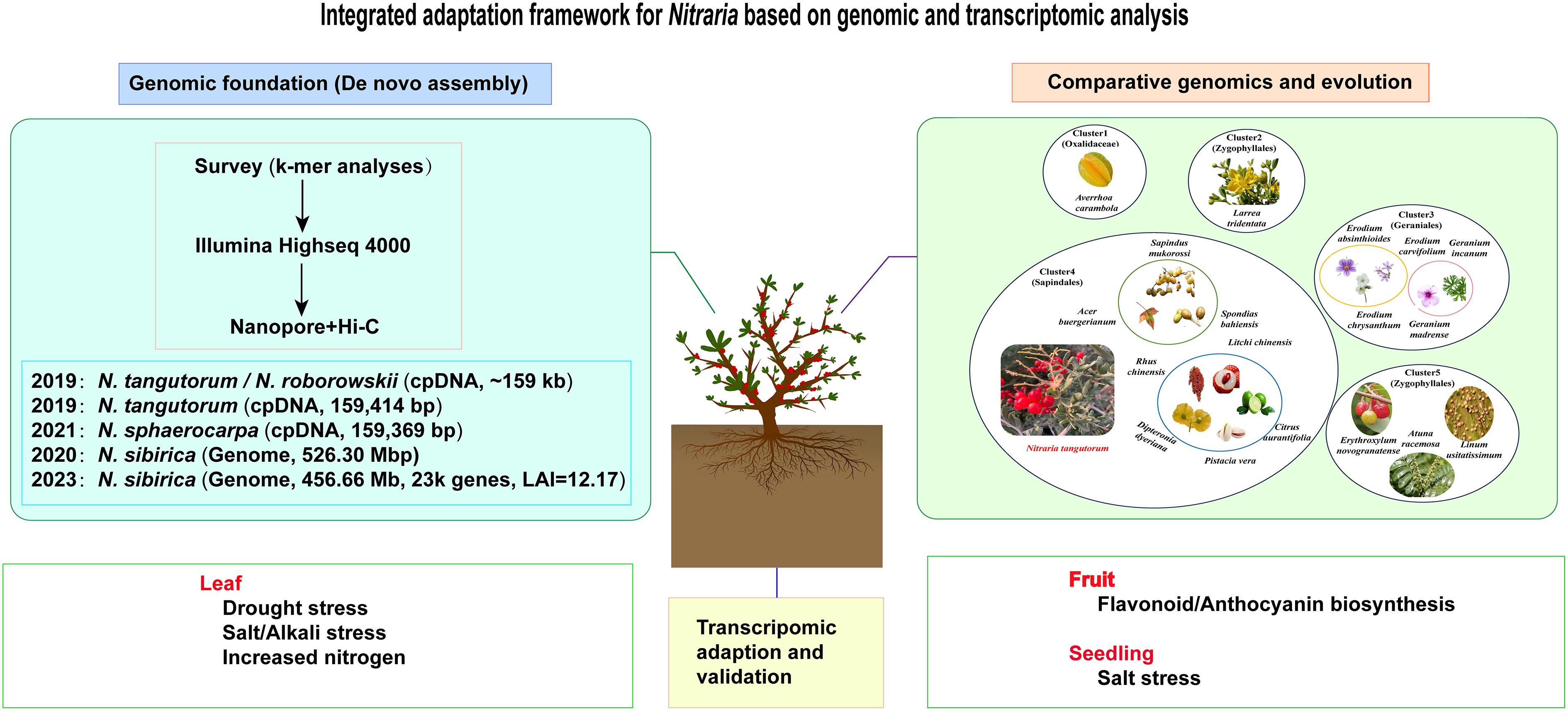
Figure 1.
Genome and transcriptome-based studies on adaptive evolution in Nitraria. This study employed multi-platform sequencing technologies to assemble the complete chloroplast genomes and whole-genome sequences of N. tangutorum and N. sibirica. Combined with transcriptomic profiling, it elucidates the molecular regulatory mechanisms underlying abiotic stress tolerance and the biosynthesis of bioactive compounds in the fruit of these species.
-
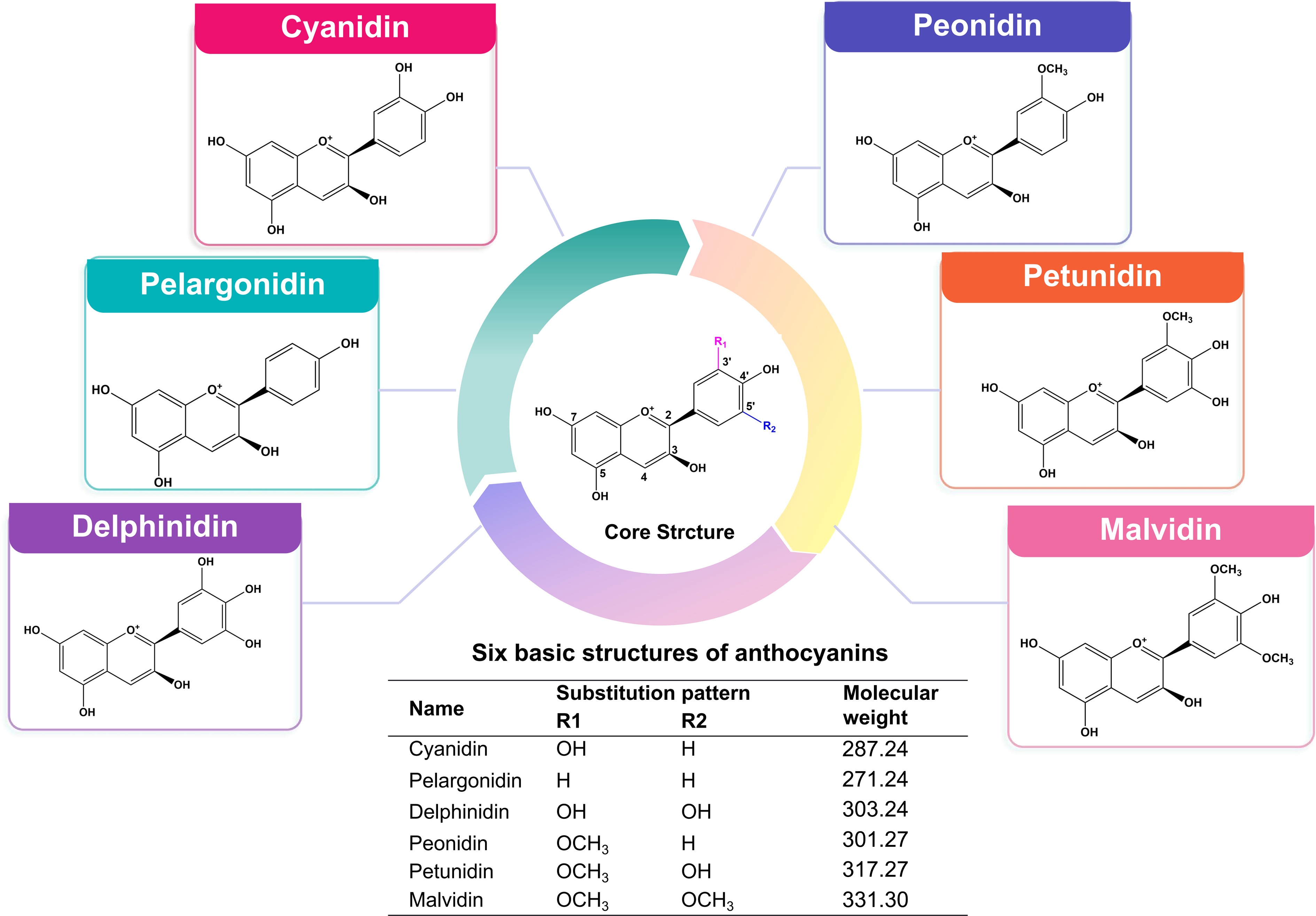
Figure 2.
Core skeleton and six basic structural classes of anthocyanidins. This figure illustrates the positively charged flavylium core skeleton of anthocyanidins, as well as the six fundamental anthocyanidin monomers derived from substitutions on the B-ring. A supplementary table lists their respective substituent groups and molecular weight characteristics.
-
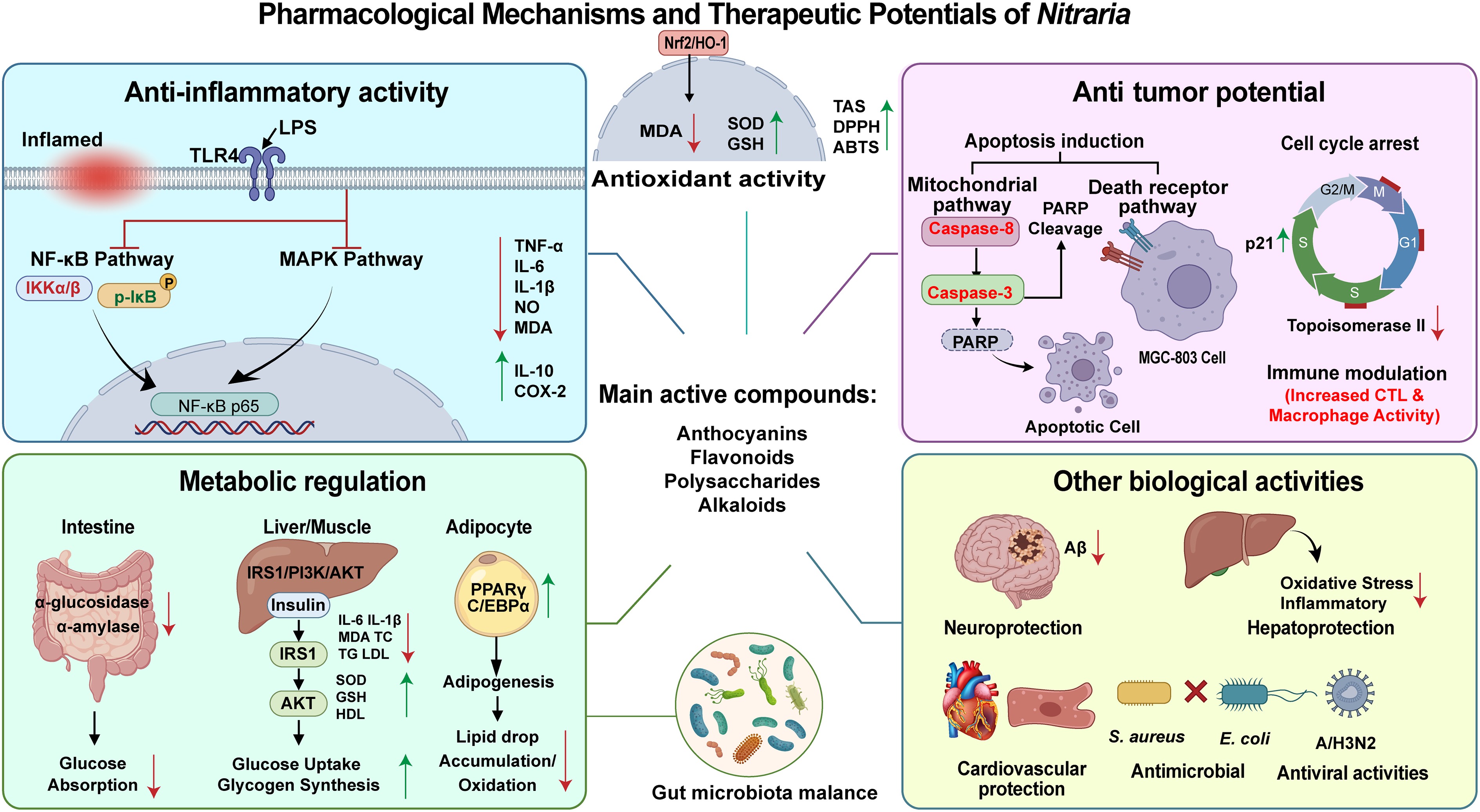
Figure 3.
Multitarget pharmacological regulatory mechanisms of bioactive constituents in Nitraria. This figure depicts the multi-target pharmacological pathways of key bioactive components from Nitraria, including anthocyanins and flavonoids, covering their mechanisms of anti-inflammation, antioxidant activity, anti-tumor effects, regulation of glucose and lipid metabolism, and antimicrobial and antiviral activities.
-
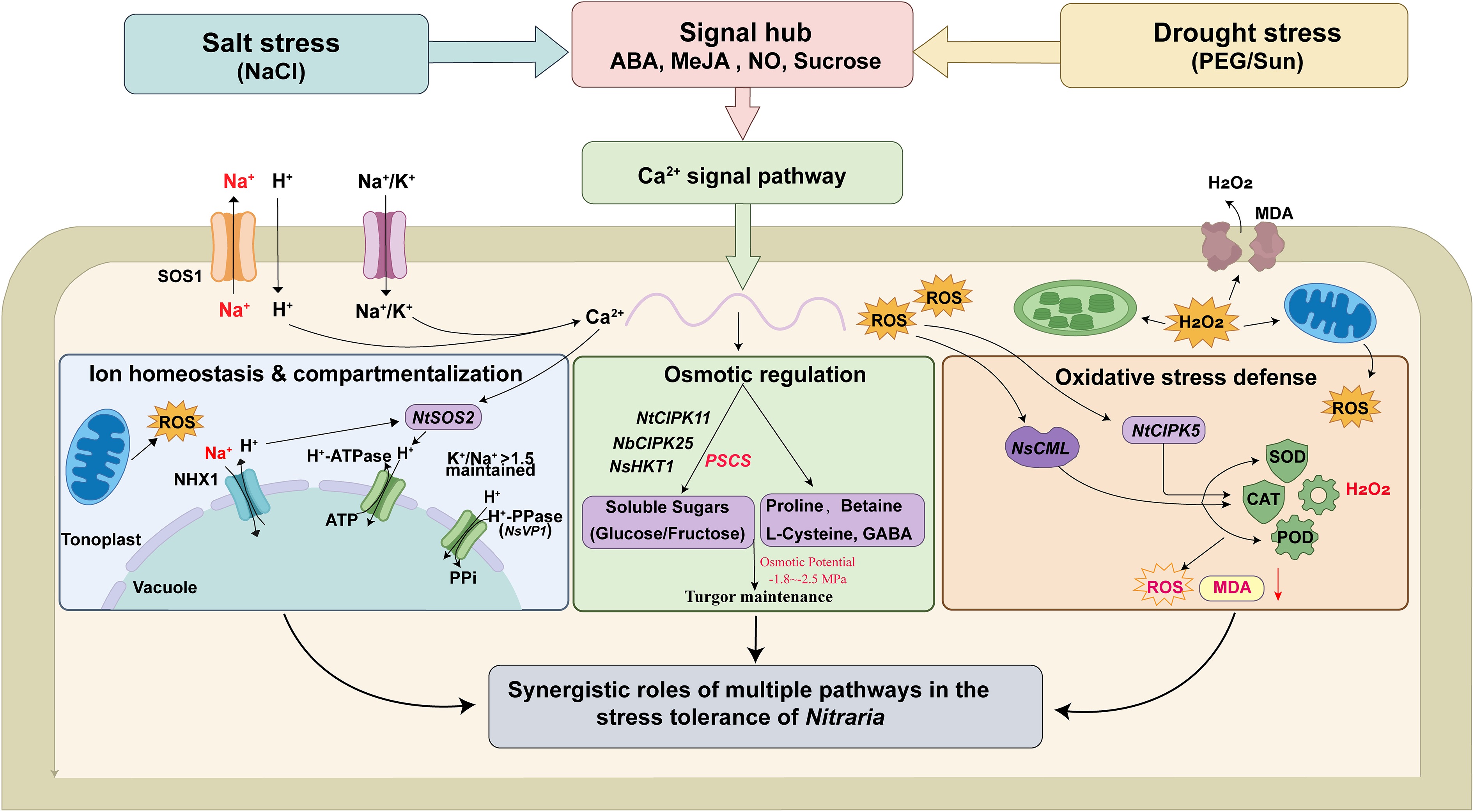
Figure 4.
Synergistic multi-pathway defense mechanisms of Nitraria under salt and drought stress. This figure dissects the molecular mechanisms by which Nitraria copes with salt and drought stresses via synergistic interactions among three major pathways: ion homeostasis, osmotic adjustment, and antioxidative defense.
-
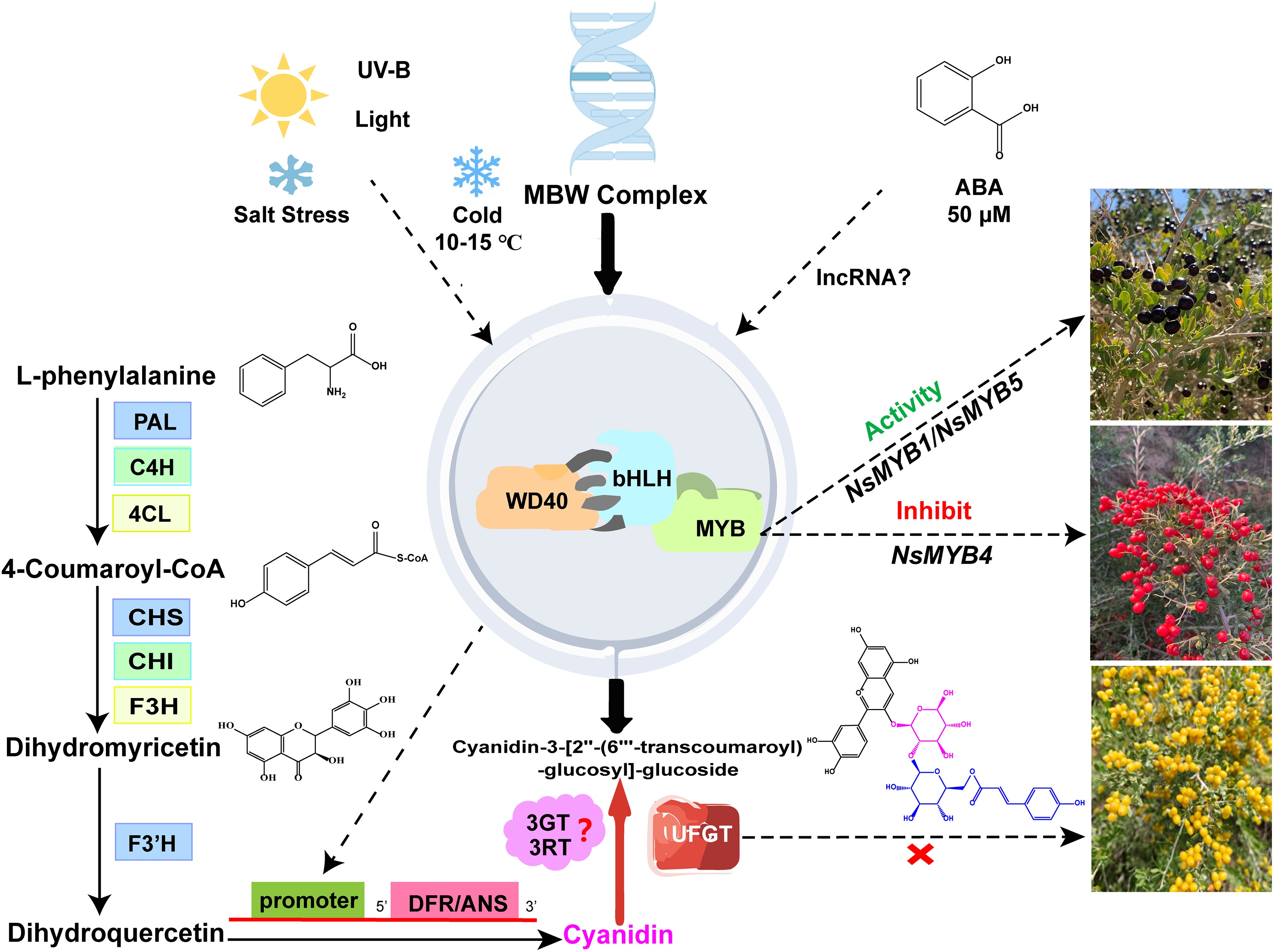
Figure 5.
Anthocyanin biosynthetic pathway and molecular regulatory network in Nitraria fruit. This figure defines the core biosynthetic pathway of anthocyanins in Nitraria fruits starting from L-phenylalanine and reveals the molecular basis underlying the formation of distinct fruit phenotypes modulated by environmental and endogenous signaling cues.
-
No. Compound MS+
(m/z)MS/MS
(m/z)Molecular
formulaCore structure Key distinguishing structural features Species Ref. 3' 5' 1 Cyanidin-3-O-diglucoside 611.16 287.05 C27H31O16+ Cyanidin Di-Glu OH N. sibirica [1,5,45,46] 2 Cyanidin-3-O-sambubioside 581.15 287.05 C26H29O15+ Cyanidin Samb OH N. sibirica/N. tangutorum [4,5,45] 3 Pelargonidin-3-O-diglucoside 595.17 271.06 C27H31O15+ Pelargonidin Di-Glu OH N. sibirica/N. tangutorum [1,5,46] 4 Peonidin-3-O-diglucoside 625.18 301.07 C28H33O16+ Peonidin Diglucoside OH N. sibirica/N. tangutorum [1,5,46] 5 Cyanidin-3-[2''-(6'''-transcaffeoyl)-glucosyl]-glucoside 773.19 287.05 C36H37O19+ Cyanidin Trans-caffeoyl-Di-Glu OH N. sibirica/N. tangutorum [5,46] 6 Cyanidin-3-[2″-(6‴-transcoumaroyl)-glucosyl]-glucoside 757.20 287.05 C36H37O18+ Cyanidin Trans-coumaroyl-Di-Glu OH N. sibirica/N. tangutorum [1,4,5,44−46] 7 Pelargonidin-3-O-(caffeoyl)-diglucoside 757.20 271.06 C36H37O18+ Pelargonidin Caffeoyl-Di-Glu OH N. sibirica/N. tangutorum [1,4,5,45] 8 Pelargonidin-3-[3-[2''-(6'''-transcoumaroyl)-glucosyl]-glucoside 741.20 271.06 C36H37O17+ Pelargonidin Transcoumaroyl-Di-Glu OH N. sibirica/N. tangutorum [5,45,46] 9 Cyanidin-3-O-[2-O-(β-D-glycopyranosyl)-β-D-glucopyranoside] 611.16 287.05 C27H31O16+ Cyanidin β-D-glycopyranosyl-β-
D-glucopyranosideOH N. tangutorum [1,4] 10 Cyanidin-3-[2″-(6‴-cis-caffeoyl)-glucosyl]-glucoside 773.19 287.05 C36H37O19+ Cyanidin Cis-caffeoyl-Di-Glu OH N. tangutorum [4] 11 Cyanidin-3-[2″-(6‴-ferulyl)-glucosyl]-glucoside 787.21 287.05 C37H39O19+ Cyanidin Ferulyl-Di-Glu OH N. tangutorum [1,4] 12 Pelargonidin-3-[2″-(6‴-ferulyl)-glucosyl]-glucoside 771.21 271.06 C37H39O18+ Pelargonidin Ferulyl-Di-Glu OH N. tangutorum [4] 13 Pelargonidin-3-[2″-(6‴-cis-coumaroyl)-glucosyl]-glucoside 741.20 271.06 C36H37O17+ Pelargonidin Cis-coumaroyl-Di-Glu OH N. tangutorum [1] 14 Cyanidin-3-O-hexose 449.11 287.05 C21H21O11+ Cyanidin Hex OH N. tangutorum [1] 15 Cyanidin-3-O-(cis-p-coumaroyl)-diglucoside 757.20 287.05 C36H37O18+ Cyanidin Cis-p-coumaroyl-Di-Glu OH N. tangutorum [1,46] 16 Delphinidin-3-O-(cis-p-coumaroyl)-glucoside 611.16 303.08 C30H27O14+ Delphinidin Cis-p-coumaroyl-Di-Glu OH N. tangutorum [1] 17 Cyanidin-3-O-(p-coumaroyl)-glucoside 595.17 287.05 C30H27O13+ Cyanidin p-coumaroyl-Glu OH N. tangutorum [1,45] 18 Malvidin-3-O-glucoside 493.13 331.10 C23H25O12+ Malvidin Glu OH N. tangutorum [45] 19 Delphinidin-3-O-(6″-O-coumaroyl)-glucoside,5-O-glucoside 773.19 303.08 C36H37O19+ Delphinidin Coumaroyl-Glu Glu N. tangutorum [4,45] 20 Delphinidin-3-O-(cis-p-coumaroyl)-glucoside-5-O-glucoside 773.19 303.08 C36H37O19+ Delphinidin cis-p-coumaroyl-Glu Glu N. tangutorum [1,45] 21 Delphinidin-3-O-(trans-p-coumaroyl)-glucoside-5-O-glucoside 773.19 303.08 C36H37O19+ Delphinidin Trans-p-coumaroyl-Glu Glu N. tangutorum [1] 22 Delphinidin-3-O-(caffeoyl)-diglucoside 773.19 303.08 C36H37O19+ Delphinidin Caffeoyl-Di-Glu OH N. tangutorum [46] 23 Peonidin-3-O-(6″-O-coumaroyl)-glucoside, 5-O-glucoside 771.21 301.07 C37H39O18+ Peonidin Coumaroyl-Glu Glu N. tangutorum [45] 24 Malvidin-3-O-(6″-O-acetyl)-glucoside 535.15 331.10 C25H27O13+ Malvidin Acetyl-Glu OH N. tangutorum [45] 25 Petunidin-3-O-(6″-O-coumaroyl)-glucoside 625.17 317.07 C31H29O14+ Petunidin Coumaroyl-Glu OH N. tangutorum [45] 26 Peonidin-3-O-(6″-O-coumaroyl)-glucoside 609.16 301.07 C30H27O14+ Peonidin Coumaroyl-Glu OH N. tangutorum [45] 27 Malvidin-3-O-(6"-O-coumaroyl)-glucoside, 5-O-glucoside 801.24 331.10 C38H39O19+ Malvidin Coumaroy-Glu Glu N. tangutorum [45] 28 Malvidin-3-O-(cis-6"-O-coumaroyl)-glucoside 639.20 331.10 C31H31O14+ Malvidin Cis-coumaroy-Glu OH N. tangutorum [45] 29 Malvidin-3-O-(trans-6"-O-coumaroyl)-glucoside 639.20 331.10 C31H31O14+ Malvidin Trans-coumaroy-Glu OH N. tangutorum [45] 30 Delphinidin-3-rutinoside 611.16 303.08 C27H31O16+ Delphinidin Rut OH N. tangutorum [46] Note: Di-Glu, diglucoside; Samb, sambubioside; Glu, glucoside; Hex, hexoside; Rut, rutinoside. Table 1.
Anthocyanins isolated from the fruits of Nitraria.
-
No. Compound [M-H]- Molecular formula Categories Species Ref. 1 Isorhamnetin 315.05 C16H12O7 Flavonoid N. retusa [8] 2 Isorhamnetin 3-O-glucoside 477.10 C22H22O12 Flavonoid N. retusa [8,49] 3 Isorhamnetin 3-O-rutinoside 623.16 C28H32O16 Flavonoid N. sibirica/N. tangutorum [8,12,49] 4 Kaempferol 3-O-neohesperidoside 593.15 C27H30O15 Flavonoid N. tangutorum [12] 5 Kaempferol 7-O-rutinoside 593.15 C27H30O15 Flavonoid N. tangutorum [12] 6 Quercetin 3-O-rutinoside 609.15 C27H30O16 Flavonoid N. sibirica/N. tangutorum [12,56] 7 Quercetin-3-O-(2G-rhamnosyl-rutinoside) 755.20 C33H40O20 Flavonoid N. sibirica/N. tangutorum [12,56] 8 Glucosyl-4-hydroxycinnamic acid 325.06 C15H18O8 Phenolic acid N. sibirica [58] 9 Gallic acid 169.02 C7H6O5 Phenolic acid N. retusa [54,55] 10 Ferulic acid hexoside 355.10 C16H20O9 Phenolic acid N. tangutorum [12] 11 Caffeic acid derivative 259.03 NA Phenolic acid N. tangutorum [12] 12 Ellagic acid 301.00 C14H6O8 Phenolic acid N. retusa [54,55] 13 Flazin 307.07 C17H12N2O4 Alkaloid N. sibirica/N. tangutorum [12,56,58] 14 N-(fructofuranosyl-2-O-glucoside)-tryptophan 526.99 C23H32N2O12 Alkaloid N. sibirica [58] 15 Tangutorid E 301.11 C16H18N2O4 Alkaloid N. sibirica/N. tangutorum [12,58] 16 Tangutorid C 345.07 C17H18N2O6 Alkaloid N. sibirica [58] 17 Tangutorid D 345.07 C17H18N2O6 Alkaloid N. sibirica [58] 18 β-carboline derivative 347.12 C17H20N2O6 Alkaloid N. tangutorum [12] 19 Tryptophan hexoside 365.13 C17H22N2O7 Alkaloid N. tangutorum [12] 20 Asparagine hexoside (I) 293.12 C10H18N2O8 Alkaloid N. tangutorum [12] 21 Tryptophan fructoside 365.13 C17H22N2O7 Alkaloid N. tangutorum [12] Table 2.
Summary of partial identified main bioactive constituents in Nitraria.
Figures
(5)
Tables
(2)