






Search
2020 Volume 7
Article Contents
RESEARCH ARTICLE   Open Access    

Aberrant Expression of Peroxisome Proliferator-Activated Receptors in Colorectal Cancer and Their Association with Cancer Progression and Prognosis

    Fund Project: The financial support for the study was provided by the Islamic Azad University (grant number 132655)
More Information
  • Corresponding author: Gholam Basati Department of Clinical Biochemistry, Faculty of Medicine Ilam University of Medical Sciences, Banganjab Street Ilam 693917143 (Iran) E-Mail basati-gh@medilam.ac.ir
  • Introduction: Peroxisome proliferator-activated receptors (PPARs), PPARα, PPARγ, and PPARδ, are nuclear ligand-activated transcription factors which presumably contribute to a broad range of pathophysiological processes, such as tumorigenesis. Nevertheless, their exact role as tumor suppressors or promoters is not straightforward in colorectal cancer (CRC). Therefore, expression values of these PPARs and their relation with tumor progression and prognosis were examined in CRC patients.
    Methods: In this work, the relative expression values of the PPARs were measured by real-time polymerase chain reaction in 100 CRC tumor tissues paired with adjacent normal tissues. After that, the association between relative expression values of the PPARs in tumor tissues and the cancer progression-related clinicopathological characteristics as well as overall survival of patients were assessed.
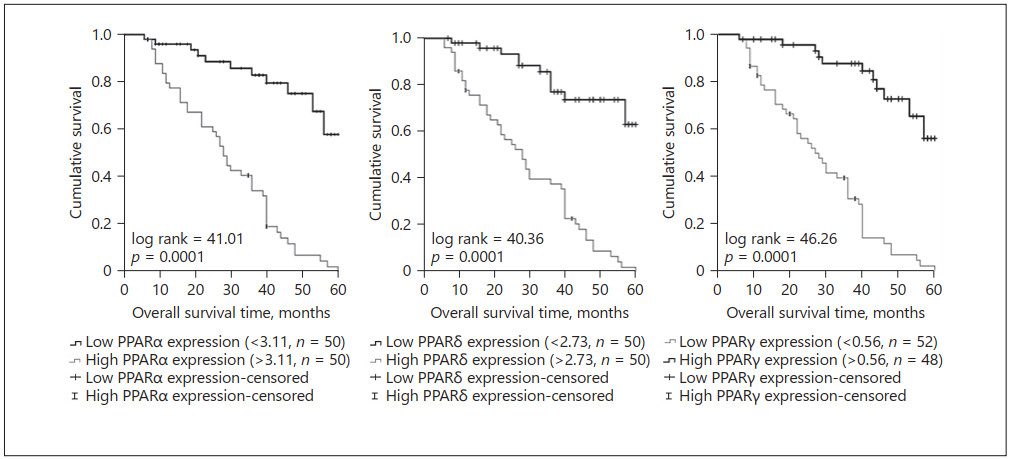
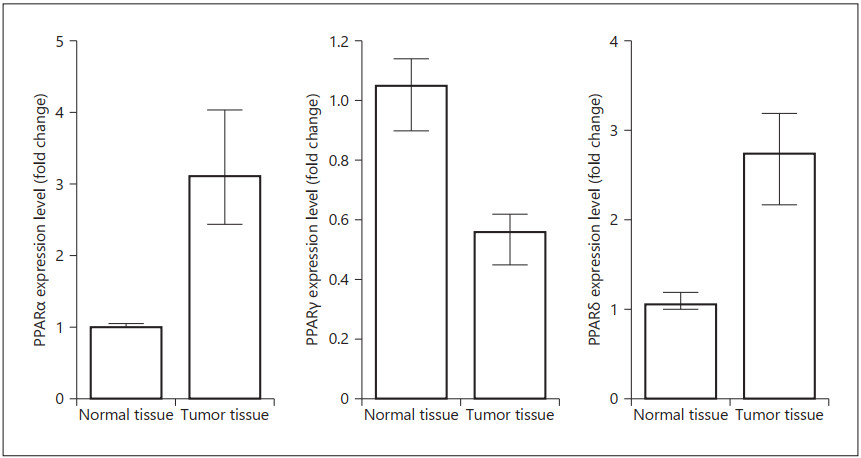
    Results: While PPARα and PPARδ seemed to be overexpressed, PPARγ was suppressed in CRC tumor tissues compared with paired adjacent normal tissues (p = 0.0001). The relative expressions of PPARα and PPARδ were negatively associated with tumor size, tumor grade, TNM stage, metastasis, lymphatic invasion, and decreased overall survival time (p < 0.05). The same associations, but in reverse direction, were found for PPARγ.
    Conclusions: It was found that PPARα and PPARδ were overexpressed while PPARγ was suppressed in CRC tumor tissues, and these deregulations are associated with cancer progression and poor prognosis.
  • Cite this article

    Musa Yaghoubizadeh, Leila Pishkar, Gholam Basati. 2020. Aberrant Expression of Peroxisome Proliferator-Activated Receptors in Colorectal Cancer and Their Association with Cancer Progression and Prognosis. Gastrointestinal Tumors. 7:5 doi: 10.1159/000503995
    Musa Yaghoubizadeh, Leila Pishkar, Gholam Basati. 2020. Aberrant Expression of Peroxisome Proliferator-Activated Receptors in Colorectal Cancer and Their Association with Cancer Progression and Prognosis. Gastrointestinal Tumors. 7:5 doi: 10.1159/000503995

Figures(2)  /  Tables(3)

Article Metrics

Article views(541) PDF downloads(378)

Other Articles By Authors

Research Article   Open Access    

Aberrant Expression of Peroxisome Proliferator-Activated Receptors in Colorectal Cancer and Their Association with Cancer Progression and Prognosis

    Fund Project: The financial support for the study was provided by the Islamic Azad University (grant number 132655)
  • Corresponding author: Gholam Basati Department of Clinical Biochemistry, Faculty of Medicine Ilam University of Medical Sciences, Banganjab Street Ilam 693917143 (Iran) E-Mail basati-gh@medilam.ac.ir
Fund Project:  The financial support for the study was provided by the Islamic Azad University (grant number 132655)
Gastrointestinal Tumors  7 Article number: 10.1159/000503995  (2020)  |  Cite this article

Abstract: 

Introduction: Peroxisome proliferator-activated receptors (PPARs), PPARα, PPARγ, and PPARδ, are nuclear ligand-activated transcription factors which presumably contribute to a broad range of pathophysiological processes, such as tumorigenesis. Nevertheless, their exact role as tumor suppressors or promoters is not straightforward in colorectal cancer (CRC). Therefore, expression values of these PPARs and their relation with tumor progression and prognosis were examined in CRC patients.
Methods: In this work, the relative expression values of the PPARs were measured by real-time polymerase chain reaction in 100 CRC tumor tissues paired with adjacent normal tissues. After that, the association between relative expression values of the PPARs in tumor tissues and the cancer progression-related clinicopathological characteristics as well as overall survival of patients were assessed.
Results: While PPARα and PPARδ seemed to be overexpressed, PPARγ was suppressed in CRC tumor tissues compared with paired adjacent normal tissues (p = 0.0001). The relative expressions of PPARα and PPARδ were negatively associated with tumor size, tumor grade, TNM stage, metastasis, lymphatic invasion, and decreased overall survival time (p < 0.05). The same associations, but in reverse direction, were found for PPARγ.
Conclusions: It was found that PPARα and PPARδ were overexpressed while PPARγ was suppressed in CRC tumor tissues, and these deregulations are associated with cancer progression and poor prognosis.

  • About this article
    Cite this article
    Musa Yaghoubizadeh, Leila Pishkar, Gholam Basati. 2020. Aberrant Expression of Peroxisome Proliferator-Activated Receptors in Colorectal Cancer and Their Association with Cancer Progression and Prognosis. Gastrointestinal Tumors. 7:5 doi: 10.1159/000503995
    Musa Yaghoubizadeh, Leila Pishkar, Gholam Basati. 2020. Aberrant Expression of Peroxisome Proliferator-Activated Receptors in Colorectal Cancer and Their Association with Cancer Progression and Prognosis. Gastrointestinal Tumors. 7:5 doi: 10.1159/000503995

Catalog

    /

    DownLoad:  Full-Size Img  PowerPoint
    Return
    Return