








Search
2021 Volume 8
Article Contents
RESEARCH ARTICLE   Open Access    

Trends and In-Hospital Outcomes of Splanchnic Vein Thrombosis Associated with Gastrointestinal Malignancies: A Nationwide Analysis

More Information
  • Corresponding author: Shivani Handa Department of Internal Medicine, Mount Sinai West and Morningside 1000 Tenth Avenue New York, NY 10019 (USA) shivanihanda5@gmail.com 
  • Introduction: Gastrointestinal cancers have a strong association with splanchnic vein thrombosis (SVT), yet the hospitalization data is unknown.
    Objective and Methods: We analyzed around 78 million discharges from the 2007–2017 Nationwide Inpatient Sample with an inclusion criterion of adult patients admitted for portal or hepatic vein thrombosis as a primary diagnosis with a gastrointestinal or hepatobiliary malignancy as a secondary diagnosis. The outcomes were in-hospital mortality, complication rates, and resource utilization. Odds ratios (OR) and means were adjusted for confounders using multivariate regression analysis models.
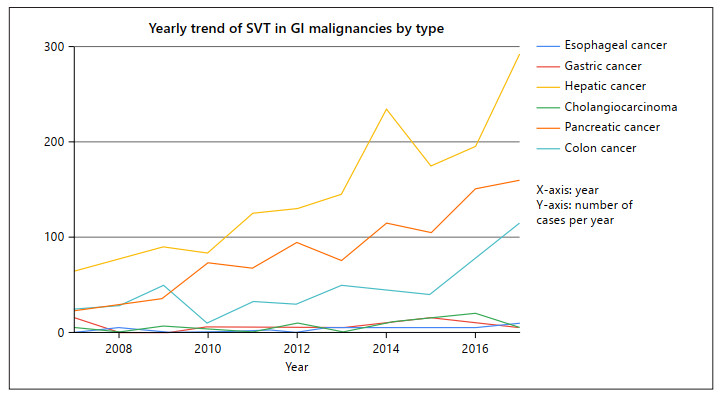
    Results: Out of the total 32,324 hospitalizations for SVT, 3,220 (10%) were associated with a GI malignancy, of which hepatocellular carcinoma (HCC) and pancreatic cancer were the most common. Portal vein thrombosis accounted for 95% of these hospitalizations. Admissions for pancreatic cancer-associated SVT have increased by 7.2 times from 2007 to 2017. Patients with SVT and concomitant GI malignancies were significantly older and had a higher comorbidity score than those with SVT without GI malignancy. Risk of inpatient mortality for SVT patients were significantly higher for patients with gastric cancer (rate: 12.1%, OR 8.6, 95% CI: 1.8–39.7) and HCC (rate: 7.6%, OR 2.77, 95% CI 1.5–4.8) as compared to non-GI malignancy-related SVT. Odds of variceal bleeding were significantly higher for patients with HCC (OR 1.67, 95% CI: 1.2–2.34) than patients without GI malignancy.
    Conclusions: Digestive cancer-associated SVTs constitute 10% of all SVT related hospitalizations and are significantly increasing in the past decade. We report the baseline characteristics and predictors of inpatient mortality in this study.
  • Cite this article

    Shivani Handa, Kamesh Gupta, Michelle Sterpi, Ahmad Khan, Abhinav Hoskote, Anup Kasi. 2021. Trends and In-Hospital Outcomes of Splanchnic Vein Thrombosis Associated with Gastrointestinal Malignancies: A Nationwide Analysis. Gastrointestinal Tumors. 8:513368 doi: 10.1159/000513368
    Shivani Handa, Kamesh Gupta, Michelle Sterpi, Ahmad Khan, Abhinav Hoskote, Anup Kasi. 2021. Trends and In-Hospital Outcomes of Splanchnic Vein Thrombosis Associated with Gastrointestinal Malignancies: A Nationwide Analysis. Gastrointestinal Tumors. 8:513368 doi: 10.1159/000513368

Figures(2)  /  Tables(4)

Article Metrics

Article views(679) PDF downloads(554)

Research Article   Open Access    

Trends and In-Hospital Outcomes of Splanchnic Vein Thrombosis Associated with Gastrointestinal Malignancies: A Nationwide Analysis

  • Corresponding author: Shivani Handa Department of Internal Medicine, Mount Sinai West and Morningside 1000 Tenth Avenue New York, NY 10019 (USA) shivanihanda5@gmail.com 
Gastrointestinal Tumors  8 Article number: 10.1159/000513368  (2021)  |  Cite this article

Abstract: 

Introduction: Gastrointestinal cancers have a strong association with splanchnic vein thrombosis (SVT), yet the hospitalization data is unknown.
Objective and Methods: We analyzed around 78 million discharges from the 2007–2017 Nationwide Inpatient Sample with an inclusion criterion of adult patients admitted for portal or hepatic vein thrombosis as a primary diagnosis with a gastrointestinal or hepatobiliary malignancy as a secondary diagnosis. The outcomes were in-hospital mortality, complication rates, and resource utilization. Odds ratios (OR) and means were adjusted for confounders using multivariate regression analysis models.
Results: Out of the total 32,324 hospitalizations for SVT, 3,220 (10%) were associated with a GI malignancy, of which hepatocellular carcinoma (HCC) and pancreatic cancer were the most common. Portal vein thrombosis accounted for 95% of these hospitalizations. Admissions for pancreatic cancer-associated SVT have increased by 7.2 times from 2007 to 2017. Patients with SVT and concomitant GI malignancies were significantly older and had a higher comorbidity score than those with SVT without GI malignancy. Risk of inpatient mortality for SVT patients were significantly higher for patients with gastric cancer (rate: 12.1%, OR 8.6, 95% CI: 1.8–39.7) and HCC (rate: 7.6%, OR 2.77, 95% CI 1.5–4.8) as compared to non-GI malignancy-related SVT. Odds of variceal bleeding were significantly higher for patients with HCC (OR 1.67, 95% CI: 1.2–2.34) than patients without GI malignancy.
Conclusions: Digestive cancer-associated SVTs constitute 10% of all SVT related hospitalizations and are significantly increasing in the past decade. We report the baseline characteristics and predictors of inpatient mortality in this study.
  • About this article
    Cite this article
    Shivani Handa, Kamesh Gupta, Michelle Sterpi, Ahmad Khan, Abhinav Hoskote, Anup Kasi. 2021. Trends and In-Hospital Outcomes of Splanchnic Vein Thrombosis Associated with Gastrointestinal Malignancies: A Nationwide Analysis. Gastrointestinal Tumors. 8:513368 doi: 10.1159/000513368
    Shivani Handa, Kamesh Gupta, Michelle Sterpi, Ahmad Khan, Abhinav Hoskote, Anup Kasi. 2021. Trends and In-Hospital Outcomes of Splanchnic Vein Thrombosis Associated with Gastrointestinal Malignancies: A Nationwide Analysis. Gastrointestinal Tumors. 8:513368 doi: 10.1159/000513368

Catalog

    /

    DownLoad:  Full-Size Img  PowerPoint
    Return
    Return