







Search
2021 Volume 8
Article Contents
RESEARCH ARTICLE   Open Access    

Capecitabine as Maintenance Therapy for High-Risk, Resected Colorectal Cancer

More Information
  • Corresponding author: Gerald M. Higa Departments of Clinical Pharmacy and Medicine West Virginia University, Schools of Pharmacy and Medicine 64 Medical Center Drive, Morgantown, WV 26506 (USA) ghiga@hsc.wvu.edu
  • Introduction: In 2020, colorectal cancer will be the fourth most frequently diagnosed malignant neoplasm and the second leading cause of site-specific, cancer-related deaths in the USA. Notably, 80% of the new cases are, by staging criteria, potentially curable even those with completely resected stage 4 disease. If slightly more than half the losses can be attributed to metastatic disease at presentation, then the remaining portion of deaths may be linked to disease relapse after surgery and, if applicable, adjuvant chemotherapy. The inference that these therapies are not curative for a significant number of subjects poses a role for maintenance therapy.
    Objective: To assess event-free survival (EFS) of patients who received capecitabine as maintenance therapy following treatment according to current guidelines.
    Methods: Clinical outcomes data were collected for 35 subjects treated with capecitabine as maintenance therapy. Descriptive statistical analyses were conducted on collective data related to duration of maintenance therapy and disease or clinical status from surgery to initial event. Kaplan-Meier method and log-rank test were used to analyze EFS and overall survival.
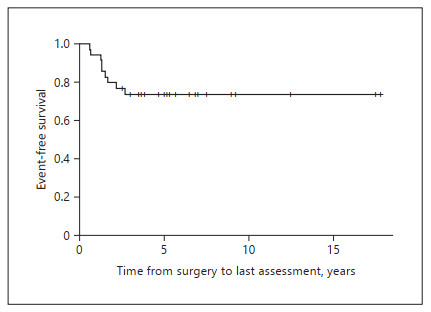
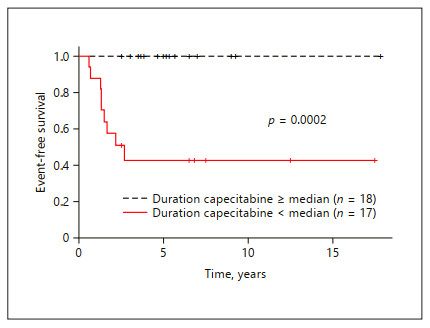
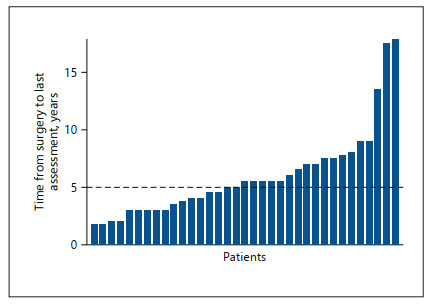
    Results: Of the entire cohort, 26 subjects have no evidence of disease (NED), a median of 5.5 years from surgery. Kaplan-Meier analyses indicated a 5-year EFS rate of 74% (95% CI: 60–90%). Eighteen of these 26 patients received capecitabine ≥30 months. Eight of the 17 subjects treated with capecitabine therapy for <30 months developed progressive disease; the majority of the relapses occurred within 20 months of surgery. The difference between the two groups was statistically significant. Six subjects died, only two of who had metastatic disease at the time of death; the other four had NED at least 4 years from surgery. Five patients with resected stage 4 disease who received capecitabine as maintenance therapy were alive >5 years from surgery.
    Conclusion: The findings and analyses of this cohort of patients suggest that maintenance capecitabine therapy reduces the risk of disease progression and cancer-related death.
  • Cite this article

    Miklos L. Auber, Sijin Wen, Gerald Hobbs, Gerald M. Higa. 2021. Capecitabine as Maintenance Therapy for High-Risk, Resected Colorectal Cancer. Gastrointestinal Tumors. 8: doi: 10.1159/000513960
    Miklos L. Auber, Sijin Wen, Gerald Hobbs, Gerald M. Higa. 2021. Capecitabine as Maintenance Therapy for High-Risk, Resected Colorectal Cancer. Gastrointestinal Tumors. 8: doi: 10.1159/000513960

Figures(3)  /  Tables(1)

Article Metrics

Article views(1030) PDF downloads(789)

Research Article   Open Access    

Capecitabine as Maintenance Therapy for High-Risk, Resected Colorectal Cancer

  • Corresponding author: Gerald M. Higa Departments of Clinical Pharmacy and Medicine West Virginia University, Schools of Pharmacy and Medicine 64 Medical Center Drive, Morgantown, WV 26506 (USA) ghiga@hsc.wvu.edu
Gastrointestinal Tumors  8 Article number: 10.1159/000513960  (2021)  |  Cite this article

Abstract: 

Introduction: In 2020, colorectal cancer will be the fourth most frequently diagnosed malignant neoplasm and the second leading cause of site-specific, cancer-related deaths in the USA. Notably, 80% of the new cases are, by staging criteria, potentially curable even those with completely resected stage 4 disease. If slightly more than half the losses can be attributed to metastatic disease at presentation, then the remaining portion of deaths may be linked to disease relapse after surgery and, if applicable, adjuvant chemotherapy. The inference that these therapies are not curative for a significant number of subjects poses a role for maintenance therapy.
Objective: To assess event-free survival (EFS) of patients who received capecitabine as maintenance therapy following treatment according to current guidelines.
Methods: Clinical outcomes data were collected for 35 subjects treated with capecitabine as maintenance therapy. Descriptive statistical analyses were conducted on collective data related to duration of maintenance therapy and disease or clinical status from surgery to initial event. Kaplan-Meier method and log-rank test were used to analyze EFS and overall survival.
Results: Of the entire cohort, 26 subjects have no evidence of disease (NED), a median of 5.5 years from surgery. Kaplan-Meier analyses indicated a 5-year EFS rate of 74% (95% CI: 60–90%). Eighteen of these 26 patients received capecitabine ≥30 months. Eight of the 17 subjects treated with capecitabine therapy for <30 months developed progressive disease; the majority of the relapses occurred within 20 months of surgery. The difference between the two groups was statistically significant. Six subjects died, only two of who had metastatic disease at the time of death; the other four had NED at least 4 years from surgery. Five patients with resected stage 4 disease who received capecitabine as maintenance therapy were alive >5 years from surgery.
Conclusion: The findings and analyses of this cohort of patients suggest that maintenance capecitabine therapy reduces the risk of disease progression and cancer-related death.

  • About this article
    Cite this article
    Miklos L. Auber, Sijin Wen, Gerald Hobbs, Gerald M. Higa. 2021. Capecitabine as Maintenance Therapy for High-Risk, Resected Colorectal Cancer. Gastrointestinal Tumors. 8: doi: 10.1159/000513960
    Miklos L. Auber, Sijin Wen, Gerald Hobbs, Gerald M. Higa. 2021. Capecitabine as Maintenance Therapy for High-Risk, Resected Colorectal Cancer. Gastrointestinal Tumors. 8: doi: 10.1159/000513960

Catalog

    /

    DownLoad:  Full-Size Img  PowerPoint
    Return
    Return