











-
Wheat (Triticum aestivum L.) is the most important food crop in the world. It provides about one-fifth of the daily calories and protein for more than two billion people and takes up more land than any other food crop[1]. It has been domesticated for a long time and can grow in a wide range of environments, from temperate to arid zones. This has made it important for both subsistence and commercial agriculture. However, the things that made wheat so successful in the past are becoming harder to do in the 21st Century: worsening droughts, competition for water between sectors, soil degradation, and higher production risk[2].
In Egypt, where wheat is the main food and a key part of social stability, these pressures are especially strong. Egypt is the world's largest wheat importer because it only grows about half of what it needs (about 9–10 million tonnes in recent years). The production system is limited by water because there is not much arable land (about 6%), there is not much rain, and the Nile's water is heavily relied on and managed through a large amount of infrastructure[3,4]. The irrigation network is experiencing financial losses, and the increasing demand exacerbates the situation. One of the country's most important social safety nets is bread subsidies, which mean that people must always have bread at home[5]. In this context, technologies that enhance water productivity while maintaining yield are not only advantageous for farming but also crucial for ensuring the country's food security.
Reclaimed land with sandy soils has contributed significantly to Egypt's recent agricultural growth[6]. These soils have big pores and rough particles, resulting in poor water retention, poor nutrient retention, and poor cohesion. These characteristics make it more likely that plants will lose nutrients and water. Low organic matter makes it even harder for cation exchange and microbes to work, which makes the cycle of low fertility and low resilience even stronger. There is not much room for error when watering sandy soil. If one does not provide them with enough water, they become very stressed, and if one supplies them with too much, the water quickly drains below the root zone, taking soluble nutrients with it[7−9].
Deficit irrigation is an effective strategy for water systems with insufficient water resources. Deficit irrigation aims to optimize production per unit of water by using less than complete crop evapotranspiration (ETc) while protecting the essential growth phases[10], instead of focusing on maximum yield per unit of area. Minor water deficits in wheat can elicit adaptation mechanisms such as stomatal regulation, osmotic correction, and the activation of antioxidant defenses. These reactions maintain stable performance under conditions of water scarcity[11,12]. Deficit irrigation can significantly reduce percolation losses in sandy soils, thus enhancing the overall efficiency of irrigation. Deficit irrigation imposes physiological stress on the organism, which may hinder growth, impair tillering, and restrict production if not managed properly. To guarantee efficient direct irrigation, additional techniques must be implemented to enhance plants' resilience and maintain the rhizosphere's activity during periods of water scarcity[13−15].
Plant biostimulants are a new technique. Biostimulants, unlike fertilizers, aim to improve physiological processes in plants and the interactions of roots, soil, and microbes instead of directly supplying nutrients[16,17]. Cyanobacterial (blue-green algae) products, including extracts from Nostoc spp., are particularly promising for arid and semi-arid agriculture. Nostoc are bacteria that fix nitrogen and have special heterocysts and an extracellular matrix that is rich in polysaccharides[18]. Extracts usually have phytohormone-like substances (auxins, cytokinins, gibberellins), amino acids, vitamins, antioxidants, and other bioactives that can change the structure of the roots, photosynthesis, and stress signaling[19]. In addition to foliar or root effects on the plant, Nostoc’s extracellular polymeric substances and metabolites can affect the rhizosphere by promoting microbial consortia, helping aggregates form, and slightly improving water retention and nutrients' residence time in sandy matrices that would otherwise leak[20].
These mechanistic characteristics render Nostoc extracts suitable additives for deficit irrigation. Deficit irrigation conceptually introduces regulated stress to conserve water; Nostoc priming can enhance stress tolerance, sustain photosynthetic activity, and preserve sink strength during grain filling[20,21]. At the whole-plant level, the expected results include enhanced root length density and branching (facilitating water and nutrient acquisition), regulated canopy temperature through improved stomatal control, and diminished oxidative damage during intermittent deficits[22]. At the interface between the soil and roots, exopolysaccahride (EPS)-mediated microaggregation and increased microbial activity may slightly slow the movement of water and make nutrients more available, which would help to overcome the natural problems of sandy substrates. The advantage of this priming is probably not linear; the interaction may be strongest at moderate deficits (for example, 80% ETc), where physiological buffering can maintain yield, and may taper off at severe deficits (for example, 60% ETc) if the stress is too much for the plant to handle[23,24].
Notwithstanding a robust theoretical framework, empirical investigations at the field level that combine deficit irrigation with Nostoc-based biostimulants in sandy soils are limited, especially under applicable irrigation thresholds (100%, 80%, and 60% ETc) and feasible spray schedules for farmers. Previous research has primarily focused on biostimulants or irrigation techniques independently, neglecting potential synergistic or antagonistic relationships. To address this deficit, the present work used clearly defined irrigation techniques, applied a designated Nostoc extract during the critical growth phases, and assessed agronomic outcomes related to water productivity in coarse-textured soils. Nostoc extract facilitates physiological priming and rhizosphere conditioning, thus mitigating the performance detriments typically associated with deficit irrigation. The expected advantages include enhanced water productivity and increased grain yield per unit of applied water without a corresponding decrease in productivity, particularly when the deficit irrigation is mild (80% ETc). This strategy provides advantages for agriculture and promotes sustainability by conserving irrigation water, which can be allocated to various districts to expand cultivated areas or address seasonal deficits. Moreover, the incorporation of biological nitrogen inputs and enhanced nutrient efficiency may reduce the reliance on synthetic fertilizers, benefiting both the economy and the environment in Egypt's sandy soils with low organic matter. The research aimed to (1) measure the impact of deficit irrigation at 100%, 80%, and 60% of crop evapotranspiration (ETc) on wheat's growth and yield; (2) analyze the effectiveness of Nostoc extract (administered via two foliar sprays at 30 and 45 days after sowing, at a concentration of 200 mL L−1) under each irrigation condition; and (3) evaluate the synergistic effects of deficit irrigation and Nostoc treatment, with an emphasis on preserving yield and improving water productivity.
-
The experiments were conducted at the experimental farm of Arab El-Awammer Research Station Agricultural Research Center (ARC) (latitude 27°16' N, longitude 31°08' E and 71 m above sea level), Assiut, Egypt. The physical and chemical characteristics of the experimental site are shown in Table 1. In addition, the climatic data of the experimental area during the growing seasons are presented in Table 2. We used a randomized complete block design (RCBD) in a split-plot setup with three replicates on sandy calcareous soil. The main plots received three irrigation levels: 100%, 80%, and 60% of ETc, representing full supply, moderate deficit, and severe deficit. Subplots received either no algae or a Nostoc algae extract applied twice at 30 and 45 days after sowing, coinciding with tillering and early stem elongation, when modulation of root growth, tiller survival, and canopy development can have very strong effects on the subsequent resource capture and yield formation. The application dose (200 mL extract per L spray solution) reflects a practical rate used in on-farm biostimulant programs and ensured operational relevance. The drip irrigation system consisted of 16-mm GR polyethylene tubing with integrated emitters spaced 30 cm apart. Lateral lines were arranged 50 cm apart, and each emitter delivered water at a rate of 4 L h−1 under a pressure of 1.5 bars. The wheat cultivar ('Sids-12') was sown at a seeding rate of 80 kg feddan−1 (one feddan = 4,200 m2) on 28 and 30 November during the 2022–2023 and 2023–2024 winters, respectively. Harvesting took place on 25 and 26 April in the first and second seasons, respectively. All agronomic practices were carried out according to the standard recommendations of the Egyptian Ministry of Agriculture. Phosphorus and potassium fertilizers were applied at rates of 30 kg P2O5 feddan−1 and 50 kg K2O feddan−1. Triple superphosphate (46% P2O5) was incorporated into the soil in a single dose before planting, whereas potassium sulfate (50% K2O) was applied in two equal splits during the growing season. Nitrogen fertilizer was supplied through the irrigation system as ammonium nitrate (33.5% N), applied in six equal fertigation doses starting 15 days after planting and continuing at 10-day intervals.
Table 1. Physical and chemical properties of representative composite soil samples from the experimental field site.
Property Value Sand (%) 87.67 Silt (%) 8.06 Clay (%) 4.27 Texture grade Sand Water-holding capacity (%) 23.08 Bulk density (ton m−3) 1.65 Organic matter (%) 0.78 CaCO3 (g kg−1) 280.5 pH (1:1) 8.46 EC (1:1) (ds m−1) 0.58 Soluble cations (mmol kg−1) Calcium 1.67 Magnesium 0.69 Sodium 0.83 Potassium 0.26 Soluble anions (mmol kg−1) Bicarbonate 0.43 Chloride 1.54 Sulfate 1.92 Available macronutrients (mg kg−1) Nitrogen 32.2 Phosphorus (Olsen) 7.9 Potassium 40.1 EC electrical conductivity. Table 2. Mean monthly meteorological data obtained from the Assiut weather station during two seasons, 2022–2023 and 2023–2024.
Temperature (°C) Relative
humidity (%)Wind speed
(km/h)Sunshine
hours (h)Max Min 2022–2023 December 22.9 9.3 57.6 9.6 9.0 January 21.1 7.1 56 10.1 8.9 February 20.2 6.1 51 11.8 9.7 March 27.1 12.1 34.3 9.9 9.9 April 31.5 15.1 25.5 14.2 10.3 2023–2024 December 23.4 9.9 60.2 8.9 9.0 January 20.9 7.1 53.2 9.1 8.9 February 21.9 8.2 46.3 10.5 9.7 March 26.6 11.1 36.5 10.9 9.9 April 32.1 16.6 32.6 13.7 10.3 Soil and plant analysis
-
To determine the nitrogen, phosphorus, and potassium, plant samples were air-dried then oven dried at 70 °C to a constant weight. Accurately weighed samples of 0.5 g of the dried ground materials were subjected to wet digestion using a mixture of sulfuric acid and hydrogen peroxide[25]. The digested materials were subjected to analysis to determine the N, P, and K contents. Nitrogen concentration was determined via the modified Kjeldahl method[26]. However, phosphorus was calorimetrically measured according to Jackson[27]. Potassium was measured by flame photometry following Jackson[27].
CROPWAT model
-
The CROPWAT model was used to calculate reference evapotranspiration according to the Penman–Monteith model. Crop evapotranspiration was calculated according to Allen et al. as follows[28]:
$ ET_c=ET_0 \times K_c $ (1) where, ETc is crop evapotranspiration; ET0 is the reference evapotranspiration, and Kc is the crop coefficient (from FAO Paper 56)[28].
The amounts of actual irrigation water applied under each irrigation treatment were determined via the following equation from James[29]:
$ {I.R_a}=\dfrac{{ET_c + Lf}}{{E_r}} $ (2) where, I.Ra is the total actual irrigation water applied (mm) per interval, ETc is the crop evapotranspiration calculated by the CROPWAT model (8), Lf is the leaching factor (10%), and Er is the irrigation system's efficiency.
The irrigation water productivity (kg m−3) values were calculated as follows:
$ \rm {Water\; productivity}=\dfrac{{Grain\; yield\; (kg\; fed^{-1})}}{{Irrigation\; water \;applied \;(m^3\;fed^{-1})}} $ (3) Data analysis
-
Data analysis was conducted using SPSS version 20 (SPSS Inc., USA). The normality of the data was verified prior to analysis. Analysis of variance (ANOVA) was performed to assess differences in the soil indicators among the treatments (p ≤ 0.05), and means were compared using Duncan's multiple range test at the 5% level. Correlation analyses examining the relationships among soil and plant properties were conducted using OriginPro 2021. A partial least squares structural equation model (PLS-SEM) was constructed using SmartPLS 4 to elucidate the direct and indirect effects of key variables on water productivity. The model's fit was primarily evaluated using the standardized root mean square residual (SRMR) and the normed fit index (NFI), which are recommended global fit measures in PLS-SEM. The model showed an excellent fit, with an SRMR value of 0.00 (below the 0.08 threshold) and an NFI value of 1.00, indicating the mode'ls very good performance overall. The variables were selected according to the study's core hypothesis and supported by preliminary correlation and multicollinearity tests, ensuring the statistical robustness and clarity of the model.
-
By studying the soil properties (Table 3) with the treatments applied in the experimental field, we find that the application of algae increased the percentage of organic matter in the soil under all irrigation treatments and was higher under 80% ETc and 60% ETc, was higher in the second season (0.95 ± 0.00) for both treatments, and took the same direction. The electrical conductivity (EC) and water-holding capacity (WHC) did not record any significant differences between the water treatments and the algae treatments (p ≤ 0.05). The soil pH was in the completely opposite direction, as the application of algae led to a decrease in the acidity and this decrease grew greatest with a decrease in the amount of water applied under 60% ETc, where a decrease of 0.29 was recorded in the first season and a peak of 0.31 in the second season.
Table 3. Effect of irrigation levels and algae on soil properties.
Irrigation Algae OM (%) WHC (%) pH EC (ds m−1) 2022–2023 2023–2024 2022–2023 2023–2024 2022–2023 2023–2024 2022–2023 2023–2024 100% Without 0.84 ± 0.00 0.86 ± 0.01 22.77 ± 0.18 23.43 ± 0.43 8.12 ± 0.05 8.16 ± 0.07 0.33 ± 0.01 0.34 ± 0.00 With 0.89 ± 0.00 0.89 ± 0.02 23.57 ± 0.46 24.10 ± 0.22 8.04 ± 0.04 8.03 ± 0.03 0.36 ± 0.01 0.36 ± 0.01 80% Without 0.82 ± 0.01 0.83 ± 0.01 22.88 ± 0.26 23.55 ± 0.43 8.16 ± 0.10 8.10 ± 0.03 0.59 ± 0.03 0.59 ± 0.01 With 0.94 ± 0.00 0.95 ± 0.00 24.07 ± 0.73 24.47 ± 0.33 8.03 ± 0.03 8.02 ± 0.01 0.62 ± 0.01 0.61 ± 0.01 60% Without 0.82 ± 0.02 0.83 ± 0.01 22.30 ± 0.56 22.97 ± 0.03 8.42 ± 0.09 8.35 ± 0.04 0.63 ± 0.02 0.62 ± 0.01 With 0.93 ± 0.00 0.95 ± 0.02 24.22 ± 0.26 24.38 ± 0.19 8.13 ± 0.05 8.04 ± 0.04 0.69 ± 0.01 0.67 ± 0.00 Irrigation ** ns ns ns ** ** ** ** Algae ** ** ** ** ** ** ** ** interaction ** ** ns ns * ** ns ** Data are presented as the mean ± standard deviation. OM, organic matter; WHC, water-holding capacity; EC, electrical conductivity. * p-value ≤ 0.05, ** p-value ≤ 0.001; ns = nonsignificant. Water productivity under different irrigation levels and algae treatments
-
Figure 1 presents the paired samples' t-test results comparing the effect of algae treatment on water productivity under different irrigation levels (100%, 80%, and 60% of ETc). Across all irrigation regimes, the algae treatment increased water productivity relative to the corresponding treatments without algae. The increases were statistically significant at 100% ETc and 80% ETc (p ≤ 0.05), but not at 60% ETc in the first season (p = 0.86) and the second season (p = 0.58). Application of algae under 80% ETc increased water productivity by 12.01% and 12.19% in the first and second seasons, respectively, compared with the treatment without algae.
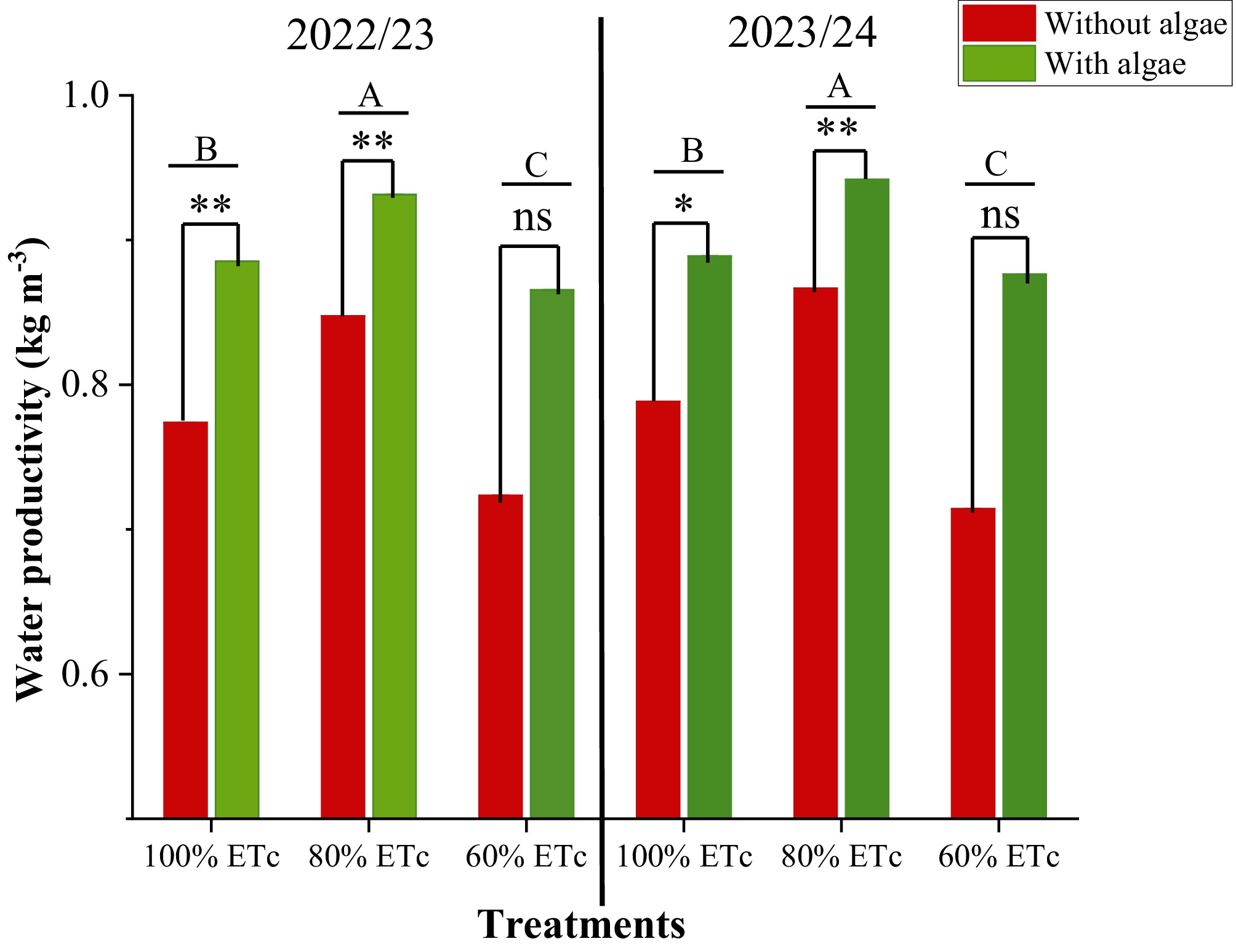
Figure 1.
Paired samples t-test analysis comparing the effect of applying algae on water productivity under different irrigation levels. *p ≤ 0.05; **p ≤ 0.001; ns = nonsignificant. A, B, and C refer to the differences between the means of various irrigation levels.
Effect of irrigation levels and algae treatment on plant characteristics and nutrient concentrations
-
Table 4 shows that plant characteristics (plant height, total yield, grain yield, straw yield, and seed index) increased with increasing irrigation water and algae treatment. The lowest value was recorded at 60% ETc without adding algae in both seasons. Significant differences were found for irrigation levels and algae treatments (p ≤ 0.05). No significant differences were found for the interaction between them except for the seed index in the second season. For example, total yield recorded the highest value at 100% ETc in the second season with algae (5,526.43 ± 61.30 kg feddan−1), but the lowest value was recorded in the first season under 60% ETc without algae (2,880.97 ± 37.81 kg feddan−1). Tables 5 and 6 show the nutrient concentrations in the straw and grain. We observe that the addition of algae led to a significant increase (p ≤ 0.05) in nutrient concentrations in both straw and grain under all irrigation treatments. For example, the percentage of N in the straw reached its highest level at 60% ETc with algae (0.74 ± 0.01) and its lowest value at 100% ETc without algae (0.45 ± 0.02).
Table 4. Effect of irrigation levels and algae on wheat yield.
Irrigation Algae Plant height (cm) Total yield (kg feddan−1) Grain yield (kg feddan−1) Straw yield (kg feddan−1) Seed index (g) 2022–2023 2023–2024 2022–2023 2023–2024 2022–2023 2023–2024 2022–2023 2023–2024 2022–2023 2023–2024 100% Without 97.07 ± 1.15 104.33 ± 2.16 4,866.33 ± 128.56 5,130.03 ± 23.09 1,815.83 ± 35.72 1,932.47 ± 23.77 3,050.53 ± 135.71 3,197.57 ± 21.96 49.07 ± 0.57 52.37 ± 0.55 With 100.00 ± 1.87 107.50 ± 1.13 5,184.50 ± 90.56 5,526.43 ± 61.30 1,989.03 ± 31.24 2,097.13 ± 31.76 3,195.50 ± 98.58 3,429.30 ± 58.75 50.00 ± 0.10 53.40 ± 0.26 80% Without 90.80 ± 3.26 97.20 ± 1.00 4,488.57 ± 35.61 4,782.73 ± 22.15 1,590.83 ± 27.32 1,699.53 ± 15.30 2,897.73 ± 56.79 3,083.20 ± 33.52 44.77 ± 0.58 47.60 ± 0.61 With 93.93 ± 3.05 101.97 ± 1.93 4,758.60 ± 197.37 5,028.33 ± 155.44 1,781.97 ± 15.47 1,906.67 ± 16.61 2,976.70 ± 211.23 3,121.70 ± 171.29 46.93 ± 0.15 50.30 ± 0.26 60% Without 75.93 ± 0.76 78.40 ± 0.56 2,880.97 ± 37.81 3,031.13 ± 18.82 1,018.50 ± 97.45 1,050.40 ± 70.54 1,862.53 ± 112.92 1,980.80 ± 54.87 36.53 ± 0.49 38.80 ± 0.10 With 80.00 ± 0.26 83.43 ± 0.95 3,107.83 ± 58.75 3,282.97 ± 20.07 1,132.30 ± 13.05 1,217.63 ± 24.40 1,975.50 ± 57.12 2,065.33 ± 20.48 38.27 ± 0.55 40.93 ± 0.59 Irrigation ** ** ** ** ** ** ** ** ** ** Algae ** ** ** ** ** ** ns ** ** ** Interaction ns ns ns ns ns ns ns ns ns * Data are presented as the mean ± standard deviation. * p ≤ 0.05; ** p ≤ 0.001; ns = nonsignificant. Table 5. Effect of irrigation levels and algae on the nutrient content of straw.
Irrigation Algae N in straw (%) P in straw (%) K in straw (%) 2022–2023 2023–2024 2022–2023 2023–2024 2022–2023 2023–2024 100% Without 0.45 ± 0.02 0.45 ± 0.01 0.18 ± 0.01 0.18 ± 0.01 1.24 ± 0.01 1.27 ± 0.01 With 0.57 ± 0.02 0.59 ± 0.02 0.19 ± 0.01 0.19 ± 0.01 1.27 ± 0.01 1.30 ± 0.01 80% Without 0.51 ± 0.02 0.53 ± 0.01 0.18 ± 0.01 0.18 ± 0.01 1.25 ± 0.01 1.29 ± 0.01 With 0.63 ± 0.02 0.65 ± 0.01 0.20 ± 0.01 0.20 ± 0.01 1.28 ± 0.01 1.31 ± 0.01 60% Without 0.60 ± 0.02 0.62 ± 0.01 0.19 ± 0.01 0.19 ± 0.01 1.27 ± 0.01 1.30 ± 0.01 With 0.72 ± 0.01 0.74 ± 0.01 0.20 ± 0.01 0.20 ± 0.01 1.30 ± 0.01 1.34 ± 0.01 Irrigation ** ** * ns ** ** Algae ** ** ** ** ** ** Interaction ns ns ns ns ns ns Mean ± standard deviation. N nitrogen, P phosphorus, K potassium. * p value ≤ 0.05; ** p value ≤ 0.001; ns = nonsignificant. Table 6. Effect of irrigation levels and algae on the nutrient content of grain.
Irrigation Algae N in grain (%) P in grain (%) K in grain (%) 2022–2023 2023–2024 2022–2023 2023–2024 2022–2023 2023–2024 100% Without 1.59 ± 0.01 1.64 ± 0.01 0.31 ± 0.01 0.32 ± 0.01 0.63 ± 0.01 0.65 ± 0.01 With 1.72 ± 0.01 1.74 ± 0.00 0.43 ± 0.02 0.44 ± 0.01 0.67 ± 0.02 0.69 ± 0.02 80% Without 1.71 ± 0.01 1.75 ± 0.00 0.39 ± 0.01 0.40 ± 0.01 0.64 ± 0.01 0.66 ± 0.01 With 1.92 ± 0.04 1.98 ± 0.04 0.54 ± 0.02 0.55 ± 0.02 0.73 ± 0.01 0.75 ± 0.01 60% Without 1.94 ± 0.05 1.95 ± 0.00 0.44 ± 0.02 0.44 ± 0.01 0.71 ± 0.01 0.72 ± 0.01 With 2.05 ± 0.03 2.05 ± 0.04 0.63 ± 0.01 0.64 ± 0.01 0.75 ± 0.01 0.77 ± 0.01 Irrigation ** ** ** ** ** ** Algae ** ** ** ** ** ** Interaction * ** ** ** ** ** Mean ± standard deviation. N nitrogen, P phosphorus, K potassium. * p value ≤ 0.05, ** p value ≤ 0.001; ns = non-significant. Relationship between soil properties and plant characteristics
-
The correlation matrix illustrates the interrelationships among soil and plant variables (Fig. 2). Organic matter exhibited a significant positive correlation with N, P, and K contents in both the straw and grain, indicating that nutrient accumulation in plant tissues is strongly associated with soil organic matter status. Conversely, organic matter exhibited a significant negative correlation with soil pH, indicating that elevated organic matter levels are associated with intensified soil acidification processes. Soil pH demonstrated significant negative correlations with most nutrient parameters, including N, P, and K in the plants, highlighting that nutrient availability tends to increase under a decline in soil pH. Strong positive correlations were also observed among plant nutrient contents (N, P, and K), reflecting their co-accumulation in plant tissues and suggesting possible synergistic uptake mechanisms. Furthermore, soil and plant nutrient concentrations were positively correlated, indicating that improved soil fertility directly enhances plants' nutrient acquisition.
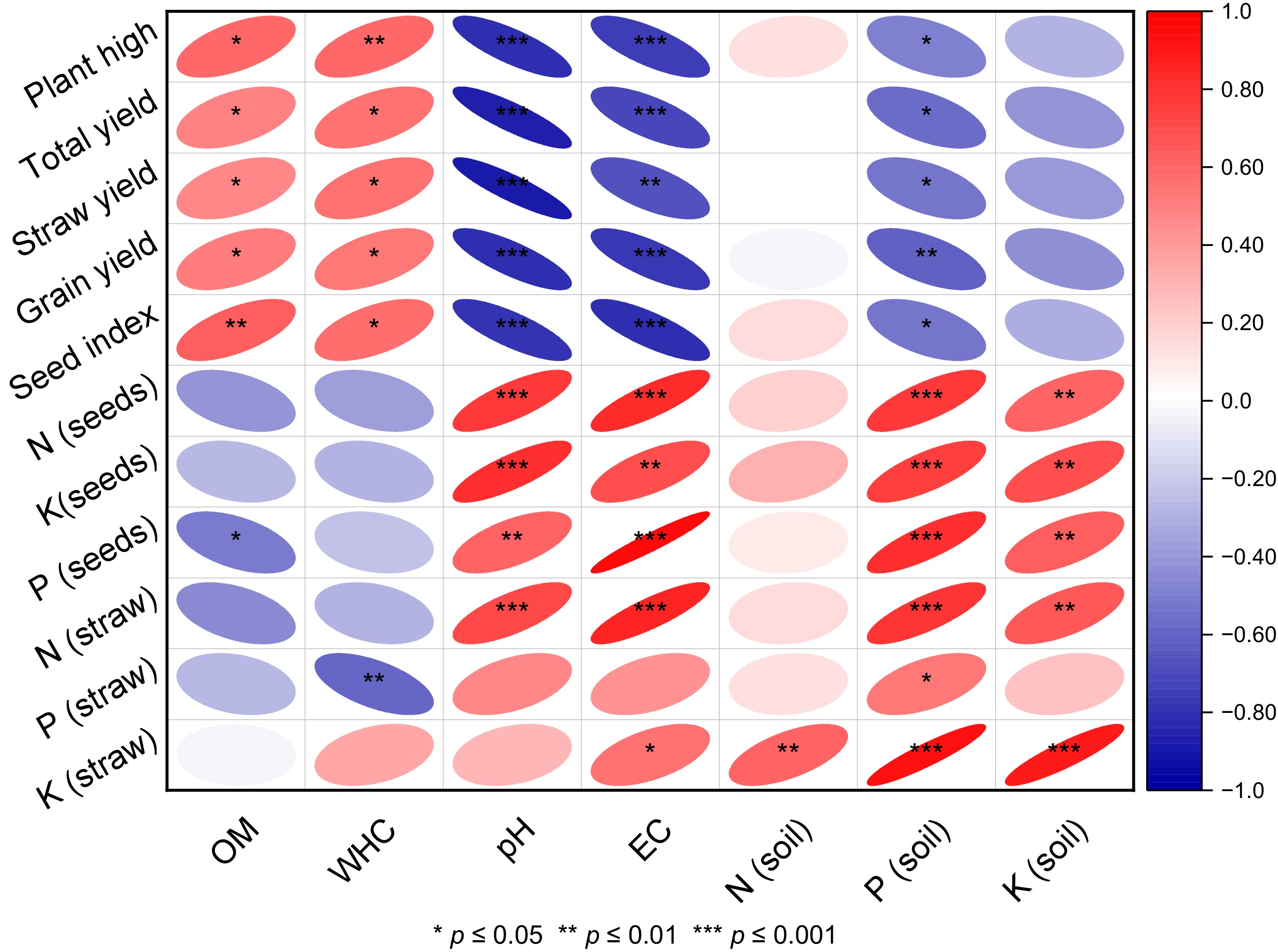
Figure 2.
Pearson's correlation analysis of soil and plant properties under different irrigation levels and algae treatments. OM, organic matter; WHC, water-holding capacity; NPK (soil).
Irrigation water applied at different growth stages
-
Figure 3 illustrates the irrigation water applied (m3 feddan−1) at different growth stages of wheat under three irrigation levels (100%, 80%, and 60% ETc) during the 2022–2023 and 2023–2024 growing seasons. In both seasons, the amount of irrigation water increased progressively from the initial to the mid-season stage, followed by a decline during the late-season stage. The mid-season stage recorded the highest level of irrigation water, reflecting the period of peak water demand for wheat growth. Across both years, the irrigation levels showed a consistent pattern: The 100% ETc treatment received the highest total amount of water, followed by 80% ETc and 60% ETc. Although the overall trend was similar between the two seasons, slightly higher irrigation volumes were recorded in 2023–2024 compared with 2022–2023, which may be attributed to variations in climatic conditions or reference evapotranspiration (ET0) during the growing periods (Fig. 4).
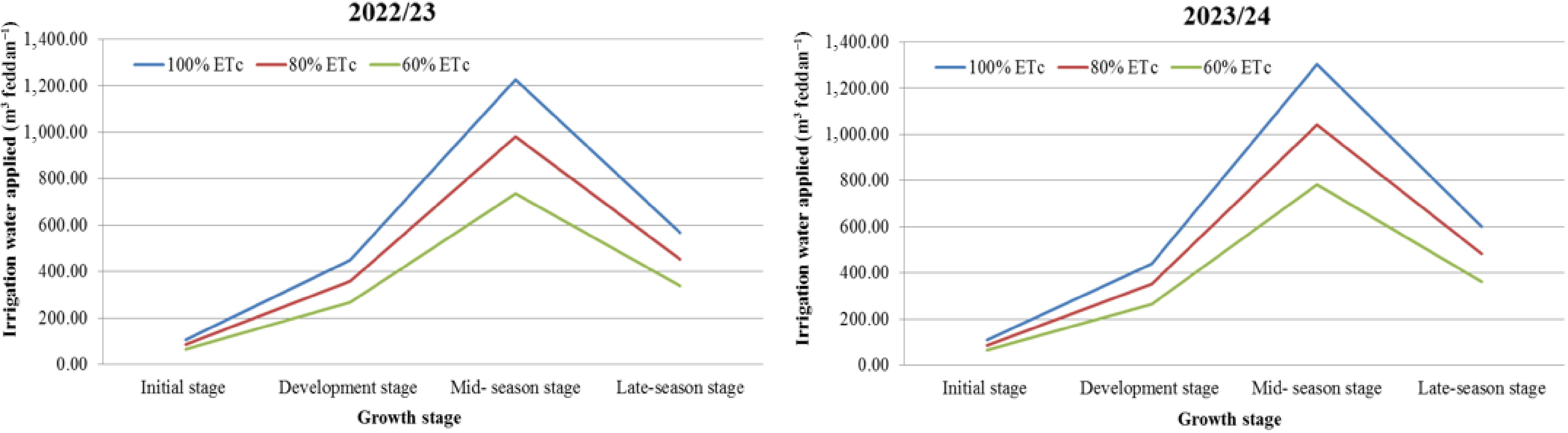
Figure 3.
Irrigation water applied (m3 feddan−1) at different growth stages of wheat grown under different irrigation levels during the two seasons 2022/2023 and 2023/2024.
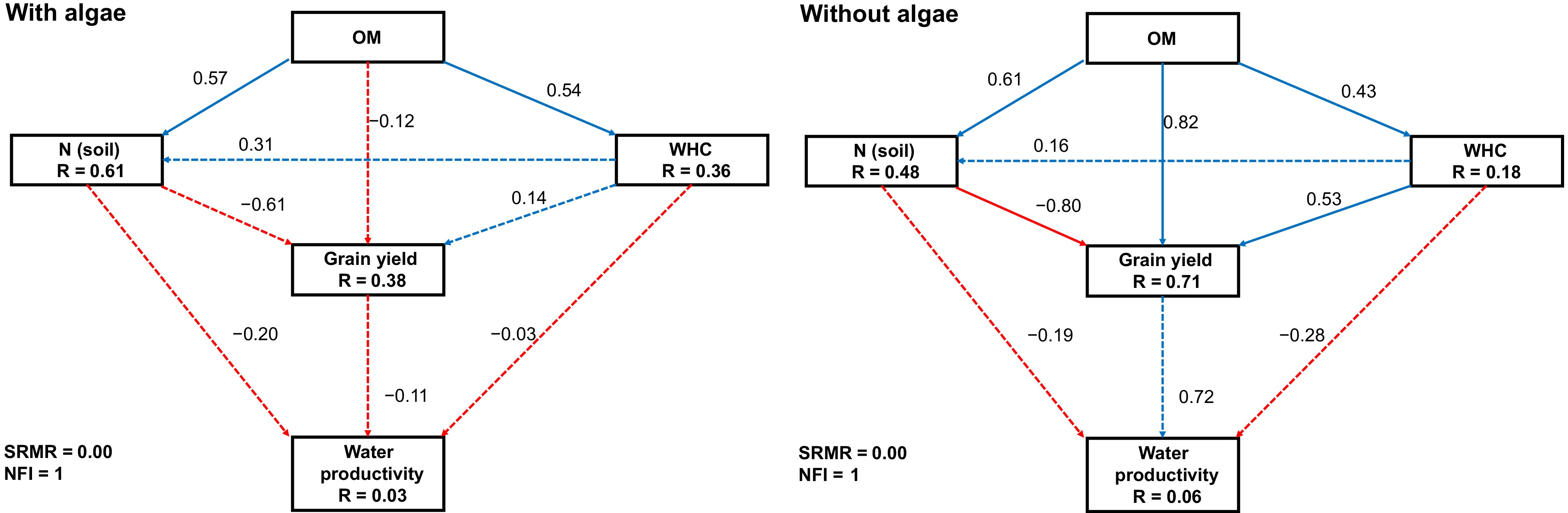
Figure 4.
Partial least squares structural equation model of the effects of organic matter (OM), WHC, and available soil N, and grain yield on water productivity, with and without the application of algae. Blue and red indicate positive and negative effects, respectively. Dashed arrows show that coefficients did not differ significantly (p ≤ 0.05).
-
The results presented in Table 3 demonstrate that characteristics including plant height, total yield, grain yield, straw yield, and seed index significantly benefit from both increased irrigation levels and algae treatment, with the lowest value observed at 60% ETc irrigation without algae. This aligns well with existing literature indicating that optimal irrigation levels improve plants' physiological parameters, such as relative water content, leaf area, and yield components, by ensuring that sufficient water is available for metabolic processes and growth. Supplementing irrigation with algae further enhances these effects, likely due to algae’s biofertilizer properties, which can improve nutrient uptake, soil fertility, and stimulate plant growth hormones[29−33]. The study shows that plant growth traits like height, total yield, grain yield, straw yield, and the seed index increase with higher irrigation levels because the optimal water supply supports better physiological functions, nutrient uptake, and metabolic processes in wheat plants. Stress from lower irrigation levels (e.g., 60% ETc) reduces these attributes as a result of water deficits' effects on growth and grain filling[34,35]. The application of algae extracts such as foliar sprays or biofertilizers enhances the growth and yield of wheat by providing additional nutrients, growth hormones, and bioactive compounds, which improve photosynthesis, nutrient efficiency, and stress tolerance. For example, spraying algae extract at higher concentrations significantly increased grain, straw, and biological yields in wheat[36]. Studies have found the significant effects of irrigation and algae on wheat's yield components individually, although their interaction was mostly not significant except for some traits, such as teh seed index, in certain seasons. The highest total wheat yield was recorded at 100% irrigation combined with algae, while the lowest yield was at 60% ETc irrigation without algae, confirming the additive benefits of proper irrigation and algae treatment in boosting wheat's productivity[37].
The significant differences found for irrigation and the algae treatment independently (p ≤ 0.05) underscore their individual roles in boosting plants' performance. Nonetheless, the lack of a significant interaction between irrigation and algae for most traits, except the seed index in the second season, suggests that their effects are mostly additive rather than synergistic, although some combined influence on seed quality parameters occurred. The highest total yield recorded at full irrigation with algae compared with the lowest yield at 60% ETc irrigation without algae highlights the critical importance of sufficient water supply along with using biofertilizer for maximizing crops' productivity, particularly under water-limited conditions[38]. The incorporation of algae significantly elevated nitrogen levels in both the straw and grain across all irrigation levels. This indicates that algae serve as an effective biofertilizer. Algae contain significant amounts of nitrogen and other nutrients that gradually convert into minerals in the soil. The process enhances nitrogen's availability and facilitates its uptake by wheat plants. Algal biomass and its released extracellular chemicals enhance microbial activity in the soil, thereby accelerating nitrogen's mineralization and transformation processes[39]. Collectively, these factors enhance nitrogen utilization efficiency. Algae supply amino acids, phytohormones, and other bioactive compounds that facilitate root development and nutrient absorption, resulting in enhanced physiological responses in plants. The results are most pronounced under conditions of insufficient water (60% ETc), where algae promote root growth and enhance soil moisture retention, thus promoting more effective nitrogen absorption compared with fully watered but unamended soil. Applying algae to crops enhances nutrient mobility within the soil and facilitates nitrogen absorption; hence, it augments the nutritional content of the crops, particularly under conditions of limited water availability[40,41].
Responses of soil properties to irrigation levels and algae treatment
-
The application of algae increased the percentage of organic matter in the soil because algae contribute organic carbon through the decay of their biomass, which adds humus and enriches the soil's organic content. This increased organic matter improves the soil's structure, moisture retention, and fertility, making the soil more habitable for plants. Algae also fix atmospheric nitrogen into forms that plants can use, enhancing soil nutrient availability without needing artificial fertilizers. This effect is a confounder at lower irrigation levels (80% ETc and 60% ETc) because the organic matter helps improve soil water retention and nutrient-holding capacity under water-limited conditions[30]. Regarding EC and WHC, the presence of algae positively influences these properties because of the organic compounds and extracellular polysaccharides they produce, which help bind soil particles and maintain moisture. Although the water irrigation levels did not significantly change EC and WHC, the algae treatments did, indicating algae's role in improving these physical and chemical properties of the soil, independently of irrigation[42,43]. The observation that soil pH decreased with the algae treatment, and more so at lower water application levels, can be explained by the bioactive compounds and secretions from algae that can alter the soil's chemical conditions. Algae release pH-altering substances which can neutralize the soil pH, improving nutrient availability for plants. The effect was more pronounced at 60% ETc irrigation, which suggests that under drier conditions, algae’s influence on chemical balance is stronger, possibly because the soil's buffering capacity changes with moisture content.
Climate and irrigation water applied at different growth stages
-
The slightly higher irrigation volumes recorded in the 2023–2024 season compared with 2022–2023 can be attributed primarily to variations in the climatic conditions and reference evapotranspiration (ET0) during the cropping periods. These variations impact the crop’s water requirements, leading to adjustments to the amount of irrigation applied[44].
Climatic factors such as temperature, humidity, wind speed, and solar radiation significantly influence ET0, which, in turn, determines the water demand of crops like wheat. Higher temperatures or lower humidity increase ET0, necessitating more water to meet the crop’s needs, especially during critical growth stages such as jointing, flowering, and grain filling. Changes in weather patterns, including increased sunshine or wind, can accelerate water loss from the soil and plant tissues, prompting farmers or irrigation systems to apply more water to maintain optimal moisture levels[43,45]. Furthermore, variations in climatic conditions may involve differences in rainfall patterns and soil moisture conditions, which also impact irrigation requirements. A drier season with less rainfall leads to increased reliance on supplemental irrigation, thus increasing overall water application[46,47]. Conversely, wetter seasons with more natural precipitation could reduce the need for irrigation, but if measured irrigation volumes still increased, it could reflect adaptive management to ensure sufficient water supply during peak demand periods.
Effects of applying algae on the interactions of soil properties, grain yield, and water productivity
-
The PLS-SEM results reveal important insights into how algae application reshapes the relationships among soil nitrogen, organic matter, WHC, and crop outcomes like grain yield and water productivity. Under algae application, organic matter showed positive associations with both N (0.57) and WHC (0.54), suggesting a closer linkage of soil biochemical and physical properties within the modeled framework. These associations are consistent with previous studies reporting that algae amendments are related to improved soil aggregation and water retention[48,49]. Within the model, N was negatively associated with grain yield (−0.61), indicating that higher soil N levels corresponded to lower yield values in this pathway structure, although this relationship was weaker compared with the no-algae condition. The weak negative association between grain yield and water productivity under algae treatment may reflect shifts in the modeled water–yield relationship, potentially linked to the altered soil moisture dynamics associated with higher organic matter and WHC. These findings should be interpreted as statistical associations within the SEM framework rather than direct mechanistic effects[30,49,50].
Conversely, in the absence of algae, organic matter remained positively associated with N but exhibited a stronger negative association with grain yield (−0.80). Organic matter was positively linked with both WHC (0.43) and grain yield (0.82), and grain yield showed a strong positive association with water productivity (0.72). The negative association between WHC and water productivity (−0.28) may indicate differences in how soil water retention relates to productivity in the absence of biological amendments. Overall, the modeled pathways suggest a less integrated interaction among N, organic matter, and WHC when algae are not applied[51,52].
The literature supports the idea that increasing organic matter promotes soil aggregation, which increases WHC, especially in sandy or coarse soils where organic matter-induced small pore formation boosts plant-available water capacity. This improves drought resilience and nutrient retention. The differences in pathways and strengths under the algae treatment indicate a biological enhancement of soil processes, integrating nutrient cycling and water retention more effectively than when algae are absent[53].
From the perspective of a circular agricultural system, the observed changes in soil properties' interactions following the application of algae indicate ramifications that extend beyond yield results. The enhanced integration among soil organic matter, nitrogen dynamics, and WHC may contribute to improved nutrient cycling efficiency, potentially reducing reliance on external mineral fertilizer inputs. Enhanced soil structural features and moisture retention support the objectives of improving soil health, which are essential for circular agriculture. The altered water and yield connections suggest potential advantages for enhancing water distribution in constrained irrigation scenarios. Although these implications need more validation, the findings endorse the prospective function of algae-based supplements in resource-efficient and circular agricultural settings.
The statistically nonsignificant differences in water productivity, despite the visible changes, suggest high variability. The limited sample size, which is common in field trials, should be considered in interpreting the impacts. This discussion underscores the value of algae as a biological soil amendment for improving soil health, nutrient cycling, and crop water use, complementing the critical role of organic matter in soils without biological inputs.
-
This study indicated that combining algae with different levels of irrigation water can be a beneficial way to improve soil quality and wheat production in sandy soils with limited water. Adding algae to the soil always increased the amount of organic matter, which, in turn, made nutrients more available and easier to absorb. The strong positive correlations with N, P, and K levels in both the straw and grain demonstrate this improvement. Furthermore, using algae helped reduce the pH of the soil. The 60% ETc treatment had the most significant effect, which suggests that the soil's chemical conditions and microbial activity improved. The 80% ETc level had the highest water productivity, which suggests that mild deficit irrigation with algae is the best strategy to save water and make crops grow better. Overall, the results indicate that algae are a biofertilizer that makes soil structure better, helps it hold more water, and lessens the negative impacts of reduced irrigation. Therefore, adding algae to irrigation management can be a long-term and cost-effective way to boost wheat's productivity on sandy soils, especially in places like Egypt where water is scarce and fertilizer prices are increasing.
We thank the Agricultural Research Center (ARC), Assiut, Egypt and Assiut University, Assiut, Egypt. The authors supported the work.
-
The authors confirm their contributions to the paper as follows: conceptualization: Hefzy M, Abdelaziz M; methodology: Hefzy M, Abdel Monsef O, Zahran MMAA; funding acquisition: Hefzy M; data curation: Hefzy M, Abdel Monsef O, Zahran MMAA; resources: Abdel Monsef O, Zahran MMAA; review and editing: Hefzy M, Mahmoud GAE; writing – original draft: Abdelaziz M. All authors reviewed the results and approved the final version of the manuscript.
-
The data that support the findings of this study are available on request from the corresponding author.
-
The authors declare that they have no conflict of interest.
- Copyright: © 2026 by the author(s). Published by Maximum Academic Press, Fayetteville, GA. This article is an open access article distributed under Creative Commons Attribution License (CC BY 4.0), visit https://creativecommons.org/licenses/by/4.0/.
-
About this article
Cite this article
Hefzy M, Abdel Monsef O, Zahran MMAA, Mahmoud GAE, Abdelaziz M. 2026. Synergistic influence of deficit irrigation and Nostoc algae extract on wheat growth and water productivity in a sandy calcareous soil. Circular Agricultural Systems 6: e011 doi: 10.48130/cas-0026-0011 

Synergistic influence of deficit irrigation and Nostoc algae extract on wheat growth and water productivity in a sandy calcareous soil
- Received: 04 December 2025
- Revised: 16 February 2026
- Accepted: 03 March 2026
- Published online: 15 May 2026
Abstract: Water scarcity and the rising cost of chemical fertilizers pose major challenges to sustainable crop production in Egypt, particularly in sandy soils with low fertility. This study was conducted during the winters of 2022–2023 and 2023–2024 to investigate the combined effects of different irrigation levels and Nostoc algae extract on soil properties and wheat (Triticum aestivum) productivity. Three irrigation levels (100%, 80%, and 60% of crop evapotranspiration [ETc]) were evaluated with and without added algae. To analyze our data, we performed an analysis of variance (ANOVA) to evaluate differences among the treatments; correlation analysis was conducted to assess the relationships among soil properties and plant properties. The results showed that application of algae significantly increased soil organic matter under all irrigation treatments. In contrast, soil pH decreased in response to addition of algae, with the greatest reduction observed under the 60% ETc treatment (0.29 and 0.31 units in the first and second growing seasons, respectively). Water productivity differed significantly among treatments, following the order: 80% ETc > 100% ETc > 60% ETc (p ≤ 0.05). The application of algae under the 80% ETc regime increased water productivity by 12.01% and 12.19% in the first and second seasons, respectively, compared with the treatment without algae. Moreover, organic matter exhibited a strong positive correlation with N, P, and K contents in both straw and grain. The total yield reached its greatest level at 100% ETc with algae (5,526.43 ± 61.30 kg feddan−1), whereas the lowest value was reported at 60% ETc without algae (2,880.97 ± 37.81 kg feddan−1). Overall, application of algae contributed to improved soil properties, enhanced soil nutrients, structure and moisture retention, and mitigated yield losses associated with reduced irrigation. These findings suggest that integrating algae biofertilizers with deficit irrigation strategies can serve as a sustainable approach to improve wheat production in sandy soils under water-limited conditions.
-
Key words:
- Irrigation levels /
- Sandy soil /
- Wheat /
- Nostoc