








Search
2025 Volume 4
Article Contents
REVIEW   Open Access    

Biosynthesis and regulatory mechanisms of benzylisoquinoline alkaloids in medicinal plants

More Information
  • Benzylisoquinoline alkaloids (BIAs) derived from Coptis species, opium poppy, and California poppy have been demonstrated to cure various diseases. Historically, Coptis species, opium poppy, and California poppy have served as models for the study of BIAs; however, the produced BIAs in these plants are of low yield for medicinal purposes. Although the chemical synthesis approach has been adopted for large-scale production of BIAs, medicinal plants remain the only reliable platform for this purpose. With the recent advancement of high-throughput sequencing technology, genomic or transcriptomic information of Coptis chinensis, Coptis deltoidea, Coptis teeta, opium poppy, and California poppy has been available over the past decade, which has led to a comprehensive elucidation and update of the biosynthetic pathways of BIAs and regulatory mechanisms governing BIA production. The jasmonate-independent and jasmonate-dependent regulatory pathways, triggered by external elicitors, are demonstrated in this study. Overexpression of AP2/ERF transcription factor, base editing for key enzymes of tyrosine synthesis, and transport engineering in microbes are some strategies presented to provide ideas for enhancing BIAs content. This review provides a foundation for BIA accumulation in medicinal plants and de novo synthesis of BIAs in microbial hosts, thereby facilitating the discovery and development of alkaloid-based drugs.
  • 加载中
  • [1] Aghaali Z, Naghavi MR. 2024. Developing benzylisoquinoline alkaloid-enriched opium poppy via CRISPR-directed genome editing: a review. BMC Plant Biology 24:700 doi: 10.1186/s12870-024-05412-x

    CrossRef   Google Scholar

    [2] Hong UVT, Tamiru-Oli M, Hurgobin B, Lewsey MG. 2025. Genomic and cell-specific regulation of benzylisoquinoline alkaloid biosynthesis in opium poppy. Journal of Experimental Botany 76:35−51 doi: 10.1093/jxb/erae317

    CrossRef   Google Scholar

    [3] He SM, Liang YL, Cong K, Chen G, Zhao X, et al. 2018. Identification and characterization of genes involved in benzylisoquinoline alkaloid biosynthesis in Coptis species. Frontiers in Plant Science 9:731 doi: 10.3389/fpls.2018.00731

    CrossRef   Google Scholar

    [4] Ziegler J, Facchini PJ. 2008. Alkaloid biosynthesis: metabolism and trafficking. Annual Review of Plant Biology 59:735−69 doi: 10.1146/annurev.arplant.59.032607.092730

    CrossRef   Google Scholar

    [5] Sato F. 2013. Characterization of plant functions using cultured plant cells, and biotechnological applications. Bioscience, Biotechnology, and Biochemistry 77:1−9 doi: 10.1271/bbb.120759

    CrossRef   Google Scholar

    [6] Takanashi K, Yamada Y, Sasaki T, Yamamoto Y, Sato F, et al. 2017. A multidrug and toxic compound extrusion transporter mediates berberine accumulation into vacuoles in Coptis japonica. Phytochemistry 138:76−82 doi: 10.1016/j.phytochem.2017.03.003

    CrossRef   Google Scholar

    [7] Wang J, Wang L, Lou GH, Zeng HR, Hu J, et al. 2019. Coptidis Rhizoma: a comprehensive review of its traditional uses, botany, phytochemistry, pharmacology and toxicology. Pharmaceutical Biology 57:193−225 doi: 10.1080/13880209.2019.1577466

    CrossRef   Google Scholar

    [8] Aghaali Z, Naghavi MR, Zargar M. 2024. Promising approaches for simultaneous enhancement of medicinally significant benzylisoquinoline alkaloids in opium poppy. Frontiers in Plant Science 15:1377318 doi: 10.3389/fpls.2024.1377318

    CrossRef   Google Scholar

    [9] Yamada Y, Hirakawa H, Hori K, Minakuchi Y, Toyoda A, et al. 2021. Comparative analysis using the draft genome sequence of California poppy (Eschscholzia californica) for exploring the candidate genes involved in benzylisoquinoline alkaloid biosynthesis. Bioscience, Biotechnology, and Biochemistry 85:851−59 doi: 10.1093/bbb/zbaa091

    CrossRef   Google Scholar

    [10] Xu Z, Tian Y, Wang J, Ma Y, Li Q, et al. 2024. Convergent evolution of berberine biosynthesis. Science Advances 10:eads3596 doi: 10.1126/sciadv.ads3596

    CrossRef   Google Scholar

    [11] Xu T, Kuang T, Du H, Li Q, Feng T, et al. 2020. Magnoflorine: a review of its pharmacology, pharmacokinetics and toxicity. Pharmacological Research 152:104632 doi: 10.1016/j.phrs.2020.104632

    CrossRef   Google Scholar

    [12] Zhong F, Chen Y, Chen J, Liao H, Li Y, Ma Y. 2022. Jatrorrhizine: A review of sources, pharmacology, pharmacokinetics and toxicity. Frontiers in Pharmacology 12:783127 doi: 10.3389/fphar.2021.783127

    CrossRef   Google Scholar

    [13] Roth L, Adler M, Jain T, Bempong D. 2018. Monographs for medicines on WHO's model list of essential medicines. Bulletin of the World Health Organization 96:378−85 doi: 10.2471/BLT.17.205807

    CrossRef   Google Scholar

    [14] Altinoz MA, Topcu G, Hacimuftuoglu A, Ozpinar A, Ozpinar A, et al. 2019. Noscapine, a non-addictive opioid and microtubule-inhibitor in potential treatment of glioblastoma. Neurochemical Research 44:1796−806 doi: 10.1007/s11064-019-02837-x

    CrossRef   Google Scholar

    [15] Ashrafi S, Alam S, Sultana A, Raj A, Emon NU, et al. 2023. Papaverine: a miraculous alkaloid from opium and its multimedicinal application. Molecules 28:3149 doi: 10.3390/molecules28073149

    CrossRef   Google Scholar

    [16] Becker A, Yamada Y, Sato F. 2023. California poppy (Eschscholzia californica), the Papaveraceae golden girl model organism for evodevo and specialized metabolism. Frontiers in Plant Science 14:1084358 doi: 10.3389/fpls.2023.1084358

    CrossRef   Google Scholar

    [17] Malla RR, Bhamidipati P, Adem M. 2023. Insights into the potential of Sanguinarine as a promising therapeutic option for breast cancer. Biochemical Pharmacology 212:115565 doi: 10.1016/j.bcp.2023.115565

    CrossRef   Google Scholar

    [18] Kosina P, Walterová D, Ulrichová J, Lichnovský V, Stiborová M, et al. 2004. Sanguinarine and chelerythrine: assessment of safety on pigs in ninety days feeding experiment. Food and Chemical Toxicology 42:85−91 doi: 10.1016/j.fct.2003.08.007

    CrossRef   Google Scholar

    [19] Stöckigt J, Antonchick AP, Wu F, Waldmann H. 2011. The pictet-spengler reaction in nature and in organic chemistry. Angewandte Chemie International Edition 50:8538−64 doi: 10.1002/anie.201008071

    CrossRef   Google Scholar

    [20] Ruiz-Olalla A, Würdemann MA, Wanner MJ, Ingemann S, van Maarseveen JH, et al. 2015. Organocatalytic enantioselective Pictet-Spengler approach to biologically relevant 1-benzyl-1,2,3,4-tetrahydroisoquinoline alkaloids. Journal of Organic Chemistry 80:5125−32 doi: 10.1021/acs.joc.5b00509

    CrossRef   Google Scholar

    [21] Min X, Zhu T, Hu X, Hou C, He J, et al. 2023. Transcriptome and metabolome analysis of isoquinoline alkaloid biosynthesis of Coptis chinensis in different years. Genes 14:2232 doi: 10.3390/genes14122232

    CrossRef   Google Scholar

    [22] Liu Y, Wang B, Shu S, Li Z, Song C, et al. 2021. Analysis of the Coptis chinensis genome reveals the diversification of protoberberine-type alkaloids. Nature Communications 12:3276 doi: 10.1038/s41467-021-23611-0

    CrossRef   Google Scholar

    [23] Hori K, Yamada Y, Purwanto R, Minakuchi Y, Toyoda A, et al. 2018. Mining of the uncharacterized cytochrome P450 genes involved in alkaloid biosynthesis in California poppy using a draft genome sequence. Plant & Cell Physiology 59:222−33 doi: 10.1093/pcp/pcx210

    CrossRef   Google Scholar

    [24] Zhong F, Huang L, Qi L, Ma Y, Yan Z. 2020. Full-length transcriptome analysis of Coptis deltoidea and identification of putative genes involved in benzylisoquinoline alkaloids biosynthesis based on combined sequencing platforms. Plant Molecular Biology 102:477−99 doi: 10.1007/s11103-019-00959-y

    CrossRef   Google Scholar

    [25] Xu T, Yang X, Jia Y, Li Z, Tang G, et al. 2022. A global survey of the transcriptome of the opium poppy (Papaver somniferum) based on single-molecule long-read isoform sequencing. The Plant Journal 110:607−20 doi: 10.1111/tpj.15689

    CrossRef   Google Scholar

    [26] Li Q, Ramasamy S, Singh P, Hagel JM, Dunemann SM, et al. 2020. Gene clustering and copy number variation in alkaloid metabolic pathways of opium poppy. Nature Communications 11:1190 doi: 10.1038/s41467-020-15040-2

    CrossRef   Google Scholar

    [27] Sunhe YX, Zhang YH, Fu RJ, Xu DQ, Tang YP. 2024. Neuroprotective effect and preparation methods of berberine. Frontiers in Pharmacology 15:1429050 doi: 10.3389/fphar.2024.1429050

    CrossRef   Google Scholar

    [28] Shakeri F, Kiani S, Rahimi G, Boskabady MH. 2024. Anti-inflammatory, antioxidant, and immunomodulatory effects of Berberis vulgaris and its constituent berberine, experimental and clinical, a review. Phytotherapy Research 38:1882−902 doi: 10.1002/ptr.8077

    CrossRef   Google Scholar

    [29] Askari VR, Khosravi K, Baradaran Rahimi V, Garzoli S. 2024. A mechanistic review on how berberine use combats diabetes and related complications: molecular, cellular, and metabolic effects. Pharmaceuticals 17:7 doi: 10.3390/ph17010007

    CrossRef   Google Scholar

    [30] Khezri MR, Mohammadipanah S, Ghasemnejad-Berenji M. 2024. The pharmacological effects of Berberine and its therapeutic potential in different diseases: Role of the phosphatidylinositol 3-kinase/AKT signaling pathway. Phytotherapy Research 38:349−67 doi: 10.1002/ptr.8040

    CrossRef   Google Scholar

    [31] Lu Q, Tang Y, Luo S, Gong Q, Li C. 2023. Coptisine, the characteristic constituent from Coptis chinensis, exhibits significant therapeutic potential in treating cancers, metabolic and inflammatory diseases. The American Journal of Chinese Medicine 51:2121−56 doi: 10.1142/S0192415X2350091X

    CrossRef   Google Scholar

    [32] Liu L, Li J, He Y. 2020. Multifunctional epiberberine mediates multi-therapeutic effects. Fitoterapia 147:104771 doi: 10.1016/j.fitote.2020.104771

    CrossRef   Google Scholar

    [33] Lei C, Yao Y, Shen B, Liu J, Pan Q, et al. 2019. Columbamine suppresses the proliferation and malignization of colon cancer cells via abolishing Wnt/β-catenin signaling pathway. Cancer Management and Research 11:8635−45 doi: 10.2147/CMAR.S209861

    CrossRef   Google Scholar

    [34] Wang Y, Han Y, Chai F, Xiang H, Huang T, et al. 2016. The antihypercholesterolemic effect of columbamine from Rhizoma Coptidis in HFHC-diet induced hamsters through HNF-4α/FTF-mediated CYP7A1 activation. Fitoterapia 115:111−21 doi: 10.1016/j.fitote.2016.09.019

    CrossRef   Google Scholar

    [35] Tarabasz D, Kukula-Koch W. 2020. Palmatine: a review of pharmacological properties and pharmacokinetics. Phytotherapy Research 34:33−50 doi: 10.1002/ptr.6504

    CrossRef   Google Scholar

    [36] Badshah I, Anwar M, Murtaza B, Khan MI. 2024. Molecular mechanisms of morphine tolerance and dependence; novel insights and future perspectives. Molecular and Cellular Biochemistry 479:1457−85 doi: 10.1007/s11010-023-04810-3

    CrossRef   Google Scholar

    [37] Singh A, Menéndez-Perdomo IM, Facchini PJ. 2019. Benzylisoquinoline alkaloid biosynthesis in opium poppy: an update. Phytochemistry Reviews 18:1457−82 doi: 10.1007/s11101-019-09644-w

    CrossRef   Google Scholar

    [38] Rajecky M, Slaninova I, Mokrisova P, Urbanova J, Palkovsky M, et al. 2013. Alkaloid chelirubine and DNA: blue and red luminescence. Talanta 105:317−9 doi: 10.1016/j.talanta.2012.10.045

    CrossRef   Google Scholar

    [39] Balažová A, Urdová J, Forman V, Mučaji P. 2020. Enhancement of macarpine production in Eschscholzia Californica suspension cultures under salicylic acid elicitation and precursor supplementation. Molecules 25:1261 doi: 10.3390/molecules25061261

    CrossRef   Google Scholar

    [40] Jiao X, Fu X, Li Q, Bu J, Liu X, et al. 2024. De novo production of protoberberine and benzophenanthridine alkaloids through metabolic engineering of yeast. Nature Communications 15:8759 doi: 10.1038/s41467-024-53045-3

    CrossRef   Google Scholar

    [41] Kaserer T, Steinacher T, Kainhofer R, Erli F, Sturm S, et al. 2020. Identification and characterization of plant-derived alkaloids, corydine and corydaline, as novel mu opioid receptor agonists. Scientific Reports 10:13804 doi: 10.1038/s41598-020-70493-1

    CrossRef   Google Scholar

    [42] Li Y, Zeng RJ, Chen JZ, Wu YB, Chou GX, et al. 2015. Pharmacokinetics and metabolism study of isoboldine, a major bioactive component from Radix Linderae in male rats by UPLC-MS/MS. Journal of Ethnopharmacology 171:154−60 doi: 10.1016/j.jep.2015.05.042

    CrossRef   Google Scholar

    [43] De Sousa JPM, Oliveira NCSA, Fernandes PA. 2023. Rational engineering of (S)-norcoclaurine synthase for efficient benzylisoquinoline alkaloids biosynthesis. Molecules 28:4265 doi: 10.3390/molecules28114265

    CrossRef   Google Scholar

    [44] Yang M, Zhu L, Li L, Li J, Xu L, et al. 2017. Digital gene expression analysis provides insight into the transcript profile of the genes involved in aporphine alkaloid biosynthesis in Lotus (Nelumbo nucifera). Frontiers in Plant Science 8:80 doi: 10.3389/fpls.2017.00080

    CrossRef   Google Scholar

    [45] Tjallinks G, Mattevi A, Fraaije MW. 2024. Biosynthetic strategies of berberine bridge enzyme-like flavoprotein oxidases toward structural diversification in natural product biosynthesis. Biochemistry 63:2089−110 doi: 10.1021/acs.biochem.4c00320

    CrossRef   Google Scholar

    [46] Dang TT, Facchini PJ. 2012. Characterization of three O-methyltransferases involved in noscapine biosynthesis in opium poppy. Plant Physiology 159:618−31 doi: 10.1104/pp.112.194886

    CrossRef   Google Scholar

    [47] Dang TT, Facchini PJ. 2014. Cloning and characterization of canadine synthase involved in noscapine biosynthesis in opium poppy. FEBS Letters 588:198−204 doi: 10.1016/j.febslet.2013.11.037

    CrossRef   Google Scholar

    [48] Okada N, Koizumi N, Tanaka T, Ohkubo H, Nakanishi S, Yamada Y. 1989. Isolation, sequence, and bacterial expression of a cDNA for (S)-tetrahydroberberine oxidase from cultured berberine-producing Coptis japonica cells. Proceedings of the National Academy of Sciences of the United States of America 86:534−38 doi: 10.1073/pnas.86.2.534

    CrossRef   Google Scholar

    [49] Tu TQ, Do PT, Van Nguyen D, Pham NTT, Nguyen TT, et al. 2022. The columbamine O-methyltransferase gene (CoOMT) is capable of increasing alkaloid content in transgenic tobacco plants. Molecular Biology Reports 49:2667−75 doi: 10.1007/s11033-021-07074-6

    CrossRef   Google Scholar

    [50] Takemura T, Ikezawa N, Iwasa K, Sato F. 2013. Molecular cloning and characterization of a cytochrome P450 in sanguinarine biosynthesis from Eschscholzia californica cells. Phytochemistry 91:100−8 doi: 10.1016/j.phytochem.2012.02.013

    CrossRef   Google Scholar

    [51] Beaudoin GAW, Facchini PJ. 2014. Benzylisoquinoline alkaloid biosynthesis in opium poppy. Planta 240:19−32 doi: 10.1007/s00425-014-2056-8

    CrossRef   Google Scholar

    [52] Vadhel A, Bashir S, Mir AH, Girdhar M, Kumar D, et al. 2023. Opium alkaloids, biosynthesis, pharmacology and association with cancer occurrence. Open Biology 13:220355 doi: 10.1098/rsob.220355

    CrossRef   Google Scholar

    [53] Pathak S, Lakhwani D, Gupta P, Mishra BK, Shukla S, et al. 2013. Comparative transcriptome analysis using high papaverine mutant of Papaver somniferum reveals pathway and uncharacterized steps of papaverine biosynthesis. PLoS One 8:e65622 doi: 10.1371/journal.pone.0065622

    CrossRef   Google Scholar

    [54] Desgagné-Penix I, Facchini PJ. 2012. Systematic silencing of benzylisoquinoline alkaloid biosynthetic genes reveals the major route to papaverine in opium poppy. The Plant Journal 72:331−44 doi: 10.1111/j.1365-313X.2012.05084.x

    CrossRef   Google Scholar

    [55] Ounaroon A, Decker G, Schmidt J, Lottspeich F, Kutchan TM. 2003. (R,S)-Reticuline 7-O-methyltransferase and (R,S)-norcoclaurine 6-O-methyltransferase of Papaver somniferum − cDNA cloning and characterization of methyl transfer enzymes of alkaloid biosynthesis in opium poppy. The Plant Journal 36:808−19 doi: 10.1046/j.1365-313X.2003.01928.x

    CrossRef   Google Scholar

    [56] Hagel JM, Beaudoin GAW, Fossati E, Ekins A, Martin VJJ, et al. 2012. Characterization of a flavoprotein oxidase from opium poppy catalyzing the final steps in sanguinarine and papaverine biosynthesis. Journal of Biological Chemistry 287:42972−83 doi: 10.1074/jbc.M112.420414

    CrossRef   Google Scholar

    [57] Liscombe DK, Facchini PJ. 2007. Molecular cloning and characterization of tetrahydroprotoberberine cis-N-methyltransferase, an enzyme involved in alkaloid biosynthesis in opium poppy. Journal of Biological Chemistry 282:14741−51 doi: 10.1074/jbc.M611908200

    CrossRef   Google Scholar

    [58] Beaudoin GAW, Facchini PJ. 2013. Isolation and characterization of a cDNA encoding (S)-cis-N-methylstylopine 14-hydroxylase from opium poppy, a key enzyme in sanguinarine biosynthesis. Biochemical and Biophysical Research Communications 431:597−603 doi: 10.1016/j.bbrc.2012.12.129

    CrossRef   Google Scholar

    [59] Hirata K, Poeaknapo C, Schmidt J, Zenk MH. 2004. 1, 2-Dehydroreticuline synthase, the branch point enzyme opening the morphinan biosynthetic pathway. Phytochemistry 65:1039−46 doi: 10.1016/j.phytochem.2004.02.015

    CrossRef   Google Scholar

    [60] De-Eknamkul W, Zenk MH. 1992. Purification and properties of 1, 2-dehydroreticuline reductase from Papaver somniferum seedlings. Phytochemistry 31:813−21 doi: 10.1016/0031-9422(92)80020-F

    CrossRef   Google Scholar

    [61] Higashi Y, Kutchan TM, Smith TJ. 2011. Atomic structure of salutaridine reductase from the opium poppy (Papaver somniferum). Journal of Biological Chemistry 286:6532−41 doi: 10.1074/jbc.M110.168633

    CrossRef   Google Scholar

    [62] Gesell A, Rolf M, Ziegler J, Díaz Chávez ML, Huang FC, et al. 2009. CYP719B1 is salutaridine synthase, the C-C phenol-coupling enzyme of morphine biosynthesis in opium poppy. The Journal of Biological Chemistry 284:24432−42 doi: 10.1074/jbc.M109.033373

    CrossRef   Google Scholar

    [63] Grothe T, Lenz R, Kutchan TM. 2001. Molecular characterization of the salutaridinol 7-O-acetyltransferase involved in morphine biosynthesis in opium poppy Papaver somniferum. Journal of Biological Chemistry 276:30717−23 doi: 10.1074/jbc.M102688200

    CrossRef   Google Scholar

    [64] Carr SC, Torres MA, Morris JS, Facchini PJ, Ng KKS. 2021. Structural studies of codeinone reductase reveal novel insights into aldo-keto reductase function in benzylisoquinoline alkaloid biosynthesis. Journal of Biological Chemistry 297:101211 doi: 10.1016/j.jbc.2021.101211

    CrossRef   Google Scholar

    [65] Singh W, Hui C, Li C, Huang M. 2021. Thebaine is selectively demethylated by thebaine 6-O-demethylase and codeine-3-O-demethylase at distinct binding sites: a computational study. Inorganic Chemistry 60:10199−214 doi: 10.1021/acs.inorgchem.1c00468

    CrossRef   Google Scholar

    [66] Purwanto R, Hori K, Yamada Y, Sato F. 2017. Unraveling additional O-methylation steps in benzylisoquinoline alkaloid biosynthesis in California poppy (Eschscholzia californica). Plant and Cell Physiology 58:1528−40 doi: 10.1093/pcp/pcx093

    CrossRef   Google Scholar

    [67] Jeyasri R, Muthuramalingam P, Karthick K, Shin H, Choi SH, et al. 2023. Methyl jasmonate and salicylic acid as powerful elicitors for enhancing the production of secondary metabolites in medicinal plants: an updated review. Plant Cell, Tissue and Organ Culture 153:447−58 doi: 10.1007/s11240-023-02485-8

    CrossRef   Google Scholar

    [68] Pandey P, Tripathi A, Dwivedi S, Lal K, Jhang T. 2023. Deciphering the mechanisms, hormonal signaling, and potential applications of endophytic microbes to mediate stress tolerance in medicinal plants. Frontiers in Plant Science 14:1250020 doi: 10.3389/fpls.2023.1250020

    CrossRef   Google Scholar

    [69] Lala S. 2021. Nanoparticles as elicitors and harvesters of economically important secondary metabolites in higher plants: A review. IET Nanobiotechnology 15:28−57 doi: 10.1049/nbt2.12005

    CrossRef   Google Scholar

    [70] De Geyter N, Gholami A, Goormachtig S, Goossens A. 2012. Transcriptional machineries in jasmonate-elicited plant secondary metabolism. Trends in Plant Science 17:349−59 doi: 10.1016/j.tplants.2012.03.001

    CrossRef   Google Scholar

    [71] Hara M, Morio K, Yazaki K, Tanaka S, Tabata M. 1995. Separation and characterization of cytokinin-inducible (S)-tetrahydroberberine oxidases controlling berberine biosynthesis in Thalictrum minus cell cultures. Phytochemistry 38:89−93 doi: 10.1016/0031-9422(94)00623-2

    CrossRef   Google Scholar

    [72] Hara M, Tanaka S, Tabata M. 1994. Induction of a specific methyltransferase activity regulating berberine biosynthesis by cytokinin in Thalictrum minus cell cultures. Phytochemistry 36:327−32 doi: 10.1016/S0031-9422(00)97070-5

    CrossRef   Google Scholar

    [73] Kobayashi Y, Hara M, Fukui H, Tabata M. 1991. The role of ethylene in berberine production by Thalictrum minus cell suspension cultures. Phytochemistry 30:3605−09 doi: 10.1016/0031-9422(91)80075-C

    CrossRef   Google Scholar

    [74] Roos W, Viehweger K, Dordschbal B, Schumann B, Evers S, et al. 2006. Intracellular pH signals in the induction of secondary pathways – The case of Eschscholzia californica. Journal of Plant Physiology 163:369−81 doi: 10.1016/j.jplph.2005.11.012

    CrossRef   Google Scholar

    [75] Heinze M, Steighardt J, Gesell A, Schwartze W, Roos W. 2007. Regulatory interaction of the Galpha protein with phospholipase A2 in the plasma membrane of Eschscholzia californica. The Plant Journal 52:1041−51 doi: 10.1111/j.1365-313X.2007.03300.x

    CrossRef   Google Scholar

    [76] Färber K, Schumann B, Miersch O, Roos W. 2003. Selective desensitization of jasmonate- and pH-dependent signaling in the induction of benzophenanthridine biosynthesis in cells of Eschscholzia californica. Phytochemistry 62:491−500 doi: 10.1016/S0031-9422(02)00562-9

    CrossRef   Google Scholar

    [77] Facchini PJ, Johnson AG, Poupart J, de Luca V. 1996. Uncoupled defense gene expression and antimicrobial alkaloid accumulation in elicited opium poppy cell cultures. Plant Physiology 111:687−97 doi: 10.1104/pp.111.3.687

    CrossRef   Google Scholar

    [78] Pandey SS, Singh S, Vivek Babu CS, Shanker K, Srivastava NK, et al. 2016. Endophytes of opium poppy differentially modulate host plant productivity and genes for the biosynthetic pathway of benzylisoquinoline alkaloids. Planta 243:1097−114 doi: 10.1007/s00425-016-2467-9

    CrossRef   Google Scholar

    [79] Ray T, Pandey SS, Pandey A, Srivastava M, Shanker K, et al. 2019. Endophytic consortium with diverse gene-regulating capabilities of benzylisoquinoline alkaloids biosynthetic pathway can enhance endogenous morphine biosynthesis in Papaver somniferum. Frontiers in Microbiology 10:925 doi: 10.3389/fmicb.2019.00925

    CrossRef   Google Scholar

    [80] Gurkok T, Turktas M, Parmaksiz I, Unver T. 2015. Transcriptome profiling of alkaloid biosynthesis in elicitor induced opium poppy. Plant Molecular Biology Reporter 33:673−88 doi: 10.1007/s11105-014-0772-7

    CrossRef   Google Scholar

    [81] Jablonická V, Ziegler J, Vatehová Z, Lišková D, Heilmann I, et al. 2018. Inhibition of phospholipases influences the metabolism of wound-induced benzylisoquinoline alkaloids in Papaver somniferum L. Journal of Plant Physiology 223:1−8 doi: 10.1016/j.jplph.2018.01.007

    CrossRef   Google Scholar

    [82] Mishra S, Triptahi V, Singh S, Phukan UJ, Gupta MM, et al. 2013. Wound induced tanscriptional regulation of benzylisoquinoline pathway and characterization of wound inducible PsWRKY transcription factor from Papaver somniferum. PLoS One 8:e52784 doi: 10.1371/journal.pone.0052784

    CrossRef   Google Scholar

    [83] Müller H, Heinze M, Heinke R, Schmidt J, Roos W. 2014. Self-regulation of phytoalexin production: a non-biosynthetic enzyme controls alkaloid biosynthesis in cultured cells of Eschscholzia californica. Plant Cell, Tissue and Organ Culture 119:661−76 doi: 10.1007/s11240-014-0565-6

    CrossRef   Google Scholar

    [84] Heinze M, Brandt W, Marillonnet S, Roos W. 2015. "Self" and "non-self" in the control of phytoalexin biosynthesis: Plant phospholipases A2 with alkaloid-specific molecular fingerprints. The Plant Cell 27:448−62 doi: 10.1105/tpc.114.135343

    CrossRef   Google Scholar

    [85] Gundlach H, Müller MJ, Kutchan TM, Zenk MH. 1992. Jasmonic acid is a signal transducer in elicitor-induced plant cell cultures. Proceedings of the National Academy of Sciences of the United States of America 89:2389−93 doi: 10.1073/pnas.89.6.2389

    CrossRef   Google Scholar

    [86] Cho HY, Lee-Parsons CWT, Yoon SH, Rhee HS, Park JM. 2007. Enhanced benzophenanthridine alkaloid production and protein expression with combined elicitor in Eschscholtzia californica suspension cultures. Biotechnology Letters 29:2001−5 doi: 10.1007/s10529-007-9469-4

    CrossRef   Google Scholar

    [87] Heinze M, Roos W. 2013. Assay of phospholipase A activity. Methods in Molecular Biology 1009:241−49 doi: 10.1007/978-1-62703-401-2_22

    CrossRef   Google Scholar

    [88] Heinze M, Herre M, Massalski C, Hermann I, Conrad U, et al. 2013. Signal transfer in the plant plasma membrane: phospholipase A2 is regulated via an inhibitory Gα protein and a cyclophilin. Biochemical Journal 450:497−509 doi: 10.1042/BJ20120793

    CrossRef   Google Scholar

    [89] Viehweger K, Dordschbal B, Roos W. 2002. Elicitor-activated phospholipase A2 generates lysophosphatidylcholines that mobilize the vacuolar H+ pool for pH signaling via the activation of Na+-dependent proton fluxes. The Plant Cell 14:1509−25 doi: 10.1105/tpc.002329

    CrossRef   Google Scholar

    [90] Angelova S, Buchheim M, Frowitter D, Schierhorn A, Roos W. 2010. Overproduction of alkaloid phytoalexins in California poppy cells is associated with the co-expression of biosynthetic and stress-protective enzymes. Molecular Plant 3:927−39 doi: 10.1093/mp/ssq043

    CrossRef   Google Scholar

    [91] Viehweger K, Schwartze W, Schumann B, Lein W, Roos W. 2006. The Galpha protein controls a pH-dependent signal path to the induction of phytoalexin biosynthesis in Eschscholzia californica. The Plant Cell 18:1510−23 doi: 10.1105/tpc.105.035121

    CrossRef   Google Scholar

    [92] Schwartze W, Roos W. 2008. The signal molecule lysophosphatidylcholine in Eschscholzia californica is rapidly metabolized by reacylation. Planta 229:183−91 doi: 10.1007/s00425-008-0819-9

    CrossRef   Google Scholar

    [93] Roos W, Evers S, Hieke M, Tschope M, Schumann B. 1998. Shifts of intracellular pH distribution as a part of the signal mechanism leading to the elicitation of benzophenanthridine alkaloids. Phytoalexin biosynthesis in cultured cells of Eschscholtzia californica. The Plant Physiology 118:349−64 doi: 10.1104/pp.118.2.349

    CrossRef   Google Scholar

    [94] Mariani ME, Fidelio GD. 2019. Secretory phospholipases A2 in plants. Frontiers in Plant Science 10:861 doi: 10.3389/fpls.2019.00861

    CrossRef   Google Scholar

    [95] Jablonická V, Mansfeld J, Heilmann I, Obložinský M, Heilmann M. 2016. Identification of a secretory phospholipase A2 from Papaver somniferum L. that transforms membrane phospholipids. Phytochemistry 129:4−13 doi: 10.1016/j.phytochem.2016.07.010

    CrossRef   Google Scholar

    [96] Sheikh AH, Eschen-Lippold L, Pecher P, Hoehenwarter W, Sinha AK, et al. 2016. Regulation of WRKY46 transcription factor function by mitogen-activated protein kinases in Arabidopsis thaliana. Frontiers in Plant Science 7:61

    Google Scholar

    [97] Ma N, Sun P, Li ZY, Zhang FJ, Wang XF, et al. 2024. Plant disease resistance outputs regulated by AP2/ERF transcription factor family. Stress Biology 4:2 doi: 10.1007/s44154-023-00140-y

    CrossRef   Google Scholar

    [98] Yamada Y, Yoshimoto T, Yoshida ST, Sato F. 2016. Characterization of the promoter region of biosynthetic enzyme genes involved in berberine biosynthesis in Coptis japonica. Frontiers in Plant Science 7:1352 doi: 10.3389/fpls.2016.01352

    CrossRef   Google Scholar

    [99] Zhang M, Lu P, Zheng Y, Huang X, Liu J, et al. 2024. Genome-wide identification of AP2/ERF gene family in Coptis Chinensis Franch reveals its role in tissue-specific accumulation of benzylisoquinoline alkaloids. BMC Genomics 25:972 doi: 10.1186/s12864-024-10883-1

    CrossRef   Google Scholar

    [100] Yamada Y, Koyama T, Sato F. 2011. Basic helix-loop-helix transcription factors and regulation of alkaloid biosynthesis. Plant Signaling & Behavior 6:1627−30 doi: 10.4161/psb.6.11.17599

    CrossRef   Google Scholar

    [101] Yamada Y, Motomura Y, Sato F. 2015. CjbHLH1 homologs regulate sanguinarine biosynthesis in Eschscholzia californica cells. Plant & Cell Physiology 56:1019−30

    Google Scholar

    [102] Goossens J, Mertens J, Goossens A. 2017. Role and functioning of bHLH transcription factors in jasmonate signalling. Journal of Experimental Botany 68:1333−47 doi: 10.1093/jxb/erw440

    CrossRef   Google Scholar

    [103] Yamada Y, Kokabu Y, Chaki K, Yoshimoto T, Ohgaki M, et al. 2011. Isoquinoline alkaloid biosynthesis is regulated by a unique bHLH-type transcription factor in Coptis japonica. Plant and Cell Physiology 52:1131−41 doi: 10.1093/pcp/pcr062

    CrossRef   Google Scholar

    [104] Kato N, Dubouzet E, Kokabu Y, Yoshida S, Taniguchi Y, et al. 2007. Identification of a WRKY protein as a transcriptional regulator of benzylisoquinoline alkaloid biosynthesis in Coptis japonica. Plant & Cell Physiology 48:8−18 doi: 10.1093/pcp/pcl041

    CrossRef   Google Scholar

    [105] Yamada Y, Sato F. 2016. Tyrosine phosphorylation and protein degradation control the transcriptional activity of WRKY involved in benzylisoquinoline alkaloid biosynthesis. Scientific Reports 6:31988 doi: 10.1038/srep31988

    CrossRef   Google Scholar

    [106] Yamada Y, Shimada T, Motomura Y, Sato F. 2017. Modulation of benzylisoquinoline alkaloid biosynthesis by heterologous expression of CjWRKY1 in Eschscholzia californica cells. PLoS One 12:e0186953 doi: 10.1371/journal.pone.0186953

    CrossRef   Google Scholar

    [107] Huang X, Jia A, Huang T, Wang L, Yang G, et al. 2023. Genomic profiling of WRKY transcription factors and functional analysis of CcWRKY7, CcWRKY29, and CcWRKY32 related to protoberberine alkaloids biosynthesis in Coptis chinensis Franch. Frontiers in Genetics 14:1151645 doi: 10.3389/fgene.2023.1151645

    CrossRef   Google Scholar

    [108] Liu W, Tian X, Feng Y, Hu J, Wang B, et al. 2023. Genome-wide analysis of bHLH gene family in Coptis chinensis provides insights into the regulatory role in benzylisoquinoline alkaloid biosynthesis. Plant Physiology and Biochemistry 201:107846 doi: 10.1016/j.plaphy.2023.107846

    CrossRef   Google Scholar

    [109] Yamada Y, Nishida S, Shitan N, Sato F. 2020. Genome-wide identification of AP2/ERF transcription factor-encoding genes in California poppy (Eschscholzia californica) and their expression profiles in response to methyl jasmonate. Scientific Reports 10:18066 doi: 10.1038/s41598-020-75069-7

    CrossRef   Google Scholar

    [110] Apuya NR, Park JH, Zhang L, Ahyow M, Davidow P, et al. 2008. Enhancement of alkaloid production in opium and California poppy by transactivation using heterologous regulatory factors. Plant Biotechnology Journal 6:160−75 doi: 10.1111/j.1467-7652.2007.00302.x

    CrossRef   Google Scholar

    [111] Mishra S, Phukan UJ, Tripathi V, Singh DK, Luqman S, et al. 2015. PsAP2 an AP2/ERF family transcription factor from Papaver somniferum enhances abiotic and biotic stress tolerance in transgenic tobacco. Plant Molecular Biology 89:173−86 doi: 10.1007/s11103-015-0361-7

    CrossRef   Google Scholar

    [112] Hayashi S, Watanabe M, Kobayashi M, Tohge T, Hashimoto T, et al. 2020. Genetic manipulation of transcriptional regulators alters nicotine biosynthesis in tobacco. Plant and Cell Physiology 61:1041−53 doi: 10.1093/pcp/pcaa036

    CrossRef   Google Scholar

    [113] Paul P, Singh SK, Patra B, Sui X, Pattanaik S, et al. 2017. A differentially regulated AP2/ERF transcription factor gene cluster acts downstream of a MAP kinase cascade to modulate terpenoid indole alkaloid biosynthesis in Catharanthus roseus. New Phytologist 213:1107−23 doi: 10.1111/nph.14252

    CrossRef   Google Scholar

    [114] van der Fits L, Memelink J. 2001. The jasmonate-inducible AP2/ERF-domain transcription factor ORCA3 activates gene expression via interaction with a jasmonate-responsive promoter element. The Plant Journal 25:43−53 doi: 10.1111/j.1365-313X.2001.00932.x

    CrossRef   Google Scholar

    [115] Wang Y, Wang Y, Pan A, Miao Q, Han Y, et al. 2024. CaERF1-mediated ABA signal positively regulates camptothecin biosynthesis by activating the iridoid pathway in Camptotheca acuminata. International Journal of Biological Macromolecules 261:129560 doi: 10.1016/j.ijbiomac.2024.129560

    CrossRef   Google Scholar

    [116] Mizoi J, Shinozaki K, Yamaguchi-Shinozaki K. 2012. AP2/ERF family transcription factors in plant abiotic stress responses. Biochimica et Biophysica Acta (BBA) - Gene Regulatory Mechanisms 1819:86−96 doi: 10.1016/j.bbagrm.2011.08.004

    CrossRef   Google Scholar

    [117] Yokoyama R. 2024. Evolution of aromatic amino acid metabolism in plants: a key driving force behind plant chemical diversity in aromatic natural products. Philosophical Transactions of the Royal Society B-Biological Sciences 379:20230352 doi: 10.1098/rstb.2023.0352

    CrossRef   Google Scholar

    [118] Yokoyama R, Kleven B, Gupta A, Wang Y, Maeda HA. 2022. 3-Deoxy-ᴅ-arabino-heptulosonate 7-phosphate synthase as the gatekeeper of plant aromatic natural product biosynthesis. Current Opinion in Plant Biology 67:102219 doi: 10.1016/j.pbi.2022.102219

    CrossRef   Google Scholar

    [119] Lopez-Nieves S, El-Azaz J, Men Y, Holland CK, Feng T, et al. 2022. Two independently evolved natural mutations additively deregulate TyrA enzymes and boost tyrosine production in planta. The Plant Journal 109:844−55 doi: 10.1111/tpj.15597

    CrossRef   Google Scholar

    [120] Tzin V, Malitsky S, Zvi MMB, Bedair M, Sumner L, et al. 2012. Expression of a bacterial feedback-insensitive 3-deoxy-ᴅ-arabino-heptulosonate 7-phosphate synthase of the shikimate pathway in Arabidopsis elucidates potential metabolic bottlenecks between primary and secondary metabolism. New Phytologist 194:430−39 doi: 10.1111/j.1469-8137.2012.04052.x

    CrossRef   Google Scholar

    [121] Yokoyama R, de Oliveira MVV, Kleven B, Maeda HA. 2021. The entry reaction of the plant shikimate pathway is subjected to highly complex metabolite-mediated regulation. Plant Cell 33:671−96 doi: 10.1093/plcell/koaa042

    CrossRef   Google Scholar

    [122] Rippert P, Matringe M. 2002. Purification and kinetic analysis of the two recombinant arogenate dehydrogenase isoforms of Arabidopsis thaliana. European Journal of Biochemistry 269:4753−61 doi: 10.1046/j.1432-1033.2002.03172.x

    CrossRef   Google Scholar

    [123] Schenck CA, Maeda HA. 2018. Tyrosine biosynthesis, metabolism, and catabolism in plants. Phytochemistry 149:82−102 doi: 10.1016/j.phytochem.2018.02.003

    CrossRef   Google Scholar

    [124] Schenck CA, Men Y, Maeda HA. 2017. Conserved molecular mechanism of TyrA dehydrogenase substrate specificity underlying alternative tyrosine biosynthetic pathways in plants and microbes. Frontiers in Molecular Biosciences 4:73 doi: 10.3389/fmolb.2017.00073

    CrossRef   Google Scholar

    [125] Yokoyama R, de Oliveira MVV, Takeda-Kimura Y, Ishihara H, Alseekh S, et al. 2022. Point mutations that boost aromatic amino acid production and CO2 assimilation in plants. Science Advances 8:eabo3416 doi: 10.1126/sciadv.abo3416

    CrossRef   Google Scholar

    [126] El-Azaz J, Moore B, Takeda-Kimura Y, Yokoyama R, Wijesingha Ahchige M, et al. 2023. Coordinated regulation of the entry and exit steps of aromatic amino acid biosynthesis supports the dual lignin pathway in grasses. Nature Communications 14:7242 doi: 10.1038/s41467-023-42587-7

    CrossRef   Google Scholar

    [127] Mishra R, Joshi RK, Zhao K. 2020. Base editing in crops: current advances, limitations and future implications. Plant Biotechnology Journal 18:20−31 doi: 10.1111/pbi.13225

    CrossRef   Google Scholar

    [128] Komor AC, Kim YB, Packer MS, Zuris JA, Liu DR. 2016. Programmable editing of a target base in genomic DNA without double-stranded DNA cleavage. Nature 533:420−24 doi: 10.1038/nature17946

    CrossRef   Google Scholar

    [129] Matsoukas IG. 2018. Commentary: programmable base editing of A·T to G·C in genomic DNA without DNA cleavage. Frontiers in Genetics 9:21 doi: 10.3389/fgene.2018.00021

    CrossRef   Google Scholar

    [130] Anzalone AV, Randolph PB, Davis JR, Sousa AA, Koblan LW, et al. 2019. Search-and-replace genome editing without double-strand breaks or donor DNA. Nature 576:149−57 doi: 10.1038/s41586-019-1711-4

    CrossRef   Google Scholar

    [131] Nakagawa A, Minami H, Kim JS, Koyanagi T, Katayama T, et al. 2011. A bacterial platform for fermentative production of plant alkaloids. Nature Communications 2:326 doi: 10.1038/ncomms1327

    CrossRef   Google Scholar

    [132] Nakagawa A, Nakamura S, Matsumura E, Yashima Y, Takao M, et al. 2021. Selection of the optimal tyrosine hydroxylation enzyme for (S)-reticuline production in Escherichia coli. Applied Microbiology and Biotechnology 105:5433−47 doi: 10.1007/s00253-021-11401-z

    CrossRef   Google Scholar

    [133] Minami H, Kim JS, Ikezawa N, Takemura T, Katayama T, et al. 2008. Microbial production of plant benzylisoquinoline alkaloids. Proceedings of the National Academy of Sciences of the United States of America 105:7393−98 doi: 10.1073/pnas.0802981105

    CrossRef   Google Scholar

    [134] Nakagawa A, Matsumura E, Koyanagi T, Katayama T, Kawano N, et al. 2016. Total biosynthesis of opiates by stepwise fermentation using engineered Escherichia coli. Nature Communications 7:10390 doi: 10.1038/ncomms10390

    CrossRef   Google Scholar

    [135] DeLoache WC, Russ ZN, Narcross L, Gonzales AM, Martin VJJ, et al. 2015. An enzyme-coupled biosensor enables (S)-reticuline production in yeast from glucose. Nature Chemical Biology 11:465−71 doi: 10.1038/nchembio.1816

    CrossRef   Google Scholar

    [136] Trenchard IJ, Siddiqui MS, Thodey K, Smolke CD. 2015. De novo production of the key branch point benzylisoquinoline alkaloid reticuline in yeast. Metabolic Engineering 31:74−83 doi: 10.1016/j.ymben.2015.06.010

    CrossRef   Google Scholar

    [137] Li Q, Jiao X, Li X, Shi W, Ma Y, et al. 2024. Identification of the cytochrome P450s responsible for the biosynthesis of two types of aporphine alkaloids and their de novo biosynthesis in yeast. Journal of Integrative Plant Biology 66:1703−17 doi: 10.1111/jipb.13724

    CrossRef   Google Scholar

    [138] Galanie S, Thodey K, Trenchard IJ, Filsinger Interrante M, Smolke CD. 2015. Complete biosynthesis of opioids in yeast. Science 349:1095−100 doi: 10.1126/science.aac9373

    CrossRef   Google Scholar

    [139] Thodey K, Galanie S, Smolke CD. 2014. A microbial biomanufacturing platform for natural and semisynthetic opioids. Nature Chemical Biology 10:837−44 doi: 10.1038/nchembio.1613

    CrossRef   Google Scholar

    [140] Fossati E, Narcross L, Ekins A, Falgueyret JP, Martin VJJ. 2015. Synthesis of morphinan alkaloids in Saccharomyces cerevisiae. PLoS One 10:e0124459 doi: 10.1371/journal.pone.0124459

    CrossRef   Google Scholar

    [141] Gou Y, Li D, Zhao M, Li M, Zhang J, et al. 2024. Intein-mediated temperature control for complete biosynthesis of sanguinarine and its halogenated derivatives in yeast. Nature Communications 15:5238 doi: 10.1038/s41467-024-49554-w

    CrossRef   Google Scholar

    [142] Liu T, Gou Y, Zhang B, Gao R, Dong C, et al. 2022. Construction of ajmalicine and sanguinarine de novo biosynthetic pathways using stable integration sites in yeast. Biotechnology and Bioengineering 119:1314−26 doi: 10.1002/bit.28040

    CrossRef   Google Scholar

    [143] Li Y, Li S, Thodey K, Trenchard I, Cravens A, Smolke CD. 2018. Complete biosynthesis of noscapine and halogenated alkaloids in yeast. Proceedings of the National Academy of Sciences of the United States of America 115:E3922−E3931 doi: 10.1073/pnas.1721469115

    CrossRef   Google Scholar

    [144] Li Y, Smolke CD. 2016. Engineering biosynthesis of the anticancer alkaloid noscapine in yeast. Nature Communications 7:12137 doi: 10.1038/ncomms12137

    CrossRef   Google Scholar

    [145] Jamil OK, Cravens A, Payne JT, Kim CY, Smolke CD. 2022. Biosynthesis of tetrahydropapaverine and semisynthesis of papaverine in yeast. Proceedings of the National Academy of Sciences of the United States of America 119:e2205848119 doi: 10.1073/pnas.2205848119

    CrossRef   Google Scholar

    [146] Sasaki K, Tsurumaru Y, Yazaki K. 2009. Prenylation of flavonoids by biotransformation of yeast expressing plant membrane-bound prenyltransferase SfN8DT-1. Bioscience Biotechnology and Biochemistry 73:759−61 doi: 10.1271/bbb.80729

    CrossRef   Google Scholar

    [147] Ro DK, Ouellet M, Paradise EM, Burd H, Eng D, et al. 2008. Induction of multiple pleiotropic drug resistance genes in yeast engineered to produce an increased level of anti-malarial drug precursor, artemisinic acid. BMC Biotechnology 8:83 doi: 10.1186/1472-6750-8-83

    CrossRef   Google Scholar

    [148] Mishra G, Mohapatra SK, Rout GR. 2024. Plant membrane transporters function under abiotic stresses: a review. Planta 260:125 doi: 10.1007/s00425-024-04548-2

    CrossRef   Google Scholar

    [149] Dastmalchi M, Chang L, Chen R, Yu L, Chen X, et al. 2019. Purine permease-type benzylisoquinoline alkaloid transporters in opium poppy. Plant Physiology 181:916−33 doi: 10.1104/pp.19.00565

    CrossRef   Google Scholar

    [150] Shitan N, Dalmas F, Dan K, Kato N, Ueda K, et al. 2013. Characterization of Coptis japonica CjABCB2, an ATP-binding cassette protein involved in alkaloid transport. Phytochemistry 91:109−16 doi: 10.1016/j.phytochem.2012.02.012

    CrossRef   Google Scholar

    [151] Shitan N, Bazin I, Dan K, Obata K, Kigawa K, et al. 2003. Involvement of CjMDR1, a plant multidrug-resistance-type ATP-binding cassette protein, in alkaloid transport in Coptis japonica. Proceedings of the National Academy of Sciences of the United States of America 100:751−6 doi: 10.1073/pnas.0134257100

    CrossRef   Google Scholar

    [152] Yamada Y, Urui M, Oki H, Inoue K, Matsui H, et al. 2021. Transport engineering for improving the production and secretion of valuable alkaloids in Escherichia coli. Metabolic Engineering Communications 13:e00184 doi: 10.1016/j.mec.2021.e00184

    CrossRef   Google Scholar

    [153] Yamada Y, Nakagawa A, Sato F, Minami H, Shitan N. 2022. Transport engineering using tobacco transporter NtJAT1 enhances alkaloid production in Escherichia coli. Bioscience Biotechnology and Biochemistry 86:865−69 doi: 10.1093/bbb/zbac056

    CrossRef   Google Scholar

    [154] Tian Y, Kong L, Li Q, Wang Y, Wang Y, et al. 2024. Structural diversity, evolutionary origin, and metabolic engineering of plant specialized benzylisoquinoline alkaloids. Natural Product Reports 41:1787−810 doi: 10.1039/D4NP00029C

    CrossRef   Google Scholar

    [155] Shitan N, Kiuchi F, Sato F, Yazaki K, Yoshimatsu K. 2005. Establishment of Rhizobium-mediated transformation of Coptis japonica and molecular analyses of transgenic plants. Plant Biotechnology 22:113−18 doi: 10.5511/plantbiotechnology.22.113

    CrossRef   Google Scholar

    [156] Lotz D, Imani J, Ehlers K, Becker A. 2022. Towards a genetic model organism: an efficient method for stable genetic transformation of Eschscholzia californica (Ranunculales). Plant Cell, Tissue and Organ Culture 149:823−32 doi: 10.1007/s11240-021-02223-y

    CrossRef   Google Scholar

    [157] Facchini PJ, Loukanina N, Blanche V. 2008. Genetic transformation via somatic embryogenesis to establish herbicide-resistant opium poppy. Plant Cell Reports 27:719−27 doi: 10.1007/s00299-007-0483-8

    CrossRef   Google Scholar

    [158] Modrzejewski D, Hartung F, Lehnert H, Sprink T, Kohl C, et al. 2020. Which factors affect the occurrence of off-target effects caused by the use of CRISPR/Cas: A systematic review in plants. Frontiers in Plant Science 11:574959 doi: 10.3389/fpls.2020.574959

    CrossRef   Google Scholar

    [159] Boke H, Ozhuner E, Turktas M, Parmaksiz I, Ozcan S, et al. 2015. Regulation of the alkaloid biosynthesis by miRNA in opium poppy. Plant Biotechnology Journal 13:409−20 doi: 10.1111/pbi.12346

    CrossRef   Google Scholar

    [160] Carr SC, Facchini PJ, Ng KKS. 2024. Structural analysis of a ligand-triggered intermolecular disulfide switch in a major latex protein from opium poppy. Acta Crystallographica Section D: Structural Biology 80:675−85 doi: 10.1107/S2059798324007733

    CrossRef   Google Scholar

  • Cite this article

    Qin L, Liu Y, Ming Q, Li P. 2025. Biosynthesis and regulatory mechanisms of benzylisoquinoline alkaloids in medicinal plants. Medicinal Plant Biology 4: e034 doi: 10.48130/mpb-0025-0025
    Qin L, Liu Y, Ming Q, Li P. 2025. Biosynthesis and regulatory mechanisms of benzylisoquinoline alkaloids in medicinal plants. Medicinal Plant Biology 4: e034 doi: 10.48130/mpb-0025-0025

Figures(8)  /  Tables(4)

Article Metrics

Article views(1131) PDF downloads(235)

Other Articles By Authors

REVIEW   Open Access    

Biosynthesis and regulatory mechanisms of benzylisoquinoline alkaloids in medicinal plants

Medicinal Plant Biology  4 Article number: e034  (2025)  |  Cite this article

Abstract: Benzylisoquinoline alkaloids (BIAs) derived from Coptis species, opium poppy, and California poppy have been demonstrated to cure various diseases. Historically, Coptis species, opium poppy, and California poppy have served as models for the study of BIAs; however, the produced BIAs in these plants are of low yield for medicinal purposes. Although the chemical synthesis approach has been adopted for large-scale production of BIAs, medicinal plants remain the only reliable platform for this purpose. With the recent advancement of high-throughput sequencing technology, genomic or transcriptomic information of Coptis chinensis, Coptis deltoidea, Coptis teeta, opium poppy, and California poppy has been available over the past decade, which has led to a comprehensive elucidation and update of the biosynthetic pathways of BIAs and regulatory mechanisms governing BIA production. The jasmonate-independent and jasmonate-dependent regulatory pathways, triggered by external elicitors, are demonstrated in this study. Overexpression of AP2/ERF transcription factor, base editing for key enzymes of tyrosine synthesis, and transport engineering in microbes are some strategies presented to provide ideas for enhancing BIAs content. This review provides a foundation for BIA accumulation in medicinal plants and de novo synthesis of BIAs in microbial hosts, thereby facilitating the discovery and development of alkaloid-based drugs.

    • Benzylisoquinoline alkaloids (BIAs) constitute a group of specialized plant alkaloids synthesized from tyrosine via norcoclaurine. To date, approximately 2,500 distinct structures of BIAs have been identified[1]. Owing to their diverse pharmacological properties, numerous BIAs are utilized in medical applications, such as their employment as narcotic analgesics, anti-microbials, muscle relaxants, cough suppressants, and anti-cancer agents[2,3]. BIA compounds are widely distributed in numerous plant families, including Menispermaceae, Papaveraceae, Berberidaceae, and Ranunculaceae[4].

      Coptis species, opium poppy, and California poppy historically serve as model plants for investigating BIAs, which have established effective cell and tissue culture protocols[5]. As members of Ranunculaceae, Coptis species serve as valuable and widely used medicinal plants. Among them, Coptis japonica has been thoroughly investigated since the 1990s[6]. In central and southern China, Coptis species mostly comprise C. chinese Franch., C. deltoidea C. Y. Cheng et Hsiao, and C. teeta Wall., which are also called 'Weilian', 'Yalian', and 'Yunlian' [7]. Opium poppy (Papaver somniferum L.), a member of Papaveraceae, has been cultivated and utilized as a traditional Chinese herb for about 1,400 years. Though opium poppy brings great economic benefits to human beings, it also poses great challenges, especially in terms of opioid addiction[8]. California poppy (Eschscholzia californica), another member of Papaveraceae, is native to the United States and Mexico, and mainly grows along the west coast of North America. California poppy is used as an herbal medicine due to the pharmacological effects of its contained metabolites[9].

      Predominant BIAs produced in Coptis species, opium poppy, and California poppy are listed in Table 1. Coptis species produces more than 40 alkaloids, with the predominant BIAs being berberine alkaloids and magnoflorine. These compounds exhibit pharmacological roles in anti-bacterial, antivirus, anti-fungal, anti-inflammatory, anti-diabetic, anti-cancer, cardioprotective, and neuroprotective effects[7]. Berberine is the primary toxic compound in Coptis species, which is used as an anti-microbial agent[10], while jatrorrhizine and magnoflorine are relatively safe[11,12]. Morphine and codeine extracted from opium poppy are classified as essential medicines by the World Health Organization (WHO) in view of their employment in treating severe pain, pain management, and palliative care[13]. Noscapine is utilized as an oral anti-tussive agent due to its lack of toxicity and potential for addiction, and papaverine serves as a muscle relaxant without associated toxicity[14,15]. In California poppy, pharmacological investigations of these BIAs demonstrate their anti-fungal, analgesic, and anxiolytic properties, as well as sedative activity[16]. The predominant alkaloid, sanguinarine, exhibits antibiotic activity and was historically utilized as an ingredient in toothpaste[9,17]. However, both sanguinarine and its analog chelerythrine have been demonstrated to possess genotoxic and hepatotoxic effects in vitro and in vivo[18].

      Currently, plants remain a reliable and sustainable source of BIAs[9]. However, the low yield of BIAs in medicinal plants has become a substantial barrier to their commercial production. What's worse, the large-scale chemical synthesis of BIAs is difficult in vitro because of the structural complexity, which is often costly and environmentally unfriendly[19,20]. This reality urges us to seek biotechnological strategies aimed at improving the BIA production in model plants. Thanks to the recent advancement in high-throughput sequencing technology, genomic or transcriptomic information of C. chinese, C. deltoidea, C. teeta, opium poppy, and California poppy has been available, and the biosynthetic pathways of BIAs and regulatory mechanisms of BIA biosynthesis in these plants have been comprehensively elucidated and updated[3,9,2126]. This paper aims to review the biosynthesis and regulatory mechanisms of BIAs in medicinal plants, with the purpose of transforming plants into multifunctional bioreactors for the mass production of BIAs. Additionally, this review seeks to offer theoretical support for the de novo synthesis of BIAs in microbial hosts.

      Table 1.  Benzylisoquinoline alkaloids produced in Coptis species, opium poppy, and California poppy.

      Plant Type Alkaloid Formula Property Ref.
      Coptis species Berberine Berberine C20H18NO4 Anti-inflammatory, anti-oxidant, anti-diabetic, neuro-protective, anti-cancer [2730]
      Coptisine C19H14NO4 Anti-cancer, anti-inflammatory, anti-gastrointestinal [31]
      Epiberberine C20H18NO4 Anti-adipogenesis, anti-dyslipidemia, anti-cancer, anti-bacterial [32]
      Columbamine C20H20NO4 Suppresses cancer cells, anti-hypercholesterolemic [33,34]
      Palmatine C21H22NO4 Anti-Alzheimer's disease, anti-microbial, gastroprotective, hepatoprotective, anti-inflammatory, anti-cancer [35]
      Jatrorrhizine C20H20NO4 Anti-diabetic, anti-microbial and anti-protozoal, effects on the central nervous system, anti-cancer [12]
      Aporphine Magnoflorine C20H24NO4 Anti-diabetic, anti-inflammatory, neuropsychopharmacological, hypotensive, anti-fungal [11]
      Opium poppy Morphinan Morphine C17H19NO3 Analgesic [36]
      Morphinan Codeine C18H21NO3 Narcotic or opioid analgesic [37]
      Morphinan Thebaine C19H21NO3 Used for semi-synthesis of pain-relievers [37]
      Phthalideisoquinoline Noscapine C22H23NO7 Cough suppressant and anti-cancer [37]
      1-benzylisoquinoline Papaverine C20H21NO4 Muscle relaxant [37]
      California poppy Benzophenanthridine Sanguinarine C20H14NO4 Anti-microbial [16]
      Chelirubine C21H16NO5 As a DNA fluorescent probe [38]
      Macarpine C22H18NO6 Interacting with DNA, against cancer cell lines [39]
      Chelerythrine C21H18NO4 Anti-bacterial, antineoplastic [40]
      Aporphine Corydine C20H23NO4 μ-opioid receptor agonist [41]
      Isoboldine C19H21NO4 Inhibition on the LPS-stimulated mRNA levels of IL-6 and IL-1β [42]
    • The biosynthesis of (S)-reticuline, the central intermediate from which most BIA structural types are derived, is shown in Fig. 1a. Tyrosine is decarboxylated to dopamine and 4-hydroxyphenylacetaldehyde as the entry step of BIA biosynthesis[4]. (S)-Norcoclaurine is afterwards produced by (S)-norcoclaurine synthase (NCS)[43] as the first critical step. (S)-Reticuline is finally generated via successive catalysis by norcoclaurine 6-O-methyltransferase (6OMT), (S)-coclaurine N-methyltransferase (CNMT), N-methylcoclaurine 3'-hydroxylase (NMCH), and 3'-hydroxy-N-methylcoclaurine 4'-O-methyltransferase (4'OMT)[3].
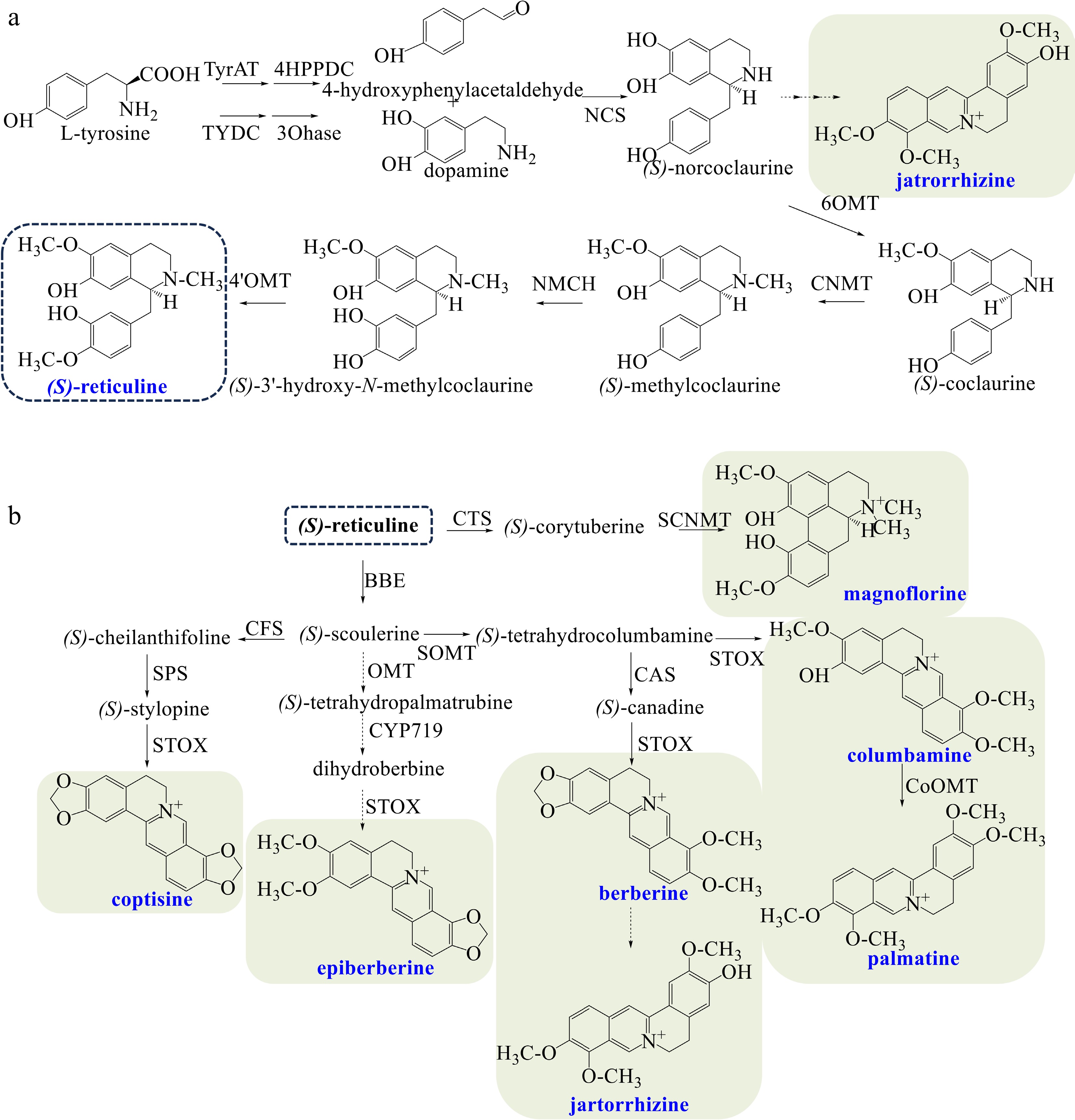
      Figure 1. 

      (a) Biosynthetic pathways of the central intermediate (S)-reticuline. (b) Biosynthetic pathways of diverse BIAs in Coptis species. The broken arrows represent a hypothetical pathway that has not yet been substantiated. Abbreviations: TyrAT, L-tyrosine aminotransferase; 4HPPDC, 4-hydroxyphenylpuruvate decarboxylase tyrosine/tyramine; TYDC, 3-hydroxylase tyrosine decarboxylase; 3OHase, tyrosine/tyramine 3-hydroxylase; NCS, (S)-norcoclaurine synthase; 6OMT, 6-O-methyltransferase; CNMT, (S)-coclaurine N-methyltransferase; NMCH, N-methylcoclaurine 3'-hydroxylase; 4'OMT, 3'-hydroxy-N-methylcoclaurine 4'-O-methyltransferase; CTS, corytuberine synthase; SCNMT, (S)-corytuberine-N-methyltransferase; BBE, berberine bridge enzyme; SOMT, soulerine 9-O-methyltransferase; CAS, canadine synthase; STOX, tetrahydroprotoberberine oxidase; CoOMT, O-methyltransferase; CFS, (S)-cheilanthifoline synthase; SPS, (S)-stylopine synthase.

      Coptis species mainly produce magnoflorine, berberine, coptisine, epiberberine, columbamine, palmatine, and jatrorrhizine (Fig. 1b). As an aporphine alkaloid, magnoflorine is synthesized via the pathway as follows: (S)-Reticuline is catalyzed to (S)-corytuberine by corytuberine synthase (CTS)[44], then magnoflorine is yielded by (S)-corytuberine-N-methyltransferase (SCNMT).

      Concerning the biosynthesis of berberine alkaloids, (S)-reticuline is first catalyzed to (S)-scoulerine by berberine bridge enzyme (BBE), which belongs to the flavoprotein family and contains two covalent binding sites for flavin adenine dinucleotide (FAD)[45]. The entry step of berberine biosynthesis is the production of (S)-tetrahydrocolumbamine by soulerine 9-O-methyltransferase (SOMT)[46]. The subsequent formation of the methanedioxy bridge of (S)-canadine is catalyzed by canadine synthase (CAS), a P450 enzyme of the CYP719A family[47]. (S)-canadine, also known as (S)-tetrahydroberberine, is oxidized to berberine by tetrahydroprotoberberine oxidase (STOX)[48]. The conversion from berberine to jatrorrhizine has not been identified[3,21,24]. (S)-tetrahydrocolumbamine can also be catalyzed by STOX directly to produce columbamine. Columbamine is further methylated by columbamine O-methyltransferase (CoOMT) to yield palmatine[49]. Biosynthetic pathway of coptisine is as follows: (S)-scoulerine is successively converted to (S)-cheilanthifoline and (S)-stylopine, which are respectively catalyzed by (S)-cheilanthifoline synthase (CFS, a P450-dependent monooxygenase) and (S)-stylopine synthase (SPS)[50]. (S)-Stylopine is further transformed into coptisine by STOX. Epiberberine may be biosynthesized by three successive catalyses derived from (S)-scoulerine, which remains a hypothetical approach that has not yet been determined. The biosynthesis pathway of jatrorrhizine from (S)-norcoclaurine has also not been identified.

    • Papaverine is a member of the 1-benzylisoquinoline alkaloids from opium poppy. Two pathways of its biosynthesis have been proposed (Fig. 2). The N-methylated (NCH3) pathway involves (S)-reticuline, while the simple N-desmethylated (NH) pathway involves (S)-norreticuline[15]. In the NH pathway, (S)-coclaurine is converted to (S)-6-O methyl norlaudanosoline, which is then O-methylated to yield (S)-norreticuline. (S)-Norreticuline is converted to (S)-norlaudanine, and then tetrahydropapaverine is produced[5154]. In the NCH3 pathway, the enzyme reticuline 7-O-methyltransferase (7OMT) catalyzes the conversion of (S)-reticuline to (S)-laudanine[55]. (S)-laudanine is fully O-methylated to (S)-laudanosine by 3'-O-methyltransferase (3'OMT), then (S)-laudanosine is demethylated to tetrahydropapaverine[15]. (S)-Tetrahydropapaverine, a shared precursor in NH and NCH3 pathways, converts to papaverine, undergoing 3-O-methylation, N-demethylation, and dehydrogenation by dihydrobenzophenanthridine oxidase (DBOX)[56].
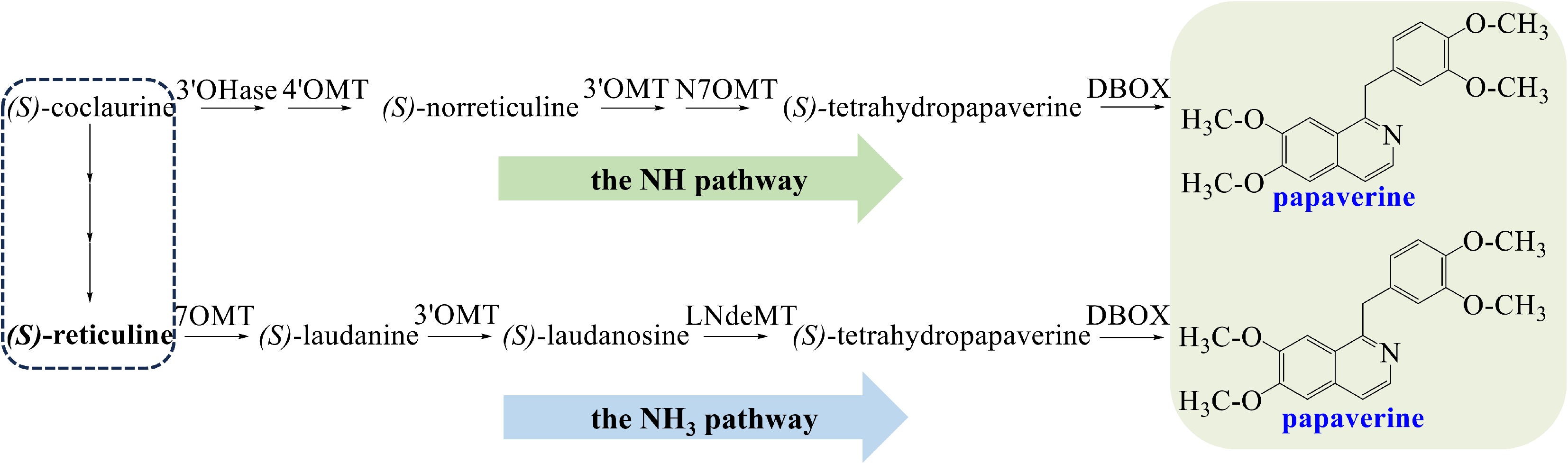
      Figure 2. 

      The NH and NH3 biosynthetic pathway of papaverine. Abbreviations: 3'OHase, 3'-hydroxylase; 4'OMT, 3'-hydroxy-N-methylcoclaurine 4'-O-methyltransferase; 3'OMT, 3'-O-methyltransferase; N7OMT, norreticuline 7-O-methyltransferase; DBOX, dihydrobenzophenanthridine oxidase; 7OMT, 7-O-methyltransferase; LndeMT, laudanosine N-demethylase.

      Opium poppy is characterized by synthesizing morphinan alkaloids (morphine, codeine, and thebaine), noscapine, and sanguinarine (Fig. 3). (S)-Scoulerine is sequentially converted to (S)-cheilanthifoline and (S)-stylopine, entering into the biosynthesis of sanguinarine. (S)-Stylopine is converted to (S)-cis-N-methylstylopine by tetrahydroprotoberberine cis-N-methyltransferase (TNMT)[57]. Protopine is subsequently yielded via hydroxylation by (S)-cis-N-methylastylopine 14-hydroxylase (MSH)[58]. Protopine is hydroxylated to 6-hydroxyprotopine by protopine 6-hydroxylase (P6H), and spontaneous rearrangement occurs to produce dihydrosanguinarine[50]. Sanguinarine is finally produced by DBOX.
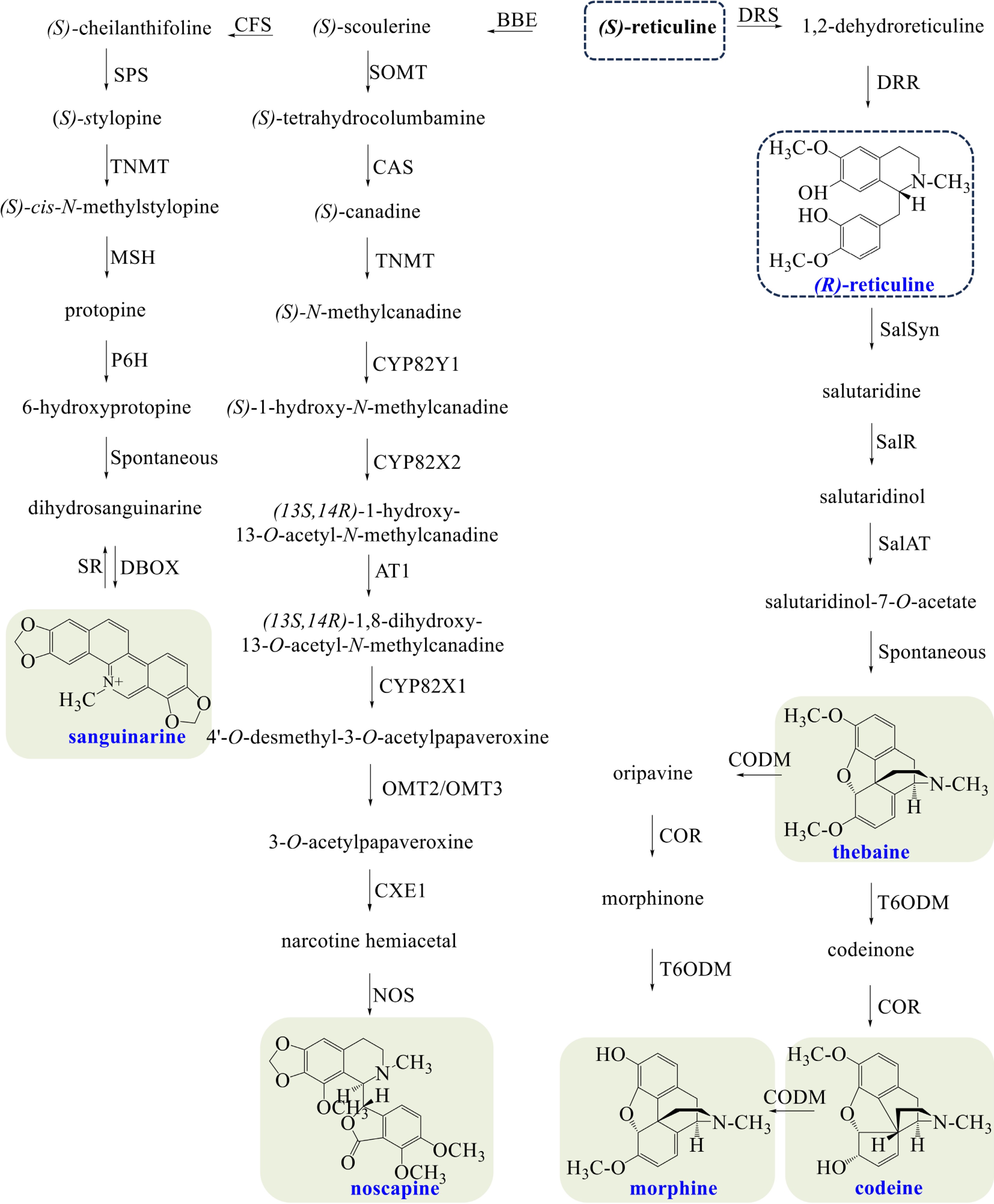
      Figure 3. 

      Biosynthetic pathways of morphine, codeine, thebaine, noscapine, and sanguinarine in opium poppy. The broken arrows represent a hypothetical pathway that has not yet been substantiated. Abbreviations: BBE, berberine bridge enzyme; CFS, (S)-cheilanthifoline synthase; SPS, stylopine synthase; TNMT, tetrahydroprotoberberine cis-N-methyltransferase; MSH, (S)-cis-N-methylastylopine 14-hydroxylase; P6H, protopine 6-hydroxylase; DBOX, dihydrobenzophenanthridine oxidase; SR, sanguinarine reductase; SOMT, soulerine 9-O-methyltransferase; CAS, canadine synthase; CYP82Y1, N-methylcanadine 1-hydroxylase; CYP82X2 1-hydroxy-N-methylcanadine 13-O-hydroxylase; AT1, 1,13-dihydroxy-N-methylcanadine 13-O-acetyltransferase; CYP82X1, 1-hydroxy-13-O-acetyl-N-methylcanadine 8-hydroxylase; OMT2/OMT3, O-methyltransferases 2/O-methyltransferases 3; CXE1, 3-O-acetylpapaveroxine carboxylesterase 1; NOS, noscapine synthase; DRS, 1,2-dehydroreticuline synthase; DRR, 1,2-dehydroreticuline reductase; SalSyn, salutaridine synthase; SalR, salutaridine reductase; SalAT, salutaridinol 7-O-acetyltransferase; T6ODM, thebaine 6-O-demethylase; COR, codeinone reductase; CODM, codeine O-demethylase.

      Noscapine belongs to the phthalideisoquinoline alkaloids, a structural subgroup of BIAs. (S)-canadine, an intermediate in the biosynthesis pathway of berberine, is N-methylated to (S)-N-methylcanadine by TNMT. Subsequently, narcotine hemiacetal is produced through sequential catalysis by N-methylcanadine 1-hydroxylase (CYP82Y1), 1-hydroxy-N-methylcanadine 13-O-hydroxylase (CYP82X2), 1,13-dihydroxy-N-methylcanadine 13-O-acetyltransferase (AT1), 1-hydroxy-13-O-acetyl-N-methylcanadine 8-hydroxylase (CYP82X1), O-methyltransferases 2/O-methyltransferases 3 (OMT2/OMT3,) and 3-O-acetylpapaveroxine carboxylesterase 1 (CXE1)[26]. Finally, noscapine is yielded by NOS.

      All aforementioned pathways begin with the (S)-epimer of reticuline; the biosynthesis of morphinan alkaloids requires its (R)-epimer. The (R)-epimerization of reticuline is a two-step process; it involves the oxidation by 1,2-dehydroreticuline synthase (DRS) and the reduction by 1,2-dehydroreticuline reductase (DRR)[59,60]. The salutaridine synthase (SalSyn) catalyzes the formation of salutaridine, then salutaridine reductase (SalR) stereospecifically deoxidizes the substrate to salutaridinol[61,62]. The stereospecific reduction of salutaridinol is catalyzed by salutaridinol 7-O-acetyltransferase (SalAT), then the acetyl group of salutaridinol-7-O-acetate spontaneously eliminates to form pentacyclic thebaine[63]. Morphine can be produced from thebaine by two different pathways, both of which consist of two demethylations and one reduction. The three enzymes involved include thebaine 6-O-demethylase (T6ODM), codeinone reductase (COR), and codeine O-demethylase (CODM)[64,65]. Codeine is the methylated precursor of morphine.

    • California poppy mainly synthesizes benzophenanthridine alkaloids (sanguinarine, chelirubine, macarpine, chelerythrine), aporphine alkaloids (magnoflorine, corydine, isoboldine), and pavine alkaloids (californidine, escholtzine) (Fig. 4). The biosynthesis of sanguinarine is the same as that in opium poppy. Dihydrosanguinarine, the dihydrogen-reduced precursor of sanguinarine, is the branching point entering into the biosynthesis of chelirubine and macarpine[66]. Dihydrosanguinarine is converted to chelirubine sequentially catalyzed by dihydrobenzophenanthridine alkaloid 10-hydroxylase (DB10H)[23], O-methyltransferase (OMT), and DBOX. However, the production of macarpine has not been expounded yet, in which dihydrobenzophenanthridine alkaloid 12-hydroxylase (DB12H)[23], OMT, and DBOX may be the catalytic enzymes.
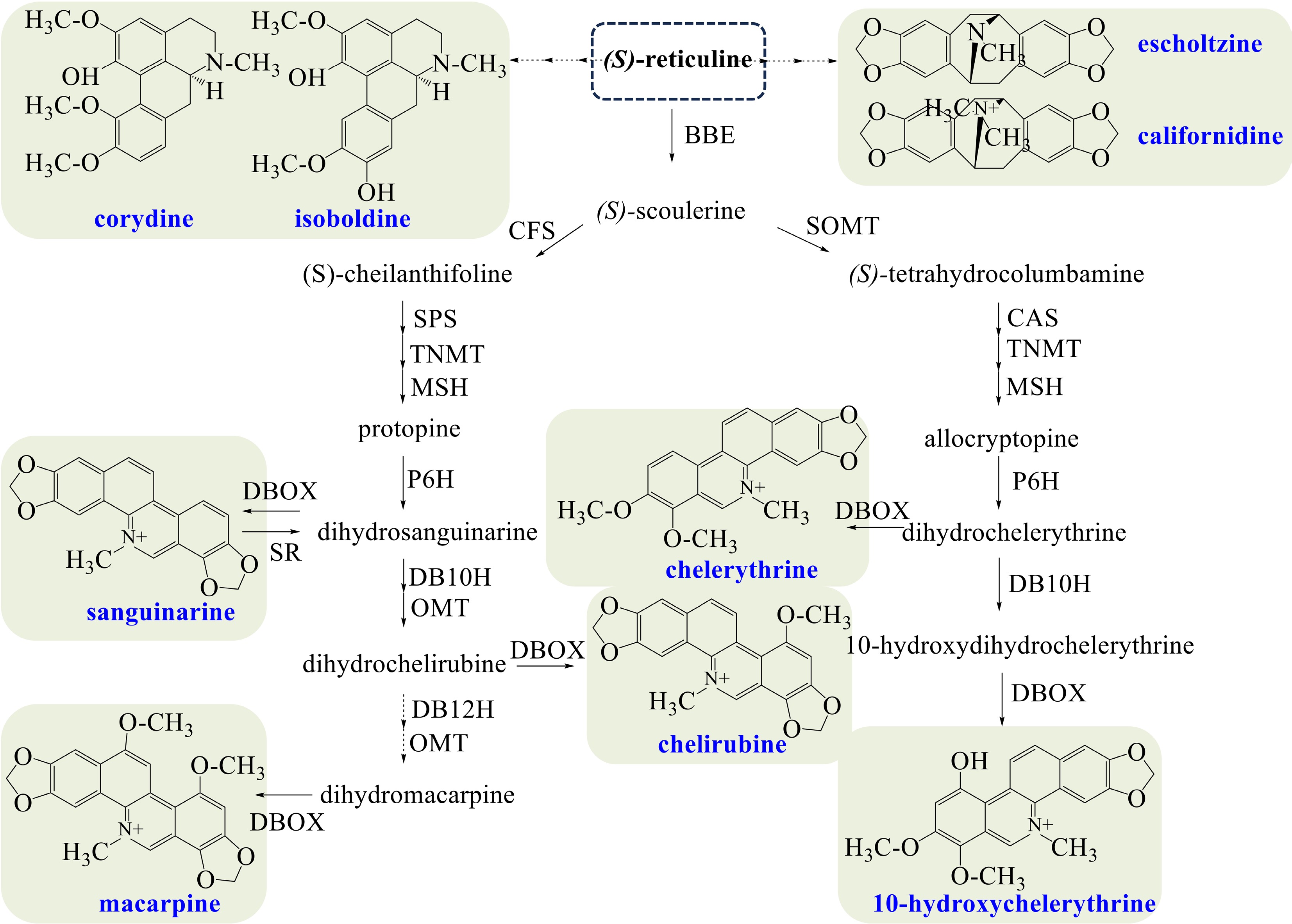
      Figure 4. 

      Biosynthetic pathways of BIAs in California poppy. The broken arrows represent a hypothetical pathway that has not yet been substantiated. Abbreviations: BBE, berberine bridge enzyme; CFS, (S)-cheilanthifoline synthase; SPS, stylopine synthase; TNMT, tetrahydroprotoberberine cis-N-methyltransferase; MSH, (S)-cis-N-methylastylopine 14-hydroxylase; P6H, protopine 6-hydroxylase; DBOX, dihydrobenzophenanthridine oxidase; SR, sanguinarine reductase; DB10H, dihydrobenzophenanthridine alkaloid 10-hydroxylase; OMT, O-methyltransferase; DB12H, dihydrobenzophenanthridine alkaloid 12-hydroxylase; SOMT, soulerine 9-O-methyltransferase; CAS, canadine synthase.

      Chelerythrine is produced from (S)-scoulerine sequentially, catalyzed by SOMT, CAS, TNMT, MSH, P6H, and DBOX. On the other hand, dihydrochelerythrine, the proximal precursor of chelerythrine, produces 10-hydroxychelerythrine by DB10H and DBOX[16]. Corydine and isoboldine could be produced from (S)-reticuline by unidentified enzymes, but the pathways remain unidentified. And the biosynthesis of californidine and escholtzine remains unclear.

    • External elicitors are biotic or abiotic substances that stimulate defense responses and secondary metabolism in plants[67]. Biotic elicitors refer to the signals triggered by endophytic fungi or bacteria, pathogenic microorganisms, including lysates and yeast extracts like polysaccharides, glycoproteins, and pectin[68]. Abiotic elicitors are divided into physical, chemical, and hormonal stimuli, which include salinity, drought, ultraviolet radiation, nanoparticles, heavy metals, methyl jasmonate (MeJA), salicylic acid (SA), and so on[6870]. For example, cytokinin causes a marked rise in berberine accumulation resulting from increased transcription of 6OMT and STOX in Thalictrum minus[71,72]. Ethylene also promotes the biosynthesis of berberine in T. minus cell cultures[73]. Positive impacts of elicitors on the BIA content in opium poppy and California poppy are listed in Table 2.

      Responding to external elicitors with low or high concentration, two different signaling pathways converge to regulate BIA biosynthesis[4]. The jasmonate-independent pathway is triggered by low elicitor concentrations. It involves Gα proteins and activated plasma membrane-anchored phospholipase A2 (PLA2), which triggers an intracellular pH signal to regulate the BIA biosynthesis[74,75]. The jasmonate-dependent pathway responds to high elicitor concentrations, which is transmitted via the jasmonic acid signal and involves the WRKY, bHLH, and AP2/ERF transcription factors[76].

      Table 2.  Positive impacts of abiotic and biotic elicitors on the BIA content in opium poppy and California poppy.

      Species Origin Elicitor Duration Concentration Alkaloid Enhancement rate Ref.
      Opium poppy Biotic Botrytis sp. 80 h 1 mL/50 mL cell culture Sanguinarine 100 folds [77]
      Acinetobacter 72 h 10 mL Morphine 1044% [78]
      Noscapine 936%
      Papaverine 349%
      Kocuria sp. 72 h 10 ml Thebaine 718% [78]
      Acinetobacter sp. + Marmoricola sp. 2 h × 2 times 1 × 108 CFU mL−1 Morphine 2250% [79]
      Papaverine 36.4%
      Noscapine 53.3%
      Abiotic GA3+TRIA 90 d 10−6 M Morphine 60.3% [51]
      MeJA 12 h 100 mM Morphine 1.8 folds [80]
      Noscapine 1.6 folds
      Thebaine 3.2 folds
      Wound 5 h / Morphine / [81]
      Thebaine
      Wound / / Papaverine 125% [82]
      Narcotine 133%
      California poppy Biotic Yeast glycoprotein 24 h 1 μg·mL−1 Sanguinarine / [83,84]
      Chelirubine
      Macarpine
      10-OHchelerythrine
      Abiotic MeJA 136 h 100 μM Sanguinarine / [85]
      10-Hydroxychelerythrine
      Chelerythrine
      Chelirubine
      Macarpine
      Dihydrochelirubine
      MeJA + SA 48 h 0.5 mg + 0.02 mg·g−1 FCW Sanguinarine 980% [86]
      MeJA, methyl jasmonate; SA, salicylic acid; GA3, gibberellic acid; TRIA, triacontanol; /, data is not shown in reports.
    • In California poppy, external elicitors of low concentration trigger an intracellular pH signal to regulate the BIA biosynthesis. Yeast glycoprotein of low concentration regulates BIA biosynthesis as follows (Fig. 5): First, PLA2 is a part of a stable membrane-anchored protein complex harbouring alterable numbers of Gα proteins and a cyclophilin[75,87]. In the company of guanosine triphosphate (GTP), yeast glycoprotein elicitor activates PLA2 via G-protein-mediated conformational transfer[88]. Second, PLA2-catalyzed lipid hydrolysis raises endogenous lysophosphatidylcholine (LPC) in the cytoplasm to a peak. The LPC acts as a second messenger to activate the H+/Na+ exchangers at tonoplast, causing a Na+-dependent efflux of vacuolar protons and transient acidification of the cytoplasm[89]. Third, the peak of cytoplasmic H+ induces the expression of BIA biosynthetic enzyme, and the rate-limiting enzyme 4'-OMT has the highest increase in expression level[90]. Finally, the triggered pH shift induces tyrosine phosphorylation of downstream individual proteins, which leads to the regulation of BIA biosynthesis[74].
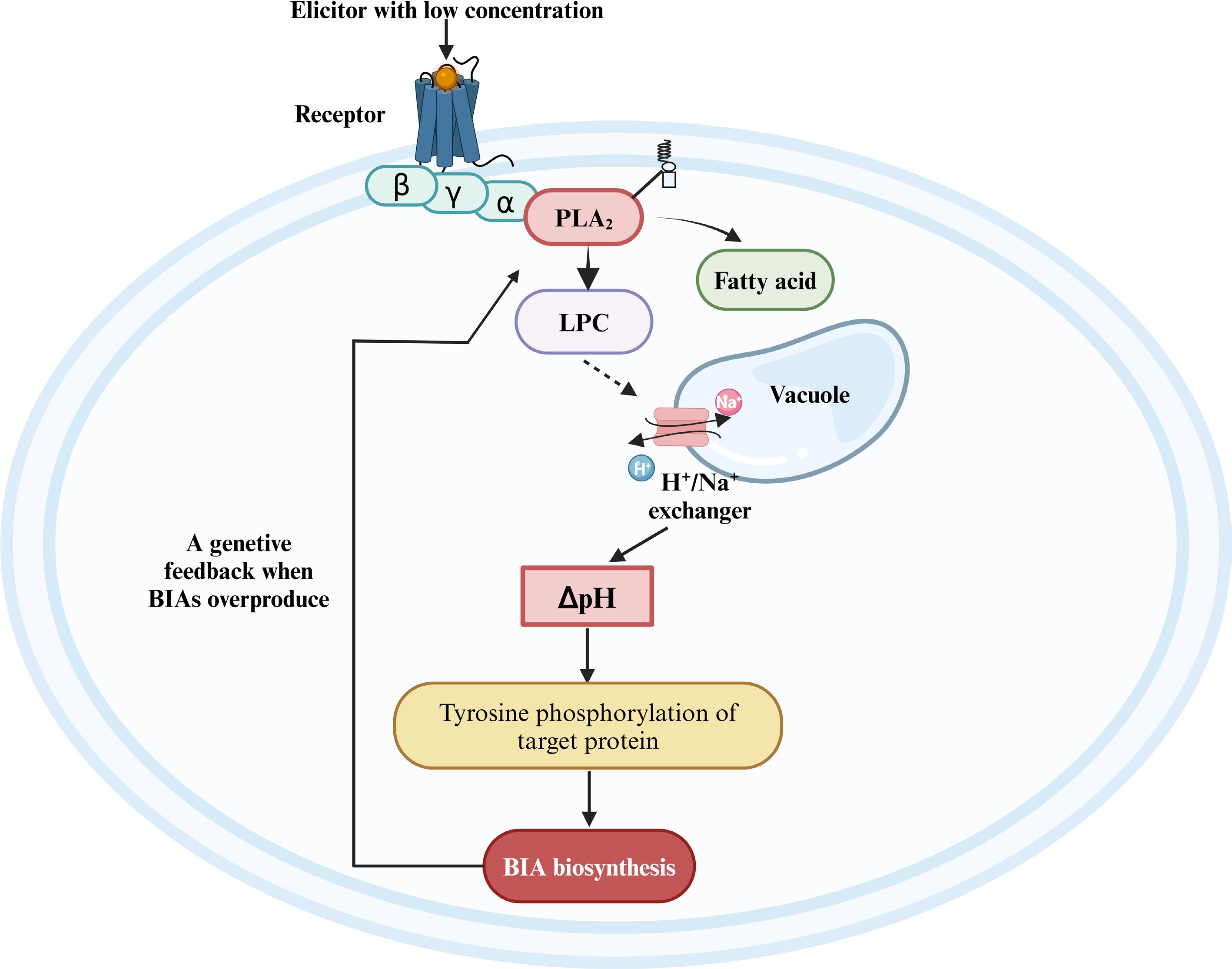
      Figure 5. 

      The regulatory model of the jasmonate-independent pathway in the biosynthesis of BIAs. BIA, benzylisoquinoline alkaloid; PLA2, phospholipase A2; LPC, lysophosphatidylcholine. Reproduced with the permission from Ross et al.[74], Copyright 2006, Elsevier. This figure was created using the BioRender online tool (BioRender.com).

      When produced BIAs are excessive, the produced final alkaloids may bind to PLA2 to emerge far-reaching negative feedback[75,89,91]. The specific alkaloid-binding pocket in PLA2 in California poppy allows the molecule to distinguish self-made BIAs from foreign ones via a filter[84]. Sanguinarine, chelirubine, macarpine, chelerythrine and 10-OH chelerythrine all inhibit the activity against PLA2 by more than 40%, while these BIAs exhibit individual differences in the inhibitory activity: 10-OH-chelerythrine is the strongest alkaloid, chelirubine acts as the second, and inhibit degree of macarpine, chelerythrine, sanguinarine are relatively weak[84]. After the final alkaloids bind to PLA2, the LPC level is adjusted by rapid enzymic reacylation, and depletion of the vacuolar proton pool blocks the elicitation of alkaloid response; BIA biosynthesis is terminated[92,93]. This negative feedback prevents the elicitation process from continuing indefinitely and protects the BIA-producing plants from self-intoxication[84].

    • When treated by elicitors with high concentration, the intracellular signal in California poppy is mainly transmitted via the accumulation of jasmonic acid (Fig. 6). Secreted PLA2 (sPLA2) is Gα-independently activated by high elicitor concentrations[67,74]. sPLA2 releases the linolenic acids, which cause the accumulation of jasmonate in the cell[94,95]. Accumulated jasmonate has striking biological effects on elicitor and stress response, as well as the induction of secondary metabolites[70]. On the one hand, accumulated jasmonate triggers the hyper-sensitive response, including loss of K+, external alkalinization, and apoptosis[91]. The deficiency of K+ stimulates the mitogen-activated protein kinase (MAPK) pathway and oxidative burst, like reactive oxygen species (ROS)[8,91]. The phosphorylated MAPKs are guided to the nucleus where they phosphorylate downstream genes. Group I WRKY transcription factors with two WRKY domains are regulated by MAPK-mediated phosphorylation[96], and MAPKs may phosphorylate multiple APETALA2/Ethylene responsive factors (AP2/ERFs) associated with plant defense responses like AtERF6, AtERF72, GmERF113, and OsEREBP1[97]. WRKY transcription factors have been fully demonstrated to regulate BIA biosynthesis in medicinal plants. CjWRKY1 and PsWRKY bind to the W-box ([T]TGACC[C/T]) in the promoter to regulate the expression of BIA biosynthetic genes[82,98]. And the G-box sequence in the promoter of target genes is trans-activated by AP2/ERF proteins involved in the regulation of BIA biosynthesis[99].
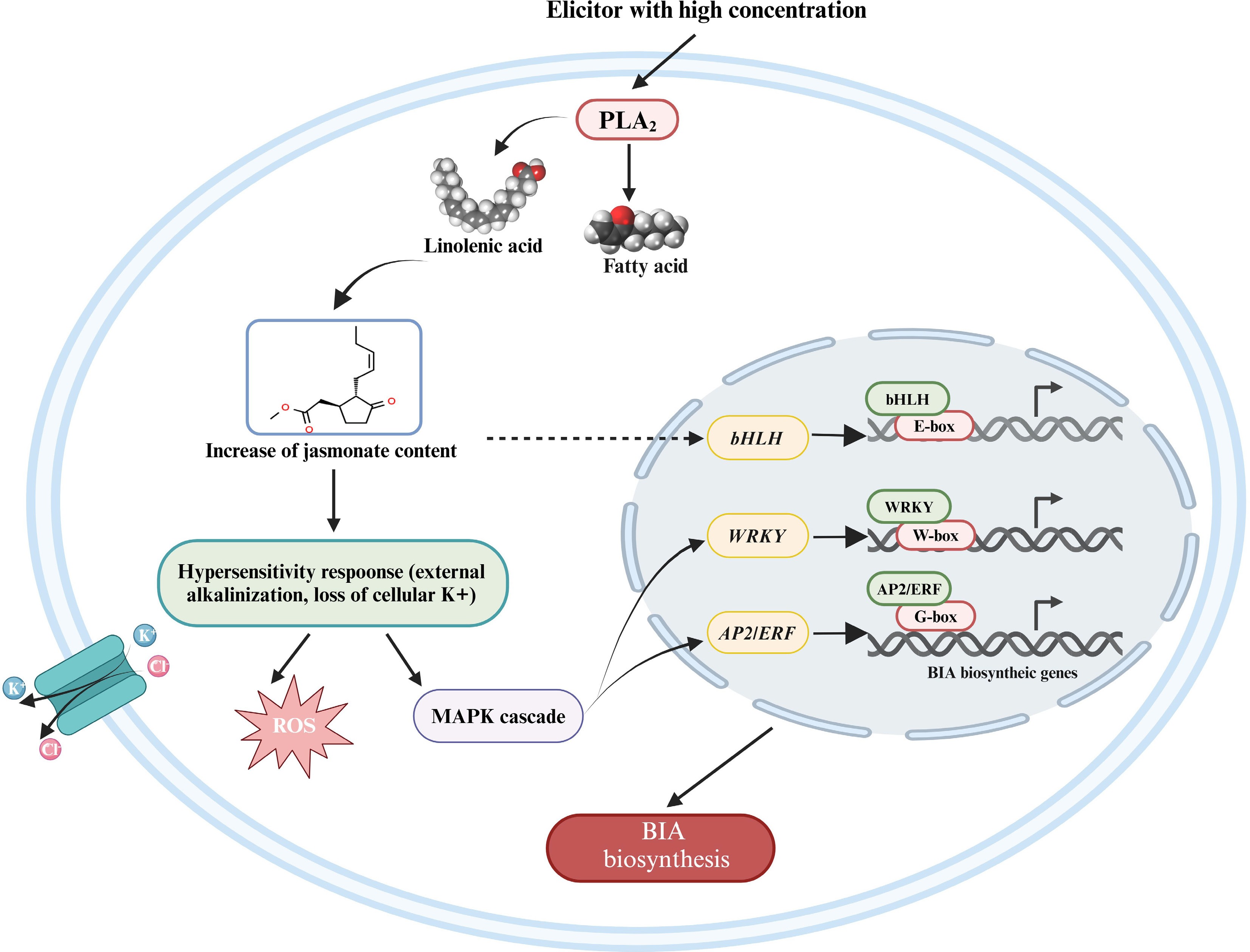
      Figure 6. 

      The regulatory model of the jasmonate-dependent pathway in the biosynthesis of BIAs. A broken arrow represents a hypothesized signal cascade that has not yet been substantiated. BIA, benzylisoquinoline alkaloid; PLA2, phospholipase A2; ROS, reactive oxygen species; MAPK, mitogen-activated protein kinase. This figure was created using the BioRender online tool (BioRender.com).

      On the other hand, jasmonate may also trigger the activation of bHLH transcription factors. CjbHLH1 is of JA-inducibility, and EcbHLH1-1 and EcbHLH1-2 are inducible by MeJA[100,101]. Little is known about which proteins participate in triggering the activation of bHLHs, considering that CjbHLH1 is a non-MYC2-type bHLH protein while EcbHLH1-1 may be involved in the regulation of EcMYC2 expression[100]. bHLH transcription factors are characterized to regulate BIA biosynthesis. bHLHs target downstream genes through the degradation of JA ZIM DOMAIN (JAZ) repressor via COI1-mediated ubiquitination and 26S proteasomal degradation[102]. The E-box in the promoter is considered to be the trans-activation target of bHLHs[98], and glutamate at position nine enables CjbHLH1 to bind to the E-box[103]. The target enzymes and alkaloids regulated by WRKYs, AP2/ERFs, and bHLHs in Coptis species, opium poppy, and California poppy are summarized in Table 3.

      Table 3.  Transcription factors targeting various BIA biosynthetic enzymes and alkaloids.

      Plant source Transcription factors Target enzymes Enhanced alkaloids Ref.
      Coptis japonica/
      Coptis chinensis
      CjWRKY1 All genes involved in berberine biosynthesis / [104]
      CjWRKY1 CYP80B2, 4'OMT and CYP719A1 / [105]
      CjWRKY1 EcCYP719A3, EcP6H, EcG3OMT, and EcG11OMT Sanguinarine, chelirubine, chelerythrine, allocryptopine, protopine, and 10-hydroxychelerythrine [106]
      CcWRKY7; CcWRKY29; CcWRKY32 CcCNMT protoberberine [107]
      CjbHLH1 All berberine biosynthetic enzyme genes (TYDC, NCS, 6OMT, CNMT, CYP80B2, 4'OMT, BBE, SMT and CYP719A1) / [103]
      CjbHLH1 4'OMT, CYP719A1 / [105]
      CcbHLH001; CcbHLH0002 CcBBE and CcCAS Five main BIA [108]
      17 members of CcAP2/ERFs; family CcCAS, CcCTS, CcCoOMT, CcNMCH, and Cc4'OMT Berberine, columbamine, coptisine, epiberberine, jatrorrhizine, and palmatine [99]
      Opium poppy PsWRKY TYDC / [82]
      California poppy EcbHLH1-1; EcbHLH1-2 6OMT, 4'-OMT and CYP719A3 Sanguinarine [101]
      EcAP2/ERF2; EcAP2/ERF3; EcAP2/ERF4; EcAP2/ERF12 Ec6OMT and EcCYP719A5 / [109]
      Arabidopsis thaliana AtWRKY1 EcCYP80B1 and EcBBE BIAs in opium poppy and California poppy [110]
    • The WRKY and bHLH transcription factors have been largely identified and characterized as crucial transcriptional activators of BIA biosynthesis. Additionally, AP2/ERF responsive factors have recently been identified as regulate BIA biosynthesis in medicinal plants. The expression of 14 members of EcAP2/ERF family in California poppy shows an analogical increase with BIA biosynthetic genes Ec6OMT and EcCYP719A5, and luciferase reporter assay confirmed the transactivation activity of EcAP2/ERF3, EcAP2/ERF3, EcAP2/ERF4 and EcAP2/ERF12 in conjunction with the promoters of Ec6OMT and EcCYP719A5 genes[109]. AP2/ERF gene family in C. chinensis contains a total of 96 CcAP2/ERF genes and are categorized into five subfamilies, protein-protein interactome (PPI) network analysis indicates that DREB1B (Cch00003559), ERF012 (Cch00006818), and AP2 type ERF (Cch00036859) respectively interact with Cc4'OMT, CcCTS and CcCAS gene[99]. Ectopic expression of Arabidopsis thaliana and Glycine max AP2/ERFs in opium poppy and California poppy cells increased the transcript levels of several BIA biosynthetic genes and enhanced the yield of BIAs[110]. PsAP2 from opium poppy directly binds and transcriptionally activates NtAOX1a promoter in Nicotiana tabacum, and its overexpression imparts higher tobacco tolerance towards abiotic or biotic stress[111]. Furthermore, AP2/ERFs have been demonstrated to positively regulate alkaloid biosynthesis in tobacco, Catharanthus roseus, and Camptotheca acuminata[112115].

      AP2/ERFs are one of the largest groups of plant-specific transcription factors. The members contain an AP2/ERF domain, which comprises 60 to 70 amino acid residues involved in DNA-binding. According to the number of conserved domains, the AP2/ERF superfamily is split into three subfamilies: AP2 (two AP2/ERF domains), RAV (an AP2/ERF domain and a B3 domain), and ERF (an AP2/ERF domain only)[116]. Overexpression of AP2/ERFs is appropriate for metabolic engineering to increase BIA content in medicinal plants. A previous study of C. chinensis provides hypothetical support for this strategy. PPI network analysis identifies the interaction among BIA biosynthetic enzymes, CcAP2/ERFs, WRKYs, bHLHs, and the ABCB subfamily of ATP-binding cassette (ABC) transporters. It reveals that DREB1B, a dehydration-responsive element binding (DREB) protein, is the central regulator of BIA biosynthesis in C. chinensis[99]. External stimuli like ABA and MeJA trigger the transcription of DREB1B, which activates the downstream Cc4'OMT gene and the downstream WRKY and bHLH transcription factors[99]. Then, activated WRKYs and bHLHs target more BIA biosynthetic enzymes, thus a cascade of amplification effect is created to enhance the BIA content[99].

    • Tyrosine, the precursor of all BIAs, is synthesized de novo from the shikimate pathway, in which the seven enzymatic reactions involved have been completely illustrated[117]. DAHP synthase (DHS) catalyzes the condensation of erythrose 4-phosphate (E4P) and phosphoenolpyruvate (PEP) into 3-deoxy-D-arabinoheptulosonate 7-phosphate (DAHP), which is a key metabolic point as the first step of the shikimate pathway[118]. The key enzyme controlling the generation of tyrosine from arogenate is arogenate dehydrogenase (TyrA)[119]. However, DHS and TyrA are subjected to complex feedback inhibitions. Chorismate is a strong inhibitor of DHS, arogenate offsets chorismate-mediated inhibition of DHS when aromatic amino acids accumulate at ~60–300 µM, however, when amino acids are beyond ~300 µM and start to inhibit chorismate mutase (CM), arogenate accumulation is attenuated and hence chorismate again inhibits DHS[120,121]. Similarly, TyrA is typically feedback inhibited by tyrosine with a half-maximal inhibitory concentration (IC50) ≤ 100 μm[122,123]. The attempts of the mutation of DHS or TyrA in legumes, Caryophyllales, and A. thaliana inspire us to obtain feedback-regulated enzymes[119,124,125]. In consideration of the pre- and post-chorismate pathways function as independently regulatory modules in plants[126], it is necessary to co-mutate DHS and TyrA to be feedback insensitive ones (Fig. 7).
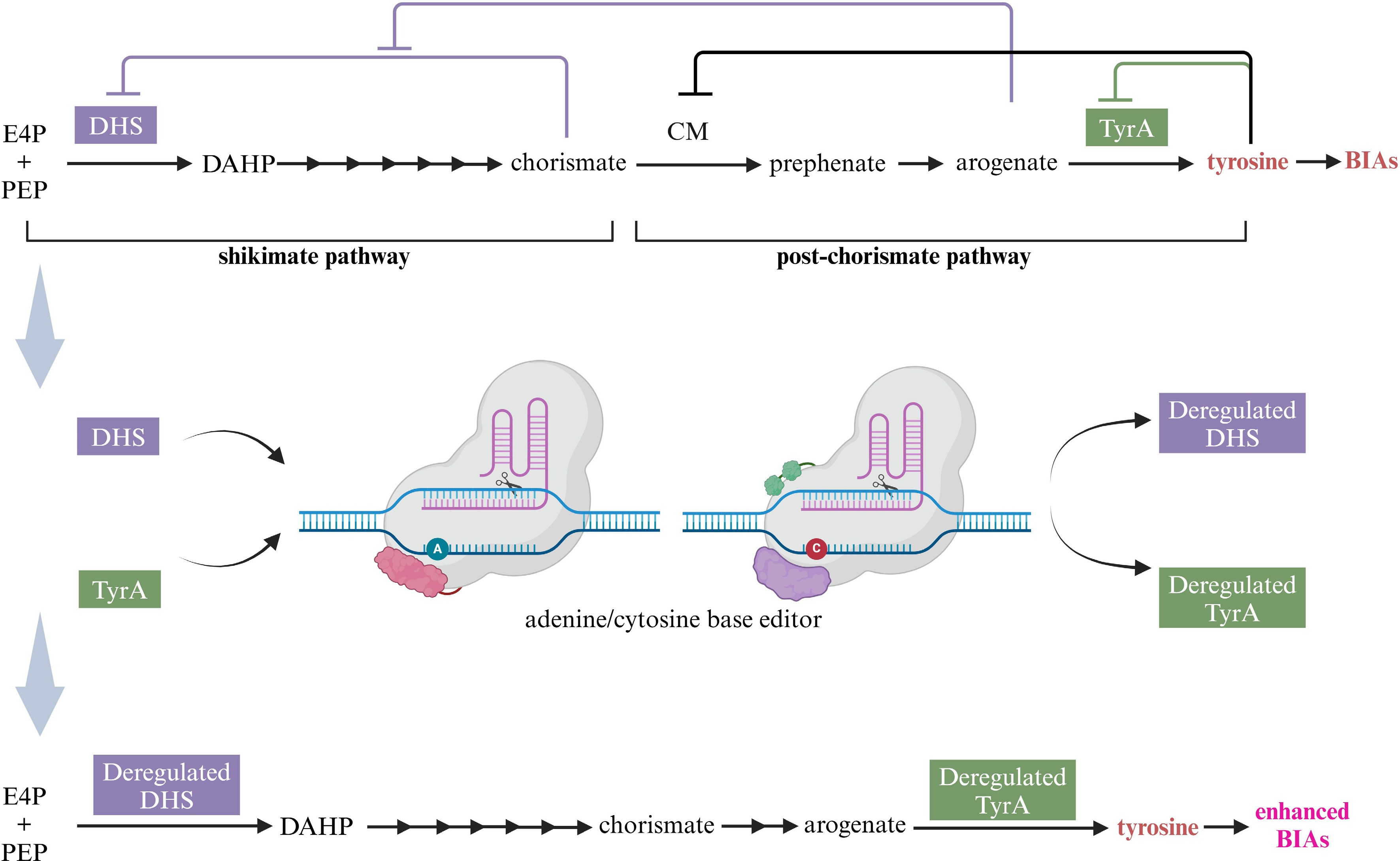
      Figure 7. 

      Acquiring higher BIA yield through channeling more tyrosine via deregulated DHS and TyrA with the aid of base editing technology. E4P, erythrose 4-phosphate; PEP, phosphoenolpyruvate, DAHP, 3-deoxy-D-arabinoheptulosonate 7-phosphate; DHS, DAHP synthase; CM, chorismate mutase; TyrA, arogenate dehydrogenase; BIAs, benzylisoquinoline alkaloids. This figure was created using the BioRender online tool (BioRender.com).

      The clustered regularly interspaced short palindromic repeats (CRISPR)/CRISPR-associated protein9 (Cas9) system enables precise genome editing at any target site at the lowest cost. Moreover, deaminase-mediated base editing technology stands out with the advantage of precise modification and high editing efficiency in plants[127]. Cytosine base editor (CBE) is assigned to the conversion of C to T, while adenine base editor (ABE) generates the conversion of A to G[128,129]. Following the development of CBE and ABE, prime editor technology is developed, which performs all 12 types of base substitutions, precise insertions of up to 44 bp, and deletions of up to 80 bp[130]. Based on the facts and technology mentioned above, feedback-regulated DHS or TyrA can be deemed as the best option for site-directed base editing with the purpose of enhancing BIA production. The putative DAHPS and putative TyrA genes discovered in C. deltoidea may offer sequence information for the base editing[24].

    • Metabolic engineering, which introduces BIA biosynthetic genes into microorganisms, provides an approach for the development of scalable manufacturing processes. Saccharomyces cerevisiae and Escherichia coli are common microbial hosts for rebuilding the BIA biosynthetic pathways. The de novo synthesis of many crucial BIAs, including (S)-reticuline, magnoflorine, thebaine, sanguinarine, noscapine, tetrahydropapaverine (the direct precursor of papaverine), berberine, palmatine, chelerythrine, and chelirubine, has been achieved in E. coli[131134] and S. cerevisiae[40,135145] (Table 4). Codeine and morphine can be converted from thebaine[139] or (R)-reticuline[140] in S. cerevisiae.

      Table 4.  The rebuilt synthesis pathways of some BIAs in microbes.

      Host Produced BIAs Strategy Yield Ref.
      Escherichia coli
      (S)-reticuline De novo synthesis 46.0 mg·L−1 culture medium [131]
      (S)-reticuline De novo synthesis 384 μM [132]
      (S)-reticuline De novo synthesis 55 mg·L−1 within 1 h [133]
      Thebaine De novo synthesis 2.1 mg·L−1 [134]
      Saccharomyces cerevisiae
      (S)-reticuline De novo synthesis 80.6 μg·L-1 [135]
      Reticuline De novo synthesis 19.2 μg·L−1 [136]
      Magnoflorine De novo synthesis 75.8 mg·L−1 [137]
      Palmatine, berberine, chelerythrine, sanguinarine, and chelirubine De novo synthesis 38.1 mg·L−1 (chelerythrine) [40]
      Thebaine De novo synthesis 6.4 ± 0.3 µg·L−1 [138]
      Codeine, morphine, hydromorphone, hydrocodone, and oxycodone Synthesis from thebaine 131 mg·L−1 (total opioid titers) [139]
      Codeine and morphine Synthesis from (R)-reticuline / [140]
      Sanguinarine De novo synthesis 448.64 mg·L−1 [141]
      Sanguinarine De novo synthesis 1.8 mg·L−1 [142]
      Noscapine De novo synthesis ~2.2 mg·L−1 [143]
      Noscapine Biosynthesis from (S)-canadine 1.64 ± 0.38 μM [144]
      Tetrahydropapaverine De novo synthesis 121µg·L−1 [145]
      Combination cultures of
      E. coli and S. cerevisiae cells
      Magnoflorine and scoulerine De novo synthesis 7.2 and 8.3 mg·L−1 culture medium [133]
      /, data is not shown in reports.

      However, low productivity and growth retardation of microbial engineering has been reported, which is mainly ascribed to the cytotoxicity of substrates or products[146,147]. Besides, it requires considerable effort to extract and purify the accumulated metabolites from various endogenous cellular metabolites. One approach available is the utilization of transporters, which remove metabolites from cells. Transporters are mainly divided into four groups: ABC transporters, multidrug and toxic compound extrusion (MATE) transporters, purine uptake permeases (PUPs), and nitrate transporter 1/peptide family (NPF) transporters[148]. Some transporters in C. japonica and opium poppy have been isolated. A BIA uptake permease (BUP) subfamily pertaining to PUPs has been discovered in opium poppy; their heterologous expression in engineered yeast hosting the opiate pathway shows that BUPs are able to uptake a variety of BIAs and certain pathway precursors like dopamine[149]. In C. japonica, berberine is biosynthesized in roots and translocated upward via xylem transport. CjABCB1 and CjABCB2 transporters, which are localized in the plasma membrane, are involved in the unloading of berberine in the rhizome[150,151]. CjMATE1 transporter, localized at the tonoplasts, mediates berberine accumulation into vacuoles as the final step of berberine synthesis and transport in C. japonica[6].

      As it is inspired from several attempt of AtDTX1 transporter in Arabidopsis, NtJAT1 transporter in N. tabacum, and BUPs in opium poppy[149,152,153], the use of transport engineering is a powerful tool to increase the BIA productivity in microorganisms (Fig. 8). Nowadays, owing to omics sequencing technology, nine members of opium poppy BUP family have been discovered[149]; nine transcripts encoding homologues of CjABCB1, CjABCB2 and CjABCB3, and 28 putative transcripts encoding MATE transporters, have been obtained from C. deltoidea[24]; In California poppy, transporter genes contained in OG0008001 and OG0012836 orthologous group are homologous to CjABCB1, MATE-type genes contained in OG0001473 and OG0007280 are homologous to CjMATE1, a gene contained in OG0000544 is homologous to BUP1, and OG0000703 contains ten predicted purine permease genes[9]. These findings prompt us to heterologously express transporter genes like CjABCB1, CjABCB2, CjMATE1, and BUPs to BIA-producing microorganisms, with the purpose of enhancing alkaloid production in microbial hosts.
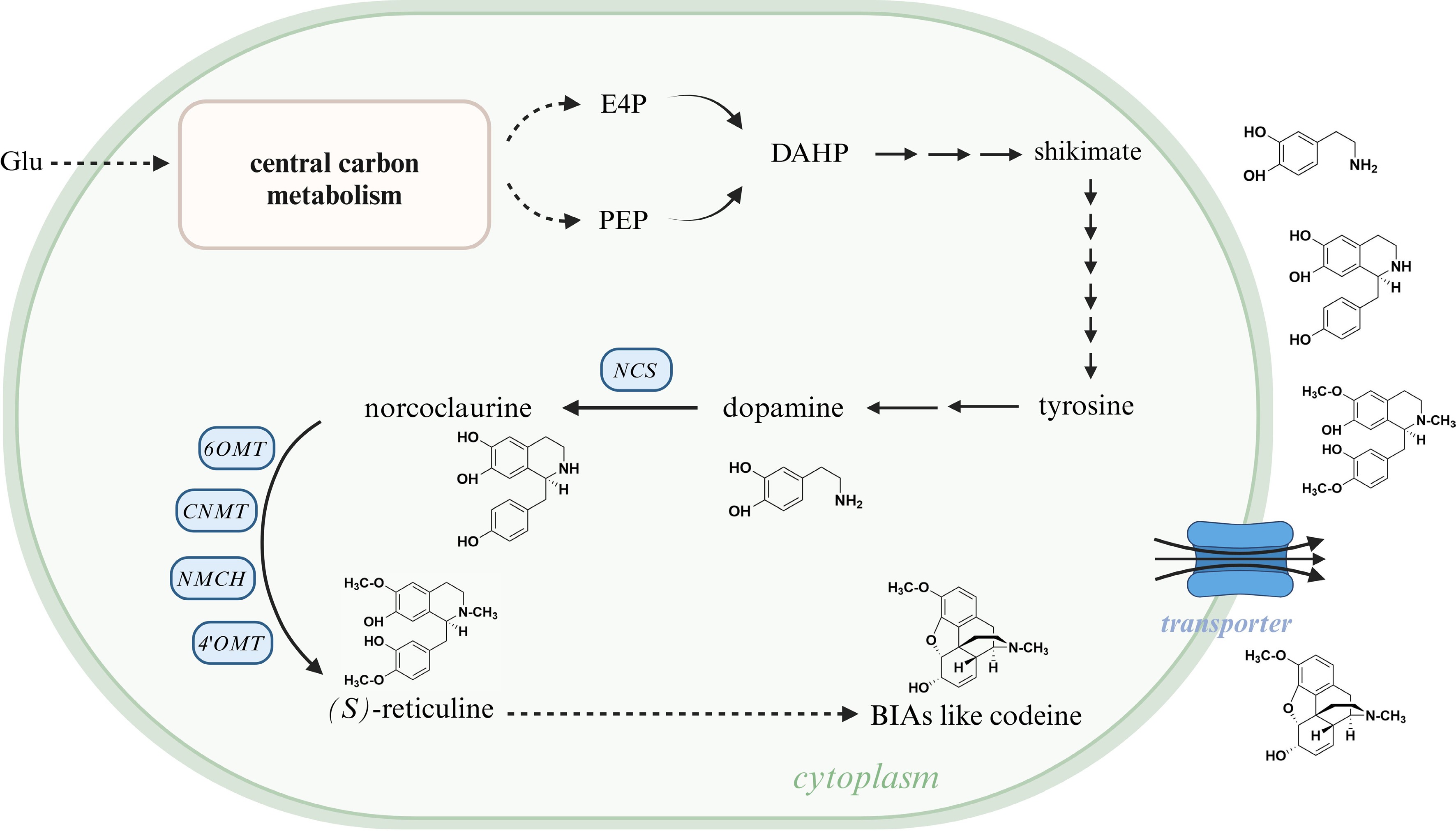
      Figure 8. 

      Schematic of the function of heterologous transporters in BIA-producing microorganisms. The substrate takes glucose as an example; transported BIAs take dopamine, norcoclaurine, (S)-reticuline, and codeine as examples. Glu, glucose; E4P, erythrose 4-phosphate; PEP, phosphoenolpyruvate; DAHP, 3-deoxy-D-arabinoheptulosonate 7-phosphate; NCS, (S)-norcoclaurine synthase; 6OMT, 6-O-methyltransferase; CNMT, (S)-coclaurine N-methyltransferase; NMCH, N-methylcoclaurine 3'-hydroxylase; 4'OMT, 3'-hydroxy-N-methylcoclaurine 4'-O-methyltransferase; BIA, benzylisoquinoline alkaloid. This figure was created using the BioRender online tool (BioRender.com).

    • Numerous plant-derived BIAs have been employed in medical applications, such as the analgesic agent morphine, the anti-cancer agent berberine, and the anti-microbial agent sanguinarine. The considerable advancement over the past decade has led to remarkable improvements in the knowledge of BIA biosynthesis pathways. It may be acquired that different BIAs are biosynthesized in different medicinal plants, which may be attributed to the evolution of BIA biosynthetic genes along with the evolution of plants. According to a previous report, NCS enzymes distribute in Ranunculales species and early-diverging eudicots, while the CYP82X/Y subfamily only exists in Papaver species, which supports their involvement in the biosynthesis of phthalideisoquinolines[154].

      Besides, the jasmonate-independent and jasmonate-dependent regulatory pathway of BIA biosynthesis is demonstrated here. Some strategies, including overexpression of transcription factors, base editing for synthetic enzymes of tyrosine, and transport engineering in microbes, are presented here, aiming to provide ideas for enhancing the BIA's content. The stable transformation and regeneration protocols of C. japonica, opium poppy, and California poppy make these strategies feasible[155157], though it is time-consuming to regenerate mature plants. Surely, the presented strategies have limitations in consideration of the off-target effects of the CRISPR/Cas9 system, because the similarity in gene sequences frequently blocks its application[158]. Therefore, the target specificity of designed sgRNAs, which edit synthetic enzymes in the tyrosine pathway, requires strict verification.

      Further research is necessary to fully elucidate the unidentified pathways of jatrorrhizine, epiberberine, corydine, isoboldine, californidine, and escholtzine. In the near future, the techniques mentioned above will be used to produce BIAs and other medicinal compounds with higher yields. Of course, some other strategies, including improving enzyme catalytic efficiency through enzyme engineering, gene editing of microRNAs, and single-cell multi-omics and spatial transcriptomics will also optimize the metabolic flux and improve BIA yield[2,159,160]. In brief, this review provides a foundation for the accumulation of BIAs in pharmaceutical plants and the de novo synthesis of BIAs in microbial hosts, thereby facilitating the discovery and development of alkaloid-based drugs in the future.

      • The authors did not receive support from any organization for the submitted work.

      • The authors confirm contribution to the paper as follows: study conception and design: Qin L, Ming Q, Li P; literature collection and analysis: Qin L, Liu Y; writing-original draft preparation: Qin L; writing-review and editing: Ming Q, Li P. All authors reviewed the results and approved the final version of the manuscript.

      • Data sharing is not applicable to this article as no datasets were generated or analyzed during the current study.

      • The authors declare that they have no conflict of interest.

      • Copyright: © 2025 by the author(s). Published by Maximum Academic Press, Fayetteville, GA. This article is an open access article distributed under Creative Commons Attribution License (CC BY 4.0), visit https://creativecommons.org/licenses/by/4.0/.
    Figure (8)  Table (4) References (160)
  • About this article
    Cite this article
    Qin L, Liu Y, Ming Q, Li P. 2025. Biosynthesis and regulatory mechanisms of benzylisoquinoline alkaloids in medicinal plants. Medicinal Plant Biology 4: e034 doi: 10.48130/mpb-0025-0025
    Qin L, Liu Y, Ming Q, Li P. 2025. Biosynthesis and regulatory mechanisms of benzylisoquinoline alkaloids in medicinal plants. Medicinal Plant Biology 4: e034 doi: 10.48130/mpb-0025-0025

Catalog

    /

    DownLoad:  Full-Size Img  PowerPoint
    Return
    Return