











-
In the era of accelerating globalization and digital integration, digital trade has emerged as a prominent area in the world economy. Simultaneously, with the rapid advancement of information technology, digital trade is profoundly reshaping the landscape and patterns of international trade. The State Council of China issued the '14th Five-Year Plan for Digital Economic Development', emphasizing the need to enhance the application of digital technology in the field of trade. It indicates the Chinese government's awareness of the importance of digital technology in driving trade development and improving trade efficiency. It would help enhance the technological content and value-added of export products, thereby increasing export technological complexity. Furthermore, the General Office of the State Council of China issued the 'Implementation Opinions on Promoting Innovative Development of Foreign Trade'. This policy encourages enterprises to utilize digital means to expand markets, optimize supply chains, and enhance trade efficiency and competitiveness. It would contribute to raising China's export technological complexity and achieving higher-quality exports. Therefore, advancing China's digital trade requires accelerating the digital transformation of traditional industries to expand channels for digital trade. Moreover, it also necessitates improving the quality of China's export structure. Research in relevant fields should focus on enhancing the quality of export products in the current information technology and economic environment to provide strategic guidance for economic development.
Reviewing existing literature on digital trade, early studies primarily focused on the foundational aspects of the concept and scope of digital trade. However, as research progressed and economic and technological environments evolved, attention shifted towards the impact of digital trade on economic growth, trade structure, and other aspects. Furthermore, digital trade exerts significant influence on both domestic and international economies. In terms of the domestic economy, digital trade profoundly affects a country's industrial structure, technological innovation, labor force, and more. Additionally, digital trade strengthens global economic connections, facilitating the formation of a more refined and specialized division of labor, thereby enhancing the overall trade environment and efficiency. Factors such as trade barriers, trade liberalization, institutional quality, and environmental regulations, among others, all have varying impacts on export technological complexity[1−5]. For instance, Zhang et al. conducted empirical tests on 16 manufacturing industries across 43 countries from 2000 to 2014[6]. Zhang et al. suggested that population aging significantly influences export technological complexity, while artificial intelligence can mitigate the adverse effects of aging. Furthermore, existing scholars often consider factors such as technological innovation, human capital, etc., as mediating effects in the relationship between digital trade and export technological complexity[7,8]. However, literature that utilizes industrial structure as a mediating variable is relatively scarce.
To sum up, existing research has mainly focused on studying the impact of digital trade on the domestic macroeconomy, with less consideration given to its effects on exports. Furthermore, studies on export technological complexity are relatively limited, with few exploring the relationship between digital trade and export technological complexity. Therefore, this paper employs empirical analysis and fixed-effects models to delve into the influence of digital trade on export technological complexity, elucidating the mediating role of industrial structure. Additionally, this study conducts research on regional heterogeneity to examine how digital trade affects export technological complexity across different regions.
The marginal contributions of this paper are as follows: (1) It has enriched the evaluation index system of digital trade. This paper discards the limitations of previous literature that mostly started from 2013 and only contained a few indicators, and constructs an evaluation system consisting of three levels and 15 indicators. Moreover, the samples cover the period from 2011 to 2023, effectively expanding the depth and breadth of theoretical research on the complexity of digital trade and export technology. (2) Application of innovative empirical research methods. This paper comprehensively employs the entropy method, fixed effects model, etc., to analyze the relationship between the two, filling the gap that previous literature did not comprehensively use these methods, enhancing the scientificity and accuracy of the research, and providing new research ideas for related fields. (3) Optimize the design of regional heterogeneity research, no longer following the previous fixed division method of four major regions. Instead, based on the differences in digital trade development, China is divided into inland and coastal regions for analysis, which is more in line with the current development situation. The conclusions drawn can provide highly valuable references for the government to formulate relevant policies.
However, this paper also has some research deficiencies: (1) Only a single model is used to test the mediating effect of the industrial structure. This method can test the existence and positive significance of the mediating effect of industrial structure, but the quantitative analysis of the mediating effect is insufficient. (2) The research subjects are limited to China only, making it difficult to comprehensively understand the universal laws and differences on a global scale.
-
Digital trade plays a crucial role in leveraging information and communication technologies. It involves trade activities conducted through digital platforms, utilizing digital technologies to digitize traditional goods trade processes, such as online order processing, electronic payments, and digital logistics tracking[9]. Digital trade significantly reduces trade costs, enhances trade efficiency and convenience, expands the scope and depth of trade, and exerts profound impacts on the global economy and trade patterns[10]. Export technological complexity serves as the primary measure for assessing the level of technological sophistication present in the exported goods of a country or region. It comprehensively considers various factors such as product structure, quality, and technological content, reflecting the technological intensity and value-added level of a country or region's exported products in international markets[11]. In the context of the digital economy, with technology continuously advancing, export technological complexity gradually becomes a critical indicator for assessing a country or region's export competitiveness.
Digital trade can reduce transaction costs and logistics costs, facilitating the development of international trade. In today's digital era, digital trade plays a crucial role due to its unique advantages. Through advanced information technology and digital platforms, buyers and sellers can communicate and transact more efficiently, reducing cumbersome intermediaries and processes, thereby significantly lowering transaction costs[12−14]. Simultaneously, digitized logistics management systems and intelligent distribution models make the logistics process more precise and expedited, greatly reducing logistics costs[15]. This provides robust support for businesses to expand into international markets, offering more enterprises the opportunity to participate in international trade, thereby driving the prosperity and growth of global trade. Furthermore, this development significantly promotes the evolution of each country's export trade structure, thereby advancing the enhancement of export technological complexity.
Furthermore, digital trade can expand the range and types of trade. On one hand, it breaks traditional trade's geographical and temporal constraints, allowing trade to transcend specific regions and fixed time points[16]. This enables businesses to extend their operations globally, reaching a broader customer base. On the other hand, digital trade encompasses not only traditional goods trade but also various digital products and services, such as software, online courses, digital media, and cloud services, which were previously not extensively involved in trade. These new types of transactions greatly enrich the essence of international trade and significantly increase the forms and types of export trade, promoting the enhancement of export technological complexity in various countries[17]. Based on this, this paper proposes the following hypothesis:
H1: Digital trade has a positive impact on the technological complexity of exports (β1 > 0).
Statistical formula: β1 > 0 indicates that digital trade has a significant positive impact on the technological complexity of exports; β1 = 0 indicates that digital trade has no significant impact on the technological complexity of exports; β1 < 0 indicates that digital trade has a significant negative impact on the technological complexity of exports. Here, β1 represents the coefficient of digital trade in the regression model.
Digital trade and industrial structure
-
Industrial structure refers to the proportion and combination of industries within the national economy, as well as within sectors within industries. It reflects the composition and development level of an economy in a country or region, evolving and adjusting continuously with factors such as economic development, technological innovation, and policy guidance[18,19].
In the current globalized economic environment, digital trade is gradually becoming a key force driving industrial transformation[20]. It accelerates the development of information and communication industries, increasing their share in the economy. Digital trade also promotes deep integration of traditional industries like manufacturing with digital technologies, enhancing production efficiency and product value[21,22]. The rapid development of communication and information processing technologies since the 1990s has led to their convergence with traditional sectors[23]. This integration endows traditional industries with new additional functions and increased competitiveness, leading to a continuous enhancement in the degree of industrial convergence. As a result, many emerging industries and formats have emerged in the economic and social spheres, such as e-commerce platforms and digital content creation, further enriching the hierarchical structure of industries.
Digital trade operates by facilitating information exchange, enhancing transaction efficiency, and optimizing resource allocation. This function maintains the adjustment and upgrading of the industrial structure and coordinates interactions with various effects of industrial structural changes[24]. Under the influence of digital trade, information flows rapidly among different entities, enabling businesses to promptly grasp market dynamics and technological trends, providing a strong basis for precise adjustments to industrial structure[25]. Digital trade improves transaction efficiency, reduces cumbersome intermediary steps and time costs, and accelerates the flow and reallocation of resources among different industries. As a result, emerging industries rise rapidly while traditional industries gain new development opportunities, achieving upgrades and transformations[26]. This coordinated interaction allows the industrial structure to better adapt to the needs of economic development, maintaining vitality and competitiveness amidst constant changes. Whether driving the growth of innovative industries or supporting the renewal of traditional industries, digital trade plays a crucial role. Based on this, the following hypothesis is proposed in this paper:
H2: Digital trade has a positive impact on industrial structure (γ1 > 0).
Statistical formula: γ1 > 0 indicates that digital trade has a significant positive impact on the industrial structure; γ1 = 0 indicates that digital trade has no significant impact on the industrial structure; γ1 < 0 indicates that digital trade has a significant negative impact on the industrial structure. Here, γ1 represents the influence coefficient of digital trade on the industrial structure in the regression model.
The impact of digital trade on export technological complexity through industrial structure
-
Benedictis et al. found that changes in industrial structure have a significant impact on a country's external trade development, with the most profound effect observed in processing trade. Adjusting and upgrading the industrial structure is beneficial for enhancing export technological complexity[27]. The digital wave is driving the restructuring of the global value chain, promoting the integration of digital industrialization and industrial digitization, thereby fostering the vigorous development of digital trade and the upgrading of industrial structure. Industrial structure adjustments facilitate optimal resource allocation among different industries, transferring resources from inefficient or declining sectors to efficient or emerging industries. This enhances resource utilization efficiency, laying the foundation for improving export technological complexity[28]. Synergistic development among different industries can generate complementary and synergistic effects. Industrial structure adjustments promote collaborative innovation and cooperation among related industries, leading to the coordinated upgrading of the industrial chain[29]. This process enhances the technological level and competitiveness of the entire industrial system, contributing to the improvement of export technological complexity.
The development of digital trade can impact export technological complexity by promoting the adjustment and upgrading of the industrial structure. As digital trade continues to evolve and deepen, it triggers a series of chain reactions. On one hand, digital trade platforms accelerate information dissemination and sharing. This enables businesses to more keenly capture changes in market demands and trends in technological innovation, thereby driving industrial structures towards better alignment with contemporary needs. For instance, promoting the digital transformation of traditional industries, supporting the rise of emerging industries, and further advancing the development of digital trade[30]. On the other hand, this adjustment and upgrading of industrial structure prompt the redistribution and optimized combination of resources among different industries[31]. As a result, the relevant industries continuously enhance their technological capabilities and innovation prowess, achieving breakthroughs and improvements in areas such as product design and production processes. Consequently, exported products possess higher technological content and value, enhancing competitiveness and influence in international markets[32]. Digital trade provides broader market and technological exchange opportunities for enterprises worldwide, prompting industries to actively adjust and upgrade industrial structures, elevating industry technological levels. This not only stimulates the growth of import and export trade volumes among countries but also enhances the technological complexity of related export products[33]. In the manufacturing sector, digital trade can promote the upgrading of industrial structures, leading to a continuous increase in the added value of related products. Ultimately, the export technological complexity of the manufacturing industry is enhanced to a certain extent[34]. Based on this, this paper proposes the following hypothesis regarding the mediating effect of industrial structure:
H3: Digital trade significantly enhances export technological complexity through industrial structure adjustments (λ1 > 0).
Statistical formula: λ1 > 0 indicates that digital trade has a significant positive impact on the complexity of export technology through industrial structure; λ1 = 0 indicates that digital trade has no significant impact on the complexity of export technology through industrial structure; λ1 < 0 indicates that digital trade has a significant negative impact on the complexity of export technology through industrial structure. Among them, λ1 represents the influence coefficient of digital trade on the complexity of export technology in the mediating effect model with industrial structure as the mediating variable.
Based on the above analysis, a theoretical research model is constructed in this study. The model in Fig. 1 illustrates the relationship between specific model components and research assumptions. On one hand, digital trade directly and positively enhances export technological complexity (i.e., β1 > 0). On the other hand, digital trade facilitates adjustments and upgrades in industrial structure (i.e., γ1 > 0), thereby promoting the increase in export technological complexity in China (i.e., λ1 > 0). In other words, industrial structure plays an intermediary role in the enhancement of export technological complexity through digital trade. To examine the effectiveness of this theoretical model, relevant data and empirical methods are combined to further test the theoretical model.
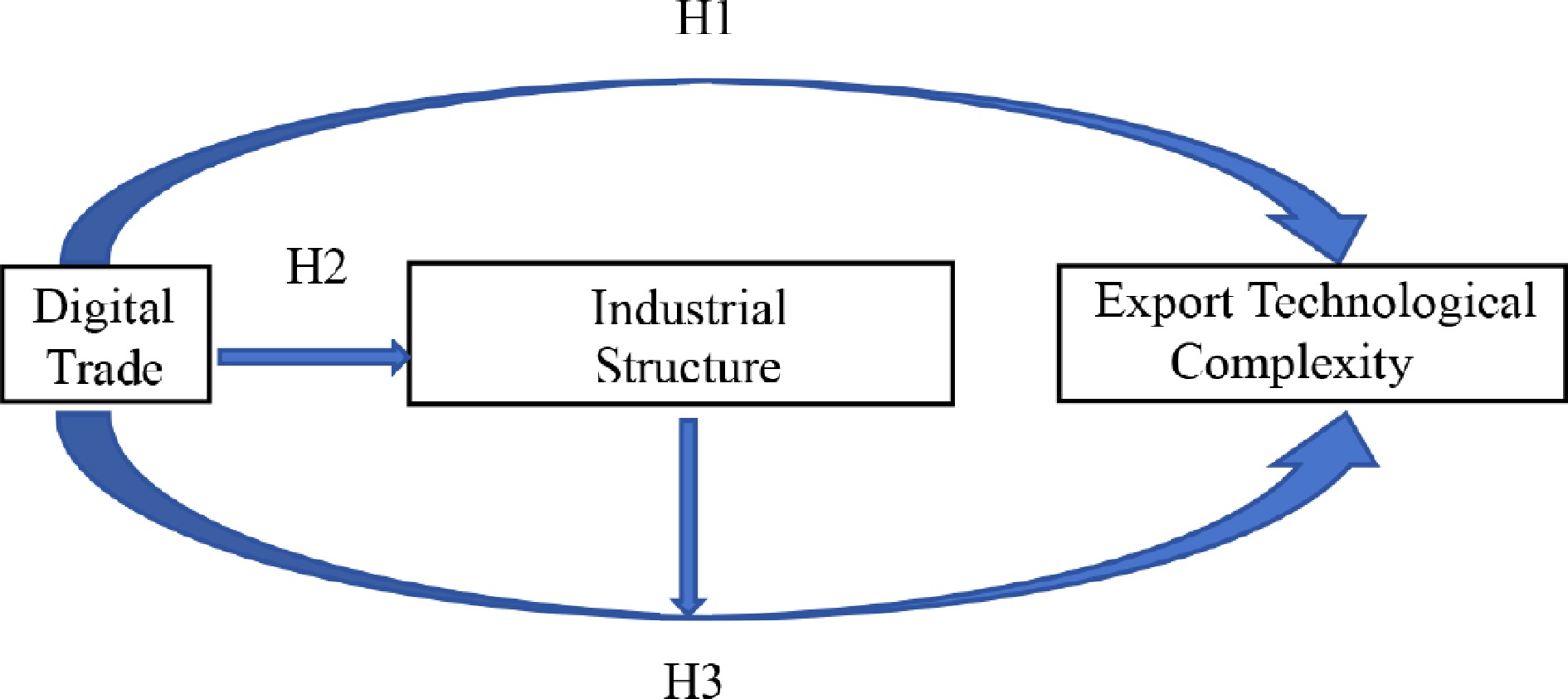
Figure 1.
Theoretical model of this paper.
-
The explanatory variable is digital trade. The digital trade development levels of 30 provinces in China from 2011 to 2023 are measured to maximize the display of horizontal differences in each province's digital trade development while ensuring dynamic comparability. A system of digital trade measurement indicators was established based on the framework proposed by Li[35], taking into account the availability of regional data. Therefore, a system of digital trade measurement indicators is constructed, consisting of four primary indicators, eight secondary indicators, and 15 tertiary indicators, as shown in Table 1.
Table 1. Digital trade measurement indicators.
Primary indicator Secondary indicator Tertiary indicator Code Digital trade infrastructure Information network infrastructure Length of long-haul fiber-optic cables (10,000 km) X1 Number of internet broadband access ports (10,000) X2 Population penetration rate of mobile phones (%) X3 Logistics transport infrastructure Number of operational freight trucks on highways (10,000) X4 Number of civil transport ships/units X5 Express delivery volume/million items X6 Digital technological innovation Technological innovation input Number of patents granted (1,000) X7 R & D expenditure/10 billion RMB X8 Digital innovation output Technology market transaction volume (billion RMB) X9 Digital trade market Digital supply Total telecommunications services volume (100 billion RMB) X10 Total postal services volume/billion RMB X11 Digital demand Software services revenue (billion RMB) X12 E-commerce sales volume/billion RMB X13 Trade potential Economic strength GDP (100 million RMB) X14 Trade scale Total import and export trade volume (${\text{\$}} $10,000 USD) X15 Source: compiled by the author. Explained variables
-
The dependent variable in this study is the export technological complexity. Following the approach of Hausmann et al.[12], the export technological complexity is calculated for each province and city. This method involves two steps. Firstly, the technological complexity of each export product category (PRODYj) is computed using the following formula:
$ PRODY_\mathrm{j}=\sum\limits_{\text{i}}^{ }\dfrac{x_{\text{ij}}/X_{\text{i}}}{\sum\limits_{\text{i}}^{ }(x_{\text{ij}}/X_{\text{i}})}Y_\mathrm{i} $ (1) where, xij represents the trade value of province i's exports in category j, Xi represents the total export value of province i, and Yi represents the per capita GDP of each province, adjusted using the consumer price index and standardized to the real value based on the year 2000. Among them, i represents the 30 provincial research samples of this paper. While j represents the 22 types of goods classified by HS codes.
Next, the export technological complexity of each province and city is calculated. Building on the results from the first step, the export technological complexity of each province is computed by weighted calculation. The formula for this calculation is as follows:
$ {Expy}_\mathrm{i}=\sum\limits_{\mathrm{j}}^{ }\dfrac{x_{\mathrm{ij}}}{X_{\mathrm{ij}}}PRODY_\mathrm{j} $ (2) To mitigate the impact of heteroscedasticity in the data, a logarithmic transformation is applied to the final export technological complexity values.
Intermediary variables
-
In this study, the mediating variable is industrial structure. There are various indicators in existing literature for measuring industrial structure, such as the proportion among the three industries, Theil index, and other metrics. On one hand, considering the current output status of the three industries in China, the output of the primary industry is relatively small compared to the secondary and tertiary industries. On the other hand, the secondary industry mainly represents industrial production, reflecting the capacity for material production and processing. The tertiary industry, or the service industry, signifies the level of social services and consumption[36]. The ratio between these two sectors can intuitively reflect a region's material production and service conditions, providing essential insights for analyzing the optimization direction of industrial structure and development patterns. Therefore, drawing on the work of Gan et al.[37], and based on Clark's theorem, this study employs the ratio of the secondary industry to the tertiary industry to measure the industrial structure of each province and city.
Control variables
-
Building on prior research[38,39], this study incorporates five control variables to comprehensively assess the relevant environment. As shown in Table 2, the specific variables selected are as follows. The level of economic development and social consumption partly reflects China's economic progress. Tax burden level signifies the rationality of social economic resource allocation and national economic output. Foreign direct investment showcases the extent of external capital utilization in regions. Degree of openness serves as a crucial indicator of a country or region's economic integration with the global economy. Human capital level, industrialization level, and urbanization level illuminate societal human resources, industrial development status, and social structure.
Table 2. Control variables.
Index Variable name (Abbreviation) Calculation formula 1 Economic development level (LNPgdp) LNPgdp Logarithm of GDP per capita 2 Human capital level (HC) Number of students in higher education/Total population 3 Industrialization level (IL) Industrial value added/Gross regional product 4 Openness degree (OPEN) Total import and export trade volume/GDP 5 Social consumption level (SCL) Total retail sales of consumer goods/Gross regional product Source: compiled by the author. Model construction
-
Referencing the research of Zhang[40], this study establishes a fixed effects model. To investigate the relationship between digital trade and export technological complexity, the model (3) is formulated. Taking into account the influence of various economic environments on the model, this study incorporates control variables on top of model (3), as demonstrated in model (4).
$ Expy_\mathrm{{it}}=\alpha_0+\alpha_1Dtra_\mathrm{{it}}+v_\mathrm{i}+\varepsilon_\mathrm{{it}} $ (3) $ Expy_\mathrm{{it}}=\beta_0+\beta_1Dtra_\mathrm{{it}}+\beta_2Control_{\text{it}}+v_{\mathrm{i}}+\varepsilon_{\mathrm{i\mathrm{t}}} $ (4) In the model, i represents the province, t represents the year, Expy represents export technological complexity, Dtra represents digital trade, Control represents the control variables, vi characterizes the province-specific fixed effects that do not change over time, and εit stands for the random disturbance term.
To investigate whether industrial structure mediates the relationship between digital trade and export technological complexity, the approach of Fan et al.[41] was followed, and models (5) and (6) specified.
$ Ind_\mathrm{{it}}=\gamma_0+\gamma_1Dtra_\mathrm{{it}}+\gamma_2Control_\mathrm{{it}}+v_\mathrm{{it}}+\varepsilon_\mathrm{{it}} $ (5) $ Expy_{\mathrm{it}}=\lambda_0+\lambda_1Dtra_{\mathrm{it}}+\lambda_2Ind_\mathrm{{it}}+\lambda_3Control_\mathrm{{it}}+v_\mathrm{i}+\varepsilon_\mathrm{{it}} $ (6) where, Ind represents industrial structure.
Variable testing and model selection
-
The study employs a broad set of indicators, some of which may overlap in their measurement. To ensure the reliability of the selected variables, the accuracy of parameter estimates, and the validity of the conclusions, a multicollinearity test is conducted before performing baseline regressions. As shown in Table 3, all VIF values are below five, both for individual variables and overall. This indicates that severe multicollinearity is not present among the variables. Additionally, an F-test is performed on the model. The result is statistically significant at the 1% level, supporting the existence of a linear relationship in the regression equation and confirming that the model as a whole is meaningful. Finally, a Hausman test is conducted. The results show that the p-value is less than 0.05, indicating the rejection of the null hypothesis, providing strong evidence in favor of using a fixed-effects model rather than a random-effects model.
Table 3. Multicollinearity test.
VIF 1/VIF Dtra 3.131 0.319 HC 1.535 0.651 IND 4.305 0.232 IL 2.562 0.390 LNPgdp 4.482 0.223 OPEN 1.893 0.528 SCL 1.478 0.676 Mean VIF 2.770 Source: compiled by the author. Data
-
Based on the research hypotheses outlined above, panel data were analyzed from 30 provinces in China from 2011 to 2023. It ensures the scientific rigor, availability, and comprehensiveness of the data for constructing the digital trade index system, export technological complexity, industrial structure, and the control variables. The data for the digital trade indicators, industrial structure, and the indicators in the control variables are mainly sourced from the official department. They are the China Statistical Yearbook, provincial statistical yearbooks, and the Ministry of Commerce. Data on export technological complexity and trade-related information are obtained from the General Administration of Customs, China Statistical Yearbook, and National Research Network.
In this study, Xizang, where data is severely missing, was not included in the research sample. For the missing data of some provinces in a certain year, this paper adopts the interpolation method to complete the data. For sample data with relatively stable data changes, the missing values are mainly calculated through the linear relationship between two adjacent valid data points. However, if the data fluctuates greatly, Lagrange interpolation is adopted, and a polynomial equation is constructed using multiple known data points for estimation to enhance the accuracy of filling.
-
First, the impact of digital trade on the export technological complexity of China is examined. Table 4 presents the baseline regression results. Column (1) reports the estimated effect of digital trade alone. The coefficient is 2.207, which is positive and statistically significant at the 1% level. This suggests that, without controlling for other variables, a 1% increase in digital trade is associated with a 2.207% rise in export technological complexity. Control variables that may affect regional export technological complexity are then incorporated. The results are shown in Column (2) of Table 4. As additional controls are included, the coefficient on digital trade declines consistently. After controlling for human capital in Model (2), the coefficient drops to 1.471. When the economic development level is added in Model (3), it further decreases to 0.702. Subsequent models introduce social consumption level, industrialization level, and openness to trade. The coefficient stabilizes between 0.704 and 0.767. This pattern implies that some control variables exhibit complementary or substitution effects with digital trade. The initial estimate may capture indirect influences from other economic factors. Even after including all controls, the coefficient on digital trade remains positive and significant at the 1% level. This indicates a robust positive effect of digital trade on export technological complexity.Therefore, Hypothesis H1 is supported.
Table 4. Basic regression results.
(1) Expy (2) Expy (3) Expy (4) Expy (5) Expy (6) Expy Dtra 2.209*** 1.471*** 0.702*** 0.735*** 0.767*** 0.704*** (39.796) (21.551) (7.745) (8.119) (8.505) (7.806) HC 0.663*** 0.387*** 0.381*** 0.346*** 0.405*** (14.235) (8.210) (8.145) (7.271) (8.188) LNPgdp 0.790*** 0.777*** 0.810*** 0.768*** (11.171) (11.067) (11.519) (10.974) SCL −0.079*** −0.058** −0.045 (−2.799) (−2.013) (−1.600) IL 0.113*** 0.131*** (2.978) (3.475) OPEN −0.229*** (−3.673) Observations 390 390 390 390 390 390 R2 0.815 0.882 0.913 0.914 0.917 0.920 F 1583.7 1337.9 1242.0 951.3 779.6 674.8 *, **, *** indicates significant at the significance level of 10%, 5%, and 1% respectively, the content inside () represents the t-statistic. Columns (2) to (6) in Table 4 progressively introduce all five control variables. The regression results indicate the following:
(1) The coefficients of per capita GDP, human capital, and industrialization level are all positive and statistically significant. First, after including human capital in Column (2), the coefficient on digital trade decreases considerably. This suggests a strong complementary relationship between human capital and digital trade. The technology diffusion effect of digital trade relies on a certain level of human capital. Only when workers possess relevant knowledge and skills can they effectively absorb and apply digital technologies. These skills help transform technological advantages into higher export technological complexity. Second, when per capita GDP is added in Column (3), its coefficient is 0.790 and statistically significant. Meanwhile, the coefficient on digital trade declines further. This implies that the economic development level serves as an important foundation for digital trade to exert its influence. Higher per capita GDP reflects better infrastructure and a more favorable innovation environment. They provide sufficient funding and resources for technological upgrading in exports. Thus, economic development strengthens the positive effect of digital trade on export technological complexity. Finally, Column (5) introduces the industrialization level. Its coefficient is 0.113 and significant. In this specification, the coefficient on digital trade increases slightly to 0.767. This result supports the presence of synergy between industrialization and digital trade. Industrialization provides broad application scenarios for digital technologies. For example, smart manufacturing and industrial internet integration combine digital tools with traditional production. Such integration enhances the technological content and value-added of products. It further amplifies the role of digital trade in driving technological upgrading.
(2) The estimated coefficients for both social consumption level and the degree of openness are statistically significant and negative. When social consumption level is introduced in Column (4), its coefficient is –0.079 and significant. Concurrently, the coefficient on digital trade experiences a slight increase. This result indicates that there is a potential mismatch between the domestic consumption structure and the technological upgrade driven by digital trade. Specifically, if social consumption remains concentrated in mid- and low-tier products, firms may prioritize production that caters to this lower-tech domestic demand. This reallocation of resources could crowd out investment in R & D and production of high-technology export products, thereby exerting a modest dampening effect on export technological complexity in the short term. Regarding openness to trade, its introduction in Column (6) yields a coefficient of –0.229, which is significantly negative. The coefficient on digital trade remains stable at 0.704. This finding is consistent with the baseline regression results and indicates potential risks within the current pattern of openness. If trade openness is predominantly focused on sectors with lower technological content, such as processing trade, firms may become overly reliant on external technology inputs while underinvesting in indigenous innovation capabilities. This reliance could anchor China's export industries in lower segments of the global value chain, consequently inhibiting the enhancement of export technological complexity.
Robustness test
Endogeneity test
-
Potential endogeneity in the explanatory variables may bias the regression results. To address this concern and verify the accuracy of the empirical findings, a 2SLS approach was employed to mitigate endogeneity issues in the model. Following the method of Wang & Zheng[42], the first lag of the digital trade development level is used as an instrument variable. The results of the re-estimated model are presented in Column (1) of Table 5.
Table 5. Results of robustness tests.
(1) Expy (2) Expy (3) Expy (4) Expy Dtra 0.294*** 1.074*** 0.649*** (5.011) (10.012) (6.576) DT 0.651*** (6.803) HC 0.241*** 0.371*** 0.352*** 0.471*** (5.623) (6.357) (7.095) (8.312) LNPgdp 0.660*** 0.646*** 0.704*** 0.928*** (10.607) (7.994) (10.789) (11.928) SCL −0.077** −0.019 −0.050* −0.060* (−2.022) (−0.635) (−1.707) (−1.825) IL −0.098*** 0.121*** 0.094** 0.204*** (−2.727) (2.728) (2.485) (4.518) OPEN −0.682*** −0.283*** −0.203*** −0.227*** (−14.743) (−3.959) (−3.131) (−2.904) N 360 300 338 390 R2 0.927 0.916 0.917 F 558.7 559.6 648.9 *, **, and *** respectively indicate significant at the significance level of 10%, 5%, and 1%, the content inside () represents the t-statistic. Prior to the endogeneity test, the validity of the selected instrument is examined. The Anderson LM statistic, Cragg-Donald Wald statistic, and Sargan statistic all confirm the appropriateness of the instrument variable. The 2SLS regression shows that the coefficient of Dtra remains positive and statistically significant at the 1% level. This indicates that digital trade development effectively promotes the upgrading of China's export technological complexity. These results further support Hypothesis 1, confirming that digital trade has a positive and significant effect on export technological complexity. The findings also demonstrate the robustness of the conclusions. Additionally, the results suggest that digital trade exhibits a certain lag effect, yet this does not alter its overall positive influence on export technological complexity.
Other robustness tests
Remove samples from special periods
-
The COVID-19 pandemic caused unprecedented disruptions to global economic and social activities. China's pandemic containment policies, including widespread isolation measures, significantly negatively affected its export trade. To more accurately assess the long-term relationships among variables and enhance the robustness and credibility of the model conclusions, data from the pandemic period is excluded. This approach helps examine whether the model results are influenced by this exogenous shock and ensures the robustness of the empirical findings. Accordingly, data from 2020 to 2022 is removed, and the regression is re-run. The results are presented in Column (2) of Table 5. The coefficient on digital trade remains positive and statistically significant at the 1% level. This result is consistent with earlier findings, providing further support for the robustness of Hypothesis H1.
Eliminate special individual samples
-
The four municipalities directly under the Central Government, namely Shanghai, Beijing, Tianjin, and Chongqing, have larger economic scales, greater policy flexibility, and disproportionately abundant resources. These distinctive characteristics may introduce bias into the empirical estimates. To mitigate potential distortion, these cities are excluded, and the regression is re-run[43]. As presented in Column (3) of Table 5, the coefficient on digital trade remains positive and statistically significant, with a magnitude comparable to the baseline full-sample estimate. This confirms that the positive effect of digital trade on export technological complexity is robust even after removing regions with exceptional policy advantages. The result demonstrates that the technological upgrading effect of digital trade is not driven primarily by unique policy benefits available in municipalities. Rather, it operates through general mechanisms such as reducing trade costs, accelerating technology diffusion, and improving resource allocation efficiency. These mechanisms appear universally applicable across other provinces. Moreover, both the goodness-of-fit and the F-statistic remain largely unchanged compared to the baseline model. This indicates that the adjusted sample does not diminish the model's explanatory power, further supporting the statistical reliability of the findings.
Adjust the calculation method of variables
-
To further test the robustness of the conclusions, an alternative measurement approach is adopted. Specifically, the method proposed by Verma et al.[44] is referred to, and the digital trade index is recalculated using principal component analysis instead of the original method. Firstly, standardize the 15 items of digital trade, calculate the covariance matrix, solve the eigenvalues and eigenvectors, and sort them. Then, the principal components are selected based on the cumulative variance contribution rate, and the data is mapped through the principal component matrix to form a comprehensive digital trade indicator.
Subsequently, the model is re-estimated using a fixed effects specification. The results remain consistent, thereby strongly supporting the reliability of core findings. As shown in column (4) of Table 5, even after recalculating the composite index using PCA, the impact of digital trade on the technical complexity of China's exports remains statistically significant. Specifically, the revised estimate shows that a one-unit increase in the digitally recalculated trade index is associated with a 0.651 unit increase in export technological complexity, significant at the 1% level. This confirms that the positive effect of digital trade on export technological complexity is robust to alternative measurement approaches. The result provides strong additional support for the high robustness of Hypothesis H1.
Mediating effect test
-
The mediating effect of industrial structure is tested between digital trade and export technological complexity. The two-step method was adopted to test the mediating effect, and a regression analysis was conducted using models (5) and (6). Column (1) of Table 6 shows a coefficient of 0.692 for digital trade on industrial structure. It is significant at the 1% level. That is, for every 1% increase in the digital trade index, the industrial structure will rise by 0.692%. This indicates that digital trade significantly promotes industrial upgrading. Therefore, Hypothesis H2 is supported.
Table 6. Regression results of mediating effects.
(1) IND (2) Expy Dtra 0.692*** 0.473*** (7.300) (5.209) IND 0.335*** (7.063) HC 0.175*** 0.346*** (3.372) (7.352) LNPgdp 0.001 0.768*** (0.007) (11.705) SCL 0.112*** −0.083*** (3.769) (−3.061) IL −0.468*** 0.288*** (−11.827) (6.898) OPEN 0.010 −0.233*** (0.160) (−3.979) N 390 390 R2 0.730 0.930 F 159.1 665.4 *, **, *** indicates significant at the significance level of 10%, 5%, and 1% respectively, the content inside () represents the t-statistic. Column (2) of Table 6 further reveals the mediating role of industrial structure. The coefficient for industrial structure is 0.335 and is significant. This shows that industrial upgrading itself enhances export technological complexity. Advanced industrial structure directly increases the technological content of exports. After adding industrial structure as a mediator, the direct effect of digital trade drops from 0.704 to 0.473. However, it remains positive and significant. This confirms a partial mediating effect. Digital trade improves export technological complexity both directly and indirectly through industrial upgrading. Control variables show consistent results. Per capita GDP and human capital have positive effects. Openness to trade has a negative effect. This stability supports model robustness. Overall, the industrial structure is a key transmission channel. These results validate Hypothesis H3. They provide evidence that digital trade boosts export technological complexity by promoting industrial transformation.
Heterogeneity analysis
-
Due to variations in infrastructure, economic development levels, and human resources across regions, the impact of digital trade on total factor productivity in the service industry may differ among provinces. In China, coastal areas generally possess more advanced economic foundations, better information technology infrastructure, and superior transportation conditions. These advantages facilitate greater access to international markets and provide inherent benefits for digital trade development. In contrast, inland regions face relative isolation and encounter more obstacles in developing digital trade. To account for these regional disparities, the 30 provinces in the sample are classified into coastal and inland regions. This classification follows official guidelines issued by the National Development and Reform Commission and the National Bureau of Statistics. Specifically, 12 coastal provinces and 18 inland provinces were identified. The detailed regional division is presented in Table 7.
Table 7. Regional division.
Region Specific province Coastal cities Liaoning Province, Hebei Province, Beijing Municipality, Tianjin Municipality, Shandong Province, Jiangsu Province, Shanghai Municipality, Zhejiang Province, Fujian Province, Guangdong Province, Guangxi Zhuang Autonomous Region, Hainan Province Inland cities Shanxi Province, Jilin Province, Heilongjiang Province, Anhui Province, Jiangxi Province, Henan Province, Hubei Province, Hunan Province, Sichuan Province, Guizhou Province, Yunnan Province, Shaanxi Province, Gansu Province, Qinghai Province, Inner Mongolia Autonomous Region, Ningxia Hui Autonomous Region, Chongqing Municipality Data source: Compiled based on the documents of the National Development, and Reform Commission and the National Bureau of Statistics of China. The regional heterogeneity regression results are shown in Table 8. The regression results show that digital trade has a coefficient of 0.941 on export technological complexity. This is significant at the 1% level. This value is notably higher than that of inland regions. It indicates that digital trade has a stronger promoting effect in coastal areas. This advantage stems from better digital infrastructure and more advanced digital trade foundations. Coastal regions benefit from superior geographical locations and policy support. They integrate earlier into global digital trade networks. They also achieve deeper fusion between digital technology and trade. Thus, digital trade more effectively boosts the technological upgrading of exports. Among control variables, human capital and economic development show strongly positive and significant effects. This reflects the role of higher human capital accumulation and economic development in coastal regions. These factors strongly support the technological upgrading effect of digital trade. Industrialization has a positive but small coefficient. This may be because coastal regions already have mature industrialization. Thus, its marginal contribution to export technological complexity is limited. Social consumption and trade openness are not significant. This may indicate a better alignment between consumption and export structures in coastal areas. It may also reflect that trade openness has moved beyond low-end lock-in, reducing its inhibitory effect.
Table 8. Regional heterogeneity regression results.
Coastal cities expy Inland cities expy Dtra 0.941*** 0.280*** (6.353) (3.172) HC 0.440*** 0.389*** (5.634) (6.365) LNPgdp 0.774*** 0.720*** (6.539) (11.079) SCL 0.030 −0.031 (0.672) (−0.876) LI 0.166* 0.080*** (1.746) (2.767) OPEN −0.071 −0.056 (−0.817) (−1.400) N 156 234 R2 0.925 0.932 F 285.7 477.2 *, **, *** indicates significant at the significance level of 10%, 5%, and 1% respectively, the content inside () represents the t-statistic. The regression results show a coefficient of 0.280 for digital trade. It is statistically significant at the 1% level. Although smaller than the coastal estimate, it confirms that digital trade still promotes export technological complexity inland. This weaker effect arises because inland regions started digital trade development later. Their digital infrastructure and supporting industries remain less developed. Among control variables, human capital and per capita GDP show positive and significant effects. This aligns with coastal findings. It confirms that human capital and economic development are fundamental to export upgrading across all regions. Industrialization also has a positive and significant coefficient. This suggests inland regions are in a phase of accelerated industrialization. In addition, social consumption and trade openness are not significant. This may reflect relatively limited consumer markets and lower trade openness in inland areas. Their potential influence on export technological complexity has not yet fully materialized.
Therefore, the impact of digital trade on the technical complexity of exports shows significant regional heterogeneity, which provides an empirical basis for formulating differentiated regional digital trade development policies.
-
Against the backdrop of the digital economy era, the global economic landscape is constantly evolving, with increasing uncertainties facing exports. In this context, digital trade will continue to play a crucial role. This study, utilizing industrial structure as a mediating variable, empirically analyzes the impact of digital trade on export technological complexity using panel data from 30 Chinese provinces from 2011 to 2023. Through the empirical analysis conducted, the following conclusions are drawn:
There exists a significant positive relationship between digital trade and export technological complexity. This indicates that in today's increasingly globalized and digitized economic landscape, the vigorous development of digital trade plays a positive and robust role in enhancing export technological complexity. The complex and volatile economic environment is influenced by various factors such as fluctuations in demand markets, changes in foreign direct investment, and the development of socio-economic and human capital levels. While these factors may have varying impacts on the complexity of exported technologies from different perspectives, their presence does not alter the positive impact of digital trade on the complexity of exported technologies.
Digital trade can have a significant positive impact on export technological complexity through industrial structure, with the indirect effects of industrial structure being greater than the direct effects. The optimization and adjustment of industrial structure, facilitated by digital trade, have become crucial pathways for enhancing export technological complexity. Specifically, the upgrading of industrial structure led to more rational resource allocation and significantly improved production efficiency, thereby injecting higher technological content into export products. Moreover, the indirect effects of industrial structure are greater than the direct effects. This implies that the impact of digital trade on export technological complexity through industrial structure is not limited to direct channels but also involves extensive and profound indirect transmission mechanisms. This indirect effect may manifest in promoting the coordinated development of related industries, stimulating innovation, facilitating the application of technology, and thus elevating export technological complexity on a broader and deeper level.
Digital trade has a significant positive coefficient for the technical complexity of exports to both coastal and inland areas, and the impact coefficient of coastal areas is twice that of inland areas. This result fully demonstrates the extensive influence and positive role of digital trade in different regions of the country. Coastal areas, with their superior geographical location and policy support, have integrated into the global digital trade network earlier. The integration of digital technology and trade is deeper, making it easier to promote the technological upgrading of export products through digital trade. Although the influence coefficient of inland areas is not as large as that of coastal areas, the promoting effect of digital trade still exists in this region. This might be due to the fact that the development of digital trade in inland regions started relatively late, and the digital infrastructure and supporting industries are still not perfect, resulting in a relatively weak pulling effect on the technical complexity of exports.
This paper was funded by the Educational Teaching Reform Research Project of Heilongjiang University in 2024 (Grant No. 2024C29), and the 2025 annual planning project of Heilongjiang Provincial Education Science "14th Five-Year Plan" (Grant No. GJB1425255).
-
The authors confirm their contributions to the paper as follows: study conception and design, data collection, analysis and interpretation of results, draft manuscript preparation: Huang Y; data analysis, writing − review and editing: Wang C. All authors reviewed the results and approved the final version of the manuscript.
-
The dataset generated during the current study is available from the corresponding author on reasonable request.
-
The authors declare that they have no conflict of interest.
- Copyright: © 2026 by the author(s). Published by Maximum Academic Press, Fayetteville, GA. This article is an open access article distributed under Creative Commons Attribution License (CC BY 4.0), visit https://creativecommons.org/licenses/by/4.0/.
-
About this article
Cite this article
Huang Y, Wang C. 2026. Impact of digital trade on the technological complexity of China's exports. Statistics Innovation 3: e004 doi: 10.48130/stati-0026-0004 

Impact of digital trade on the technological complexity of China's exports
- Received: 30 August 2025
- Revised: 23 December 2025
- Accepted: 21 January 2026
- Published online: 31 March 2026
Abstract: Against the backdrop of the rapid development of globalization and digitalization, digital trade, as a new form of trade, is profoundly changing the pattern and operation mode of international trade. As an important participant in world trade, studying the impact of China's digital trade on the complexity of its export technology has significant practical significance. Based on the panel data of various provinces in China from 2011 to 2023 and using the fixed effects model, this paper explores the impact of digital trade on the complexity of China's export technology and the mediating role of industrial structure in this context. The research results show that: (1) Digital trade has significantly increased the technological complexity of China's exports. This means that as digital trade continues to develop, the technological content and added value of China's export products are constantly increasing. (2) The industrial structure plays a significant positive mediating role in the impact of digital trade on the complexity of export technologies. (3) Digital trade has a significant positive impact on the technical complexity of exports in different regions. This article can provide important references for relevant governments and export enterprises to formulate management policies.
-
Key words:
- Digital trade /
- Export technical complexity /
- Industrial structure