







Search
2020 Volume 7
Article Contents
RESEARCH ARTICLE   Open Access    

The Efficacy and Safety of a Promising Single-Channel Endoscopic Closure Technique for Endoscopic Treatment-Related Artificial Ulcers: A Pilot Study

More Information
  • Corresponding author: Eikichi Ihara, MD, PhD Department of Medicine and Bioregulatory Science Graduate School of Medical Sciences, Kyushu University, 3-1-1 Maidashi, Higashi-ku Fukuoka 812-8582 (Japan) E-Mail eikichi@intmed3.med.kyushu-u.ac.jp 
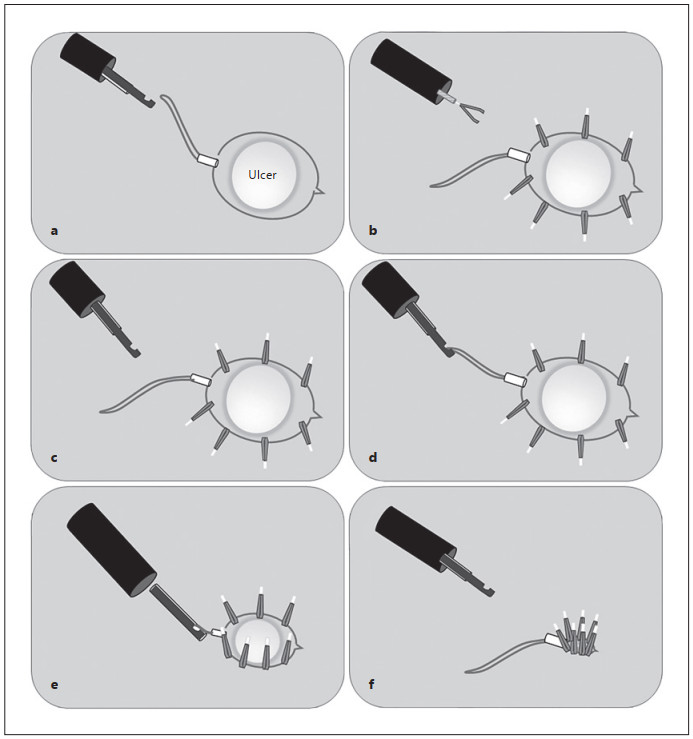
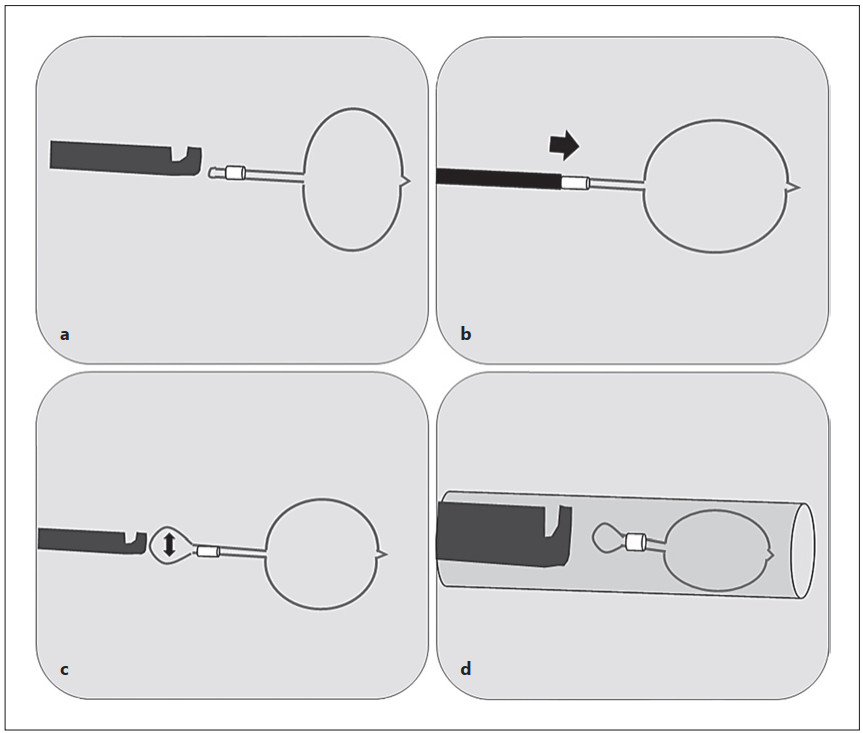
  • Background/Aims: It is important to appropriately manage patients with procedure-related artificial mucosal ulcers or procedure-related complications. Many endoscopic closure techniques have been reported; however, they often require the use of special devices. We developed a single-channel endoscopic closure technique (SCCT) that can be performed with conventional devices. In the present study, we describe the technique and evaluate its efficacy.
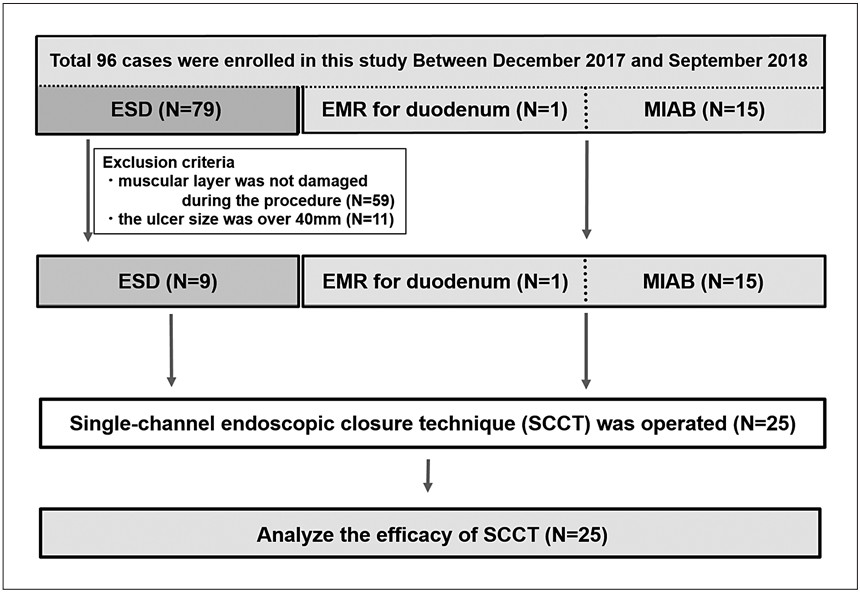
    Methods: Twenty-five consecutive patients who underwent endoscopic treatment and whose artificial ulcer was closed using the SCCT were enrolled in this study. The technical success rate, number of clips for closure, procedure time, complication rate on the day of the procedure, clinical success rates on days 1 and 5, and incidence of severe stenosis of the gastrointestinal (GI) tract at 2 months after the procedure were evaluated.
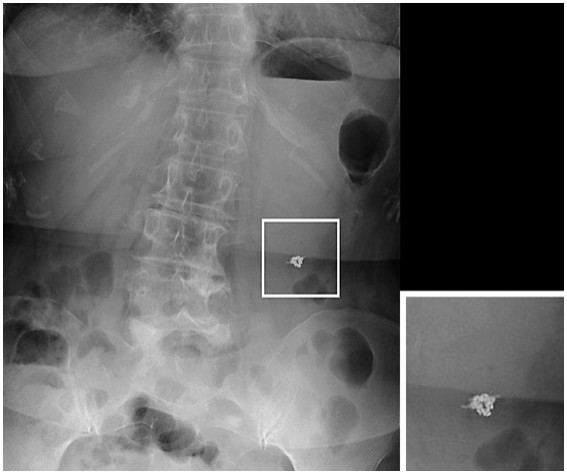
    Results: The median ulcer diameter was 20 mm. The tumor locations were the stomach (n = 19), jejunum (n = 1), and colon (n = 5). The technical success rate was 100% (25/25), and the rate of incomplete closure was 0% (0/25). Eight clips were needed on average. The median procedure time was 18 min (range 5–49 min). The complication rate was 0% (25/25). The clinical success rates on days 1 and 5 were 100% (19/19) and 100% (9/9), respectively. No patients presented stenosis as a late complication at 2 months after the procedure (0/25).
    Conclusion: The SCCT could be applied in the treatment of artificial ulcers in several parts of the GI tract with a high clinical success rate and no complications. The SCCT appears to be a good option for closing artificial mucosal ulcers.
  • Cite this article

    Yosuke Minoda, Eikichi Ihara, Haruei Ogino, Keishi Komori, Yoshihiro Otsuka, Hiroko Ikeda, Mitsuru Esaki, Takatoshi Chinen, Takahiro Matsuguchi, Shunsuke Takahashi, Noriko Shiga, Rie Yoshimura, Yoshihiro Ogawa. 2020. The Efficacy and Safety of a Promising Single-Channel Endoscopic Closure Technique for Endoscopic Treatment-Related Artificial Ulcers: A Pilot Study. Gastrointestinal Tumors. 7:4 doi: 10.1159/000503994
    Yosuke Minoda, Eikichi Ihara, Haruei Ogino, Keishi Komori, Yoshihiro Otsuka, Hiroko Ikeda, Mitsuru Esaki, Takatoshi Chinen, Takahiro Matsuguchi, Shunsuke Takahashi, Noriko Shiga, Rie Yoshimura, Yoshihiro Ogawa. 2020. The Efficacy and Safety of a Promising Single-Channel Endoscopic Closure Technique for Endoscopic Treatment-Related Artificial Ulcers: A Pilot Study. Gastrointestinal Tumors. 7:4 doi: 10.1159/000503994

Figures(4)  /  Tables(2)

Article Metrics

Article views(881) PDF downloads(658)

Research Article   Open Access    

The Efficacy and Safety of a Promising Single-Channel Endoscopic Closure Technique for Endoscopic Treatment-Related Artificial Ulcers: A Pilot Study

  • Corresponding author: Eikichi Ihara, MD, PhD Department of Medicine and Bioregulatory Science Graduate School of Medical Sciences, Kyushu University, 3-1-1 Maidashi, Higashi-ku Fukuoka 812-8582 (Japan) E-Mail eikichi@intmed3.med.kyushu-u.ac.jp 
Gastrointestinal Tumors  7 Article number: 10.1159/000503994  (2020)  |  Cite this article

Abstract: 

Background/Aims: It is important to appropriately manage patients with procedure-related artificial mucosal ulcers or procedure-related complications. Many endoscopic closure techniques have been reported; however, they often require the use of special devices. We developed a single-channel endoscopic closure technique (SCCT) that can be performed with conventional devices. In the present study, we describe the technique and evaluate its efficacy.
Methods: Twenty-five consecutive patients who underwent endoscopic treatment and whose artificial ulcer was closed using the SCCT were enrolled in this study. The technical success rate, number of clips for closure, procedure time, complication rate on the day of the procedure, clinical success rates on days 1 and 5, and incidence of severe stenosis of the gastrointestinal (GI) tract at 2 months after the procedure were evaluated.
Results: The median ulcer diameter was 20 mm. The tumor locations were the stomach (n = 19), jejunum (n = 1), and colon (n = 5). The technical success rate was 100% (25/25), and the rate of incomplete closure was 0% (0/25). Eight clips were needed on average. The median procedure time was 18 min (range 5–49 min). The complication rate was 0% (25/25). The clinical success rates on days 1 and 5 were 100% (19/19) and 100% (9/9), respectively. No patients presented stenosis as a late complication at 2 months after the procedure (0/25).
Conclusion: The SCCT could be applied in the treatment of artificial ulcers in several parts of the GI tract with a high clinical success rate and no complications. The SCCT appears to be a good option for closing artificial mucosal ulcers.
  • About this article
    Cite this article
    Yosuke Minoda, Eikichi Ihara, Haruei Ogino, Keishi Komori, Yoshihiro Otsuka, Hiroko Ikeda, Mitsuru Esaki, Takatoshi Chinen, Takahiro Matsuguchi, Shunsuke Takahashi, Noriko Shiga, Rie Yoshimura, Yoshihiro Ogawa. 2020. The Efficacy and Safety of a Promising Single-Channel Endoscopic Closure Technique for Endoscopic Treatment-Related Artificial Ulcers: A Pilot Study. Gastrointestinal Tumors. 7:4 doi: 10.1159/000503994
    Yosuke Minoda, Eikichi Ihara, Haruei Ogino, Keishi Komori, Yoshihiro Otsuka, Hiroko Ikeda, Mitsuru Esaki, Takatoshi Chinen, Takahiro Matsuguchi, Shunsuke Takahashi, Noriko Shiga, Rie Yoshimura, Yoshihiro Ogawa. 2020. The Efficacy and Safety of a Promising Single-Channel Endoscopic Closure Technique for Endoscopic Treatment-Related Artificial Ulcers: A Pilot Study. Gastrointestinal Tumors. 7:4 doi: 10.1159/000503994

Catalog

    /

    DownLoad:  Full-Size Img  PowerPoint
    Return
    Return