









Search
2021 Volume 8
Article Contents
RESEARCH ARTICLE   Open Access    

Screening Status as a Determinant of Choice of Colorectal Cancer Screening Method: A Population-Based Informed Survey

More Information
  • Corresponding author: Idris Guessous Department of Primary Care Medicine, Geneva University Hospitals Unit of Population Epidemiology Rue Gabrielle-Perret-Gentil 4, Geneva 1205 (Switzerland) idris.guessous@hcuge.ch
  • Objectives: Fecal blood testing is a noninvasive alternative to colonoscopy for colorectal cancer (CRC) screening and is preferred by a substantial proportion of individuals. However, participant-related determinants of the choice of screening method, particularly up-to-date screening status, remain less studied. We aimed to determine if up-to-date screening status was related to choosing a fecal blood test over colonoscopy.
    Setting: Participants in the population-based cross-sectional survey study Bus Santé in Geneva, Switzerland – aged 50–69 years.
    Design: Cross-sectional survey study using mailed questionnaires inquiring about CRC screening method of choice after providing information on advantages and disadvantages of both screening methods. We used multivariable logistic regression models to determine the association between up-to-date CRC screening status and choosing fecal blood testing.
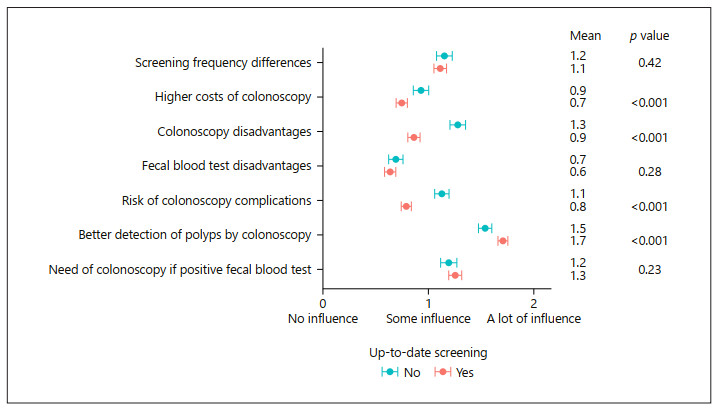
    Key results: We included 1,227 participants. Thirty-eight percent of participants did not have up-to-date CRC screening. Overall, colonoscopy (54.9%) was preferred to fecal blood testing (45.1%) (p < 0.001) as screening method of choice. However, screening method choices differed between those with (65.6% colonoscopy and 34.4% fecal blood testing) and without up-to-date CRC screening (36.5% colonoscopy and 63.5% fecal blood testing). Not having up-to-date CRC screening was associated with a higher probability of choosing fecal blood testing as screening method (odds ratio = 2.6 [1.9; 3.7], p < 0.001) after adjustment for the aforementioned confounders.
    Conclusions: Not having up-to-date screening was independently associated with fecal blood testing as the preferred method for CRC screening. Proposing this method to this subpopulation, in a context of shared decision, could potentially increase screening uptake in settings where it is already high.
  • Cite this article

    José Luis Sandoval, Allan Relecom, Cyril Ducros, Jean-Luc Bulliard, Beatrice Arzel, Idris Guessous. 2021. Screening Status as a Determinant of Choice of Colorectal Cancer Screening Method: A Population-Based Informed Survey. Gastrointestinal Tumors. 8:54 doi: 10.1159/000512954
    José Luis Sandoval, Allan Relecom, Cyril Ducros, Jean-Luc Bulliard, Beatrice Arzel, Idris Guessous. 2021. Screening Status as a Determinant of Choice of Colorectal Cancer Screening Method: A Population-Based Informed Survey. Gastrointestinal Tumors. 8:54 doi: 10.1159/000512954

Figures(1)  /  Tables(2)

Article Metrics

Article views(694) PDF downloads(492)

Research Article   Open Access    

Screening Status as a Determinant of Choice of Colorectal Cancer Screening Method: A Population-Based Informed Survey

  • Corresponding author: Idris Guessous Department of Primary Care Medicine, Geneva University Hospitals Unit of Population Epidemiology Rue Gabrielle-Perret-Gentil 4, Geneva 1205 (Switzerland) idris.guessous@hcuge.ch
Gastrointestinal Tumors  8 Article number: 10.1159/000512954  (2021)  |  Cite this article

Abstract: 

Objectives: Fecal blood testing is a noninvasive alternative to colonoscopy for colorectal cancer (CRC) screening and is preferred by a substantial proportion of individuals. However, participant-related determinants of the choice of screening method, particularly up-to-date screening status, remain less studied. We aimed to determine if up-to-date screening status was related to choosing a fecal blood test over colonoscopy.
Setting: Participants in the population-based cross-sectional survey study Bus Santé in Geneva, Switzerland – aged 50–69 years.
Design: Cross-sectional survey study using mailed questionnaires inquiring about CRC screening method of choice after providing information on advantages and disadvantages of both screening methods. We used multivariable logistic regression models to determine the association between up-to-date CRC screening status and choosing fecal blood testing.
Key results: We included 1,227 participants. Thirty-eight percent of participants did not have up-to-date CRC screening. Overall, colonoscopy (54.9%) was preferred to fecal blood testing (45.1%) (p < 0.001) as screening method of choice. However, screening method choices differed between those with (65.6% colonoscopy and 34.4% fecal blood testing) and without up-to-date CRC screening (36.5% colonoscopy and 63.5% fecal blood testing). Not having up-to-date CRC screening was associated with a higher probability of choosing fecal blood testing as screening method (odds ratio = 2.6 [1.9; 3.7], p < 0.001) after adjustment for the aforementioned confounders.
Conclusions: Not having up-to-date screening was independently associated with fecal blood testing as the preferred method for CRC screening. Proposing this method to this subpopulation, in a context of shared decision, could potentially increase screening uptake in settings where it is already high.

  • About this article
    Cite this article
    José Luis Sandoval, Allan Relecom, Cyril Ducros, Jean-Luc Bulliard, Beatrice Arzel, Idris Guessous. 2021. Screening Status as a Determinant of Choice of Colorectal Cancer Screening Method: A Population-Based Informed Survey. Gastrointestinal Tumors. 8:54 doi: 10.1159/000512954
    José Luis Sandoval, Allan Relecom, Cyril Ducros, Jean-Luc Bulliard, Beatrice Arzel, Idris Guessous. 2021. Screening Status as a Determinant of Choice of Colorectal Cancer Screening Method: A Population-Based Informed Survey. Gastrointestinal Tumors. 8:54 doi: 10.1159/000512954

Catalog

    /

    DownLoad:  Full-Size Img  PowerPoint
    Return
    Return