












-
Areca catechu L. (areca nut, also known as betel nut in sociocultural contexts), a widely cultivated and consumed palm cash crop in tropical and subtropical regions, has long been deeply embedded in social and religious practices of many cultures, with its production and marketing closely tied to local livelihoods. Numerous demographic and field studies indicate that in regions such as Micronesia, Taiwan Province of China, India, and parts of South Asia, the production–distribution–consumption chain of areca nut constitutes an important local economic network and cultural practice[1−5]. Consequently, framing the areca nut issue solely as a public health concern overlooks its complex role as an element of agrobiodiversity within regional farming systems, its contribution to varietal resource conservation, its place in processing value chains, and its significance for farmer livelihoods[3−6]. In the literature, the terms areca nut, betel nut, and betel quid are often used inconsistently. In this review, 'areca nut' refers strictly to the seed of Areca catechu L., whereas 'betel quid' denotes a chewing preparation in which areca nut is combined with betel leaf (Piper betle), slaked lime, and optionally tobacco.
Examining Areca catechu L. from the perspective of agrobiodiversity first requires identifying and summarizing the current status of its germplasm and genomic resources. In recent years, several genetic and genomic studies have provided new tools for research on Areca catechu L. resources. These include analyses of chloroplast/plastome diversity and profiling (progress in plastome data and methodologies for Areca catechu L. and related Areca spp.)[7], the release of complete chloroplast genome data[8], and reported chromosome-scale genome assemblies[9].
Cultivation systems and processing techniques also shape the chemical profile of the product and its associated exposure risks, alongside considerations for resource conservation. The distribution of areca nut constituents, such as the spatial variation of major alkaloids, already shows differences at the level of fruit development and histology[10]. Furthermore, chemical-toxicological evidence indicates how processing and formulation (e.g., combination with slaked lime, betel leaf, tobacco, etc.) reshape the chemical spectrum and may generate potentially harmful products, such as the detection of suspected direct alkylating agents in areca nut and its processed products[11]. Therefore, from an agricultural management perspective, cultivar selection, harvest maturity, and post-harvest processing are all important leverage points affecting both the final exposure risk and the commercial value of the product.
From a public health perspective, a substantial body of epidemiological research indicates a consistent association between areca nut use and diseases such as oral submucous fibrosis (OSMF) and oral squamous cell carcinoma (OSCC)[12−14]. The link between areca nut consumption and the corresponding disease problems has been consistently observed in cohort- and cross-sectional studies across multiple regions (e.g., Taiwan Province of China, India, Mariana Islands), including large-scale population screening programs[15−18]. Concurrently, molecular and cell biology research on the pathogenic mechanisms of areca nut indicates that its primary alkaloids (e.g., arecoline) are involved in oxidative stress, DNA damage, imbalance in extracellular matrix metabolism (e.g., dysregulation of MMP/TIMP), and activation of pro-fibrotic signaling pathways. These mechanistic findings are consistent with epidemiological observations[4,5,19,20].
Despite clear health risks, a simplistic policy of 'prohibition' from agricultural and social perspectives often faces challenges related to cultural embeddedness, industrial dependency, and livelihood substitution. Regulation and control of areca nut must seek more realistic risk management and harm-reduction approaches that respect cultural contexts and safeguard farmers’ livelihoods. These include reducing the potential for harmful components through varietal and cultivation improvements, minimizing the generation of hazardous products via optimized processing techniques, and providing alternative livelihoods and value-added utilization pathways along the industry chains (e.g., other uses of areca nut by-products)[3,4]. These issues lie at the core of agrobiodiversity and sustainable use, including how to balance conservation and utilization, and how to support the positive transformation of local agricultural systems through scientific research and policy.
Building on these multidimensional perspectives, this review takes agrobiodiversity as its central framework to systematically integrate the germplasm/genomic resources of areca nut, its cultivation systems and ecological interactions, the processing-chemistry-exposure chain, and how these elements collectively shape health risks and governance options. We will first outline genetic and genomic resources (providing an evidence base for germplasm conservation and breeding), then discuss how cultivation and processing influence chemical composition and risk exposure, followed by an evidence-based review and evaluation of health impacts, and finally propose research and policy priorities oriented toward sustainable use. This review aims to provide researchers with an interdisciplinary synthesis that starts from agricultural resource management while integrating public health, cultural, and economic realities.
-
Areca catechu L. holds significant importance across various aspects of human life, from cultural practices to potential health impacts. Understanding its taxonomic hierarchy forms the basis of its study. Areca catechu L. belongs to the family Arecaceae, which encompasses a diverse range of palm species[21]. This family is characterized by its tropical and subtropical distribution, and its members often possess economic importance, such as the production of fruits, oils, and timber.
At the genus level, the genus Areca comprises approximately 50 species, with Areca catechu L. being one of the most well-known. The species is further classified based on its morphological and genetic characteristics. For example, the physical appearance of the areca nut, including its size, shape, and color, may vary among different populations and cultivars. Such morphological differences are commonly used for preliminary taxonomic identification. On the genetic side, studies have been conducted to analyze specific DNA sequences and genetic markers of areca nut, aiding in its precise placement within the taxonomic framework[7]. This genetic analysis can also reveal relationships with other closely related species within the genus, providing insights into the evolutionary history of Areca catechu.
Meanwhile, a population genetics study covering 196 areca nut accessions from different geographic regions, including Hainan islands, mainland of China, and Southeast Asia, and based on 40,173 high-quality single nucleotide polymorphism (SNP) markers, revealed overall low nucleotide diversity (π ≈ 2.46 × 10⁻⁵ to 5.71 × 10⁻⁵). The samples clustered into three main genetic groups, with moderate genetic differentiation (Fst values) observed among them[22]. These results indicate an overall low level of nucleotide diversity within the sampled areca nut accessions. However, given that the dataset in the study by Qi et al.[22] is dominated by local germplasm from Hainan, with relatively limited representation of foreign or specialized accessions, the current evidence is insufficient to draw definitive conclusions regarding genetic bottlenecks or their potential impacts on breeding diversity, disease resistance, or the maintenance of diverse metabolic traits. Expanded and more geographically representative germplasm collections, particularly incorporating under-represented foreign resources, will be essential to accurately assess genetic diversity and to support future areca nut improvement and sustainable cultivation.
Association between genetic diversity and chemical traits
-
Genetic diversity within Areca catechu L. populations is a key factor influencing a range of agronomic and biochemical traits, including disease resistance and alkaloid composition. Previous studies have demonstrated that different areca nut cultivars exhibit distinct genetic profiles. Molecular marker–based approaches, such as simple sequence repeats (SSRs) and amplified fragment length polymorphisms (AFLPs), have been successfully employed to assess genetic diversity and population structure in A. catechu, enabling the identification of genetic variation among cultivars and geographic accessions[23].
The distribution and concentration of the four major alkaloids present in areca nut, arecoline, arecaidine, guvacoline, and guvacine, also vary across different genetic varieties. Magnetic resonance and mass spectrometry imaging have shown that during nut maturation, these alkaloids separate into distinct regions of the nut[10]. The white and brown regions of the nut, which begin to form as internal fluids solidify upon maturation, exhibit different alkaloid compositions. Arecoline, arecaidine, and guvacoline are present in the brown region, whereas guvacine is located in the white region. Such spatial separation is likely related to the genetic regulation of alkaloid synthesis and transport within the nut, highlighting how genetic diversity influences the chemical composition of areca nut varieties. A comprehensive understanding of the molecular basis underlying these differences in chemical traits relies on the availability of high-quality genomic resources and integrative functional genomics studies.
Genomic resources and functional genomics
-
More recent research, using haplotype-resolved genome sequencing (PacBio HiFi + Hi-C), has obtained two homologous chromosome sets of areca nut (Ac.Hap1 ≈ 2.45 Gb; Ac.Hap2 ≈ 2.49 Gb) and identified large-scale structural variants between the two haplotypes, including several megabase-scale inversions[24]. By integrating transcriptomic and metabolomic data, the study systematically mapped the biosynthetic pathways of alkaloids (e.g., arecoline) and secondary metabolites, such as flavonoids/polyphenols in areca nut. It also identified key enzymes (e.g., AcGNMT1, AcGNMT2) and multiple UDP-glucosyltransferase/rhamnosyltransferase genes involved in flavonoid glycosylation. These findings provide actionable targets for future molecular breeding or gene editing aimed at modulating areca nut quality, such as reducing harmful components or optimizing secondary metabolite profiles[24].
Phylogenetic studies of Areca catechu L.
-
Phylogenetic studies of areca nut aim to understand the evolutionary relationships of areca nut with other plant species. These investigations typically utilize molecular data, such as DNA sequences from specific genes or entire genomes. For example, the complete chloroplast genome sequence of the areca nut has been determined, providing valuable information for phylogenetic analysis[8]. The chloroplast genome exhibits a typical quadripartite structure and specific gene content, which can be compared with chloroplast genomes of other palm species to infer evolutionary divergence.
Comparative analyses suggest that areca nut likely diverged from its close relatives, Elaeis guineensis and Cocos nucifera, approximately 50.3 million years ago[9]. Whole-genome duplication events, which are shared among palms and monocots, also played a role in its evolutionary history. These duplication events may have led to the evolution of new gene functions and traits, thereby contributing to the distinctive characteristics of the areca nut. Furthermore, studies on the genetic diversity of viruses associated with areca nut, such as Areca necrotic ringspot virus (ANRSV) and Areca palm velarivirus 1 (APV1), can offer insights into the co-evolution of palms and these pathogens, further enriching our understanding of the phylogenetic context of areca nut[21−25].
Origin and domestication history of Areca catechu L.
-
Unlike many cereal or tuber crops, the origin and early domestication process of the areca nut remain unclear due to the absence of definitive macro-archaeobotanical evidence. To date, systematically reported and reliably identified remains of areca nuts, charred seeds, or other plant macrofossils that could directly indicate its domestication stage have not been found at archaeological sites. This lack of evidence is not unique to areca nut but represents a common limitation for tropical perennial palms in the archaeological record, whose domestication histories are often difficult to reconstruct directly through traditional archaeobotanical means.
Despite the scarcity of direct plant remains, the long-standing and widespread tradition of chewing and using areca nut in regions such as South Asia, Southeast Asia, and the Taiwan Province of China, is consistently reflected in historical documents, ethnographic records, and linguistic materials. These indirect lines of evidence suggest that areca nut held a highly stable and continuous cultural position in those regions, implying that its systematic use and cultivation may have a considerable antiquity. It must be emphasized, however, that such cultural and historical clues primarily reflect the long-term continuity of human-plant relationships and cannot directly pinpoint the precise timing, location, or process of the domestication event. The poor preservation of areca nut in the archaeological record is likely closely related to its biological characteristics and traditional use patterns. The fruit contains high water content and non-lignified tissues, making it highly susceptible to decay in tropical, warm, and humid environments. Furthermore, its traditional use involving cutting and chewing typically does not produce concentrated deposits or easily identifiable plant waste, further reducing the likelihood of its preservation and identification at archaeological sites. Consequently, relying solely on archaeobotanical evidence to reconstruct the origin and domestication history of areca nut faces significant methodological limitations.
Within this context, population genetic studies provide complementary but still limited insights into the origin and dispersal of areca nut. By comparing genetic diversity, population structure, and differentiation patterns among populations from different geographic regions, researchers have attempted to infer potential centers of origin and dispersal routes. However, existing studies based on whole-genome or high-density SNP data are constrained by sampling biases, limited geographic coverage, and insufficient resolution, which may restrict the reliability of inferred evolutionary histories. The observed low nucleotide diversity in cultivated populations and structural differentiation among geographic groups likely reflect long-term artificial selection, but these patterns should be interpreted cautiously given current data limitations.
In summary, due to the persistent absence of macro-archaeobotanical evidence and the methodological limitations of current population genomic studies, it remains difficult to construct a clear and unified model for areca nut domestication. Future research integrating a broader sampling of wild Areca species, higher-resolution genomic analyses, and interdisciplinary evidence from archaeology, historical linguistics, and ethnobotany are likely essential to clarify the origin and domestication history of this species.
-
Areca nut has a long history of traditional use across diverse cultures worldwide. In South and Southeast Asia, it is commonly chewed either alone or as part of a betel quid, which typically includes betel leaf, slaked lime, and sometimes tobacco. This practice is deeply embedded in social and cultural traditions. In India, for example, chewing betel quid is not only a social activity but also carries religious significance in certain rituals[26,27].
In the Mariana Islands, areca nut chewing is prevalent, with different ethnic groups exhibiting distinct preferences. For instance, Chamorros prefer the mature nut and swallow it, while other groups, such as Chuukese, Palauans, and Yapese, favor the immature nut and do not swallow it[28].
Contemporary research reinforces that areca nut/betel quid use is deeply rooted in identity, social etiquette, and ritual practices, and highlights the role of social contexts and peer norms in both initiation and maintenance of use. In recent years, social media has emerged as a new arena for circulating and reproducing cultural imagery related to areca nut[29]. Studies show that content related to areca nut on platforms, such as Instagram, often centers on narratives of cultural pride, social connection, and local identity, which can shape young people’s risk perceptions and behavioral intentions[30,31]. Research focusing on adolescent samples in Guam and the Pacific Islands further indicates that exposure to areca-nut-related social media posts and peer-use norms are both associated with greater willingness to try or earlier initiation of areca-nut use, underscoring that digital media channels are a non-negligible component of contemporary areca-nut use dynamics[32].
Socio-economic impacts and the development of consumption patterns
-
The areca nut trade carries significant socioeconomic implications, especially in regions where it is widely cultivated and consumed. India is one of the world’s largest producers and consumers of areca nut[2]. Areca nut cultivation provides a livelihood for a large number of farmers, particularly in the southern states. The trade also involves multiple stages, from primary production by farmers to the processing and marketing of areca nut products.
The industry of areca nut is not merely an expression of a consumption practice, but also a major source of income for farming households in many regions, particularly in South Asia, Southeast Asia, and some tropical provinces of China. Academic and policy analyses consistently highlight that areca nut cultivation and processing play a notable role in local employment, farmer income, and regional economies. At the same time, the industry is highly exposed to shocks, such as market price volatility, climate risks, and public-health regulations (e.g., changes in demand or policy can rapidly transmit to prices and smallholder earnings)[33]. Therefore, when assessing the public health risks of areca nut and formulating control policies, it is essential to simultaneously consider alternative livelihoods, compensation mechanisms, and pathways for industrial transition, so that simple restrictive measures do not abruptly disrupt farmers’ livelihoods and provoke social backlash[33].
However, the areca nut trade is not without challenges. The health risks associated with areca nut consumption, such as an increased risk of oral cancer, have led to calls for regulation. In some regions, attempts to control the trade for health reasons may conflict with the economic interests of those involved in the industry. In the Taiwan Province of China, for example, although the health risks of chewing areca nut are recognized, the industry retains a degree of economic influence, making it a challenge to balance public health concerns with economic considerations. Furthermore, the global trade in areca nut may also be affected by factors, such as international health regulations and changing consumer preferences in different countries.
Areca nut consumption patterns have shifted over time. Historically, areca nut was consumed mainly in its natural form or as part of a traditional betel quid. However, with the development of the food industry, processed areca nut products have increased, such as flavored supari and pan masala in South Asia[34].
In some regions, the practice of areca nut consumption has been influenced by factors such as urbanization and lifestyle changes. In urban areas, processed areca nut products may be more readily available, potentially making consumption more convenient. A study in India found that the use of tobacco-containing betel quid has declined in certain age groups, while the use of tobacco-free betel quid is associated with different socioeconomic groups[35]. In Taiwan Province of China, male oral cancer incidence has been linked to areca nut consumption, with cohort effects strongly shaped by areca-nut-chewing practices[1]. This suggests that shifts in consumption patterns may carry significant health implications and are likely intertwined with various social and economic factors.
-
While modern medical research has highlighted the toxicity and carcinogenicity of areca nut, it has long been used as a traditional medicine in many cultures. Documented applications include its use as a digestive aid, expectorant, anthelmintic, stimulant, anti-fatigue agent, mood enhancer, and topical analgesic[36]. The scientific evaluation of these 'potential benefits' can be classified into three categories of evidence sources: traditional texts and folk experience, in vitro/animal experimental validation, and limited population or clinical studies. Overall, while many traditional uses have gained some pharmacological support in vitro or in animal models (e.g., anti-parasitic, antioxidant, and anti-inflammatory activities), high-quality evidence from human clinical trials remains scarce. Concurrently, the carcinogenic and fibrogenic risks of areca nut are supported by strong and consistent evidence from epidemiological and experimental studies, which dominate the risk–benefit assessment[37].
-
The principal alkaloids in areca nut, arecoline, arecaidine, guvacine, and guvacoline, act as cholinergic receptor agonists and produce measurable physiological effects on the central and peripheral nervous systems. Experimental neuropharmacological studies, primarily investigating the muscarinic cholinergic agonist arecoline, indicate that acute cholinergic stimulation can selectively enhance alertness- and attention-related cognitive processes. In parallel with these experimental observations, human observational and clinical studies of areca nut exposure report transient increases in alertness and attentional performance following short-term use, accompanied by short-lived physiological responses indicative of autonomic and neuroendocrine activation. Animal experiments have shown that arecoline influences behavioral phenotypes through cholinergic, dopaminergic, and serotonergic pathways, among others[38−41]. These physiological effects may mechanistically explain the folk use of areca nut as a stimulant and fatigue-relieving substance. However, such short-term stimulatory effects do not outweigh the risks of chronic damage associated with long-term exposure.
Recent animal and cellular studies have shown that at low doses, arecoline, the primary alkaloid in areca nut, can exert acetylcholine-like effects through cholinergic receptors, involving both muscarinic and nicotinic actions, and evidence is accumulating for its short-term enhancement of memory and certain mood-related behaviors (e.g., anxiety- or depression-like phenotypes). In multiple mouse/rat models, short-term or low-dose arecoline treatment has been reported to improve novel object recognition and spatial memory performance, and to ameliorate behavioral phenotypes in inflammation- or drug-induced depression-like models. These effects may be related to modulation of synaptic plasticity, monoamine neurotransmitter levels, and indirect regulation of inflammatory pathways[42,43].
-
Areca nut is rich in polyphenols, such as catechins, proanthocyanidins, and other flavonoids. In recent years, numerous in vitro and animal studies have investigated the pharmacological activities of polyphenols and other non-alkaloid components in areca nut. In vitro, several studies have reported that areca nut polyphenols (ANP) significantly inhibit the release of inflammatory cytokines (TNF-α, IL-6) in LPS-stimulated RAW264.7 macrophage models and upregulate antioxidant response pathways (e.g., Nrf2 downstream genes), thereby indicating anti-inflammatory and antioxidant activities[44,45]. In animal and multi-omics studies, areca nut extracts or isolated polyphenols have been reported to exhibit potential in alleviating fatigue, enhancing short-term endurance, and improving oxidative stress markers (multi-omics evidence supports their role in modulating energy metabolism and redox pathways to partially exert 'anti-fatigue' effects). However, these studies typically use purified extracts, high doses, and short-term exposure, and therefore cannot be directly extrapolated to the long-term impact of chewing whole nuts orally[46]. These diverse effects, along with other pharmacological functions of areca nut components, are summarized in Fig. 1.
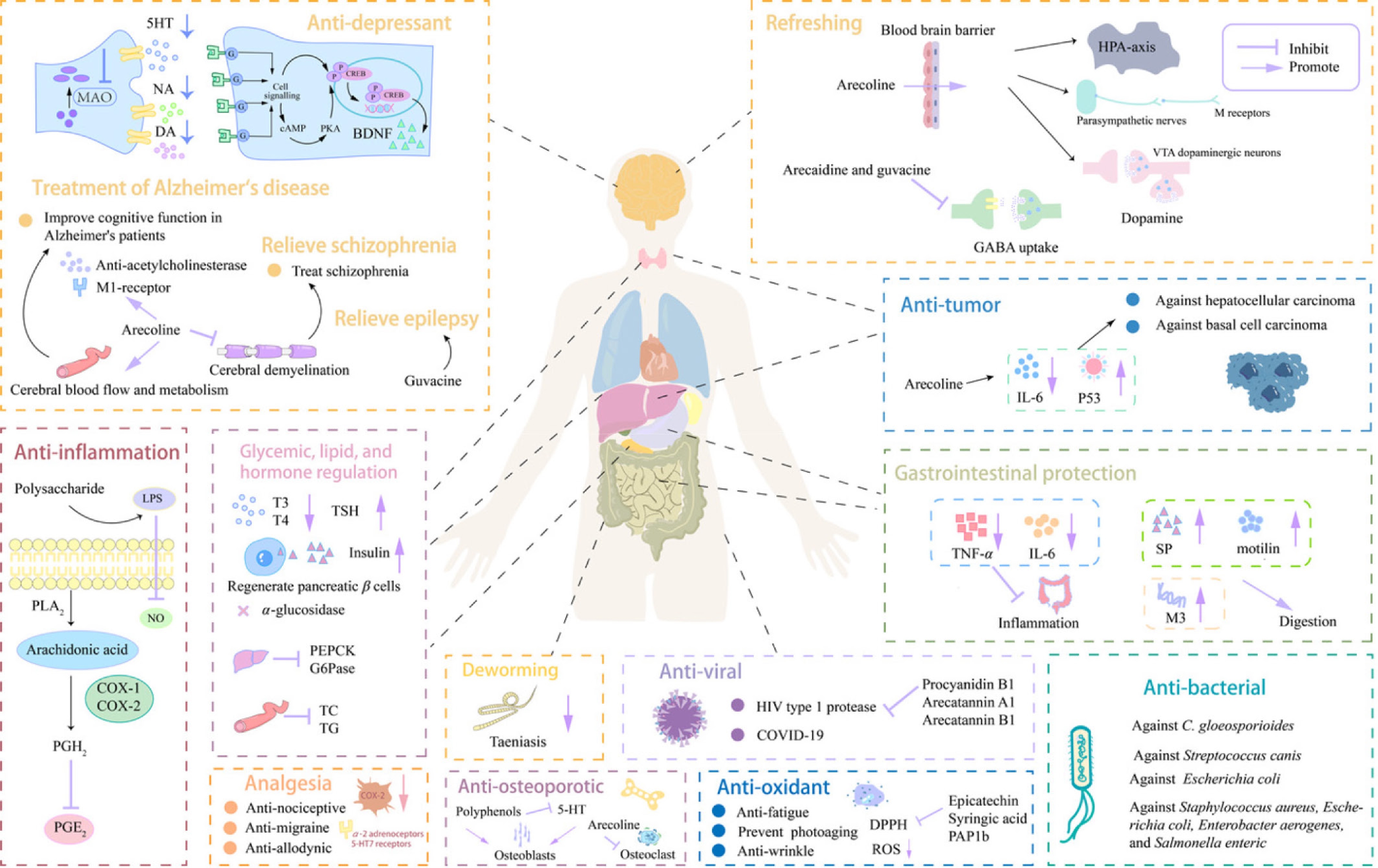
Figure 1.
Summary of the beneficial functions of areca nut components.
Areca nut exhibits diverse pharmacological activities, including effects on the nervous system (refreshing, anti-depression, analgesia, treatment of Alzheimer’s disease, relieving schizophrenia and epilepsy), effects on the endocrine system (glycemic, lipid, and hormone regulation), gastrointestinal protection, anti-inflammatory, anti-tumor, anti-oxidant, anti-bacterial, deworming, and anti-viral effects. The sharp arrow indicates activation, and the flat arrow indicates inhibition. Adapted from Sun H. et al.[51], Nutrients 2024, 16(5):695, Fig. 2, doi:10.3390/nu16050695 , licensed under CC BY 4.0.Historically, areca nut has been used as an anthelmintic agent. Multiple in vitro and animal studies have reported that areca nut (either crude extracts or specific solvent fractions) exhibits significant lethal or inhibitory effects against nematodes and certain parasites (including models such as Ascaridia/Ascaris, Galli, Fasciola, etc.), with evidence of causing paralysis or death of parasites within a short period compared to conventional anthelmintic drugs[47−49]. A small number of early clinical or comparative trials (small sample sizes, heterogeneous designs) have explored the efficacy of areca nut preparations compared to drugs such as mebendazole. The results suggest that areca nut may possess some activity in certain contexts, but evidence regarding its efficacy, dosage standards, and safety is insufficient to support its use as a replacement for prescription antiparasitic agents with established efficacy[50]. Thus, current evidence regarding areca nut as a potential 'natural anthelmintic' remains largely based on laboratory and animal studies, with a scarcity of human randomized controlled trials and a need for rigorous evaluation of its toxicity and long-term safety.
Historical and modern experimental data show that extracts of Areca/betel nut and some purified fractions exhibit activities in vitro and in animal studies that include stimulating saliva production, promoting gastrointestinal motility, antiparasitic effects, and reducing certain gastrointestinal inflammatory responses. For example, in several animal models, arecoline or areca -nut polyphenols have been reported to enhance digestive enzyme activity, improve lipid metabolism, and, depending on the route of administration, increase intestinal peristalsis or reduce the severity of certain pathological diarrheal conditions. In livestock and aquaculture models, improved digestion, absorption, and weight gain have also been observed, suggesting that certain components may have potential as digestive stimulants or feed additives. These diverse pharmacological functions are summarized in Fig. 1, which illustrates the nervous, endocrine, and gastrointestinal activities of areca nut components, along with their antioxidant, antimicrobial, antiparasitic, and other systemic effects[51,52]. Meanwhile, accumulating evidence suggests that areca nut consumption may influence the gut–brain axis and modulate the composition of the gut microbiota. These observations point to complex systemic effects associated with areca nut exposure that remain to be further elucidated[53−56]. However, all evidence supporting these digestive-enhancing properties is derived primarily from in vitro or animal studies. The long-term and low-dose safety, toxicity of metabolites, and the benefit-risk profile in human populations remain unclear.
In summary, evidence supporting the putative benefits of areca nut is derived predominantly from experimental research, including in vitro studies and animal models reporting antioxidant, anti-inflammatory, antiparasitic, and short-term anti-fatigue–related effects. Human evidence is limited and heterogeneous, consisting mainly of a small number of exploratory clinical trials and observational studies, none of which have been confirmed by rigorously designed, large-scale randomized clinical trials. Meanwhile, IARC-level carcinogenicity evidence and epidemiological data provide a clear risk assessment for long-term use[57]. Therefore, future research should prioritize: (1) conducting systematic toxicokinetic and long-term carcinogenicity assessments on single molecules or chemically modified low-toxicity derivatives; (2) ensuring that any human trials employ non-oral routes of administration, include clear dose stratification, and incorporate long-term (multi-year) follow-up to monitor fibrosis and oncological endpoints; and (3) strictly distinguishing in public communication and scientific discourse between 'pharmacological evidence from in vitro/animal studies' and 'clinically validated human indications', to avoid misleading the public and increasing population health burdens.
Epidemiology, disease burden, and public health implications of areca nut use
-
The prevalence of areca nut chewing varies across different populations. In South and Southeast Asia, it is relatively common, with a substantial proportion of the population engaging in the practice. In India, for instance, areca nut is consumed in various forms, often as part of a betel quid or in processed products, such as pan masala. A study of a rural Indian population found that among 2,175 areca -nut chewers, 7.3% presented with oral potentially malignant disorders, highlighting both the high prevalence of the habit and its associated health risks in this group[18].
In the Western Pacific region, such as in Guam and the Mariana Islands, areca nut chewing is also widespread. A five-year prevalence of areca nut chewing in Guam was reported at 11%, with an increasing trend observed among non-Chamorro groups (primarily other Micronesian populations)[3]. In parts of Papua New Guinea, a high proportion of pregnant women chew areca nut. In a study of 2,700 pregnant women, 83.3% used areca nut, with most chewing daily[6]. These figures illustrate the broad reach of areca nut chewing across diverse populations worldwide.
Areca nut consumption is associated with numerous health risks. One of the most well-established risks is the increased incidence of oral cancer. Oral submucous fibrosis (OSMF), a potentially malignant disorder, is strongly linked to areca nut chewing. A study of 860 OSMF patients in India found that areca nut (gutkha) was identified as a significant etiological factor in 55.8% of cases[58].
Areca nut also poses risks to other organ systems. It is associated with an elevated risk of esophageal squamous cell carcinoma (ESCC). A retrospective study of 286 ESCC patients showed that those with a history of areca nut chewing had a younger age at onset, poorer response to radiotherapy and chemotherapy, and shorter overall survival compared to non-chewers[15]. Furthermore, areca nut consumption has been linked to metabolic disturbances. A population-based study in Taiwan Province of China found that areca nut chewers had significantly higher triglyceride levels and leukocyte counts, as well as elevated diastolic blood pressure and aspartate aminotransferase levels, indicating potential metabolic and cardiovascular impacts[59].
Given the health risks associated with areca nut consumption, public health strategies are crucial. Strategies include developing targeted education and public awareness programs. These can target the general public, particularly in high-prevalence areas, to inform them about the health hazards of areca nut use. For example, in Vanuatu, where areca nut use is a growing concern, participants in one study recommended using radio and existing community networks to disseminate information about the dangers of areca nut use[16].
Another strategy involves implementing policies similar to tobacco control. Some countries have considered or enacted bans on certain areca nut products, especially those mixed with tobacco. However, without adequate enforcement and alternative support for those involved in the areca nut industry, the effectiveness of such bans may be limited. Additionally, screening programs can be established to detect early signs of areca-nut-related health problems, such as oral cancer. In Taiwan, China, population-based oral cancer screening programs targeting smokers and/or betel quid chewers have been shown to be effective in reducing the incidence of advanced disease and oral cancer mortality[60].
-
The oral pathology induced by areca nut involves complex biological mechanisms. One of the key processes involves the disruption of normal cellular functions in oral tissues. For example, areca nut extract has been shown to affect the migration and differentiation of normal gingival epithelial cells[13]. Treatment of these cells with areca nut extract at a concentration of 10 μg/mL reduced cell viability, activated matrix metalloproteinase-9 (MMP-9), and impaired established cell-cell contacts through disruption of E-cadherin and F-actin distribution.
Induction of oxidative stress represents another important mechanism. Areca nut components can lead to the generation of reactive oxygen species (ROS), which damage cellular components, such as DNA, proteins, and lipids. In oral keratinocytes, areca nut extract has been found to increase ROS production, subsequently activating signaling pathways involved in inflammation and carcinogenesis. Furthermore, areca nut may interfere with the normal regulation of extracellular matrix (ECM) metabolism. It can disrupt the balance between matrix metalloproteinases (MMPs) and tissue inhibitors of metalloproteinases (TIMPs), resulting in abnormal ECM deposition characteristic of oral submucous fibrosis[19].
Recent in vitro and mechanistic studies have further clarified the specific pathways through which areca nut extract (ANE) activates profibrotic and pro-invasive signaling in oral epithelial/keratinocyte models. Non-cytotoxic concentrations of ANE can induce TGF-β1 expression and activate Smad2 phosphorylation, while also triggering Smad-independent pathways, including TAK1 and downstream MAPK, PI3K/Akt, EGFR, and JAK signaling cascades. As illustrated in Fig. 2, these signaling events collectively upregulate MMP-9 and downregulate TIMPs, leading to extracellular matrix (ECM) degradation and remodeling. This process can be mitigated by antioxidants (e.g., catalase), TAK1/ALK5 inhibitors, or certain plant extracts, indicating that the ROS–TGF-β/TAK1–MMP-9 axis is a critical pathway through which ANE causes tissue damage and tumor invasion. These findings provide additional molecular evidence for the disturbance of local ECM metabolism in the oral cavity and help explain the seemingly paradoxical phenotype whereby betel quid/ANE exposure promotes both fibrosis (aberrant collagen deposition) and cancer cell invasion/metastasis[44,45,61,62].
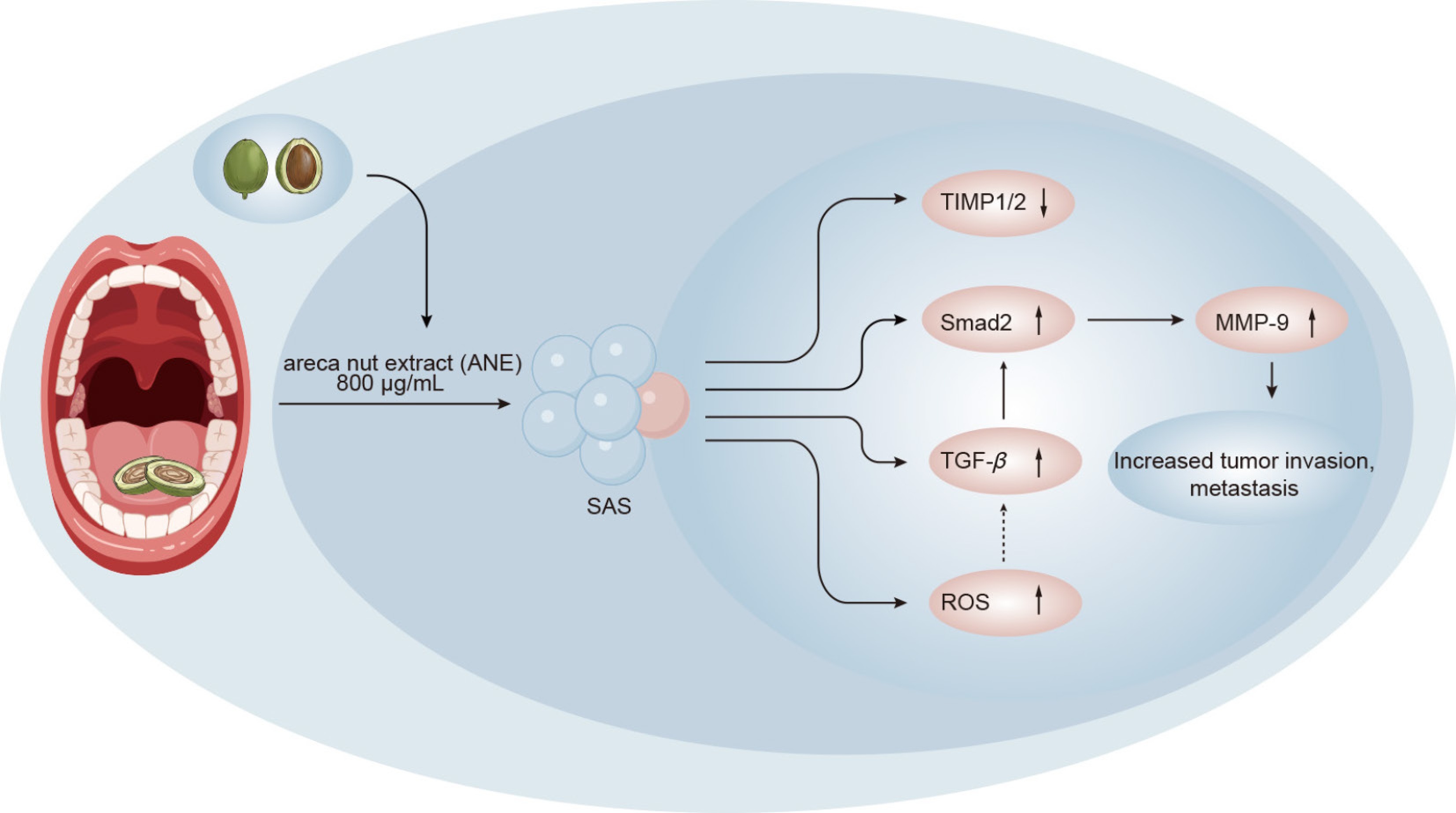
Figure 2.
Proposed signaling mechanisms of ANE-induced MMP-9 expression/secretion of oral mucosal cells.
Neuropharmacology of areca nut alkaloids and extra-oral systemic mechanisms
-
Areca alkaloids, such as arecoline, arecaidine, guvacoline, and guvacine, exert systemic effects on the body. Arecoline, the most abundant alkaloid, has been shown to affect the central nervous system. In studies using PC12 cells, arecoline treatment induced neurotoxicity, manifested as downregulated cell viability, upregulated apoptosis, and increased caspase-3 activity[63]. Arecoline also triggered excessive endoplasmic reticulum (ER) stress and disrupted endogenous hydrogen sulfide (H2S) production in these cells.
Regarding the reproductive system, arecoline has been investigated in male diabetic rats. It was found that treating rats with arecoline at a dose of 10 mg/kg body weight for 10 d promoted β-cell regeneration and reversed testicular and accessory sex gland dysfunction in type 1 diabetic rats[64]. It increased serum levels of insulin and gonadotropins and activated key genes involved in β-cell regeneration, such as pancreatic and duodenal homeobox 1 (pdx-1) and glucose transporter 2 (GLUT-2). However, the long-term effects of areca alkaloids on the reproductive system in non-diabetic individuals may differ and require further investigation.
Multiple studies have shown that areca nut extract (ANE)/arecoline rapidly increases intracellular reactive oxygen species (ROS) generation and depletes antioxidant defenses, such as glutathione, leading to lipid peroxidation, increased protein carbonylation products, and direct or indirect DNA damage[65,66]. Integrating toxicological and metabolic research, it is evident that areca components can damage DNA through oxidative pathways in the oral microenvironment, as well as generate N-nitrosamines (ASNAs) via nitrite-mediated nitrosation/nitration. These intermediates are metabolically activated in vivo and exhibit strong carcinogenicity, thereby converting short-term oxidative damage into long-term genotoxic risks (including base alkylation, DNA breaks, and chromosomal aberrations). These mechanisms provide molecular-level evidence supporting the epidemiological association between areca nut use and oral submucous fibrosis as well as squamous cell carcinoma[67].
Systematic reviews and mechanistic studies indicate that arecoline and its derivatives not only cause direct DNA damage, but also promote epithelial-mesenchymal transition (EMT), acquisition of cancer stem-cell-like properties, and chemoresistance by altering DNA methylation, miRNA expression (e.g., miR-22-regulated pathways), and epigenetic regulators, such as sirtuins. In other words, the carcinogenic pathways of areca nut exposure are multi-layered: oxidative and chemical modifications (nitrosation/alkylation) trigger genetic damage, while epigenetic modifications stabilize pro-carcinogenic programs, thereby increasing the probability of malignant transformation and influencing tumor progression dynamics[68,69].
-
Significant progress has been made in the detection of areca nut-induced oral lesions. One area of advancement refers to the use of molecular markers. For instance, in oral submucous fibrosis (OSF), the expression of certain genes and proteins can serve as indicators of the disease. One study found that a combined biomarker panel of Ki67 and p16 showed significantly different expression between malignant and non-malignant groups in OSF patients, suggesting their potential for predicting high-risk cases[4].
Imaging techniques are also increasingly being utilized. Dermoscopy, a non-invasive technique used in dermatological diagnosis, has been explored for diagnosing oral lichen planus, which may be associated with areca nut use. In a case report, mucoscopy (dermoscopy of mucosal surfaces) was used to identify characteristic features of oral lichen planus, such as a tri-color pattern consisting of a structureless veil-like gray-white area, well-demarcated red shiny erosions, and violet-to-brown clods, along with specific vascular patterns[70]. Furthermore, screening programs have been developed. In Taiwan Province of China, population-based oral cancer screening programs targeting high-risk individuals, including betel quid chewers, have proven effective in reducing the incidence of advanced disease and mortality from oral cancer[60].
Treatment possibilities for areca nut-related diseases
-
Treatments for areca nut-related diseases vary depending on the type and stage of the condition. For oral submucous fibrosis, surgical intervention may be considered in advanced cases. The use of a nasolabial flap has been evaluated for managing severe trismus in OSF. A retrospective study of 42 patients who underwent surgical treatment for OSF via nasolabial flap due to a mouth-opening of < 20 mm showed that the mean preoperative mouth-opening of 14.60 mm increased to 33.05 mm at the end of a 2-year follow-up, indicating the efficacy of this surgical approach[71].
Pharmacological therapies are also under exploration. For example, active components of Salvia miltiorrhiza Bunge, namely tanshinone IIA, salvianolic acid A, and salvianolic acid B, have been studied in vitro for their antifibrotic effects against areca -nut-extract-induced OSF. These compounds were found to inhibit abnormal viability and collagen accumulation in mouse oral mucosal fibroblasts, as well as the activation of certain signaling pathways involved in fibrosis[12]. Furthermore, lifestyle modifications, such as cessation of areca nut chewing, are often emphasized as a primary treatment measure, as they may potentially halt disease progression[72].
Engagement of healthcare providers in managing areca nut use
-
Healthcare providers play a vital role in managing areca nut use. Dentists and dental auxiliaries are at the forefront of raising patient awareness about the health risks associated with chewing areca nut. In regions where areca nut consumption is widespread, such as India and Southeast Asia, the professionals can enhance the public to understand oral submucous fibrosis and other areca-nut-related oral health issues[2].
Doctors also contribute significantly to identifying and managing systemic health problems linked to areca nut use. For example, in Taiwan Province of China, where areca nut chewing is associated with an increased risk of certain metabolic disorders, doctors can screen patients for these conditions and provide appropriate advice and treatment[73]. Furthermore, mental health professionals need to recognize the addictive potential of areca nut. A cross-sectional study among mental health professionals in India revealed significant gaps in their understanding of areca -nut-related addiction and a lack of awareness about cessation interventions, underscoring the need for education and training in this area[74].
-
Despite substantial advances in understanding the chemical composition, neuropharmacological properties, and oral–systemic health impacts of areca nut, its continued use remains a highly complex and contested issue. This complexity arises from the intersection of deeply rooted socio-cultural practices, unequivocal evidence of carcinogenicity, persistent scientific uncertainties, and uneven regulatory responses across regions. Addressing areca nut–related harm therefore, requires not only biomedical and clinical insights, but also culturally informed public health strategies and forward-looking policy frameworks.
Sociocultural controversies and risk communication challenges between cultural values and health risks
-
The most prominent debate surrounding areca nut use centers on the tension between its deep-seated sociocultural value and its well-established health risks. In many parts of South and Southeast Asia, areca nut chewing is deeply embedded in social customs, religious rituals, and interpersonal practices. Among Indigenous cultures in Taiwan Province of China, for example, the betel quid symbolizes social belonging, emotional bonds, and marital commitment, remaining an integral part of community life to this day[27].
In stark contrast to its cultural significance, the World Health Organization (WTO) has classified areca nut as a Group 1 carcinogen, with substantial evidence linking its use to oral cancer, oral submucous fibrosis, and various systemic diseases. However, awareness of these health risks among users is uneven across populations. A study conducted in Guam, for instance, revealed that current areca nut chewers had relatively limited awareness of the health hazards, whereas former users commonly cited health concerns as their primary reason for quitting[5]. This disparity suggests that, against a backdrop of longstanding cultural identity and intergenerational transmission, health risks are often downplayed or normalized.
Consequently, striking a balance between respecting cultural traditions and reducing the disease burden remains a core challenge for public health. Effective intervention strategies should not rely solely on biomedical risk warnings but must integrate culturally sensitive health education, community engagement, and context-appropriate risk communication models[75,76]. Otherwise, purely clinical or regulatory measures may face social resistance and struggle to achieve substantial impact.
Scientific uncertainties and emerging research directions
-
As the health risks associated with areca nut become widely recognized, emerging research has begun to focus on identifying safer alternatives and exploring new utilization pathways. One significant direction involves developing non-carcinogenic substitutes for areca nut, aiming to simulate its sensory experience and stimulant effects without introducing similar toxicity. Such research typically involves screening plant-derived components or compound formulations that offer mild psychoactive stimulation but have lower potential for genotoxicity and fibrogenicity[77].
Another research avenue emphasizes the modification of areca nut components or their non-oral application. For instance, reducing the toxicity of its active ingredients through chemical modification while retaining their potential biological activity, or developing areca nut and its processing by-products into sources of bioactive substances for non-edible uses, even as feedstock for biofuels. This approach could help reduce direct chewing consumption to some extent and provide economic alternatives for regions reliant on the areca nut industry[78,79].
However, these explorations still face numerous scientific uncertainties. A major gap is the lack of systematic evaluation for proposed substitutes regarding their long-term safety, addictive potential, and cultural acceptability. Evidence from clinical or population studies on these aspects remains very limited. Furthermore, while attempting to replicate the neuropharmacological effects of areca nut, avoiding the perpetuation or transfer of addictive behavior itself poses a fundamental challenge. Future research urgently needs to integrate multidisciplinary perspectives, from toxicology and neuroscience to behavioral science and socio-cultural analysis, to address the existing evidence gaps.
Policy, regulation, and future control strategies
-
Future policies and regulatory systems targeting areca nut use will likely need to establish a multilayered, evidence-based integrated framework. Governments and international health organizations should continuously refine regulations related to areca nut consumption based on accumulating scientific evidence. Particular emphasis should be placed on implementing stricter market access, sales, and advertising restrictions for areca nut products mixed with tobacco, as they significantly increase carcinogenic risk.
International cooperation also holds potential for a crucial role in areca nut control strategies. Given that areca nut use spans multiple countries and regions, sharing epidemiological data, intervention experiences, and policy outcomes can contribute to the development of more coordinated and effective public health responses. Countries with successful tobacco control experiences may offer transferable pathways and tools for areca nut regulation.
Concurrently, policy formulation must carefully consider the socioeconomic impact of the areca nut cultivation and processing industries. While advancing public health goals, providing support for industry practitioners to transition towards alternative crops or sustainable non-edible uses of areca nut is essential for minimizing social resistance and economic disruption. Such comprehensive strategies, balancing regulatory rigor, cultural sensitivity, and economic sustainability, are likely to form the core direction for reducing the future health burden associated with areca nut[80].
In summary, mitigating the public health burden associated with areca nut use involves addressing multiple interconnected challenges, including entrenched sociocultural practices, uneven awareness of health risks, inconsistent regulatory implementation, and gaps in scientific evidence regarding effective interventions. Importantly, studies show that certain components of areca nut have pharmacological activities, including antioxidant, anti-inflammatory, and digestive-enhancing effects, which should be carefully considered when designing policy and public health strategies. Moving forward, priority actions include strengthening international collaboration, developing culturally sensitive health education, and risk communication programs, and systematically evaluating both the risks and documented bioactive effects of areca nut. By integrating evidence-based assessments of its health risks and verified bioactivities, these strategies aim to implement effective and socially acceptable measures for reducing the burden of areca nut–related diseases.
-
The authors confirm their contributions to the paper as follows: study conception and design: Xu F, Dai Z, Zhou Z, Guo D, Hu Y; draft manuscript preparation: Xu F, Yang L, Wang S. All authors reviewed the results and approved the final version of the manuscript.
-
Data sharing not applicable to this article as no datasets were generated or analyzed during the current study.
-
This work was supported by Hainan Academy of Agricultural Sciences at the academy level project (HAAS2025ZDGZ14); Hainan Province Science and Technology Special Fund (ZDYF2024XDNY230); Eamarked fund for HNARS (HNARS-01-G01).
-
The authors declare that they have no conflict of interest.
-
#Authors contributed equally: Feng Xu, Zijian Dai
- Copyright: © 2026 by the author(s). Published by Maximum Academic Press on behalf of Yunnan Agricultural University. This article is an open access article distributed under Creative Commons Attribution License (CC BY 4.0), visit https://creativecommons.org/licenses/by/4.0/.
-
About this article
Cite this article
Xu F, Dai Z, Zhou Z, Guo D, Hu Y, et al. 2026. Balancing conservation and risk: biodiversity, domestication history, and health implications of Areca catechu L.. Agrobiodiversity 3(1): 21−30 doi: 10.48130/abd-0026-0002 

Balancing conservation and risk: biodiversity, domestication history, and health implications of Areca catechu L.
- Received: 31 December 2025
- Revised: 02 March 2026
- Accepted: 03 March 2026
- Published online: 28 March 2026
Abstract: Areca catechu L. (areca nut, referring specifically to the seed of Areca catechu consumed alone and excluding betel quid formulations), an economically important tropical crop, has attracted multidisciplinary attention due to its notable biological diversity, documented domestication history, and extensive socio-cultural interactions, positioning it as a salient subject in agricultural, biological, medical, and anthropological research. This review systematically summarizes the taxonomic classification, genetic diversity, phylogenetic relationships, and domestication evidence of Areca catechu L. in Asia and Oceania, highlighting its importance as an agricultural genetic resource. We outlined the historical evolution of its social roles and consumption patterns across different cultures, and analyzed its function in regional economic structures. Furthermore, based on recent molecular biological and toxicological studies, we summarized the potential pharmacological activities of Areca catechu components observed in vitro and in animal models, including central nervous system stimulation, anti-parasitic, anti-inflammatory, and antioxidant effects. However, both epidemiological and experimental evidence consistently demonstrate clear and robust fibrogenic and carcinogenic effects on the oral mucosa, whereas evidence supporting potential health benefits remains limited and largely confined to experimental settings. We emphasized that public health risks must be fully considered in related research and agricultural applications.