











-
Wuyi rock tea (WRT), a type of oolong tea mainly produced in the Wuyi mountains of China, is famous for its unique flavor characteristics of 'rock charm and flowery fragrance'[1,2]. Various suitable tea cultivars contribute to many kinds of WRT products including 'Dahongpao', Rougui, Shuixian, Dangui, among others. In recent years, many groups identified WRT odorants and elucidated the effects of the manufacturing process on the formation of flavor quality. For instance, a study identified 26 odorants as key aroma-active compounds in Rougui WRT and found that the roasting process intensified its roasty and cinnamon-like aromatic qualities[3]. In our previous studies, the key odorants of 'Dahongpao' WRT tea infusions have been revealed through the sensomics approach[4], and proved that 14 odorants including 6-methyl-5-hepten-2-one, γ-hexalactone, methyl 2-methylbutanoate, linalool, among others, contributed most to the flavor quality of 'Dahongpao'. These studies verified that 'roasty-smelling' pyrazines in WRTs were generated from the Maillard reaction of theanine and sugar under roasting conditions. Although significant progress has been made in understanding the flavor characteristics of WRT infusions, relatively few studies have examined the captivating aroma that lingers in an empty cup.
The empty cup aroma refers to the phenomenon that the aroma of an empty cup can still be perceived after drinking the freshly prepared tea infusion. The empty cup aroma is a typical characteristic of WRTs and a potential marker for appraising their flavor quality. Despite the valuable impact of the empty cup aroma on tea’s flavor quality, research on this aspect is limited. To the best of our knowledge, only the empty cup aroma of raw pu-erh tea was analyzed via the sensomics approach and proved that 2-methylbutanoic acid mainly contributed to its fermented soybean-like empty cup aroma[5]. In contrast, numerous studies paid attention to the empty cup aroma of other beverages, especially Chinese Baijiu. For example, Zhang et al. identified 155 volatile compounds in the empty cups of jiangxiang type Baijiu[6], and 2,3-dimethyl-5-ethylpyrazine, phenyl alcohol, p-cresol, sotolon, and phenylacetic acid were reported as the main contributors to the empty cup aroma of soy sauce aroma type Baijiu due to their highest flavor dilution factors[7].
It is not possible to precisely determine the absolute concentration of an odorant in the headspace above the respective tea infusion and empty cup to interact at the human receptor level. Therefore, odor thresholds in a given matrix have long been proven helpful in evaluating the odor activity of an odorant[8]. For example, δ-decalactone presents an odor threshold of 1.8 μg/kg in water[9], and 1,550 μg/kg in oil[10]. However, the interact perception between odorants and nonvolatiles are usually not considered, odor thresholds were only measured in water to evaluate the odor activities of odorants in tea infusions. Flavor interactions, including odor-odor, taste-taste, and odor-taste exist in tea infusion. For example, Zheng et al. added the odor compound (E)-nerolidol to the infusion of Fu brick tea and found that it had a significant effect on the overall aroma perception[11]. Scharbert et al. demonstrated that astringent flavanol-3-glycosides interact with bitter caffeine to amplify the bitter flavor in black tea infusions[12]. Yu et al. found geraniol and β-ionone enhanced the sweetness of black tea infusions[13]. Song et al. found that caffeine enhanced the flowery and fruity aroma in Fenghuang Dancong oolong tea by lowering the odor thresholds of γ-hexalactone and (Z)-jasmone[14]. The volatile components of lemongrass and its major constituent (citronellal) significantly reduced the bitterness of black tea infusions and caffeine solutions[15]. Decaffeinated tea, on the other hand, lost some of the charming flowery volatiles and non-volatiles[16], which might be related to the thresholds of flavor substances, the selectivity of human olfactory and taste receptor proteins, and the potential synergistic or antagonistic effects between these substances[17,18]. Caffeine is one of the factors contributing to the different flavors of different rock teas[19], it is also an important component in the formation and flavor of green tea[20]. Caffeine is an interesting compound that can be mostly extracted from solvent and detected via GC-MS. Therefore, in our previous studies[4,9], caffeine was removed from solvent-assisted flavor evaporation (SAFE)-distillate of tea infusion extract by application of flash chromatography. However, previous studies haven't yet investigated the flavor interaction between caffeine and aroma-active compounds in 'Dahongpao' infusions. Considering the distinct aroma between the tea infusion and the empty cup of 'Dahongpao', the perceptual interaction potentially might exist in 'Dahongpao' WRT.
Therefore, to elucidate the aroma differences between the tea infusion and the empty cup of 'Dahongpao' WRT, the key odorants in both the tea infusion and the empty cup were identified by aroma quantitative descriptive analysis combined with headspace solid-phase micro-extraction gas chromatography-olfactometry/mass spectrometry (HS-SPME-GC-O/MS). The effect of caffeine on the perception of the possible key aroma-active compounds was explored via odor threshold determination and S-curves. The present study provides a new insight into assessing the flavor quality of WRT.
-
The 'Dahongpao' samples were provided by the Wuyi Star Tea Co., Ltd. (Fujian, China). The fresh leaves of the 'Dahongpao' tea plant were harvested from Wuyi Mountain in 2021. The fresh leaves are made according to the traditional process immediately after harvest: withering, tumbling, aeration, rolling, and drying (GB/T 18745-2006, 6.6 Production processes,
http://down.foodmate.net/standard/yulan.php?itemid=15031 ). The crude dried leaves are then roasted at 150 °C for 5.5 h to obtain the finished tea. The final product was assessed as high-quality 'Dahongpao' dry tea with a water content of about 1.5% (information provided by Wuyi Star Tea Co., Ltd.). The tea sample was stored at −20 °C to preserve the original characteristics.Chemicals
-
The following odorant references and chemicals were commerically obtained: hexanal, methyl hexanoate, benzaldehyde, 6-methyl-5-hepten-2-one, phenylacetaldehyde, naphthalene, methyl salicylate, geraniol, and indole (Aladdin Chem., Shanghai, China); (Z)-linalool oxide (furanoid), β-cyclocitral, (Z)-3-hexenyl hexanoate, and (E)-nerolidol (TRC, Toronto, Canada); 2-pentylfuran, and decanal (O2si, Shanghai, China); (E,E)-2,4-heptadienal (Ark Pharm, Shanghai, China); 1,3-dimethylbenzene, 2,5-dimethylpyrazine, 5-methyl-2-ethylpyrazine, 1-ethyl-1H-pyrrole-2-carbaldehyde, (E)-2-octenal, 3,5-dimethyl-2-ethylpyrazine, N-ethyl-2-acetylpyrrole, methyl phenylacetate, 1-furfurylpyrrole, (E)-β-ionone, and dihydroactinidiolide (Macklin Biochem, Shanghai, China); (E,E)-3,5-octadien-2-one and geranyl acetone (ZZStandard, Shanghai, China); 2-heptanone, linalool, and nonanal (Dr. Ehrenstorfer GmbH, Augsburg, Germany); (Z)-jasmone (TCI, Shanghai, China); α-ionone (Cato, Guangzhou, China); β-ionone epoxide (Aikon Biopharmaceutical R&D Co.,Ltd., Jiangsu, China); δ-decalactone (TMstandard, Beijing, China); heptaldehyde (ISOREAG, Shanghai, China); n-alkane mixture (C7−C40) (Aladdin Chemicals, Shanghai, China); methanol and sodium chloride (NaCl) (Sinopharm Chemical Reagent, Shanghai, China); caffeine (Chem Faces, Wuhan, China). All the reference odorants were > 95% pure for GC analysis.
Enrichment of volatiles in tea infusion and empty cup
-
Tea infusion was prepared by placing 3 g of tea leaves in a stoppered conical flask, filled with 150 mL of boiling water. After brewing for 3 min, the tea infusion was immediately cooled to room temperature in an ice bath. Ten mL of the fresh tea infusion was transferred to a headspace vial (20 mL), filled with NaCl (2 g), and tin-sealed immediately. The tea infusion was incubated for 15 min in a 60 °C water bath. The HS-SPME stabilized flexible fiber (polydimethylsiloxane/divinylbenzene, PDMS/DVB, 2 cm, 65 μm, Oakville, Canada) was employed to absorb the headspace volatile fraction for 30 min during the heated water bath. For extracting the empty cup aroma, 150 mL tea infusion was freshly prepared in a 200 mL specialized tea-smelling ceramic cup, poured away after 2 min brewing, and sealed with polyethylene film. The PDMS/DVB fiber was employed again to extract the headspace aroma of the empty ceramic cup in a water bath at 60 °C for 15 min.
Odorant identification by HS-SPME-GC-O/MS
-
The fiber was immediately injected into an Agilent 8890 GC (CA, USA) to thermal desorption for 5 min at 250 °C. The volatiles were eluted by a DB-5 capillary column (30 m × 0.25 mm i.d., 0.25 μm film thickness, Agilent, CA, USA). The GC oven temperature program was set as follows: 40 °C for 2 min, ramping up to 230 °C at 4 °C per min, and holding for 5 min. The carrier gas was helium (purity of 99.999%) was applied as the carrier gas, and the linear velocity was set as 30 cm/s. The eluate was equally separated into two parts at the end of the GC column. One part was detected by an Agilent 5977A mass spectrum detector (MSD), and the other part were sniffed by three panelists from an olfactory detection port (ODP3, Gerstel, Mülheim an der Ruhr, Germany) simultaneously. Therefore, the mass spectra, the retention time, as well as the odor quality and intensity of each odorant were recorded in detail. Retention indices (RIs) were determined and calculated by a mixture of n-alkane series (C7−C40). The odor intensity was averagely scored from 0 to 3 at a unit of 0.1 (0 was 'scarcely sensed', 1 was 'sensed but scarcely recognized', 2 was 'significantly sensed and recognized', and 3 was 'mightily sensed and recognized').
Caffeine determination by high performance liquid chromatography (HPLC)
-
The amounts of caffeine in 'Dahongpao' tea infusion was determined via Waters-E2695 HPLC equipped with an ultraviolet-visible spectroscopy detector (Milford, MA, USA), and the parameters were slightly modified from a previous study[21]. The details of analysis conditions were as follows: C18 (5 μm, 4.6 mm × 250 mm, Agilent), and ultraviolet detection at 278 nm. The mobile phase A is an aqueous solution of 0.2% glacial acetic acid. The mobile phase B is methanol. The flow rate was 0.9 mL/min. The oven temperature was 37 °C and the injection volume was 10 μL. The elute gradients were set as follows: 0–2 min, 95%–80% A, 5%–20% B; 2–14 min 80%–75% A, 20%–25% B; 14–20 min 75%–58% A, 25%–42% B; 20–22 min 58%–58% A, 42%–42% B; 22–28 min 58%–0% A, 42%–100% B; 28–31 min 0%–0% A, 100%–100% B; 31–35 min 0–95% A, 100%–5% B; 35–38 min 95%–95% A, 5%–5% B.
Sensory analysis
-
The sensory evaluation experiments were conducted in a specifically designed room at room temperature. All 15 panelists aged from 22 to 34 years old were from the School of Tea Science, Anhui Agricultural University (Hefei, China). The panel trained their olfactory abilities for at least one year by recognizing the odor qualities of various odorant aqueous solutions and various foodstuffs. Therefore, the panel was able to identify and describe the odor qualities and intensities of aroma-active compounds.
Aroma profile analysis of tea infusion and empty cup
-
The tea infusion and empty cup were freshly prepared according to the brewing process mentioned above. Eight aroma descriptors were preliminarily determined by the panel for the infusion and the empty cup of 'Dahongpao'. Then, the corresponding reference odorants were dissolved in ethanol and diluted in water at the concentration of 100-fold of thresholds: sweet (furaneol), flowery (linalool), fruity (6-methyl-5-hepten-2-one), coconut-like (δ-decalactone), green ((E)-3-hexen-1-ol), fatty/flowery ((E,E)-2,4-heptadienal), roasty (2,6-dimethylpyrazine), and woody (1-ethyl-2-pyrrolecarboxaldehyde). The aroma intensity of each descriptor was assessed on a scale from 0 to 10 (0–2 for 'not distinctive', 2–4 for 'light', 4–6 for 'medium and recognizable', 6–8 for 'distinctive', and 8–10 for 'strong and easily recognizable').
Determination of olfactory thresholds of key compounds
-
The odor threshold values of δ-decalactone, 6-methyl-5-heptene-2-one, (E,E)-2,4-heptadienal, and methyl phenylacetate in water and aqueous solution of 638.9 mg/L caffeine were determined by the orthonasal triangle tests, respectively[8]. The sigmoid curve (P = 1/(1 + e − (X − C/D))) was applied to measure the detection thresholds. Here, P was the corrected detection probability, X was the odorant concentration (log μg/L), C represents the olfactory threshold (log μg/L), and D was a specific parameter of each odorant[22]. The detection threshold was defined as the concentration at which there is a 50% chance of detection[23].
Molecular docking
-
The molecular docking method was applied to reveal the interaction mechanism between caffeine and aroma-active compounds via Autodock Vina (Scripps Research, San Diego, USA). In brief, the molecular structures of δ-decalactone, 6-methyl-5-hepten-2-one, (E,E)-2,4-heptadienal, methyl phenylacetate, caffeine, and water were downloaded from the Pubchem database (
https://pubchem.ncbi.nlm.nih.gov/ ). AutodockTools was used to determine receptors and check charges. Atomic type was specified as AD4 types, structure and build receptor docking grid box. In addition, the ligand structure should determine the root, and select the twistable key of the ligand in AutodockTools. Finally, the format of both the receptor structure and the molecule ligand structure were converted from '.pdb' to '.pdbqt' to dock the two small molecules. The caffeine and the compound were docked first, and then the two complexes were docked with water molecules. After docking using Vina, scores for docking combinations of receptor and ligand structures were calculated and Discovery studio 2019 software was used for force analysis and visualisation.Statistical analysis
-
IBM SPSS statistical software (Version 19.0, SPSS Inc., Chicago, IL, USA) was applied for T-test and ANOVA. Figures were charted by Origin 2024 (OriginLab Co., Northampton, Massachusetts, USA). The molecular docking software studied was AutoDock Vina (Vina, version 1.1.2, Scripps Research, San Diego, USA), Discovery studio 2019 (BIOVIA, Paris, French). Adobe Illustrator 2024 (Adobe, San Jose, USA) were used for image processing.
-
Aroma profile analysis was conducted to identify the overall aroma differences between the tea infusion and the empty cup. The odour quality of 'Dahongpao' was evaluated using aroma quantitative descriptive analysis. Eight odour descriptors were selected by the trained panel in the preliminary sensory evaluation to provide an overall aroma profile of the 'Dahongpao' (Fig. 1). The roasty odor exhibited the highest intensity in the empty cup (7.67), matching the level observed directly in the tea infusion. Among the aroma attributes, the tea infusion presents a stronger fatty odor impression than that of the empty cup (5.83 vs 3.00) (p ≤ 0.05). In contrast, the empty cup scored higher intensities of sweet (7.33), flowery (5.67), fruity (7.17), and coconut-like (6.67) notes, all of which exceeded the corresponding intensities perceived in the tea infusion. Interestingly, these results indicated that the aroma characteristics changed a lot after emptying the teacup. Sweet, flowery, fruity, coconut-like, and fatty notes were potential key factors contributing to the aroma perceptible difference between the tea infusion and the empty cup.
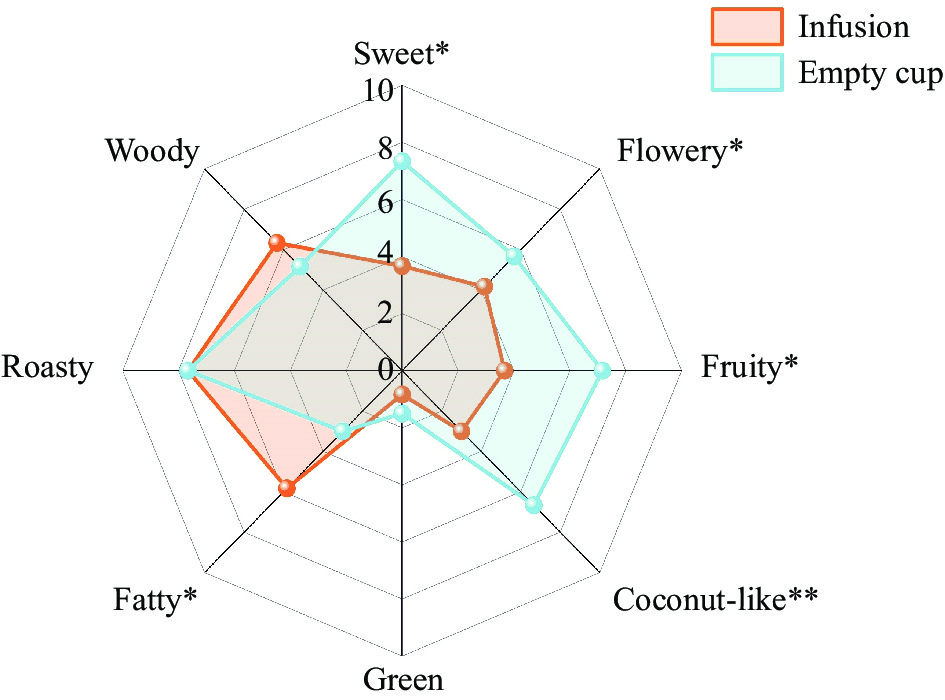
Figure 1.
Overall aroma profiles of the infusion (orange color) and the empty cup (blue color) of 'Dahongpao' tea. Odor notes with * means significantly different (p < 0.05), ** means extremely different (p < 0.01), and without * means not significantly different (p > 0.05).
Key aroma-active compounds in tea infusion and empty cup
-
The odorants in both the tea infusion and the empty cup fractions were determined by GC-O/MS. Odorants were identified by comparing the following information including the retention indices (RIs), the odour quality and intensity perceived by GC-O, and the mass spectrum with the corresponding reference compounds. Thereby, a total of 48 aroma-active regions were unambiguously detected in the aroma intensity (AI) factor range of 1 to 3. 39, and 37 aroma-active compounds were detected in the tea infusion and the empty cup, respectively. In accordance with the aroma profile data, a high AI factor between 2 and 3 in either the tea infusion or the empty cup were perceived for fruity and sweet, citrus-like, flowery, coconut-like, and fatty (Table 1).
Table 1. Aroma-active compounds in the infusion and the empty cup of 'Dahongpao' tea identified by HS-SPME-GC-MS-O.
No.a CAS No. Odorants Odor qualityb Identification
methodcRId (DB-5) AIe Detection NIST Infusion Empty cup 1 66-25-1 Hexanal Green, grassy MS/O/RI/STD 801 801 n.d.a 1 ± 0.4b 2 108-38-3 1,3-Dimethylbenzene Flowery MS/RI/STD 869 866 n.d. n.d. 3 100-41-4 Ethylbenzene Flowery MS/RI 875 868 n.d. n.d. 4 110-43-0 2-Heptanone Fruity, soapy, sweet MS/O/RI/STD 893 891 0.8 ± 0.2ga 2.1 ± 0.4bf 5 111-71-7 Heptaldehyde Citrus-like, fatty MS/RI/STD 902 901 n.d. n.d. 6 123-32-0 2,5-Dimethyl pyrazine Nutty MS/RI/STD 913 916 n.d. n.d. 7 106-70-7 Methyl hexanoate Fruity, musty MS/RI/STD 926 925 n.d. n.d. 8 13894-62-7 Methyl-(Z)-3-hexenoate Fruity, flowery MS/RI 933 933 n.d. n.d. 9 100-52-7 Benzaldehyde Bitter almond-like MS/O/RI/STD 965 962 n.d.a 1.5 ± 0.3b 10 110-93-0 6-Methyl-5-hepten-2-one Citrus-like, fruity MS/O/RI/STD 986 986 2.1 ± 0.6a 2.5 ± 0.3a 11 3777-69-3 2-Pentylfuran Vegetable-like MS/RI/STD 990 993 n.d. n.d. 12 4313-03-5 (E,E)-2,4-heptadienal Fatty, flowery MS/O/RI/STD 998 1012 2.1 ± 0.4a 2.2 ± 0.3a 13 13360-64-0 5-Methyl-2-ethylpyrazine Nutty, roasty MS/RI/STD 1004 1005 n.d. n.d. 14 138-86-3 Limonene Citrus-like MS/RI 1039 1031 n.d. n.d. 15 2408-37-9 2,6,6-Trimethylcyclohexanone Spicy MS/RI 1044 1036 n.d. n.d. 16 122-78-1 Phenylacetaldehyde Flowery, honey-like MS/O/RI/STD 1055 1045 1.7 ± 0.3a n.d.b 17 2167-14-8 1-ethyl-1H-pyrrole-2-carbaldehyde Roasty MS/RI/STD 1063 1067 n.d. n.d. 18 2548-87-0 (E)-2-octenal Fatty, nutty MS/RI/STD 1070 1060 n.d. n.d. 19 30086-02-3 (E,E)-3,5-octadien-2-one Fruity MS/O/RI/STD 1083 1072 1.5 ± 0.4a 2.5 ± 0.5a 20 5989-33-3 (Z)-linalool oxide (furanoid) Earthy, flowery, woody MS/RI/STD 1086 1074 n.d. n.d. 21 13925-07-0 3,5-Dimethyl-2-ethylpyrazine Earthy, nutty MS/O/RI/STD 1090 1084 n.d.a 1.5 ± 0.2b 22 78-70-6 Linalool Citrus-like, flowery MS/O/RI/STD 1114 1099 2.5 ± 0.2a n.d.b 23 124-19-6 Nonanal Citrus-like, soapy MS/RI/STD 1118 1104 n.d. n.d. 24 39741-41-8 2-Acetyl-1-ethylpyrrole Nutty MS/O/RI/STD 1126 1113 1.5 ± 0.3a n.d.b 25 101-41-7 Methyl phenylacetate Fruity, flowery MS/O/RI/STD 1180 1178 2.2 ± 0.2a 2.1 ± 0.1a 26 1438-94-4 1-Furfurylpyrrole Fruity, vegetable-like MS/O/RI/STD 1183 1187 1.8 ± 0.2a n.d.b 27 16491-36-4 (Z)-3-hexenyl butyrate Fruity MS/RI 1186 1187 n.d. n.d. 28 91-20-3 Naphthalene Tar-like, smoky MS/RI/STD 1192 1182 n.d. n.d. 29 119-36-8 Methyl salicylate Fatty, tallowy, terpene-like MS/RI/STD 1196 1192 n.d. n.d. 30 112-31-2 Decanal Soapy, citrus-like MS/O/RI/STD 1207 1206 2.5 ± 0.2a n.d.b 31 35154-45-1 (Z)-3-hexenyl isovalerate Fruity MS/O/RI 1213 1218 n.d.a 2.1 ± 0.2b 32 432-25-7 β-cyclocitral Fruity, flowery MS/O/RI/STD 1223 1220 1.7 ± 0.3a n.d.b 33 106-24-1 Geraniol Rose-like, citrus-like MS/O/RI/STD 1250 1255 2.8 ± 0.2a n.d.b 34 6290-37-5 2-Phenylethyl hexanoate Flowery MS/O/RI 1255 1650 2.3 ± 0.4a n.d.b 35 141-27-5 Geraniol Citrus-like MS/O/RI 1268 1270 1.8 ± 0.2a n.d.b 36 120-72-9 Indole Mothball-like MS/O/RI/STD 1295 1294 n.d.a 1.5 ± 0.3b 37 30364-38-6 1,1,6-Trimethyl-1,2-dihydronaphthalene Petrol-like MS/RI 1358 1354 n.d. n.d. 38 31501-11-8 (Z)-3-hexenyl hexanoate Fruity MS/O/RI/STD 1378 1379 1.7 ± 0.3a n.d.b 39 6378-65-0 Hexyl hexanoate Fruity MS/O/RI 1383 1384 1.5 ± 0.3a n.d.b 40 488-10-8 (Z)-jasmone Flowery, celery MS/O/RI/STD 1394 1394 1.7 ± 0.2a n.d.b 41 127-41-3 α-ionone Flowery, raspberry-like MS/O/RI/STD 1423 1426 2.3 ± 0.3a n.d.b 42 3796-70-1 Geranyl acetone Fruity, flowery MS/O/RI/STD 1446 1453 2 ± 0.5a n.d.b 43 79-77-6 (E)-β-ionone Flowery, violet-like MS/O/RI/STD 1480 1486 n.d.a 2 ± 0.4a 44 23267-57-4 β-ionone epoxide Fruity, sweet, flowery MS/RI/STD 1483 1473 n.d. n.d. 45 705-86-2 δ-decalactone Coconut-like MS/O/RI/STD 1494 1496 2.8 ± 0.2a 2.5 ± 0.3a 46 17092-92-1 Dihydroactinidiolide Coumarin MS/O/RI/STD 1533 1532 1.5 ± 0.2a n.d.b 47 40716-66-3 (E)-nerolidol Flowery, citrus-like, woody MS/O/RI/STD 1561 1564 n.d.a 2 ± 0.2b 48 1211-29-6 Methyl jasmonate Flowery MS/RI 1642 1641 n.d.a n.d.b a The compounds were numbered by the RI values. b The odor quality was described as the panelists recorded at the sniffing port. c MS, mass spectra; RI, retention index; O, olfactometry; STD, authentic reference compounds. d Retention index (RI) was determined using a series of n-alkanes standard (C7−C40) in DB-5 column. e The averaged aroma intensities (AI) perceived in ODP3 by three panelists. f Values with different Roman letters (a, b) in the same row are significantly different according to the Duncan test (p < 0.05), the result retains two significant digits. g Data are presented as the mean ± SD. The odor intensity was averagely scored from 0 to 3 at a unit of 0.1 (0 was 'scarcely sensed', 1 was 'sensed but scarcely recognized', 2 was 'significantly sensed and recognized', and 3 was 'mightily sensed and recognized'). The aroma-active compounds with the highest AI co-efficient in the empty cup were 2-heptanone (4; fruity/soapy/sweet, AI of 2.1), (E,E)-3,5-octadien-2-one(19; fruity, AI of 2.5), (Z)-3-hexenyl isovalerate (31; fruity, AI of 2.1), (E)-β-ionone (43; flowery/violet-like, AI of 2) and (E)-nerolidol (47; flowery/citrus-like/woody, AI of 2). The odors of hexanal, benzaldehyde, 3,5-dimethyl-2-ethylpyrazine, (Z)-3-hexenyl isovalerate, indole, (E)-β-ionone, and (E)-nerolidol were detected only in the empty cups and they present mainly fruity and flowery odor impression. In addition, linalool (22; citrus-like/flowery, AI of 2.5), decanal (30; soapy/citrus-like, AI of 2.5), geraniol (33; rose-like/citrus-like, AI of 2.8), 2-phenylethyl hexanoate (34; flowery, AI of 2.3), α-ionone (41; flowery/raspberry-like, AI of 2.3), and geranyl acetone (42; fruity/flowery, AI of 2) were also identified as aroma-active compounds in the infusion. Phenylacetaldehyde, linalool, 1-furfurylpyrrole, decanal, β-cyclocitral, geraniol, 2-phenylethyl hexanoate, geraniol, (Z)-3-hexenyl hexanoate, hexyl hexanoate, (Z)-jasmone, α-ionone, geranyl acetone, and dihydroactinidiolide were the compounds detected only in the infusion that differed significantly from the intensity of the aroma in the empty cups, which showed mainly flowery and citrus-like.
2-Heptanone, 6-methyl-5-hepten-2-one, and (E,E)-3,5-octadien-2-one were detected in both the empty cup and the infusion, and they mainly present fruity and sweet, but the intensity of the aroma was significantly higher in the empty cup than in the infusion, which was in line with the results of the previous sensory review. Curiously, there were fewer results in the GC-O assay for the identification of roasty aroma-active compounds in either the tea infusion or the empty cups, and it is speculated that this may be related to the choice of flexible fiber. Among them, δ-decalactone (45; coconut-like, AI of 2.8 and 2.5), 6-methyl-5-hepten-2-one (10; citrus-like, fruity, AI of 2.1 and 2.5), (E,E)-2,4-heptadienal (12; fatty/flowery, AI of 2.1 and 2.2), and methyl phenylacetate (25; fruity, flowery, AI of 2.2 and 2.1) were the key aroma-active compounds common to both infusion and empty cups, all of which had AI values greater than 2.
The volatile compounds in the infusion were mainly composed of esters, aldehydes, and alcohols. Sun et al. used HS-SPME and direct immersion solid phase microextraction (DI-SPME) combined with GC-MS to investigate the effect of brewing time on the changes in the volatile characteristics of the infusion[24]. Their results that esters, aldehydes, alcohols, fatty acids, and alkaloids, were the main volatile groups in the tea infusion. A combination of SPME and GC-O-MS and GC × GC-O-MS was employed to differentiate WRT by their aroma profiles. The results showed that Strecker aldehydes had strong influences on the aroma, including 2-methylbutanal, 3-methylbutanal, and others[3]. In the infusion, the roasty aroma was closely associated with pyrazines. This aligns with earlier HS-SPME analyses of large-leaf yellow teas, which found that 3,5-dimethyl-2-ethylpyrazine and 2-ethyl-3,6-dimethylpyrazine are the key compounds for the roasty aroma[25,26]. Among the esters, the most prominent group of compounds in infusion, they were the most abundant, also suggesting that they play key roles in determining the aroma profile of infusion[27]. Compounds such as linalool, methyl phenylacetate, and geraniol had flowery and fruity notes contributing significantly to the overall aroma of the infusion[28].
Enhancement effect of caffeine on the aroma release of key odorants
-
As shown in Fig. 2, a big chromatograph peak of caffeine was eluted in the empty cup sample via HS-SPME, while, caffeine wasn't detected in the tea infusion sample. These clues hinted to us that some acting forces such as hydrogen bonds and non-covalent bonds might occur between caffeine and water, resulting in the change of odorants' perception. Therefore, the odor thresholds of four key aroma-active compounds including δ-decalactone, 6-methyl-5-hepten-2-one, (E,E)-2,4-heptadienal, and methyl phenylacetate in water with and without caffeine respectively were determined. This assessment provided valuable insights into how caffeine influences the release of flowery and fruity-smelling odorants. According to our previous study, the aqueous solution of 638.9 mg/L caffeine determined in the 'Dahongpao' tea infusion was prepared as a matrix[29].
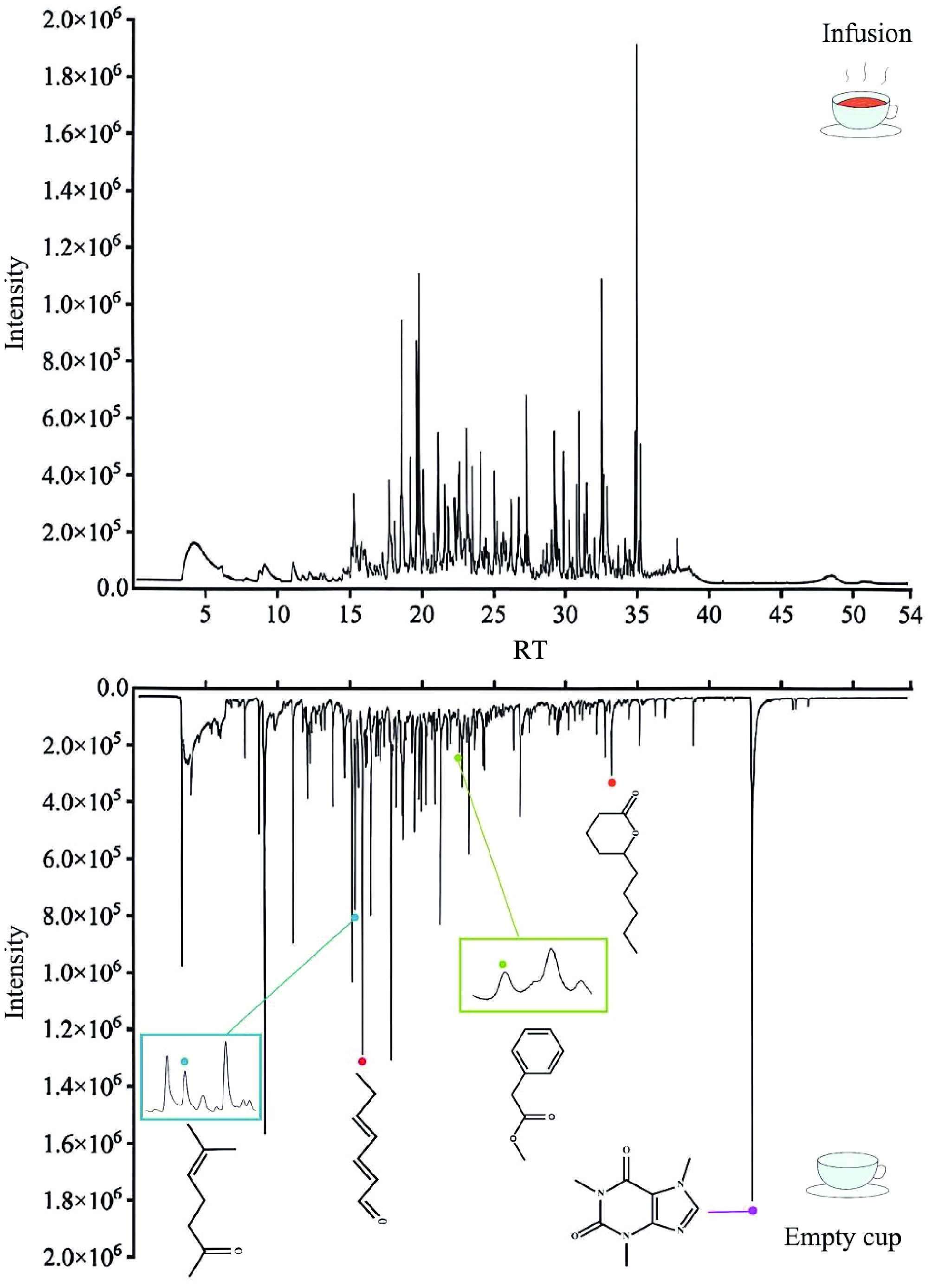
Figure 2.
Total ion chromatographs (TICs) and key different odorants of the infusion and the empty cup of 'Dahongpao' tea.
As shown in Table 2, the odor thresholds of δ-decalactone, 6-methyl-5-hepten-2-one, (E,E)-2,4-heptadienal, and methyl phenylacetate in the caffeine-containing aqueous solution were 6.52, 34.12, 14.61, and 9.05 μg/L, respectively. While, their corresponding odor thresholds were 8.08, 56.42, 29.55, and 12.12 μg/L. The D-values were represented as the ratio of the odor thresholds of odorants in the caffeine-containing aqueous solution and the corresponding odor thresholds in water. All the D values of four odorants present lower than 1, indicating the significant enhancement of caffeine to the olfactory perception of these aroma-active compounds.
Table 2. Odor thresholds of key flowery and fruity compounds in water and caffeine-containing aqueous solution.
Odorant Odor quality Odor threshold (μg/kg) Da Water Caffeine-containing
aqueous solutionδ-decalactone Coconut-like 8.08 6.52 0.81 6-Methyl-5-hepten-
2-oneCitrus-like, fruity 56.42 34.12 0.60 (E,E)-2,4-heptadienal Fatty, flowery 29.55 14.61 0.49 Methyl phenylacetate Fruity, flowery 12.12 9.05 0.75 a D were represented as the ratio of the odor thresholds of odorants in the caffeine-containing aqueous solution and the corresponding odor thresholds in water. Besides, the left-shift of S-curves of these odorants in Fig. 3 verified obvious decreases in their odor thresholds. It is noteworthy that the D-value of (E,E)-2,4-heptadienal was calculated as the lowest and the data was 0.49, suggesting the strongest aroma synergistic or potentiating effect related to caffeine. The data elucidated that caffeine significantly enhanced the flowery and fruity aroma of the tea infusion. In addition, the findings confirmed that sensory interactions among tea flowery and fruity odorants, bitter taste, and caffeine can regulate the aroma balance of 'Dahongpao' and affect the overall aroma perception.
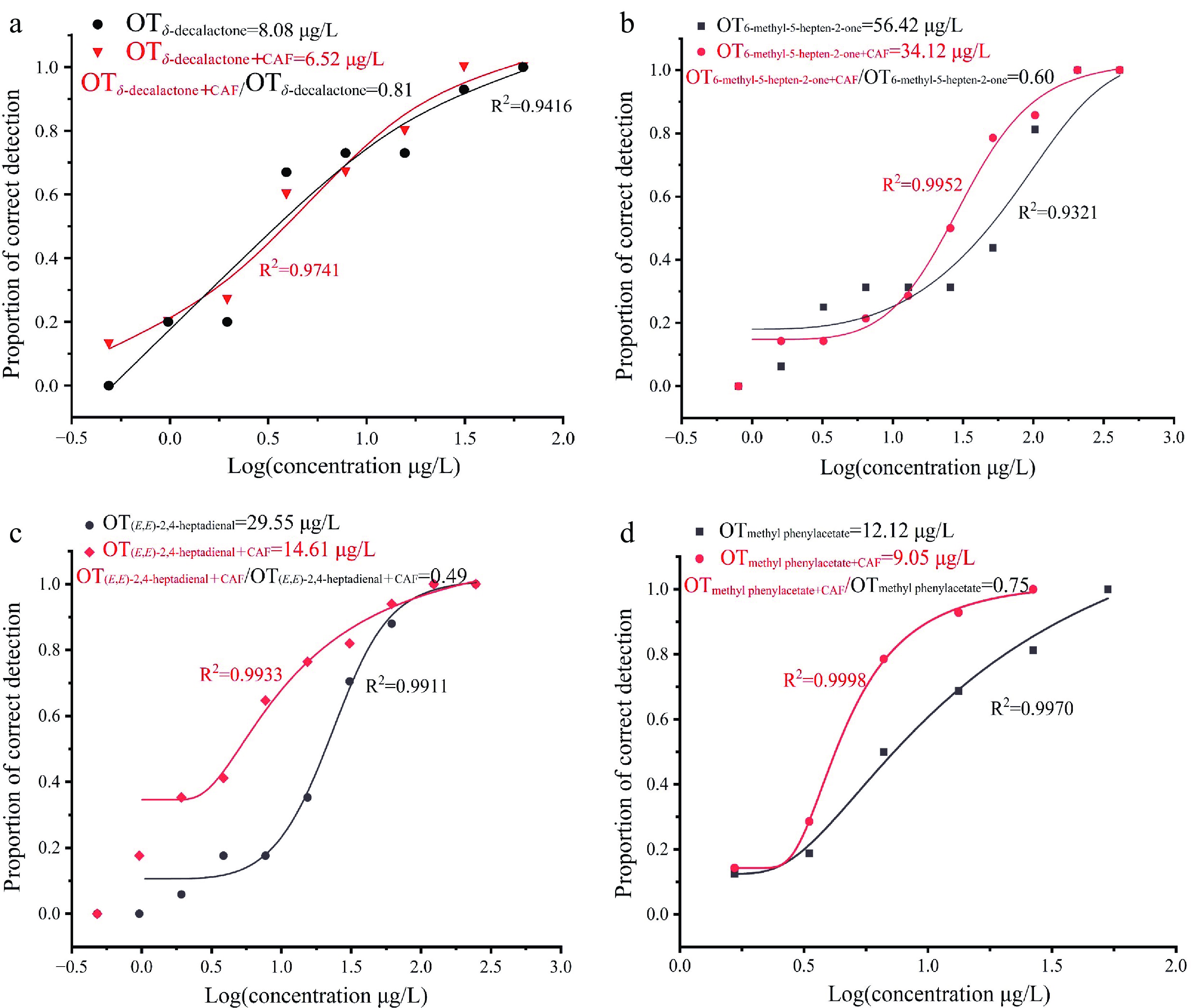
Figure 3.
Effect of caffeine on the detection probability of four flowery and fruity compounds in water. (a) δ-decalactone + 638.9 mg/L CAF; (b) 6-methyl-5-hepten-2-one + 638.9 mg/L CAF; (c) (E,E)-2,4-heptadienal + 638.9 mg/L CAF; (d) Methyl phenylacetate + 638.9 mg/L CAF.
Possible aroma interaction mechanisms via caffeine
-
Due to the obvious effect of caffeine on the flowery and fruity aroma perception of 'Dahongpao' Wuyi rock tea, understanding the interaction mechanisms between the abovementioned odorants and caffeine is crucial, particularly for the formation mechanism of the empty cup aroma and the tea infusion aroma. These aroma-active compounds including δ-decanolactone, 6-methyl-5-hepten-2-one, (E,E)-2,4-heptadienal, and methyl phenylacetate, present similar physical and chemical properties with caffeine. Therefore, they can dissolve in the aqueous solution of caffeine much easier than in water. Their better ability of nasal perception could be traced back to the droplet size (Fig. 4). To be specific, droplet size has a significant effect on the volatilization rate of volatile compounds (VOCs), which is also influenced by several factors including diffusion area, temperature, and solubility in water[30,31]. For example, at the same temperature, VOCs with higher solubility are more likely to disperse uniformly in water and form smaller droplets. The smaller droplet of a VOC leads to a larger surface area and a stronger ability to escape from the solution surface, thus accelerating its volatilization. On the contrary, VOCs with lower solubility may form larger droplets, resulting in smaller surface areas and slower diffusion over the droplet surface. As a bitter tastant with good solubility in warm water, > 80% caffeine could be extracted from tea leaves and dissolved into the tea infusion[32], further dispersed into smaller droplets with larger surface area, and finally diffuses from the surface of the solvent (Fig. 4). Therefore, aroma-active compounds could be volatilized and perceived easier by the nasal cavity, indicating that the presence of caffeine enhances the contribution of these flowery and fruity compounds to both the infusion aroma and the empty cup aroma[33−35].
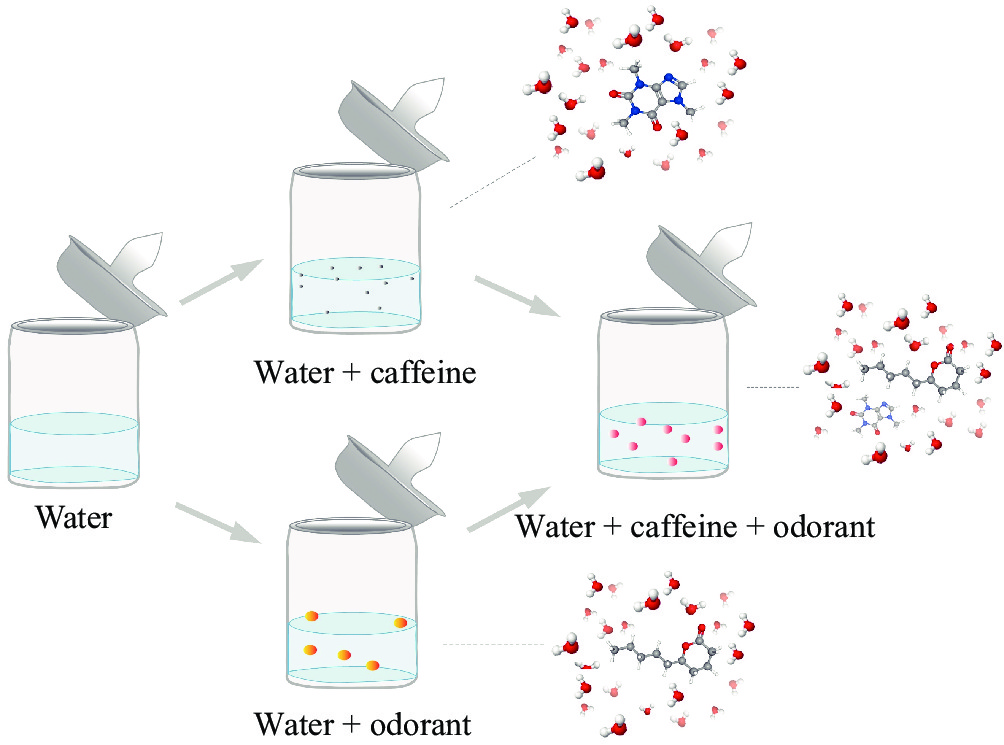
Figure 4.
The potential micromorphology of the aqueous solution of odorants with and without the addition of caffeine.
In addition to caffeine and odorants, the occurrence of water in the solution might also affect the role of caffeine in the aroma perception. Therefore, the possible covalent bond and non-covalent bond between caffeine, odorants, and water were simulated by molecular docking. The results showed that there was an interaction force between caffeine, aroma-active compounds, and water (Fig. 5). The O atom No. 1 of (E,E)-2,4-heptadienal and the H atom No. 1 of the water molecule can interact with each other via a 1.91 Å hydrogen bond, in addition, the H atom No. 2 of the water molecule interacts with the O atom No. 2 of caffeine via a 2.40 Å hydrogen bond. The O atom No. 2 of methyl phenylacetate can bind to the H atom No. 2 of the water molecule via one hydrogen bond of 2.23 Å. In addition, the H atom No. 10 of methyl phenylacetate and the O atom No. 2 of the caffeine interact with each other via a 3.01 Å hydrogen bond. In addition, methyl phenylacetate also binds to caffeine through two π-π stacking hydrophobic forces of 3.77 Å and 3.81 Å, respectively. In the binding of δ-decalactone, caffeine, and water, only the O atom No. 1 of caffeine could interact with the H atom No. 1 of the water molecule through one hydrogen bond of 1.91Å. In the binding of 6-methyl-5-hepten-2-one, caffeine, and water, only the No. 1 O atom of caffeine can bind to the No. 2 H atom of the water molecule through one hydrogen bond of 2.49 Å.
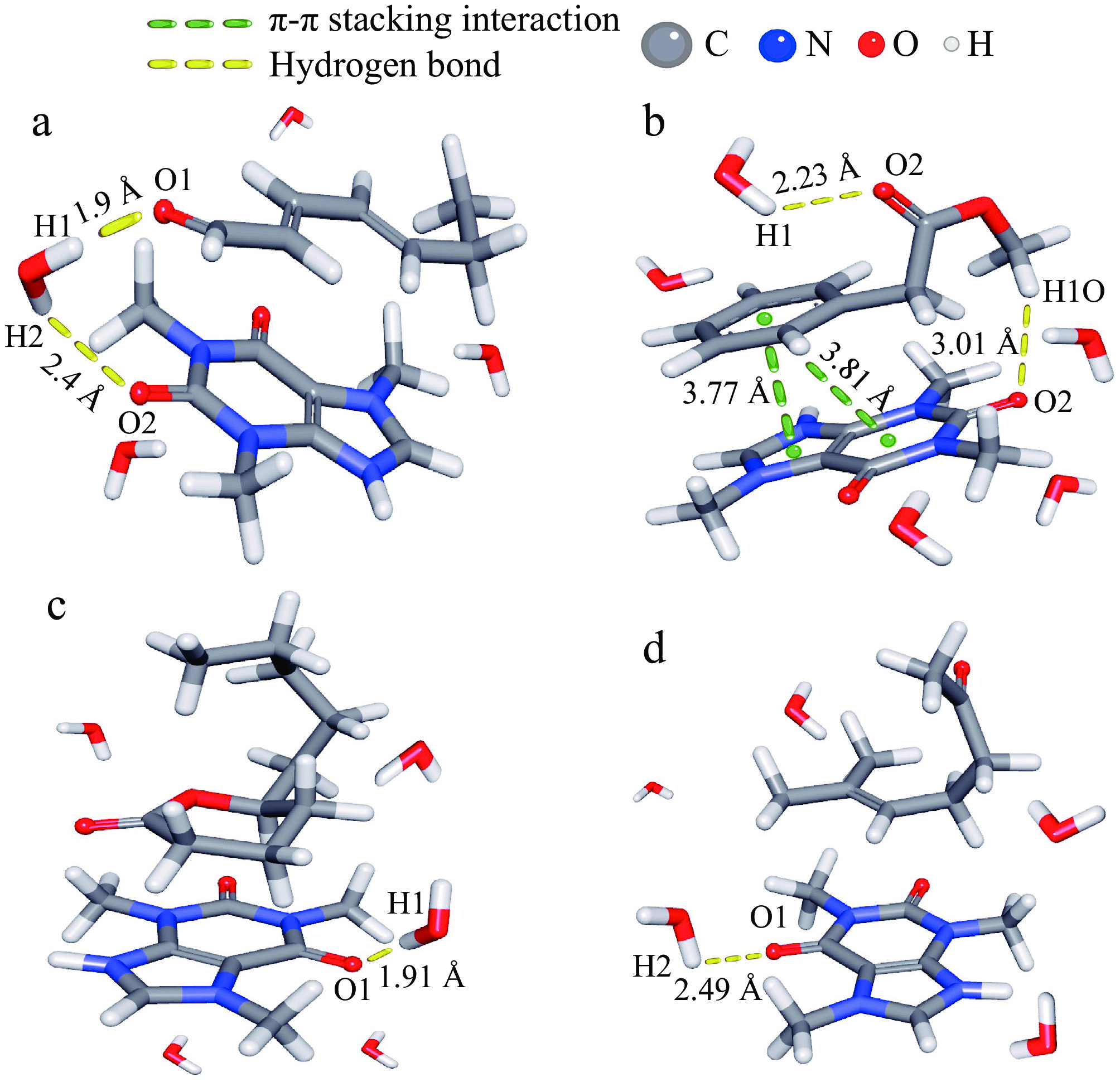
Figure 5.
Interactions between four aroma-active compounds, caffeine, and water. (a) (E,E)-2,4-heptadienal, caffeine, and water. (b) Methyl phenylacetate, caffeine, and water. (c) δ -declactone caffeine, and water. (d) 6-Methyl-5-hepten-2-one caffeine, and water.
The results showed that the binding energies between caffeine and δ-decalactone, 6-methyl-5-hepten-2-one, (E,E)-2,4-heptadienal, and methyl phenylacetate were –1.2, –1.1, –1.2, –1.4 kcal/mol, respectively. The binding energies between water and the adduct of caffeine and δ-decalactone was –0.6 kcal/mol. The binding energies between water and the adduct of caffeine and 6-methyl-5-hepten-2-one was –0.5 kcal/mol. The binding energies between water and the adduct of caffeine and (E,E)-2,4-heptadienal was –0.6 kcal/mol. The binding energies between water and the adduct of caffeine and methyl phenylacetate was –0.5 kcal/mol. A critical criterion for the spontaneous occurrence of molecular interactions is a negative binding energy[36]. All of these aroma-active compounds have negative binding energies with caffeine, and the lower the binding energy of the compound with caffeine, the stronger the affinity between the two. Among them, the binding energy of caffeine and methyl phenylacetate (–1.4 kcal/mol) is the lowest, indicating the strongest affinity between the two. In the binding diagram, the yellow dashed line indicates hydrogen bonding and the green dashed line indicates hydrophobic forces.
-
This study compared the differences in overall aroma profiles as well as odorant distribution between tea infusion and empty cup of 'Dahongpao' Wuyi rock tea via quantitative description analysis and HS-SPME-GC-O/MS. The results indicated that while the tea infusion exhibited strong woody and fatty notes, the empty cup displayed pronounced sweet, flowery, fruity, and coconut-like characteristics. The high aroma intensities of δ-declactone, 6-methyl-5-hepten-2-one, (E,E)-2,4-heptadienal, and methyl phenylacetate mainly contributed to the aroma of the infusion and the empty cup. The addition of caffeine in water reduced their respective odor thresholds, thus enhancing the olfactory perception of the flowery and fruity impression of 'Dahongpao' Wuyi rock tea. These new findings expand our understanding of the distinct aroma profiles of 'Dahongpao' tea infusion and their corresponding empty cup, while also unveiling the perceptual interactions between caffeine and aroma-active compounds. Furthermore, future research will focus on elucidating the hydrogen-bond mechanisms that underpin these aroma interactions.
-
All sensory evaluations in this study were conducted with the permission of the Science and Technology Ethics Committee of Anhui Agricultural University (Hefei, China). Participants gave informed consent via the statement: 'I am aware that my responses are confidential, and I agree to participate in these sensory evaluations' where an affirmative reply was required to enter the sensory evaluation. Additionally, the rights and privacy of all participants in the research process were protected, and they were able to withdraw from the sensory evaluation at any time without giving a reason. The tea samples and additives used in this study for sensory evaluation were food-grade ingredients and do not cause harm to humans, animals, or the environment.
This work was funded by the Natural Science Foundation of China (32302605), The Open Fund of State Key Laboratory of Tea Plant Biology and Utilization (SKLTOF20230118), and the earmarked fund CARS-19.
-
The authors confirm contributions to the paper as follows: conceptualization: Ding Q, Zhai X, Wan X; methodology: Ding Q, Song Y, Yang X; investigation: Ding Q, Song Y, Yang X, Huang D, Zhang Y, Zhai X; validation: Ding Q, Song Y; Zhai X; visualization: Ding Q, Yang X, Huang D, Zhai X; funding acquisition: Wan X, Zhai X; supervision: Zhang Y, Wan X, Mao Y, Zhai X; project administration: Wan X; formal analysis, data curation, writing-original draft: Ding Q; writing-review & editing: Mao Y, Zhai X. All authors reviewed the results and approved the final version of the manuscript.
-
Data sharing not applicable to this article as no datasets were generated or analyzed during the current study.
-
The authors declare that they have no conflict of interest.
-
# Authors contributed equally: Qiayun Ding, Yurui Song
- Copyright: © 2025 by the author(s). Published by Maximum Academic Press, Fayetteville, GA. This article is an open access article distributed under Creative Commons Attribution License (CC BY 4.0), visit https://creativecommons.org/licenses/by/4.0/.
-
About this article
Cite this article
Ding Q, Song Y, Yang X, Huang D, Wan X, et al. 2025. Decoding the key odorants responsible for the empty cup aroma of Wuyi rock tea 'Dahongpao' and their perception interactions with caffeine. Beverage Plant Research 5: e025 doi: 10.48130/bpr-0025-0013 

Decoding the key odorants responsible for the empty cup aroma of Wuyi rock tea 'Dahongpao' and their perception interactions with caffeine
- Received: 14 January 2025
- Revised: 06 March 2025
- Accepted: 31 March 2025
- Published online: 26 August 2025
Abstract: As a famous Wuyi rock tea, the empty cup aroma in 'Dahongpao' is distinct compared to the flavor of the tea infusion, but the specific odorants responsible for its unique empty aroma remain unknown. Therefore, the aroma differences between the empty cup and the infusion of 'Dahongpao' were determined via gas chromatography-olfactometry-mass spectrometry (GC-O/MS) and sensory evaluation. The results showed that 39 and 37 odorants were identified in the empty cup and the infusion of 'Dahongpao', respectively. Among them, four compounds with aroma intensities > 2 including δ-decalactone, 6-methyl-5-hepten-2-one, (E,E)-2,4-heptadienal, and methyl phenylacetate were responsible for coconut-like, sweet, flowery, and fruity notes in the empty cup and the infusion. Furthermore, determining their odor thresholds showed that adding caffeine to water significantly reduced these thresholds from 8.08 μg/L, 56.42 μg/L, 29.55 μg/L, and 12.12 μg/L to 6.52 μg/L, 34.12 μg/L, 14.61 μg/L, and 9.05 μg/L, respectively. In conclusion, this study provides valuable insights into the empty-cup aroma of 'Dahongpao' tea beverages and clarifies the role of caffeine in enhancing their pleasant aromatic profile.
-
Key words:
- 'Dahongpao' /
- Empty cup aroma /
- Flowery/fruity note /
- Caffeine /
- Aroma enhancement.