











-
The Brassicaceae family is one of the most important vegetable families, including leafy crops such as cabbage, kale, mustard, and collard, most of which are cool-season vegetables grown during early spring or fall and thrive at temperatures between 13 and 25 °C[1]. Among the Brassica vegetables, kale (Brassica oleracea var. acephala) is a versatile leafy green vegetable with good adaptability to various climate conditions[2]. Kale is a valuable source of dietary fiber and low-molecular-weight nondigestible carbohydrates, and is rich in vitamins A, K, B2, B9, and C, as well as in essential minerals such as potassium (K), calcium (Ca), and magnesium (Mg)[2,3]. In the United States, the production value of kale is estimated at 78.4 million USD in 2024, with California being the highest producing state[4]. With its wide adaptability, high yield potential, and quick maturity, kale has become increasingly important in the vegetable production of the southeastern United States, as growers seek to diversify its production and increase profitability at local markets.
High tunnels (HTs), also known as hoop houses, are unheated structures typically constructed with metal or wooden frames and covered with polyethylene film. These structures operate without automated climate control, relying primarily on passive solar heating and ventilation[5,6]. The total production value of specialty crops grown in protected environments, such as greenhouses or HTs in the United States, grew by 31.3%, increasing from
$\$748 $ $\$982 $ Biostimulants are organic and inorganic substances or microorganisms that improve plant growth, increase yield, and enhance stress tolerance when applied to agricultural crops[13]. The revenue of the biostimulant industry reached 2.5 billion USD worldwide in 2019 and is rapidly expanding in agriculture, as it is investigated as a sustainable alternative to improve productivity and alleviate stress for various species[14]. Commercially available biostimulants include microbial inoculants, humic and fulvic acids, protein hydrolysates and amino acids, and extracts derived from algae and plant species[15]. There are numerous reports of using biostimulants in vegetable production revealing varying results. Foliar application of three biostimulants has been shown to enhance chlorophyll synthesis and mineral uptake in greenhouse-grown spinach, thereby improving yield[16]. Another study on curly lettuce showed that microbial biostimulants, particularly when combined with reduced rates of synthetic fertilizer, can increase plant growth, biomass production, and fertilizer use efficiency[17]. On the other hand, biostimulants were shown to be more beneficial under stressful conditions such as drought and salinity, while showing little to no benefits when plants are grown under ideal conditions[18,19].
The successful application of biostimulants relies on the effective management of the complex interactions among the plant, biostimulant, and the growing environment[20]. Biostimulant efficacy can be strongly influenced by the application method. For example, seaweed biostimulants can be applied via foliar spray (FS), root application, or a combination of both, among which FS tends to be more effective because of the direct contact with plant tissues, allowing rapid absorption[21]. Three application methods of a seaweed extract (Ascophyllum nodosum), including FS, drench, and a combination of both, resulted in no significant differences in spinach plant growth, physiology, or nutritional value under full irrigation conditions. Conversely, under drought stress, the seaweed biostimulant increased leaf area and fresh and dry weights[18]. By comparison, biostimulants containing plant growth-promoting rhizobacteria (PGPR) are often reported to be most effective when applied directly to the root zone through soil drench or fertigation, although research reports and manufacturers recommended multiple application methods[19,22,23].
We hypothesize that growth response to different biostimulant products is cultivar-dependent in kale and can be influenced by the application method in HT production. The objective of this study was to assess how three biostimulants, including a seaweed extract, a microbial biostimulant, and an inorganic biostimulant (stabilized orthosilicic acid), as well as their application methods affect plant growth, yield, and mineral nutrient compositions of four kale cultivars grown in an HT.
-
In the experiment, we utilized four kale cultivars, including "Black Magic" (B. oleracea var. lacinato), "Westlandse Winter" (B. oleracea var. acephala), "Redbor" (B. oleracea var. acephala), and "Red Russian" (Brassica napus var. pabularia). All seeds were purchased from Johnny's Selected Seeds (Fairfield, ME, USA). Kale transplants were prepared in September 2024 in a greenhouse located on the Mississippi State University (MSU) campus (33.45° N, 88.79° W), where the temperature was maintained at 25 °C. Seeds were sown into 50-cell plug trays with a peat-based soilless substrate (PRO-MIX BX General Purpose; Premier Tech Horticulture, Quebec, Canada). At 44 days after planting (DAP), seedlings were transplanted into two-gallon black plastic containers (Nursery Supplies, Inc., Chambersburg, PA, USA) filled with a soilless substrate (Metro-Mix 852, containing 50%–60% pine bark; Sun Gro Horticulture, Agawam, MA, USA) in an HT at the R.R. Foil Plant Science Research Center of MSU (Starkville, MS, USA; 33.45° N, 88.79° W). Prior to transplanting at 41 DAP, seedlings were moved outdoors for hardening. The HT measured 29.0 m in length and 9.1 m in width and was oriented north to south, constructed with a metal frame covered with 0.15 mm (6 mil) clear polyethylene film. The tunnel was equipped with side curtain walls (1.5 m tall) and end doors (3 m tall) (Tubular Structure, Lucedale, MS, USA). Within the experiment duration, the side curtains and end walls were closed when air temperatures dropped below 4.4 °C and left open when temperatures remained above this threshold.
A slow-release fertilizer (15N–3.9P–10K; Osmocote® 15–9–12 Plus, 3–4 months; ICL Specialty Fertilizers, Summerville, SC, USA) was applied to each container at the medium recommended rate of 36 g·plant−1. Kale plants were drip-irrigated daily as needed and fertigated with a water-soluble fertilizer (20N–8.7P–16.6K; Peters®Professional 20–20–20 General Purpose; ICL Specialty Fertilizers) at a rate of 100 ppm nitrogen during the first 2 weeks of establishment, applied through an injector (D14MZ2; Dosatron Intl., Inc., Clearwater, FL, USA).
Microenvironment
-
During the experiment, environmental variables inside the high tunnel, including air temperature, relative humidity (RH), and photosynthetically active radiation (PAR), were monitored using a data logger (HOBO USB Micro Station H21-USB; Onset Computer Corp., Bourne, MA, USA), which was positioned at the center of the high tunnel. A sensor for temperature and RH (HOBO S-THB-M002; Onset Computer Corp.) and a quantum sensor (HOBO S-LIA-M003; Onset Computer Corp.) were attached to the data logger to collect measurements at hourly intervals. Daily light integral (DLI) was calculated by multiplying daily average PAR with 0.0864, as reported by Torres and Lopez[24]. The outdoor air temperature and RH data for Starkville were obtained from the USDA Natural Resources Conservation Service website[25]. Daily growing degree days (GDDs) were measured as follows: (daily average temperature-base temperature [4 °C]). Cumulative GDDs within certain time periods were estimated by summing daily GDDs.
Biostimulant application
-
The effects of three biostimulants, including DuneTM (Impello Biosciences, Loveland, CO, USA), Continuum V2TM (Impello Biosciences, Loveland, CO, USA), and Kelpak Maxx (Kelp Products Ltd., Simon's Town, South Africa), on the production of kale were investigated. DuneTM is a biostimulant formulated with stabilized mono- and ortho-silicic acid, which is a soluble and readily available form of silicon for plant uptake. Continuum V2TM is a microbial inoculant that contains a blend of plant growth-promoting rhizobacteria, including Paenibacillus chitinolyticus (1 × 10⁶ CFU·mL−1), Bacillus subtilis (1 × 10⁶ CFU·mL−1), Bacillus pumilus (1 × 10⁶ CFU·mL−1), and Bacillus amyloliquefaciens (1 × 10⁶ CFU·mL−1). The product Kelpak Maxx is a seaweed extract derived from a large brown kelp species, Ecklonia maxima. The application rates for each biostimulant treatment were determined based on the manufacturer's recommendation. Specifically, DuneTM and Continuum V2TM were prepared into a solution at a rate of 2 mL per gallon (0.528 mL·L−1). Kelpak Maxx was applied as 1% solution. The control consisted of tap water. Each biostimulant was applied using three methods: FS until runoff, substrate drench (SD) at a rate of 120 mL per container, and a combination of both. The biostimulant treatments were applied weekly for a total of five applications, initiated 1 week after transplanting.
Plant growth measurements
-
Plant height was measured from the surface of the substrate to the top point of the plant, while plant widths were measured horizontally in two perpendicular directions and then averaged to present the crown diameter. Three new mature leaves from each plant were selected to measure the relative chlorophyll content, also referred to as the soil–plant analysis development (SPAD) reading, using a SPAD meter (SPAD 502 Plus; Konica Minolta, Inc., Osaka, Japan). Three SPAD readings were then averaged to represent the leaf SPAD of a given plant. Plant size and leaf SPAD data were measured twice: first at 34 or 35 days after transplanting (DAT) and again at 99 DAT. One leaf from each plant was also measured for coloration using a chroma meter (CR-400, Konica Minolta Sensing Americas, Inc., Ramsey, NJ, USA) using the CIELAB color space, where L represents lightness, a* represents the green-to-red hue, and b* represents the blue-to-yellow hue.
Harvesting
-
Kale leaves were harvested twice within the experiment: first on February 19, 2025, at 104 DAT, and second on March 25, 2025, at 138 DAT. Harvesting was conducted by manually cutting all mature leaves with scissors, while younger leaves were left to regrow to enable repetitive harvests. At each harvest, the fresh weight of marketable leaves from each plant was measured, and the total number of leaves harvested from each plant was also recorded. To determine individual leaf size and moisture level, a portion of the marketable leaves was selected, counted, weighed fresh, and then oven-dried at 60 °C for dry weight determination. After a constant weight was achieved, the dry weight of each sample was recorded. The total leaf dry weight harvested from a plant was calculated by multiplying the total fresh leaf weight (TFLW) by the moisture level derived from the sampled leaves.
Mineral nutrient analyses
-
The dried plant samples from the second harvest at 138 days were ground using a plant grinder (Wiley Mini Mill, Thomas Scientific, Swedesboro, NJ, USA) until they passed through a 1-mm sieve. To determine total nitrogen (N) concentration, 0.25 g of the ground material was analyzed by combustion using an elemental analyzer (Vario MAX Cube; Elementar Americas, Inc., Long Island, NY, USA). The concentrations of phosphorus (P), potassium (K), calcium (Ca), magnesium (Mg), sulfur(S), copper (Cu), iron (Fe), manganese (Mn), zinc (Zn), and boron (B) were measured through inductively coupled plasma optical emission spectrometry (SPECTROBLUE; SPECTRO Analytical Instruments, Kleve, Germany). All macronutrients (mg·g−1) and micronutrients (µg·g−1) were presented on a dry-weight basis. The plant tissue analyses were carried out at the Mississippi State University Extension Service Soil Testing Laboratory.
Experimental design and statistical analyses
-
In this study, we used a split-plot design with factorial arrangement of treatments consisting of four kale cultivars, three biostimulant types plus control, and three application methods, contributing to 48 treatment combinations. The biostimulant treatment served as the main plot factor. Within the main plot, kale cultivar and application method were randomly distributed. There were five replications in the study, with each consisting of two plants. Three-way ANOVA was used to test the effects of cultivar, biostimulant type, and application method, as well as their interactions on all the measured variables. Data were analyzed using the PROC GLIMMIX procedure in SAS (version 9.4; SAS Institute, Cary, NC, USA). When significant differences were found, treatment means were compared using Tukey's HSD test at α = 0.05.
-
Three environmental variables, including air temperature, RH, and PAR, inside the HT were recorded hourly within the experiment duration from November 12, 2024, to March 25, 2025. The air temperature inside the HT ranged from −11.0 °C on January 22, 2025, to 33.1 °C on November 12, 2024. The daily average air temperature inside the HT ranged from −1.5 °C to 22.2 °C, compared with the daily average temperature outdoors ranging from −5.9 to 23.7 °C (Fig. 1). For RH, the daily average RH ranged from 44.35% on March 1, 2025, to 98.05% on December 28, 2024. In comparison, the daily average RH outdoors ranged from 37.04% on March 1, 2025, to 97.38% on December 17, 2024 (Fig. 2). The daily light integral (DLI) in the HT ranged from 0.35 mol·m−2·d−1 on January 19, 2025, to 36.64 mol·m−2·d−1 on March 25, 2025, while the average DLI recorded was 15.34 mol·m−2·d−1 within the experiment duration (Fig. 3).
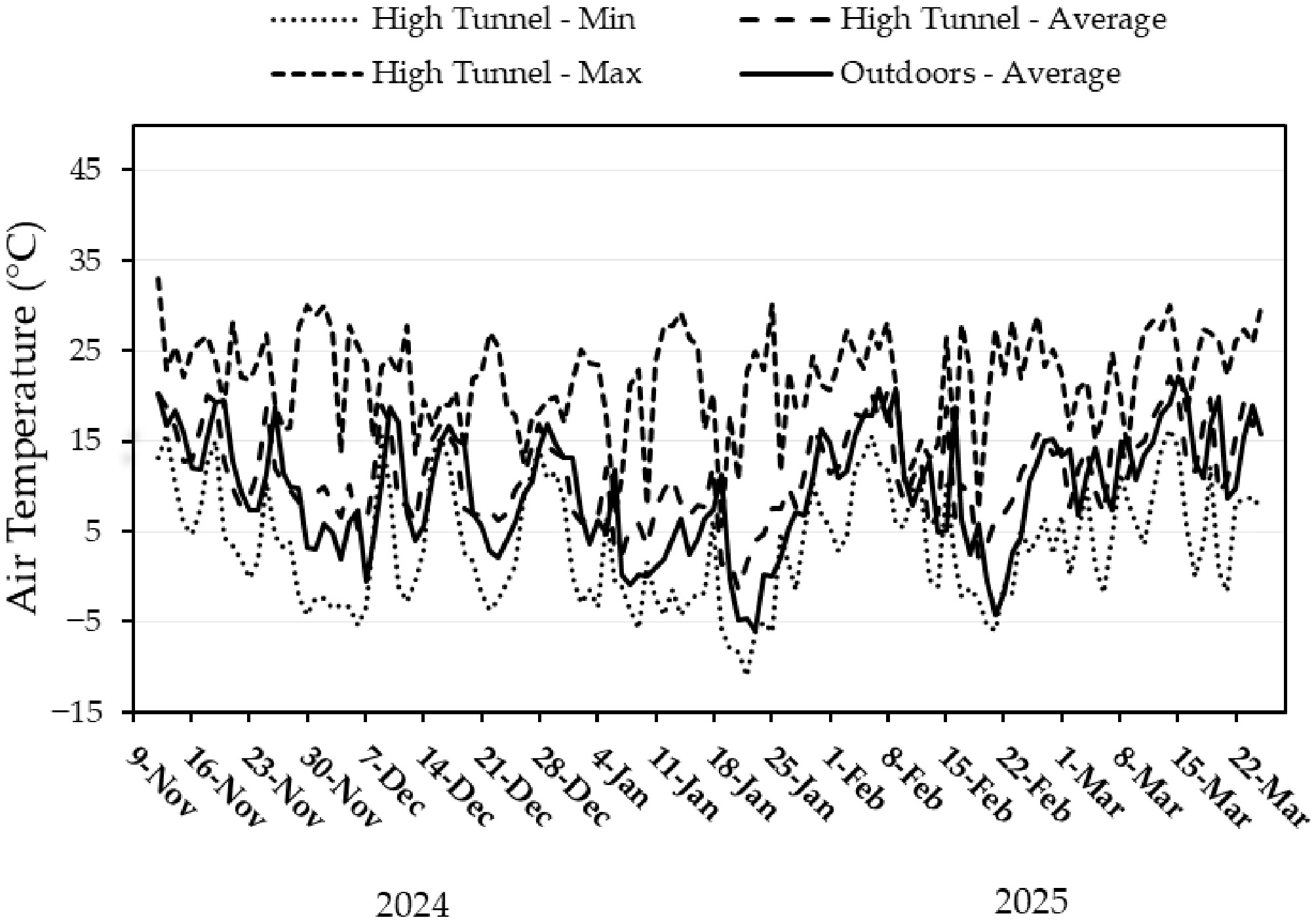
Figure 1.
Daily minimum, average, and maximum air temperature in the high tunnel recorded using a temperature and RH sensor (HOBO S-THB-M002; Onset Computer Corp) connected to a data logger (HOBO Micro Station H21-002; Onset Computer Corp., Bourne, MA, USA) at hourly intervals from November 12, 2024, to March 25, 2025. The daily average air temperature outdoors for Starkville was obtained from the USDA Natural Resources Conservation Service website.
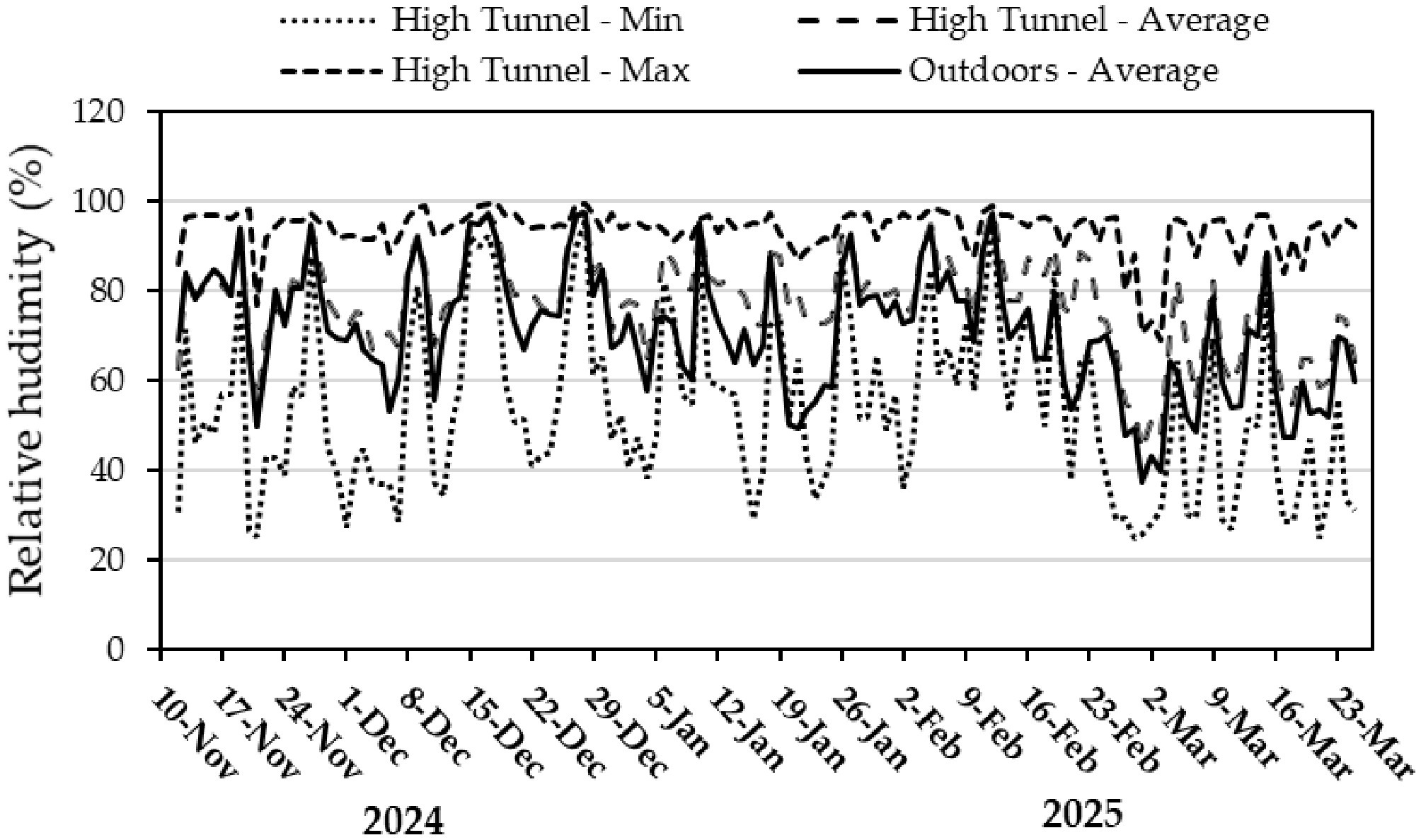
Figure 2.
Daily minimum, average, and maximum RH in the high tunnel recorded using a temperature and RH sensor (HOBO S-THB-M002; Onset Computer Corp) connected to a data logger (HOBO Micro Station H21-002; Onset Computer Corp., Bourne, MA, USA) at hourly intervals from November 12, 2024, to March 25, 2025. The daily average RH outdoors for Starkville was obtained from the USDA Natural Resources Conservation Service website.
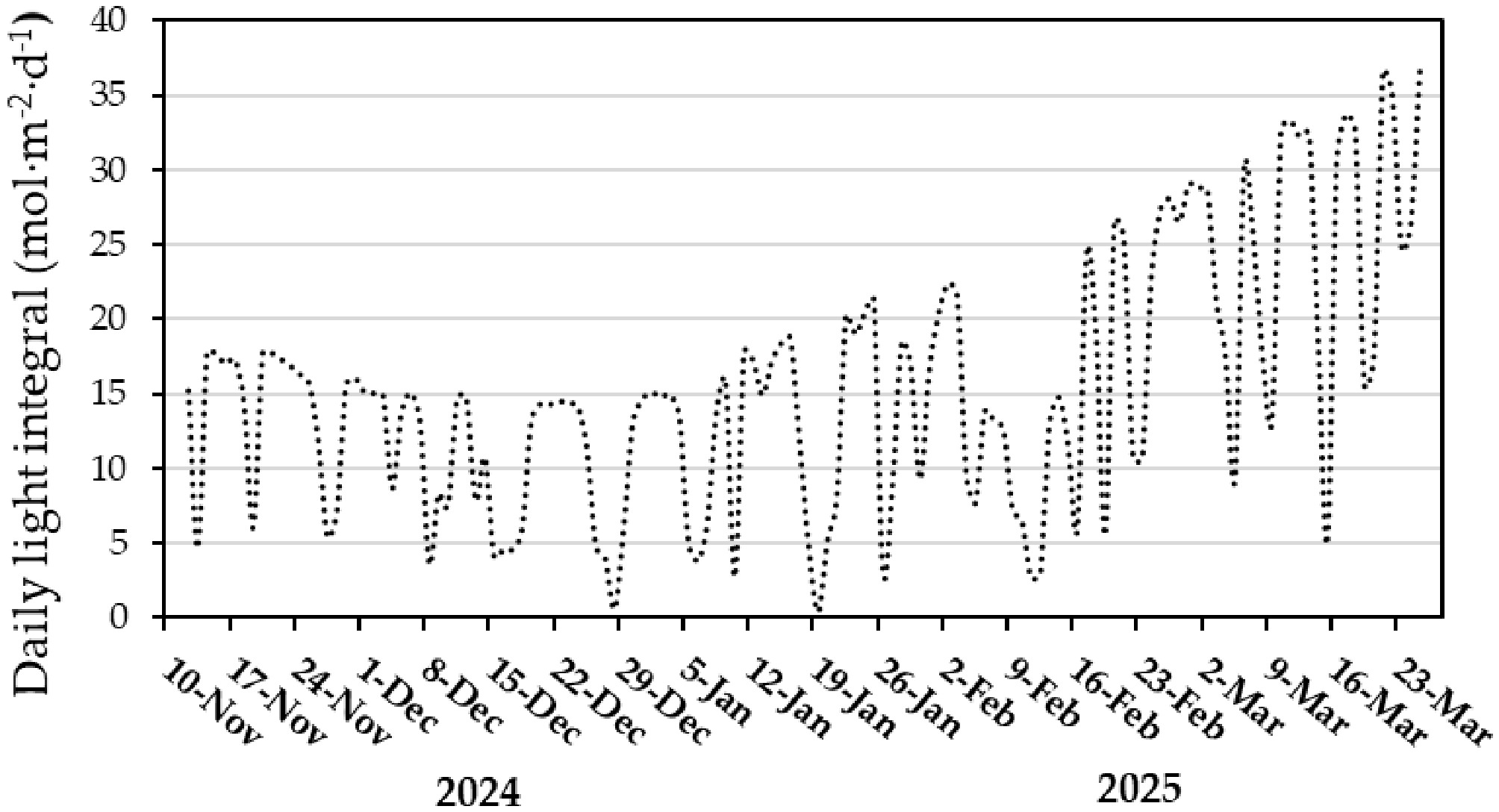
Figure 3.
Daily light integral (DLI) inside the high tunnel from November 12, 2024, to March 25, 2025. DLI was calculated by multiplying the daily average of PAR by 0.0864. The PAR under the high tunnel was recorded hourly by a quantum sensor (HOBO S-LIA-M003; Onset Computer Corp.) connected to a data logger (HOBO Micro Station H21-002; Onset Computer Corp., Bourne, MA, USA).
Plant height, crown diameter, and leaf SPAD
-
Plant height and crown diameter varied among cultivars in both measurements at 34 DAT and 99 DAT (Table 1). At 34 DAT, the cultivar "Red Russian" produced the tallest plant of 18.1 cm, followed by "Westlandse Winter" with a plant height of 15.9 cm. "Black Magic "and "Redbor" produced similar plant heights of 15.0–15.6 cm. At 99 DAT, "Red Russian" also produced the tallest plant of 39.7 cm, while the other three cultivars showed similar plant heights ranging from 31.2 to 32.4 cm. Plant height was also affected by biostimulant type but not by application method in both measurements (Tables 2 and Supplementary Table S1). At 34 DAT, Kelpak Maxx resulted in the largest plant height of 17.4 cm, compared with the control, Continuum V2, or Dune, with similar plant heights ranging from 15.6 to 15.8 cm. At 99 DAT, the application of Kelpak Maxx resulted in a plant height of 35.5 cm, which was similar to that of Dune, but higher than the control or Continuum V2.
Table 1. Variation of plant height, crown diameter, and leaf SPAD measured on two dates among kale cultivars.
Cultivar 34 DAT
Plant heightz
(cm)34 DAT
Crown diameter
(cm)35 DAT
SPAD99 DAT
Plant height
(cm)99 DAT
Crown diameter
(cm)99 DAT
SPADBlack Magic 15.5 bc 31.4 b 77.5 a 32.3 b 46.8 bc 84.8 a Redbor 15.00 c 27.5 c 47.2 d 31.2 b 45.5 c 56.5 c Red Russian 18.1 a 44.6 a 56.0 b 39.7 a 61.2 a 62.8 b Westlandse Winter 15.9 b 32.2 b 50.5 c 32.4 b 48.2 b 52.4 d p value < 0.0001 < 0.0001 < 0.0001 < 0.0001 < 0.0001 < 0.0001 z Different lowercase letters suggest significant difference among means within a column according to Tukey's HSD test at p < 0.05. Table 2. Plant height, crown diameter, and leaf SPAD measured on two dates as affected by the main effect of biostimulant type.
Biostimulant 34 DAT
Plant heightz
(cm)34 DAT
Crown diameter
(cm)35 DAT
SPAD99 DAT
Plant height
(cm)99 DAT
Crown diameter
(cm)99 DAT
SPADSulfur
(mg·g−1)Control 15.8 b 34.0 57.1 33.4 b 51.4 ab 63.2 4.66 a Continuum V2 15.6 b 33.7 58.1 33.1 b 49.4 c 63.9 4.42 ab Dune 15.8 b 33.7 57.6 33.9 ab 49.6 bc 65.1 4.18 b Kelpak Maxx 17.4 a 34.5 58.6 35.5 a 51.6 a 64.3 4.53 ab p value < 0.0001 0.38 0.76 0.0012 0.002 0.40 0.013 z Different lowercase letters suggest significant difference among means within a column according to Tukey's HSD test at p < 0.05. For crown diameter at 34 DAT, "Red Russian" produced the largest crown diameter of 44.6 cm, higher than that of any other cultivar. Lower than that of "Red Russian," "Black Magic" and "Westlandse Winter" showed similar crown diameters of 31.4 and 32.2 cm, respectively. "Redbor" produced the smallest crown diameter of 27.5 cm among cultivars. At 99 DAT, "Red Russian" also produced the largest crown diameter of 61.2 cm. By comparison, "Redbor" and "Black Magic" produced the smallest crown diameters of 45.5 and 46.8 cm, respectively. Crown diameter was also affected by biostimulant type but not by application method at 99 DAT (Tables 2 and Supplementary Table S1). Kelpak Maxx and the control resulted in larger crown diameters, ranging from 51.4 to 51.6 cm, than Continuum V2 with a plant diameter of 49.4 cm.
Leaf SPAD varied among cultivars in both measurements (Table 1). "Black Magic" showed the highest relative chlorophyll content of 77.5 and 84.8 at 35 DAT and 99 DAT, respectively. The ranking of leaf SPAD among cultivars at 35 DAT was as follows: "Black Magic" (77.5) > "Red Russian" (56.0) > "Westlandse Winter" (50.5) > "Redbor" (47.2). The ranking of leaf SPAD among cultivars at 99 DAT was as follows: "Black Magic" (84.8) > "Red Russian" (62.8) > "Redbor" (56.5) > "Westlandse Winter" (52.4). Leaf SPAD was not affected by biostimulant type or application method at either measurement (Supplementary Table S1).
Leaf coloration
-
The leaf coloration parameters, including L, a*, and b* readings, measured at 120 DAT, varied among cultivars and were not affected by biostimulant type or the application method (Table 3 and Supplementary Table S2). For the lightness value L, the ranking among cultivars was as follows: "Westlandse Winter" (37.75) > "Red Russian" (34.77) > "Black Magic" (26.00) > "Redbor" (19.15), with a significant difference between any two cultivars. For the green to red hue, "Redbor" produced leaves with the highest positive a* value of 9.28 among cultivars, suggesting red coloration. The other three cultivars all produced leaves with negative a* values with green hue, where "Westlandse Winter" leaves had the lowest a* value of −10.15 and the most green hue among cultivars. For the yellow to blue hue, the three cultivars, including "Black Magic," "Red Russian," and "Westlandse Winter," produced positive b* values with a yellow hue, with "Westlandse Winter" producing the highest b* value of 17.84. Leaves from "Redbor" produced a negative b* value of −1.15 with a blue hue.
Table 3. Kale cultivars varied in leaf coloration measured at 120 DAT.
Cultivar Lz a* b* Black Magic 26.00 c −4.10 b 3.00 c Redbor 19.15 d 9.28 a −1.51 d Red Russian 34.77 b −6.81 c 8.10 b Westlandse Winter 37.75 a −10.15 d 17.84 a p value < 0.0001 < 0.0001 < 0.0001 z Different lowercase letters suggest significant difference among means within a column according to Tukey's HSD test at p < 0.05. Total dry leaf weight (TDLW) followed the same trend as TFLW in both harvests (Table 4). In February, "Red Russian" produced the highest TDLW of 80.4 g·plant−1, followed by "Westlandse Winter" (60.1 g·plant−1), while "Black Magic" and "Redbor" produced lower TDLWs of 42.0 and 39.3 g·plant−1, respectively. In March, "Red Russian" and "Westlandse Winter" produced higher TDLWs of 60.1–61.2 g·plant−1 than "Black Magic" or "Redbor" with TDLWs of 36.2–39.9 g·plant−1.
Total fresh and dry leaf weights
-
Total fresh and dry leaf weights varied among cultivars at both harvests in February at 104 DAT and in March 2025 at 138 DAT (Table 4). Biostimulant type and application method did not affect the total fresh or dry leaf weights at any harvest (Supplementary Table S1). In the February harvest, "Red Russian" produced the highest TFLW of 596.8 g·plant−1, higher than any other cultivars. "Westlandse Winter" recorded the second highest TFLW of 502.6 g·plant−1, while "Black Magic" and "Redbor" produced similarly the lowest TFLWs of 290 and 264.8 g·plant−1, respectively. In the March harvest, the two cultivars, "Red Russian" and "Westlandse Winter," produced higher TFLWs of 329.9–374.3 g·plant−1 than "Black Magic" or "Redbor," with similar TFLWs of 198.4–233.9 g·plant−1.
Table 4. Kale cultivars varied in total fresh and dry leaf weights and individual fresh and dry leaf weights harvested in February and March 2025.
Cultivar February 2025 March 2025 Total
fresh leaf
weightz
(g·plant−1)Total
dry leaf
weight
(g·plant−1)Individual
fresh leaf
weight
(g·leaf−1)Individual
dry leaf
weight
(g·leaf−1)Total
fresh weight
(g·plant−1)Total
dry
weight
(g·plant−1)Individual fresh
leaf
weight
(g·leaf−1)Individual dry
leaf
weight
(g·leaf−1)Black Magic 290.0 c 42.0 c 12.4 b 1.76 b 198.4 b 36.2 b 6.50 c 1.21 c Redbor 264.8 c 39.2 c 12.0 b 1.77 b 233.9 b 39.9 b 6.33 c 1.07 c Red Russian 596.8 a 80.4 a 24.3 a 3.22 a 374.3 a 61.2 a 10.8 b 1.79 b Westlandse Winter 502.6 b 68.9 b 23.5 a 3.20 a 329.9 a 60.1 a 15.8 a 2.87 a p value < 0.0001 < 0.0001 < 0.0001 < 0.0001 < 0.0001 < 0.0001 < 0.0001 < 0.0001 z Different lowercase letters suggest significant difference among means within a column according to Tukey's HSD test at p < 0.05. Leaf size
-
Leaf size measured as individual fresh (IFLW) and dry leaf weight (IDLW) varied among cultivars and was not affected by biostimulant type or application method, as harvested in February or March 2025 (Table 4 and Supplementary Table S1). In the February harvest, "Red Russian" and "Westlandse Winter" produced higher fresh (24.3 and 23.5 g·leaf−1, respectively) and dry leaf weights (3.20 and 3.22 g·leaf−1, respectively) than "Black Magic" or "Redbor" with fresh and dry leaf weights of 12.0–12.4 g·leaf−1 and 1.76–1.77 g·leaf−1, respectively. In March 2025, IFLW and IDLW followed the same trend: "Westlandse Winter" > "Red Russian" > "Black Magic," or "Redbor."
Macronutrient concentrations
-
Macronutrient concentrations, including N, P, K, Ca, Mg, and S, varied among kale cultivars (Table 5) and were not affected by biostimulant type or application method, with two exceptions: potassium concentration was significantly affected by biostimulant application method, and sulfur concentration was affected by biostimulant type (Table 2 and Supplementary Table S2).
Table 5. Kale cultivars varied in macronutrient concentrations.
Cultivars Nitrogenz
(mg·g−1)Phosphorus
(mg·g−1)Potassium
(mg·g−1)Calcium
(mg·g−1)Magnesium
(mg·g−1)Sulfur
(mg·g−1)Black Magic 47.3 a 4.63 a 29.3 a 14.84 a 3.10 a 5.36 a Redbor 41.1 b 4.29 b 25.7 b 13.17 b 2.84 b 3.97 c Red Russian 33.0 d 3.88 c 29.6 a 9.45 c 1.78 d 3.78 c Westlandse Winter 36.3 c 4.28 b 29.6 a 12.92 b 2.51 c 4.70 b p value < 0.0001 < 0.0001 < 0.0001 < 0.0001 < 0.0001 < 0.0001 z Different lowercase letters suggest significant difference among means within a column according to Tukey's HSD test at p < 0.05. For N concentration, the ranking among cultivars was as follows: "Black Magic" (47.3 mg·g−1) < "Redbor" (41.1 mg·g−1) > 'Westlandse Winter' (36.3 mg·g−1) > 'Red Russian' (33.0 mg·g−1) (Table 5).
'‘Black Magic" had the highest P concentration of 4.63 mg·g−1, while "Red Russian" had the lowest P concentration of 3.88 mg·g−1 among cultivars. "Redbor" and "Westlandse" had intermediate P concentrations of 4.29 mg·g−1 and 4.28 mg·g−1, respectively (Table 5).
Regarding K concentration, "Red Russian," "Westlandse Winter," and "Black Magic" had similar K levels, ranging from 29.3 to 29.6 mg·g−1, higher than that of "Redbor," that is, 25.7 mg·g−1 (Table 5). Potassium concentration was also affected by the method of application of the biostimulant. FS resulted in a higher K concentration (29.61 mg·g−1) than SD (27.82 mg·g−1). The application method combining FS and SD resulted in a similar K concentration of 28.11 mg·g−1 to FS or SD (data not shown).
Calcium concentration followed a similar trend to P concentration among cultivars (Table 5). "Black Magic" had the highest Ca concentration of 14.84 mg·g−1, while "Red Russian" produced the lowest Ca concentration of 9.45 mg·g−1. The two cultivars "Redbor" and "Westlandse Winter" exhibited intermediate Ca concentrations of 12.92−13.17 mg·g−1.
Magnesium concentrations followed a similar trend to N concentration among cultivars with the following ranking: "Black Magic" (3.10 mg·g−1) > "Redbor" (2.84 mg·g−1) > "Westlandse Winter" (2.51 mg·g−1) > "Red Russian" (1.78 mg·g−1) (Table 5).
Sulfur concentration was the highest in "Black Magic" (5.36 mg·g−1), followed by "Westlandse Winter"' with a S concentration of 4.70 mg·g−1. "Redbor" and "Red Russian" had similarly lower S concentrations than "Black Magic" or "Westlandse Winter" (Table 5). When affected by the biostimulant type, the control resulted in a higher S concentration of 4.66 mg·g−1 than Dune (4.18 mg·g−1). Kelpak Maxx and Continuum V2 resulted in similar S concentrations of 4.42–4.53 mg·g−1 to the control or Dune (Table 2).
Micronutrient concentrations
-
Micronutrient concentrations, including Cu, Zn, Mn, Fe, and B, all varied among cultivars (Table 6). Iron concentration was also affected by the interaction between biostimulant type and application method (Table 7). Concentrations of Cu, Mn, Zn, and B were not affected by biostimulant type or application method (Supplementary Table S2).
Table 6. Kale cultivars varied in macronutrient concentrations.
Cultivars Copperz
(µg·g−1)Zinc
(µg·g−1)Manganese
(µg·g−1)Iron
(µg·g−1)Boron
(µg·g−1)Black Magic 1.82 a 63.0 a 83.3 b 142.3 a 41.4 a Redbor 1.76 a 67.6 a 98.7 a 134.5 a 40.0 a Red Russian 1.01 b 44.7 b 40.2 d 48.8 c 26.8 b Westlandse Winter 1.24 b 43.6 b 47.9 c 79.5 b 27.9 b p value < 0.0001 < 0.0001 < 0.0001 < 0.0001 < 0.0001 z Different lowercase letters suggest significant difference among means within a column according to Tukey's HSD test at p < 0.05. Table 7. Iron concentration as affected by the interaction between biostimulant type and application method.
Biostimulant Application methodz, y Iron (µg·g−1) Control FS+SD 99.78 ab FS 108.2 ab SD 93.53 b Continuum V2 FS+SD 80.81 b FS 117.1 ab SD 104.4 ab Dune FS+SD 90.82 b FS 139.3 a SD 107.2 ab Kelpak Maxx FS+SD 103.3 ab FS 88.7 b SD 78.49 b p value 0.031 z Different lowercase letters suggest significant difference among means within a column according to Tukey's HSD test at p < 0.05. y Each biostimulant treatment was applied through three methods, including foliar spray until runoff (FS), substrate drench (SD) at a rate of 120 mL per plant, and a combination of both (FS+SD). For Cu concentration, "Black Magic" and "Redbor" showed higher Cu levels of 1.82 and 1.76 µg·g−1 than "Red Russian" or "Westlandse," with Cu concentrations of 1.01 and 1.24 µg·g−1, respectively (Table 6).
Zinc concentration followed a similar trend to Cu, where "Black Magic" and "Redbor" had higher Zn concentrations of 63.0 and 67.6 µg·g−1, respectively, than "Red Russian" (44.7 µg·g−1) or "Westlandse" (43.61 µg·g−1) (Table 6).
There was a clear separation of Mn concentration among cultivars. The ranking was as follows: "Redbor" (98.7 µg·g−1) > "Black Magic" (83.3 µg·g−1) > "Westlandse Winter" (47.9 µg·g−1) > "Red Russian" (40.2 µg·g−1) (Table 6).
Iron concentration was the highest in "Black Magic" and "Redbor," at 142.3 and 134.5 µg·g−1, respectively. "Westlandse Winter" recorded an intermediate Fe concentration of 79.5 µg·g−1, while "Red Russian" had the lowest Fe concentration of 48.8 µg·g−1 (Table 6). Iron concentration was also affected by the interaction between biostimulant type and application method (Table 7). Dune applied via FS resulted in higher Fe in tested kale cultivars than Continuum V2 and Dune applied via the combination of FS+SD, control and Kelpak Maxx applied via SD, or Kelpak Maxx applied through FS, and otherwise resulted in a similar Fe concentration to other treatment combinations.
For boron, "Black Magic" and "Redbor" showed similarly higher B concentrations of 41.4 and 40.0 µg·g−1, respectively, than "Red Russian" (26.8 µg·g−1) or "Westlandse Winter" (27.94 µg·g−1) (Table 6).
-
This experiment investigated the response of four kale cultivars to three commercial biostimulants applied via FS, SD, or a combination of both under HT conditions. One of the most notable findings was that the four tested cultivars varied in plant and leaf size, coloration, yield, SPAD, and mineral nutrient compositions. Biostimulant type affected plant vegetative growth including plant height at 34 DAT and plant height and crown diameter at 99 DAT, and altered S concentration in kale cultivars. Potassium concentration was affected by biostimulant application method, while Fe concentration was affected by the interaction between biostimulant type and application method. The application of three types of biostimulant through three application methods did not affect other tested variables besides those mentioned above. Genotypic variation among kale cultivars has contributed to the statistical differences in most tested variables.
Despite the common consensus that biostimulants of various categories offer a potentially novel approach to modify plant physiological processes, stimulate growth, mitigate stress-induced limitations, and increase yield, the effects of biostimulants in research reports varied from strongly detrimental to strongly beneficial[26,27]. Seaweed extracts are known to contain a diverse array of bioactive molecules, including eckol that has auxin-like activity and encourages root formation, brassinosteroids that modulate hormonal balance and promote root and shoot development, and glycine betaine that functions as a compatible osmolyte to assist in the repair of photosystem II and strengthens the antioxidant systems during abiotic stress[28]. In this study, Kelpak Maxx increased vegetative growth of kale cultivars including plant height and crown diameter compared with the other two biostimulants and/or the control, consistent with reported benefits of seaweed extracts.
However, the benefits of seaweed extracts in modulating plant size and physiological processes like gas exchange do not necessarily translate into increased fresh leaf yield or biomass accumulation. As agreed by Arthur et al.[19], Kelpak Maxx increased leaf temperature and electron transport rate without altering fresh or dry shoot weights of Brassica rapa species. In the same study, foliar application of the seaweed extract, a PGPR biostimulant, and stabilized silicic acid did not affect marketable yield of five Brassica rapa cultivars grown in an HT. Another study found that three commercial biostimulant products, including a microbial inoculant (Tribus®Original), Vitazyme (containing plant growth regulators and B vitamins), and a seaweed extract (A. nodosum) did not affect chili pepper yield of nine cultivars over two growing seasons when grown in containers[29].
The effects of biostimulants are reported to be more pronounced under stressful conditions. Under nutrient deficiency, okra seedlings showed increased growth when treated with a seaweed extract (Kelpak®)[30]. Microbial biostimulants containing Bacillus, Pseudomonas, and Trichoderma species increased leaf area of pak choi when subjected to moderate-salinity stress, but resulted in similar or lower leaf area and shoot fresh weights compared with the control without the salt stress[31]. Detrimental effects of biostimulant were also reported, where seed treatment with A. nodosum extract caused a strong reduction in the shoot biomass of baby leaf lettuce grown at salinity levels of 0, 40, or 80 mM NaCl L−1 under organic production system. The four kale cultivars used in this study were well irrigated and fertilized and were not subject to specific biotic or nonbiotic stress conditions. Therefore, the lack of stress might have mitigated the beneficial effects of the three applied biostimulants regardless of their application method. Numerous reports showed that plants are more likely to respond positively to the applications of various biostimulants when they are under moderate to high stressful conditions, including biotic and abiotic stresses like salinity, drought, and water stress[26,32,33].
The interaction between plants and biostimulants can be situation-dependent, varying among reports, species, growth stage, growing conditions, cultural practices, and application specifics. Numerous reports revealed significant benefits from biostimulant applications. Several leafy greens, including kale, showed a 11%−35% increase in the yield when treated with a seaweed extract (Simplex®, from A. nodosum) via FS in an organic production system[34]. Soil application of B. subtilis increased the fresh and dry weights of "Redbor" kale by 33% and 42%, respectively[35]. Microbial biostimulants also demonstrated more significant effects on onion seedling growth when applied in conjunction with organic fertilizer, where microbial biostimulant promotes plant growth through multiple mechanisms including beneficial root–microbe interactions that enhance nutrient uptake, the production of hormone-like metabolites that stimulate plant development, and biocontrol activities that help protect plants from pests and diseases[28,36]. Young seedlings are more prone to stress-induced limitations, and thus are likely to respond more positively to biostimulant applications compared with established plants. Therefore, besides the absence of notable stresses, the growing conditions (field, greenhouse, HT, or container), plant growth stage, and biostimulant application concentration, timing, method, and frequency all contributed to the lack of benefit in this study.
Within the experiment duration, the minimum temperature inside the HT decreased to below freezing for several days in December 2024 and January 2025, with the lowest recorded at −11.0 °C. Subsequently, plants showed no visible damage. Kale is known to be one of the most cold-tolerant species in the Brassicaceae family. Many varieties can withstand temperatures in the low 20s °F (−6.7 °C), while some can survive lower temperatures (as low as −20 °C) when protected[37,38]. The cumulative GDDs reached 639 GDDs by the first harvest (at 104 DAT) and 962 GDDs by the second harvest (at 138 DAT), with faster heat accumulation in February and March. DLI fluctuated from 0.35 mol·m−2·d−1 to 21.30 mol·m−2·d−1 from November to January, while ranging from 5.09 mol·m−2·d−1 to 36.64 mol·m−2·d−1 during February and March with increasing light exposure. We acknowledge the limitation of this experiment being conducted once without replications over time. However, microenvironment data, including air temperature and DLI and accumulative GDDs, can be useful indicators to project the yield of leafy green vegetables[19]. Asian leafy green cultivars grown in Mississippi produced 1.66–1.97 times more marketable yield when planted in February with 352 accumulated GDDs compared with November planting with 245 accumulated GDDs at 36 DAP in two production cycles[12]. Maximizing yield of leafy greens depends on photosynthesis, irradiance, carbon dioxide, and water availability[39], where consistent warm temperature, heat accumulation, and light intensity were considered major factors that determine fresh and dry plant weights during cool seasons[1].
Yield differences among cultivars were also pronounced in this study, with "Red Russian" (596.8 g·plant−1 in the first harvest and 374.3 g·plant−1 in the second harvest) and "Westlandse Winter" (502.6 g·plant−1 in the first harvest and 329.9 g·plant−1 in the second harvest) producing higher fresh leaf yield in both harvests than "Black Magic" (290 g·plant−1 in the first harvest and 198.4 g·plant−1 in the second harvest) or "Redbor" (264.8 g·plant−1 in the first harvest and 233.9 g·plant−1 in the second harvest). The yields of "Red Russian" and "Black Magic" in this study exceeded those reported for the same cultivars grown during the fall season under organic field conditions, in a study evaluating 13 kale cultivars, where the yield ranged from 60 to 404 g·plant−1[40]. The cumulative yield of "Red Russian" in this study was within the range of the same cultivar grown in an HT for winter production in a temperate climate, from October to March, with a range of productivity from 917 to 1,390 g·plant−1[3]. Kale production can be affected by several factors, including cultivar type, planting density, harvest frequency, and production system. The microenvironment data and leaf yield data support that the HT system offers a feasible season extension option for kale production in the southeastern United States with a satisfactory yield.
Kale cultivars varied in their mineral nutrient profile in both macro- and micronutrients. Among the tested cultivars, "Black Magic" had the highest concentrations of N, P, Ca, Mg, and S, while "Red Russian" had the lowest concentrations of N, P, Ca, and Mg (Table 5). For micronutrients, the two cultivars "Black Magic" and "Redbor" had higher concentrations of Cu, Fe, B, Mn, and Zn than "Red Russian" or "Westlandse Winter." When compared to the reported range of mineral nutrients in kale mature leaves by Bryson et al.[41], "Red Russian" had lower concentrations of Ca, Mg, Fe, and B, while other cultivars generally showed mineral concentrations within the sufficient range. "Red Russian" and "Westlandse Winter" had bigger plant sizes and higher leaf yields in both harvests than "Black Magic" or "Redbor," which likely resulted in a diluting effect of mineral nutrients also found in other species[42]. In addition, the sulfur concentration in tested cultivars is higher than the reported ranges, while the Cu concentration was lower in all cultivars compared to the reported ranges. Such differences could be attributed to different production systems (open field vs. high tunnel), sampling time, and kale cultivars, where Richardson et al.[3] reported that an HT resulted in a lower Cu concentration in kale. Besides being a nutrient-dense source for essential minerals, kale is also known for its health-promoting properties due to a diverse array of bioactive phytochemicals, including glucosinolates, carotenoids, and phenolic compounds[43,44]. Therefore, the content of health-beneficial bioactive phytochemicals as affected by genetic variation and biostimulant application requires further investigation.
-
Genetic variation among kale cultivars has contributed to statistical differences in most tested variables, including plant height, crown diameter, leaf SPAD and coloration, fresh and dry leaf weights, and mineral nutrient concentrations. "Red Russian" and "Westlandse Winter" showed higher fresh leaf yields than "Black Magic" or "Redbor" in both harvests at 104 DAT and 138 DAT. A high leaf yield resulted in a diluting effect in mineral concentrations, where "Red Russian" had the lowest concentrations of N, P, Ca, and Mg among cultivars, and "Red Russian" and "Westlandse Winter" had lower micronutrient concentrations, including Fe, Cu, B, Mn, and Zn, than "Black Magic" or "Redbor." The seaweed biostimulant Kelpak Maxx increased plant height and crown diameter. However, the three biostimulants and different application methods did not affect leaf yield, size, coloration, or most mineral nutrient concentrations (except for S, K, and Fe) in tested kale cultivars. The HT system offers a feasible season extension option for kale production in the southeastern United States with a satisfactory yield. The benefits of the three applied biostimulants through three methods appeared to be limited, likely due to the lack of biotic or abiotic stresses, as evidenced by multiple reports.
This work was supported by the United States Department of Agriculture (USDA) Mississippi Department of Agriculture and Commerce Specialty Crop Block Grant Program and the United States Department of Agriculture (USDA) National Institute of Food and Agriculture Hatch Project MIS-149220. The authors would also like to thank Kelp Products Ltd (Cape Town, South Africa) for the generous donation of the Kelpak Maxx liquid seaweed concentrate used in this study. Mention of a trademark, proprietary product, or vendor, does not constitute a guarantee or warranty of the product by Mississippi State University or the USDA and does not imply its approval to the exclusion of other products or vendors that also may be suitable.
-
The authors confirm their contribution to the paper as follows: study conception and design: Li T; experiment operation and data collection: Alsughayyir A, Arthur J, Pennington A, Li T; draft manuscript preparation: Alsughayyir A; review and editing: Li T, Bi G, Zhang Q, Orlinski P, Bheemanahalli R; funding acquisition: Li T, Bi G. All authors reviewed the results and approved the final version of the manuscript.
-
All data generated or analyzed during this study are included in this published article.
-
The authors declare that they have no conflict of interest.
-
accompanies this paper online at: https://doi.org/10.48130/tihort-0026-0012.
- Supplementary Table S1 Three-way ANOVA test results showing levels of significance for vegetative growth, leaf yield and size.
- Supplementary Table S2 Three-way ANOVA test results showing levels of significance for leaf coloration, macro- and micro-nutrient concentrations.
- Copyright: © 2026 by the author(s). Published by Maximum Academic Press, Fayetteville, GA. This article is an open access article distributed under Creative Commons Attribution License (CC BY 4.0), visit https://creativecommons.org/licenses/by/4.0/.
-
About this article
Cite this article
Alsughayyir A, Li T, Arthur J, Pennington A, Bi G, et al. 2026. Biostimulant type and application method affect plant growth and mineral nutrient compositions of kale cultivars grown in a high tunnel. Technology in Horticulture 6: e019 doi: 10.48130/tihort-0026-0012 

Biostimulant type and application method affect plant growth and mineral nutrient compositions of kale cultivars grown in a high tunnel
- Received: 15 May 2026
- Revised: 25 June 2026
- Accepted: 09 July 2026
- Published online: 26 August 2026
Abstract: Kale (Brassica oleracea L. var. acephala) is an important cool-season Brassica vegetable cultivated in the southeastern United States for its nutrient-dense features and versatility. Biostimulants are various organic and inorganic substances or microorganisms that are used to improve plant growth and yield, as well as to enhance stress tolerance in agricultural crops. Growth responses of kale cultivars to commercial biostimulants and their application methods under a protected environment remain unclear. This study examined plant growth, leaf yield and quality, and mineral nutrient compositions of four kale cultivars, including "Black Magic," "Westlandse Winter," "Redbor," and "Red Russian," as affected by three biostimulants, including Dune™, Continuum V2™, and Kelpak Maxx, plus water as the control, when applied as a foliar spray, substrate drench, or a combination of both in a high tunnel. Results showed that kale cultivars varied in all measured variables, including plant height, crown diameter, leaf SPAD and coloration, fresh and dry leaf weights, leaf size, and concentrations of macro- and micronutrients. 'Red Russian' and 'Westlandse Winter' produced higher fresh leaf yields and bigger leaf size than 'Black Magic' or 'Redbor' at both harvests, respectively 104 and 138 days after transplanting (DAT). Biostimulant type altered the vegetative growth of plants, including plant height and crown diameter, and also affected leaf sulfur concentration. Biostimulant type and their application methods did not affect leaf coloration, yield, or most mineral concentrations except for potassium, sulfur, or iron. Genetic variation among kale cultivars was the primary source of difference, while the application of biostimulants may potentially be more beneficial under stressful conditions.