










-
Fungal plant diseases account for more than half of the plant disease records in the Philippines[1]. Some fungal diseases have placed the country on several 'international maps' of plant diseases. For instance, the island of Mindanao is known for having the dreaded Panama wilt in the banana cv. Cavendish caused by Fusarium oxysporum f. sp. cubense Tropical Race 4 (TR4). A recent study also reported a novel fungal species, Fusarium mindanaoense, associated with the Fusarium wilt of banana[2]. Most recently, the fungus Paramyrothecium folliicola was reported for the first time as an eggplant pathogen[3]. Several Colletotrichum species have been reported in the Philippines in the last five years. For instance, Colletotrichum fructicola, C. siamense, and C. tropicale have been isolated from cassava leaf diseases[4], C. siamense in onion[5], and C. nymphaeae in tomato[6]. Fungal diseases threaten food production, safety, and growers' livelihoods by reducing yield, contaminating food products, and reducing income[7,8].
Fungal plant diseases may also undermine conservation efforts of valuable and endangered plant species, and seed collections by reducing healthy seedling populations and seed viability[9,10]. Hence, fungal diseases are not only threats to agricultural crop production but also a plant species conservation issue. This threat is exacerbated by long-range fungal spore dispersal and the illegal trade or movement of planting materials, which could harbor fungal inoculum. Some fungal pathogens can cross national borders[11−13]. Ubiquitous, highly sporulating fungal pathogens are easily dispersed by wind[14], and rain splashes[15]. These conditions are common in tropical and subtropical regions, like the Philippines.
The fungal species in Colletotrichum are among one of the most studied fungi globally because of their multifaceted lifestyle, ubiquitous nature, and, more importantly, their role as pathogens of economically important plants[16−25]. Colletotrichum species are responsible for the destructive plant disease known as anthracnose[26]. Species in Colletotrichum have been grouped into species complexes generally based on the partial internal transcribed spacer (ITS) region[16,17,22]. Most Colletotrichum species belong to the C. gloeosporioides, C. acutatum, and C. boninense species complexes[17,18,20]. In 2022, based on the phylogenetic analyses of multiple loci, there are 278 Colletotrichum species[17,18,20−22]. Then, in 2023, the number grew to 340 recognized Colletotrichum species from 20 species complexes, with the four new species complexes proposed by Talhinhas & Baroncelli[16]. Jayawardena et al.[27] identified 450 morphospecies based solely on morphological characters. As of September 2023, there are over 760 host plant species of these Colletotrichum species from the 3,400 host-species Colletotrichum species records[16] indexed and published in databases and scientific journals. This number increases as new reports are published and recorded. For instance, two novel species, C. avicenniae from Avicennia marina and C. lumnitzerae from Lumnitzera racemose, were discovered in mangrove forests in Prachuap Khiri Khan, Thailand[28].
Colletotrichum species play a significant role in agriculture and, without effective interventions, may reduce yield, grower income, and, subsequently, the economy; thus, consumers may also be affected. For instance, anthracnose can affect both the quantity and quality of the harvest, and the reduction in yield can reduce the supply of the products, which may increase the demand and price. Furthermore, there is a cost in controlling anthracnose, and successful management starts with accurately identifying the causative agent.
Fungal species within the genus Colletotrichum have been frequently reported in the last decade, and this genus has been associated with the destructive disease, anthracnose, that is affecting several important crops in the country. At least 55 Colletotrichum species are associated with more than a hundred plant species, with anthracnose as the primary disease. Many of the Colletotrichum species reported belong to the C. gloeosporioides species complex. This paper provides a checklist of the plant pathogenic Colletotrichum species recorded in the Philippines, and their host range.
-
The information presented in this paper was based on reports published in various scientific journals (e.g., Crop Protection, New Disease Reports, Australasian Plant Pathology, etc.), listed in the US National Fungus Collections Fungus-Host Database of the US Department of Agriculture, Agricultural Research Service (
https://fungi.ars.usda.gov ), records found in the Host Index of Plant Diseases in the Philippines[29], and several other databases (e.g., Kew Botanic Gardens HerbIMI, and Global Biodiversity Information Facility). The legitimacy of the species was confirmed by cross-checking with MycoBank and Index Fungorom. -
Fifty-five Colletotrichum species have been recorded and identified in the Philippines, there are also 12 unidentified Colletotrichum species. Of the 55, 36 belong to ten species complexes (Table 1), two are singleton species, and 17 are morphospecies (Table 2). These Colletotrichum species are responsible for various diseases (mainly anthracnose) in 106 host plant species.
Table 1. Colletotrichum species associated with plant diseases in the Philippines.
Species
complexCurrent species name Host plant Associated disease Acutatum C. acutatum
sensu latoCapsicum spp. Anthracnose Annona muricata Fruit deterioration C. nymphaeae Solanum lycopersicon Anthracnose C. scovillei Capsicum sp. Anthracnose Agaves C. agaves Agave cantuta Anthracnose Boninense C. heveae Hevea brasiliensis Leaf disease Dematium C. circinans Allium cepa Smudge C. dematium Capsicum spp. Anthracnose Arachis hypogaea Anthracnose Zea mays Seedborne rot Hibiscus esculentus Anthracnose Gloeosporioides C. asianum Mangifera indica Anthacnose C. fructicola Selenicereus spp. Anthracnose Diospyrus kaki Anthracnose Mangifera indica Anthracnose C. gloeosporioides sensu lato Alchornea rugosa − Alstonia scholaris − Hevea brasiliensis − Annona muricata Fruit deterioration Canavalia ensiformis Anthracnose Citrus maxima − Citrus sinensis − Stylosanthes spp. Anthracnose Bixa orellana Anthracnose Gerbera jamesonii Anthracnose Persea americana Anthracnose Begonia spp. Anthracnose Anthurium spp. Anthracnose Anthurium spp. Spadix rot Pachyrrhizos angulatus Leafspot Codiaeum variegatum Anthracnose Dieffenbachia spp. Anthracnose Eugenia jambolana Fruit disease Vitis vinifera Anthracnose Vitis vinifera Anthracnose Psidium guajava Anthracnose Psidium guajava Anthracnose Lansium domesticum Leafspot Dioscorea hispida Leafspot Nephelium lappaceum Leaf blight Jasminum sambac Anthracnose Schefflera odorata Leaf blight Solanum lycopersicon Leafspot Dioscorea alata Leaf blight Chloropython elatum Anthracnose Episcia cupreata Anthracnose Dracaena fragrans Anthracnose Euphorbia heterophylla Leafspot Euphorbia hirta Leafspot Sweitenia spp. Blight Capsicum spp. Anthracnose Philodendron spp. Anthracnose Hevea brasiliensis Anthracnose Hevea brasiliensis Secondary leaf fall Solanum tuberosum Leafspot Various orchid species Anthracnose Various orchid species Anthracnose Carica papaya Anthracnose Carica papaya Fruit rot Carica papaya Fruit spot Carica papaya Petiole browning Agathis spp. Seedling dieback Basella Rubra Leafspot/
AnthracnoseBasella Rubra Leafspot/
AnthracnoseTheobromae cacao Cherelle wilt Anacardium occidentale Anthracnose Chrysanthemum spp. Anthracnose Mangifera indica Anthracnose Mangifera indica Wither tip Mangifera indica Wither tip Mangifera indica Wither tip Mangifera indica Wither tip Mangifera indica Wither tip Mangifera indica Wither tip Mangifera indica Wither tip Mangifera indica Wither tip Lantana camara Leafspot Polyaltha longifolia Leaf blight Vitis vinifera − C. musae Capsicum spp. Anthracnose Musa spp. Anthracnose Musa spp. Fingertip rot Musa spp. Fingertip rot Musa spp. Fingertip rot Musa spp. Fingertip rot Musa spp. Fingertip rot Musa spp. Fingertip rot Musa spp. Crown rot Musa spp. Crown rot Musa sp. Anthracnose C. siamense Nephelium lappaceum Leaf spot Allium cepa Anthracnose C. theobromicola Mangifera indica Anthracnose C. tropicale Selenicereus monacanthus Anthracnose Mangifera indica Anthracnose Nephelium lappaceum Leaf spot Graminicola-Caudatum C. falcatum Sorghum halapense Red rot Sorghum bicolor Red rot Saccharum officinarum Red rot Saccharum officinarum Red rot Saccharum officinarum Red rot Saccharum officinarum Red rot Saccharum officinarum Red rot Saccharum officinarum Red rot Saccharum officinarum Red rot Saccharum officinarum Red rot Saccharum officinarum Red rot C. graminicola Leucaena leucocephala Seedborne rot Leucaena leucocephala Seedborne rot Zea mays Seedborne rot Zea mays Storage rot Zea mays Anthracnose Zea mays Anthracnose Zea mays Anthracnose Sorghum bicolor Anthracnose Sorghum bicolor Red leafspot Sorghum bicolor Red leafspot Sorghum arundinaceaum − Sorghum hakapense Anthracnose C. gossypii Gossypium hirsutum Anthracnose Gossypium hirsutum Pink boll rot Gossypium hirsutum Seedling blight Gossypium hirsutum Seedling blight Gossypium hirsutum Seedling blight Gossypium hirsutum Seedling blight Gossypium hirsutum Seedling blight Magnum C. brevisporum Carica papaya Anthracnose Orbiculare C. lindemuthianum Phaseolus spp. Anthracnose Vigna radiata Anthracnose Hibiscus esculentus Anthracnose Stylosanthes guyanensis Leafspot Phaseolus lunatus Anthracnose Phaseolus lunatus Anthracnose Phaseolus lunatus Anthracnose Vigna spp. Anthracnose Phaseolus vulgaris Anthracnose Phaseolus vulgaris Anthracnose Phaseolus vulgaris Anthracnose Phaseolus vulgaris Anthracnose Psophocarpus tetragonolobus Anthracnose Ricinus communis Anthracnose Vigna spp. Anthracnose Orchidearum C. orchidearum Cymbidium sp. − Dendrochilum sp − Eria ornata − Pholidota imbricata − Rhynchostylis sp. − Truncatum C. truncatum Capsicum spp. Anthracnose Azadirachta indica Seedling Medicago sativa Anthracnose Trifolium pratense Anthracnose Vicia villosa Anthracnose Capsicum sp. Anthracnose Carica papaya Anthracnose Phaseolus lunatus Anthracnose Lotus purshianus. Anthracnose Melilotus alba Anthracnose Vigna spp. Seedborne rot Leucaena leucocephala − Pterocarpus indicus − Source: Tangonan[97] and new reports. (−) not indicated. Table 2. Reported morphospecies of Colletotrichum from the Philippines.
Colletotrichum species Host plant Associated with Ref. C. pithecellobii Roldan Pithecolobium dulce − [85] C. alstoniae (Sacc.) Petr. Alstonia scholaris Dead leaves [86] C. arecae Syd. & P. Syd Areca cathecu Anthracnose [87] C. bakeri (Syd. & P.Syd.) Mundk. Ricinus communis Dead stem and petioles [88] C. coffeanum F. Noack Coffea spp. Anthracnose [89] Berry blight [90] Brown blight [90] Dieack [90] C. conspicuum Syd. & P. Syd. Erythropalum scandens Living leaves [91] C. elmeri Syd Cyrtosperma merkusii Leaves [92] C. euchroum Syd. & P. Syd. Euphorbia neriifolia Leafspot [93] C. ficus Koord H. brasiliensis Anthracnose [34] C. gliricidiae Syd. & P. Syd. Gliricidia sepium Living leaves [91] C. lussoniense Manihot utilissima Dead branches [94] C. melongenae Av.-Saccá Solanum melongena Anthracnose [43] Fruit rot [95] C. merilli (Syd. & P. Syd.) Quimio Ricinus communis Stems [61] C. pandani Syd. & P. Syd. Pandanus veitchii − [93] Gloeosporium lebbek Syd. & P. Syd (Obligate synonym: C. lebbek) Albizia lebbeck − [86] C. crassipes Agave rigida − [96] C. sumbaviae Syd. & P. Syd. Sumbavia rottleroides Living leaves [57] Colletotrichum acutatum complex
Colletotrichum nymphaeae (Pass.) Aa
-
Colletotrichum nymphaeae was first reported in the Philippines on tomato fruits, causing post-harvest anthracnose[6]. The infected fruit shows sunken lesions and is sometimes covered with conidial masses. The fungus can infect wounded and unwounded tomato fruits in detached fruit experiments.
Colletotrichum scovillei Damm, P.F. Cannon & Crous
-
Colletotrichum scovillei was first reported in the Philippines on pepper fruits showing anthracnose symptoms[30]. Infected pepper fruits show anthracnose symptoms, characterized by dark, sunken lesions with a water-soaked appearance in some fruits. The fungus infects green (unripe) and red (unripe) fruits, either wounded or unwounded.
Colletotrichum acutatum
-
Alberto & Otanes[31] reported that a fungus attacked the fruits of guyabano (Annona muricata). Identification of the fungus was based on a molecular assay using the primer pair CaInt2/ITS4, which can detect C. acutatum at the species complex level; hence, the fungus they have isolated is herein referred to as C. acutatum sensu lato. Dela Cueva & Balendres[32] also detected C. acutatum sensu lato on pepper in several provinces in Southern Luzon.
Colletotrichum agaves complex
Colletotrichum agaves Cavara
-
Lee first reported Colletotrichum agaves in the Philippines in 1921[33], associated with anthracnose of Agave cantata.
Colletotrichum boninense complex
Colletotrichum heveae Petch
-
Colletotrichum heveae was first reported in the Philippines, causing leaf spot of Hevea brasiliensis by Soria[34].
Colletotrichum dematium complex
Colletotrichum circinans (Berk.) Voglino
-
Colletotrichum circinans has been associated with smudge in onion (Allium cepa), and was first reported in the country by Elayda[35].
Colletotrichum dematium (Pers.) Grove
-
Colletotrichum dematium has been associated with anthracnose in pepper[36], peanut[37], and Hibiscus esculentus[38] in the Philippines.
Colletotrichum dematium is a regulated non-quarantine pest in Egypt (2018) based on the EPPO Global Database (Table 3).
Table 3. Pest categorization of Colletotrichum species recorded in the Philippines based on the EPPO global database (2024)1
Colletotrichum species EPPO categorization EPPO code C. asianum No categorization COLLAS C. agaves No categorization GLOMCI C. alstoniae Not found in the database − C. arecae Not found in the database − C. bakeri Not found in the database − C. brevisporum No categorization COLLBV C. coccodes No categorization COLLCC C. coffeanum A12 list in Argenina (2019), and Paraguay (1992) COLLCO C. conspicuum Not found in the database − C. crassipes No categorization COLLKP C. dematium Regulated non-quarantine pest3 in Egypt (2018) COLLDE C. elmeri Not found in the database − C. euchroum Not found in the database − C. falcatum Quarantine Pest4 in Morocco (2018), and Mexico (2018) GLOMTU C. ficus Not found in the database − C. fructicola No categorization COLLFC C. gliricidiae Not found in the database − C. gossypii A1 list in Egypt (2018), Bahrain (2003), Iran (2018), Kazakhstan (2017), Uzbekistan (2008) Azerbaijan (2007), Turkey (2016), quarantine pest in Morocco (2018), Israel (2009), and Belarus (1994) GLOMGO C. graminicola Regulated non-quarantine pest in Egypt (2018), A1 list in Bahrain (2003), quarantine pest in Israel (2009) COLLGR C. heveae Not found in the database − C. lindemuthianum Regulated non-quarantine pest in Egypt (2018) COLLLD C. lussoniense Not found in the database − C. melongenae No categorization GLOMCI C. merilli Not found in the database − C. musae Regulated non-quarantine pest in Egypt (2018) COLLMU C. nigrum No categorization COLLNG C. nymphaeae No categorization COLLNY C. orchidearum No categorization COLLOR C. pithecellobii Not found in the database − C. pandani Not found in the database − C. siamense No categorization COLLSM C. sumbaviae Not found in the database − C. theobromicola No categorization COLLTH C. tropicale No categorization COLLTP C. truncatum Regulated non-quarantine pest in Egypt (2018), and A1 list in Chile (2019) COLLDU 1 Source: EPPO (2024) global database. https://gd.eppo.int [accessed September 24, 2024]. 2 A1 list—absent in the EPPO region. 3 RNQP – 'a non-quarantine pest whose presence in plants for planting affects the intended use of those plants with an economically unacceptable impact and which is therefore regulated within the territory of the importing contracting party'. IIPPC (1997). 4 Quarantine pest—quarantine pests are absent from an area or present but under official control (EPPO).Colletotrichum gloeosporiodes complex
Colletotrichum asianum Prihastuti
-
Colletotrichum asianum was first detected and isolated from mango grown in Luzon and Guimaras Islands[39]. The colonies in potato dextrose agar medium appear grayish green to black and white at the edge. Three C. asianum isolates were also pathogenic to the mango cv. Carabao fruits in wounded and unwounded trials in controlled conditions.
Colletotrichum fructicola Prihastuti
-
Colletotrichum fructicola was first reported in the Philippines in 2021 on stems of dragon fruit[40], and mango[41]. It was also reported in imported persimmon fruits[42].
Colletotrichum musae (Berk. & M.A. Curtis) Arx
-
Colletotrichum musae is the banana anthracnose pathogen and has been reported several times in the Philippines. This fungal species causes anthracnose[43,44], fingertip rot[45], and crown rot[46] in Musa spp. It has also been reported to cause anthracnose in Capsicum spp.[36]. The first molecular characterization of a Philippine isolate of C. musae was made in 2020[44], further validating its identity.
Colletotrichum musae is a regulated non-quarantine pest in Egypt (2018), based on the EPPO global database (Table 3).
Colletotrichum siamense Prihast
-
Colletotrichum siamense was first reported in the country in 2023 and was found on leaves of Nephelium lappaceaum, showing leaf spots[47]. In 2024, C. siamanse was reported in red onion sold in a market in Laguna[5].
Colletotrichum theobromicola Delacr
-
Colletotrichum theobromicola was first reported in the Philippines in 2021 and was isolated from anthracnose-infected mango[41].
Colletotrichum tropicale Rojas
-
Colletotrichum tropicale was reported in three plant species in the Philippines. It was isolated from anthracnose-infected mango[41], anthracnose-infected stems of dragon fruit[48], and leaf spot-infected N. lappaceaum[47].
Colletotrichum gloeosporioides (Penz.) Penz. & Sacc
-
Most of the reports on Colletotrichum gloeosporioides were based on their morphology, and only a few were distinguished using multi-locus analysis. Colletotrichum gloeosporioides sensu lato has been reported in various plant species (Table 1), including fruit trees like mango and papaya.
Colletotrichum graminicola-Caudatum complex
Colletotrichum falcatum Went
-
Colletotrichum falcatum is responsible for red rot in Sorghum halapense, S. bicolor, and Saccharum officinarum. One of the earliest records of Colletotrichum falcatum was in the 1920s[49]. Ahmed & Divinagracia[50] characterized 13 C. falcatum isolates from the Philippines. They found variations within the collections, particularly in spore sizes. Variations in virulence were also observed, whereby an isolate from a research station in Los Banos, Laguna, was more virulent than the other collected isolates. However, these isolates have not been preserved, and the current C. falcatum population in the field may now differ from those reported in 1973. In a follow-up work, Ahmed & Divinagracia[51] found that Philippine isolates grew well in sucrose and vitamins, e.g., biotin and thiamine, which can also induce sporulation.
Colletotrichum falcatum is a quarantine pest in Morocco (2018), and Mexico (2018), based on the EPPO global database (Table 3).
Colletotrichum graminicola (Ces. ex Sacc.) G.W. Wilson
-
Colletotrichum graminicola has been reported in Leucaena leucocephala causing seedborne rot, Zea mays, causing anthracnose[52], and Sorghum bicolor, causing anthracnose[53], and leaf spot[54].
Colletotrichum graminicola is a regulated non-quarantine pest in Egypt (2018), on the A1 list in Bahrain (2003), and a quarantine pest in Israel (2009), based on the EPPO Global Database (Table 3).
Colletotrichum gossypii Southw
-
Colletotrichum gossypii causes anthracnose[55], pink ball rot[56], and seedling blight[57] in Gossypium hirsutum.
Colletotrichum gossypii is on the A1 list in Egypt (2018), Bahrain (2003), Iran (2018), Kazakhstan (2017), Uzbekistan (2008), Azerbaijan (2007), Turkey (2016), and a quarantine pest in Morocco (2018), Israel (2009), and Belarus (1994), based on the EPPO global database (Table 3).
Colletotrichum magnum complex
Colletotrichum brevisporum Phouliv
-
Colletotrichum brevisporum causes anthracnose in papaya[58].
Colletotrichum orbiculare complex
Colletotrichum lindemuthianum (Sacc. & Magnus) Briosi & Cavara
-
Colletotrichum lindemuthianum is associated with anthracnose of Vigna radiat[59], Phaseolus lunatus[43], Phaseolus vulgaris[60], Psophocarpus tetragonolobus[61], and Ricinus communis[61].
Colletotrichum lindemuthianum is a regulated non-quarantine pest in Egypt (2018), based on the EPPO global database (Table 3).
Colletotrichum orchidearum complex
Colletotrichum orchidearum Allesch
-
Colletotrichum orchidearum has been associated with Cymbidium sp., Dendrochilum sp, Eria ornata, Pholidota imbricata, and Rhynchostylis sp.[57].
Colletotrichum truncatum complex
Colletotrichum truncatum (Schwein.) Dendrochilum sp. Andrus & W.D. Moore
-
Colletotrichum truncatum has been associated with anthracnose of Capsicum spp[61,62], Medicago sativa, Trifolium pratense, Phaseolus lunatus, Lotus purshianus, Melilotus alba, Vicia villosa[61], and Carica papaya[58].
Colletotrichum truncatum is a regulated non-quarantine pest in Egypt (2018). It is on the A1 list in Chile (2019) based on the EPPO global database (Table 3).
Singleton species
-
The two singleton species recorded in the country were Colletotrichum coccodes (Wallr.) S. Hughes [syn. C. phomoides (Sacc.) Chester], and C. nigrum Ellis & Halst. The former causes tomato and pepper anthracnose[63], and the latter causes anthracnose in Averrhoa bilimbi and fruit rot in pepper[64].
Morphospecies
-
There are 17 reported morphospecies of Colletotrichum from the Philippines (Table 2). Three of which, C. elmeri, C. gliricidiae, and C. sumbaviae, have been associated with leaves, but whether they were diseased or healthy is unknown.
Unidentified Colletotrichum species
-
Twelve fungal isolates designated as Colletotrichum species were recorded from ten plants showing various symptoms (shoot blight, anthracnose, leaf spots, fruit rot, stalk rot, and grain mold). Infected plants were Acacia mangiu[65], Manihot sp.[66], Corchorus olitorius[67], Lansium domesticum[68], Euphorbia pulcherrima[69], Wikstroemia lanceolota[70], Sorghum bicolor[71], and Dioscorea alata[72].
Occurrences
-
The most frequently reported species complex is Colletotrichum gloeosporioides sensu lato (65), and the most frequently reported species is Colletotrichum lindemuthianum (15), followed by C. truncatum (14), C. graminicola (12), C. musae (11), and C. falcatum (11). Reports and occurrences of Colletotrichum species were highest during the 1970s, 1990s, and 1980s (Fig. 1). The plant families with the most reported number of Colletotrichum species are the Fabaceae and Solanaceae (Fig. 2)
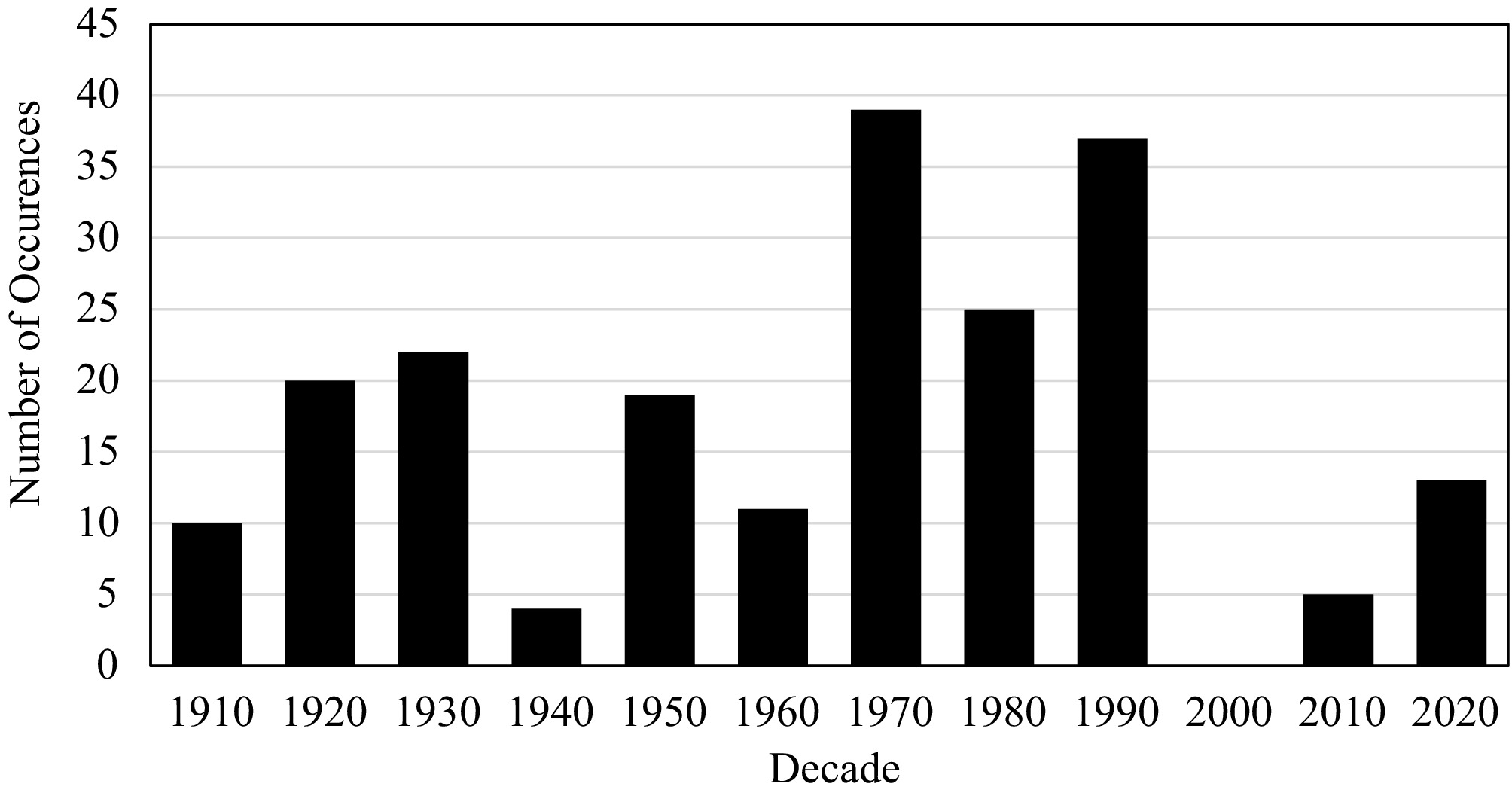
Figure 1.
Number of occurrences of Colletotrichum species reports in the Philippines.
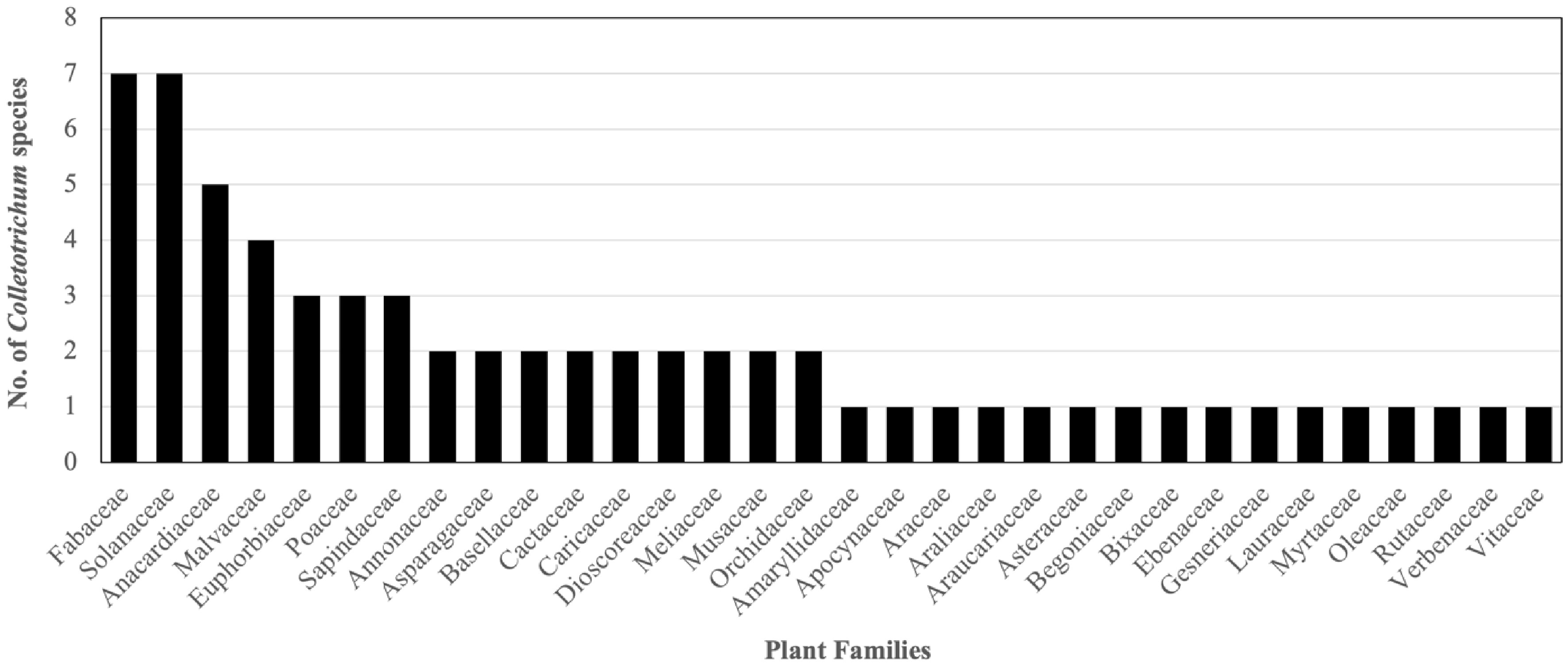
Figure 2.
Species richness of recorded Colletotrichum species across different plant families in the Philippines.
-
A checklist of Colletotrichum species associated with plant diseases in the Philippines has been provided. The Colletotrichum gloeosporioides species complex had the highest number of species reported. The earliest scientific records of Colletotrichum species associated with a plant disease in the country were in Reinking[43], reporting C. musae in banana, and C. lindemuthianum in Phaseolus lunatus. Pepper, mango, banana, and Phaseolus vulgaris had the most host reports (Table 1). The 'Host Index of Plant Diseases in the Philippines' by Tangonan[29] was particularly useful for extracting local reports. Still, validation of the current taxonomy of the reported species was necessary. The Mycobank and Index Fungurom have been useful for validating the current names of the fungi. In addition, the USDA Fungal Databases were also beneficial for researchers who want to compare country records of the Colletotrichum species and their hosts[73]. Nevertheless, the database did not cover other local reports, and the host index records were only available until 1999. Hence, the Google Scholar and SCOPUS databases were used to include new reports published since then. Colletotrichum species records from 1999 to the present, included in this checklist, can now be included in future updates of the host index.
The Philippines ranked third in the Southeast Asian region regarding the number of Colletotrichum species reported, trailing behind Thailand (151), and Malaysia (119) based on the records available in the USDA fungal databases. Interestingly, the Philippines, Malaysia, Thailand, and Indonesia have frequently reported Colletotrichum species associated with pepper, indicating pepper as a versatile host of anthracnose regardless of the associated Colletotrichum species. Colletotrichum scovillei and C. truncatum are found in all four countries. However, pepper anthracnose associated with Colletotrichum dematium[36], C. coccodes (reported as C. phomoides by Teodoro[57], and Ocfemia[63]), and C. musae[36] were only reported in the Philippines. Among these species, only C. musae has molecular data[44]. Hence, the other species should be restudied to confirm if they are indeed the species previously reported.
Among the important crops affected by Colletotrichum species were onion, pepper, papaya, mango, banana, sugarcane, tomato, sorghum, and corn. Information on the actual figures of the economic impact and losses is scarce. If it exists, it is limited to a few crops. Available reports indicate anthracnose plays a significant role in yield reduction, market demand for the harvests, and grower profit in the Philippines, as seen in other countries[74,75]. For instance, in pepper, anthracnose can wipe out an entire field. Dela Cueva & Balendres[32] reported a farm in Batangas where a grower abandoned the field because they failed to harvest healthy pepper fruits due to pepper anthracnose. When fruits were recovered from anthracnose-infected fields, some healthy fruits later developed anthracnose (due to latent infection) and were subsequently rejected or devalued during marketing. In such a case, the market could demand higher prices due to the limited product supply. From a consumer's perspective, this would be an additional household expense. For example, in December 2015, the price of siling 'labuyo' increased to Php 700 per kilo in some Metro Manila markets because of the low supply[76]. For those in the restaurant or food business, this may increase the meal price to compensate for the cost of food ingredients.
Pepper anthracnose is not only a problem in the Philippines but also in Indonesia[77], Korea[78,79], Taiwan, China[80], Thailand[81,82], and Vietnam[83,84]. This problem was exacerbated by more aggressive and virulent strains of Colletotrichum species that had previously not been reported in pepper. These strains can also infect fruits without a wound or damage. For instance, pepper fruits infected by C. scovillei were more severe than those infected by other previously known species[30,32]. Infected fruits in the field are mummified; during marketing, some fruits are non-edible because of their appearance. It is clear that when the plant organ affected by anthracnose is the fruit, which is economically important, it is likely that the fruit will be devalued because the fruit becomes less appealing to the consumer.
In controlling plant diseases, including anthracnose, growers often use pesticides (or fungicides) as an immediate response. However, some growers use these fungicides when plants are severely infected; some fungicides are however not designed to cure the disease but to protect the plant from pathogen infection, thereby reducing the disease's incidence and severity below the economic injury level. From a production perspective, using pesticides to control anthracnose is an added cost to the inputs and reduces the grower's net income. From an environmental perspective, the use of pesticides may have a long-term effect on the health of non-target organisms in the field and the soil. Therefore, the impact of anthracnose is not only limited to the direct effect on the quantity and the quality of the harvest, but also indirectly on the cost of input and the environment. Research on alternative disease control approaches is needed to reduce the reliance on pesticides in anthracnose management.
-
This paper updates the knowledge of Colletotrichum species associated with plant diseases in the Philippines. Records show 55 Colletotrichum species (36 belonging to ten species complexes, two singleton species, 17 morphospecies), and 12 unidentified Colletotrichum species hosted by 106 plant species with anthracnose as the primary disease. The Colletotrichum gloeosporioides species complex had the highest number of species reported.
The checklist will be useful as a reference for students, lecturers, researchers, plant quarantine officers, growers, and decision-makers. This checklist provides an understanding of the country's current diversity of Colletotrichum species, forms baseline information for future taxonomic studies in unexplored regions, and a reference for future discovery of new plant hosts. Furthermore, government funding agencies, e.g., the Department of Science and Technology (DOST), and the Department of Agriculture (DA), also allocate resources and funds for future anthracnose research; this list will be a useful guide to identify key crops significantly affected by anthracnose and to direct allocations to key research questions and areas, e.g., sustainable disease management strategies.
Anthracnose poses a significant threat to economically important plants in the Philippines. This checklist offers valuable insights into the Colletotrichum species linked to anthracnose associated with particulate crops. Facilitating targeted monitoring efforts aids growers and farm managers anticipate outbreaks and implement effective preventive measures. Furthermore, the checklist supports assessing the vulnerability and susceptibility of different crops or varieties to anthracnose, enabling prioritization of interventions based on risk levels. Identifying the causative species also allows for the development of strategic sanitation practices to reduce pathogen load in the field. Understanding the life cycle of these pathogens encourages practices like crop rotation, which can disrupt their cycles and minimize disease incidence. Additionally, since fungal species respond variably to fungicides and biological control agents, this checklist can inform decisions on the most effective treatments, whether fungicides, botanical extracts, or biological controls, tailored to specific Colletotrichum species or complexes.
This paper also supports the ongoing efforts of the Bureau of Plant Industry's Plant Quarantine Offices and other related agencies in monitoring plant pathogens and diseases of interest. There may be collections of Colletotrichum species in museums and other research institutions. Molecular studies on these collections are warranted to confirm species identity. In the last decade, molecular assays have been used to identify the Colletotrichum species associated with plant diseases. Sequencing the recommended barcoding gene regions would validate these isolates' current taxonomic placement, especially the reported morphospecies, and contribute to the global effort of epitypification of these Colletotrichum cultures. This will also correct previous reports and those erroneously identified Colletotrichum species. Nevertheless, from a plant pathology perspective, these isolates must be assessed for their pathogenicity on original and known hosts, and Koch's postulates should be established.
-
The author confirms sole responsibility for the following: study conception and design, data collection, analysis and interpretation of results, and manuscript preparation.
-
No new data was produced for this work. All data generated or analyzed during this study are included in this published article.
-
The author declares that there is no conflict of interest.
- Copyright: © 2025 by the author(s). Published by Maximum Academic Press, Fayetteville, GA. This article is an open access article distributed under Creative Commons Attribution License (CC BY 4.0), visit https://creativecommons.org/licenses/by/4.0/.
-
About this article
Cite this article
Balendres MA. 2025. Checklist of Colletotrichum species associated with plant diseases in the Philippines. Studies in Fungi 10: e021 doi: 10.48130/sif-0025-0021 

Checklist of Colletotrichum species associated with plant diseases in the Philippines
- Received: 24 September 2024
- Revised: 09 July 2025
- Accepted: 19 August 2025
- Published online: 10 October 2025
Abstract: Fungal plant diseases account for more than half of the plant disease records in the Philippines. The fungal species in the genus Colletotrichum are among the most well-studied fungi due to their multifaceted lifestyle, ubiquitous nature, and, more importantly, their role as pathogens of economically important plants. Colletotrichum species are responsible for the destructive plant disease known as anthracnose. Successful management of anthracnose starts with accurately identifying the causative agent. This paper examined data from databases and scholarly outputs to provide a checklist of Colletotrichum species associated with plant diseases in the Philippines. Records show 55 Colletotrichum species (36 belonging to ten species complexes, two singleton species, and 17 morphospecies), and 12 unidentified Colletotrichum species, hosted by 106 plant species, with anthracnose as the primary disease. The Colletotrichum gloeosporioides species complex had the highest number of species reported. The checklist will be useful as a reference for students, lecturers, researchers, plant quarantine officers, growers, and decision/policy-makers. This checklist provides an understanding of the country's current diversity of Colletotrichum species, forms baseline information for future taxonomic studies in unexplored regions, and a reference for future discovery of new plant hosts.
-
Key words:
- Anthracnose /
- Ascomycota /
- Checklist /
- Fungal pathogen /
- Glomerellaceae