













-
Perennial ryegrass (Lolium perenne L.) belongs to the genus Lolium within the Poaceae family. Due to its numerous tillers, fast turf establishment, tolerance to trampling, desirable plant architecture, abundant and tender leaves, and high nutritional value, it is widely employed as both a turfgrass and an ideal forage for livestock[1,2]. In China, the extensive distribution of arid and semi-arid regions severely compromises the yield and quality of perennial ryegrass due to drought stress. Therefore, identifying key genetic resources governing drought tolerance in perennial ryegrass and clarifying their regulatory mechanisms in response to drought stress will provide valuable genetic resources and a theoretical foundation for the breeding of elite drought-tolerant perennial ryegrass cultivars.
The NAC (NAM, ATAF1/2, CUC2) transcription factor family is a class of plant-specific transcription factors. It has been widely documented to play crucial roles in diverse biotic and abiotic stress responses in multiple plant species, including alfalfa (Medicago sativa L.), wheat (Triticum aestivum L.), rice (Oryza sativa L.), and maize (Zea mays L.)[3,4]. For example, a miniature inverted-repeat transposable element (MITE) insertion exists in the promoter region of the maize ZmNAC111 gene, which is strongly associated with natural variation in drought tolerance. This insertion represses the transcription of ZmNAC111, and subsequent studies have revealed that overexpression of ZmNAC111 enhances drought tolerance in maize seedlings[5]. A similar regulatory mechanism has been observed in wheat. A 108-bp DNA insertion in the promoter of the wheat TaNAC071-A gene modulates its transcriptional level and affects drought tolerance; overexpression of TaNAC071-A significantly improves drought resistance in wheat by regulating multiple drought-responsive genes[6]. In rice, overexpression of OsNAC78 enhances drought tolerance, whereas OsNAC78 mutant plants are susceptible to drought stress. Further research revealed that OsNAC78 improves drought tolerance by promoting the expression of its downstream target gene OsGSTU37, which encodes glutathione S-transferase[7]. In alfalfa, the MfNACsa transcription factor undergoes depalmitoylation under drought stress, allowing its translocation into the nucleus, where it directly regulates the transcription of GlyI, encoding lactoylglutathione lyase. GlyI enhances drought tolerance by modulating the GSH/GSSG redox balance[8]. Recent research has demonstrated that the NAC transcription factor LpCbDR1 enhances drought tolerance by regulating the expression of the drought-inducible genes LpPLA7 and LpERF1B in perennial ryegrass[9]. Our research has shown that the transcription factor LpNAC22 enhances drought tolerance in perennial ryegrass by regulating the stress-responsive genes LpLEA1 and LpLEA2-1[10]. Collectively, these studies highlight the indispensable roles of NAC proteins in regulating plant responses to drought conditions. Although our previous work revealed that LpNAC11 is induced by drought treatment in perennial ryegrass[10], whether it contributes to drought tolerance in this species remains unclear, warranting further investigation into its drought-resistant function.
In this study, we demonstrate that LpNAC11, which exhibits transcriptional activation activity and nuclear localization, positively regulates drought tolerance in perennial ryegrass. Overexpression of LpNAC11 enhances drought tolerance, and qPCR analysis revealed that LpNAC11 upregulates multiple drought stress-responsive genes. Collectively, our results indicate that LpNAC11 mediates the transcription of drought-related genes to improve drought resistance in perennial ryegrass.
-
The wild-type (WT) perennial ryegrass variety used in this study was 'Pinnacle III', obtained from Bailv (Tianjin) International Grass Industry Co., Ltd. Plants were grown in a growth chamber maintained at 25 °C with a relative humidity of 70%, under a 16-h light/8-h dark photoperiod.
Vector construction and plant transformation
-
The coding sequence of LpNAC11 was amplified and inserted into a plant expression vector containing the maize ubiquitin (Ubi) promoter using a SE Seamless Cloning and Assembly Kit (ZC231-1, ZOMANBIO). The resulting Ubi::LpNAC11 construct was transformed into Agrobacterium tumefaciens strain EHA105. Embryogenic calli of perennial ryegrass were co-cultivated with the Agrobacterium in the dark for 3 d. After co-cultivation, the calli were transferred to a selection medium containing 10 mg·L−1 phosphinothricin[11,12]. Following confirmation by qPCR, the resistant seedlings were transplanted into soil for cultivation. The primer pairs used for vector construction are listed in Supplementary Table S1.
Subcellular localization analysis
-
The 35S::LpNAC11-GFP vector was constructed using a SE Seamless Cloning and Assembly Kit, and the LpNAC11-GFP fusion protein was expressed in tobacco leaves via Agrobacterium-mediated transformation. After 3 d of cultivation, the leaves were stained with the nuclear-specific dye 4',6-diamidino-2-phenylindole (DAPI)[13], and GFP signal distribution was examined under a confocal laser microscope (Zeiss LSM880). The primer pairs used for vector construction are listed in Supplementary Table S1.
Transcriptional activity assay in yeast
-
Transcriptional activity analysis was carried out as described previously[14]. Full-length and truncated versions of LpNAC11 were fused to the GAL4 DNA-binding domain, and the resulting vectors were transformed into the yeast strain AH109. The transcriptional activation activity of LpNAC11 was evaluated based on the growth status of yeast on defective medium (SD/-Trp/-His/-Ade/X-α-Gal). The primer pairs used for vector construction are listed in Supplementary Table S1.
Drought treatment
-
The 6-month-old WT and LpNAC11-overexpressing perennial ryegrass plants were trimmed to the same height, then subjected to drought treatment by withholding water for 30 d, followed by rewatering for 5 d. Subsequently, the survival rates of each genotype were recorded.
Physiological indicators analysis
-
Physiological indicators, including relative water content (RWC), malondialdehyde (MDA) content, electrical conductivity, and proline content, were measured according to established protocols. Leaf relative water content (RWC) was calculated using the formula: RWC (%) = [(WFw − WDW)/(WTW − WDW)] × 100. Fresh weight (WFw) was weighed immediately after collecting the leaves, turgid weight (WTW) was obtained after soaking leaves in distilled water for 24 h, and dry weight (WDW) was measured after oven-drying at 65 °C to constant weight[15]. Malondialdehyde (MDA) content was determined using the thiobarbituric acid (TBA) method[16]. For electrical conductivity, plant leaves were washed with deionized water and then immersed in 10 mL of deionized water at 25 °C for 12 h. The initial conductivity (C0) was measured using a conductivity meter. After boiling the samples for 30 min and cooling to room temperature, the final conductivity (C1) was measured. Electrical conductivity was calculated using the formula: Electrical conductivity (%) = (C0/C1) × 100[17]. The proline content was determined using the ninhydrin colorimetric method. Leaf samples were homogenized in 3% sulfosalicylic acid, and the supernatant was reacted with ninhydrin reagent at 100 °C for 30 min. After extraction with toluene, the absorbance of the organic phase was measured at 520 nm, and the proline content was calculated from a standard curve[18].
Histochemical staining
-
DAB staining was performed according to the previously described method[19]. Leaf samples were collected and immersed in a DAB staining solution containing 1 mg·mL−1 DAB (pH 3.8). The samples were vacuum infiltrated for 10 min and then incubated in the dark at room temperature for 4 h. After staining, the staining solution was replaced with 95% ethanol, and the samples were heated in a boiling water bath until the chlorophyll was completely removed. NBT staining was performed according to an established protocol. Leaf samples were collected and incubated in an NBT staining solution containing 0.5 mg·mL−1 NBT (pH 7.4). The samples were vacuum infiltrated for 10 min and then incubated in the dark at room temperature for 4 h. After staining, the stained leaves were transferred to 95% ethanol and heated in a boiling water bath until the tissue was completely decolorized[20].
Quantitative real-time PCR (qPCR) analysis
-
Total RNA was extracted from leaf tissue using a Universal Total RNA Kit (ZP443-1, ZOMANBIO). First-strand cDNA was synthesized using a Reverse Transcriptase Kit (ZR102-2, ZOMANBIO). qPCR was performed using a Universal SYBR qPCR Mix on a LightCycler 480 Real-Time PCR System. The gene-specific primers used are listed in Supplementary Table S1. The LpActin1 gene was used as an internal control, and relative expression levels were calculated using the 2−ΔΔCᴛ method[21].
Data analysis
-
The statistical significance was assessed using Student's t-test with Microsoft Excel 2021 software, and the significance level was set at p < 0.05. All charts were generated using Prism 8.0 (GraphPad Software, USA), and data are presented as mean ± standard deviation.
-
Transcription factors are primarily localized in the cell nucleus, where they regulate the transcription of target genes. To investigate LpNAC11 subcellular localization, a 35S::LpNAC11-GFP vector was introduced into tobacco leaf cells, and the cells were examined using confocal laser microscopy. In cells transfected with the recombinant 35S::LpNAC11-GFP vector, GFP fluorescence signals were detected exclusively in the nucleus and colocalized with the nuclear-specific dye DAPI. In contrast, cells transfected with the empty 35S::GFP vector exhibited GFP fluorescence throughout the entire cell (Fig. 1a). These results indicate that LpNAC11 is localized to the nucleus.
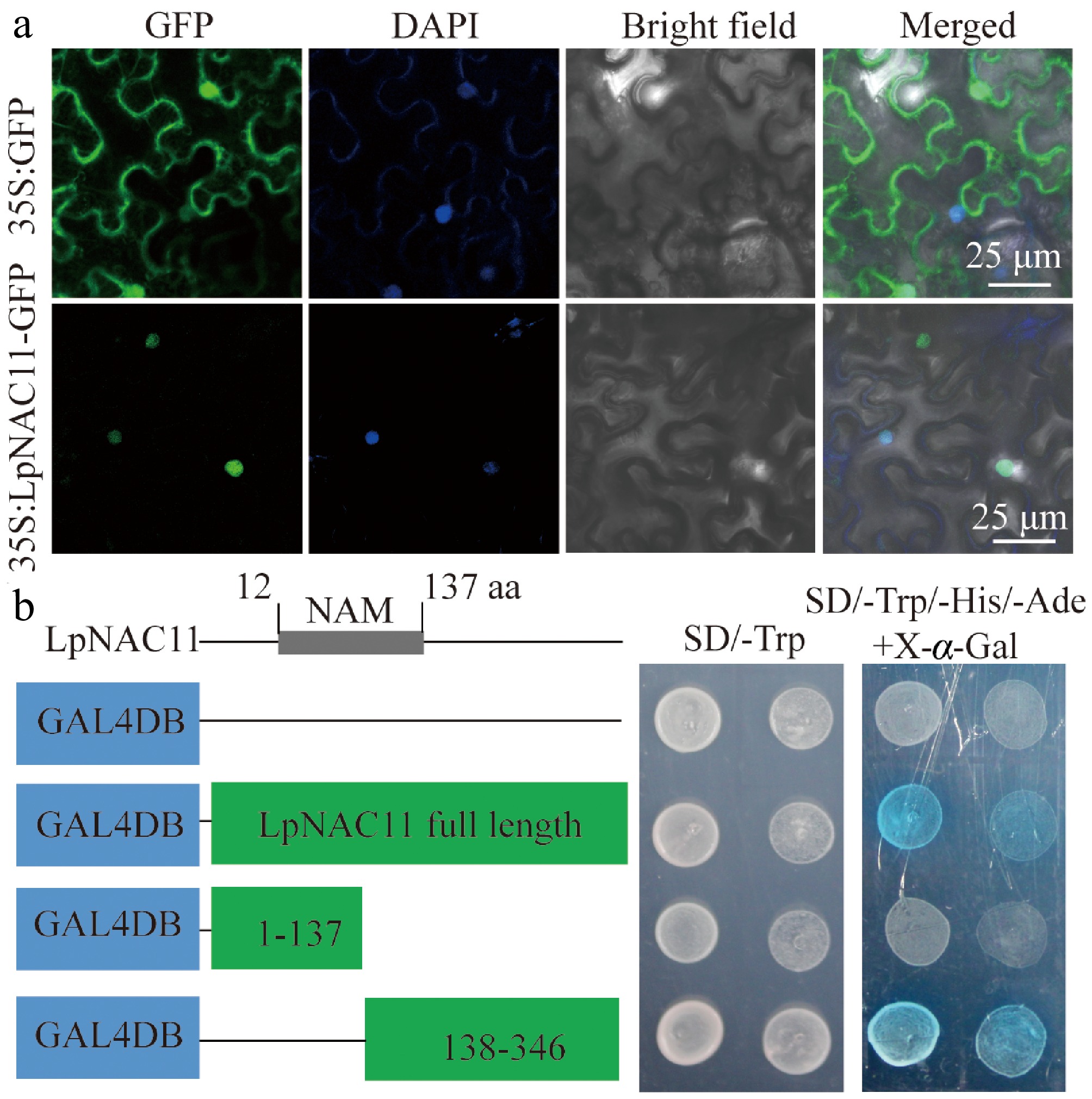
Figure 1.
Subcellular localization and transcriptional activity assay of LpNAC11. (a) Subcellular localization of LpNAC11 in tobacco epidermal cells. DAPI was used as a nucleus-specific marker. (b) Yeast transactivation assay shows the transcription activation domain of LpNAC11. NAM is a conserved domain of NAC family transcription factors.
Transcription factors can be classified as either activators or repressors. Sequence analysis of the LpNAC11 protein revealed a conserved N-terminal region containing the NAM motif of NAC transcription factors. To investigate its transcriptional activity, the full-length LpNAC11 and a series of truncated versions were cloned into yeast expression vectors and assayed in yeast cells. The results showed that yeast cells expressing full-length LpNAC11, as well as those expressing the C-terminal region (138–346 aa), were able to grow on defective medium (SD/-Trp/-His/-Ade/X-α-Gal) and turned the X-α-Gal-containing plates blue (Fig. 1b). These findings indicate that LpNAC11 has transcriptional activation activity and that its transcriptional activation domain is located at the C-terminus of the protein.
Overexpression of LpNAC11 improves the survival of perennial ryegrass under drought treatment
-
To investigate the role of LpNAC11 in drought tolerance, we overexpressed LpNAC11 in perennial ryegrass and generated two overexpression lines (Fig. 2a, b). Before drought treatment, there was no significant difference in growth status between WT and LpNAC11-overexpressing plants. After drought treatment, the overexpressing plants exhibited noticeably better growth and retained more green leaves than WT plants (Fig. 2a). Following rewatering, survival rate analysis further showed that LpNAC11-overexpressing plants had significantly higher survival rates compared with WT plants (Fig. 2c). These results indicate that overexpression of LpNAC11 improves the survival of perennial ryegrass under drought conditions.
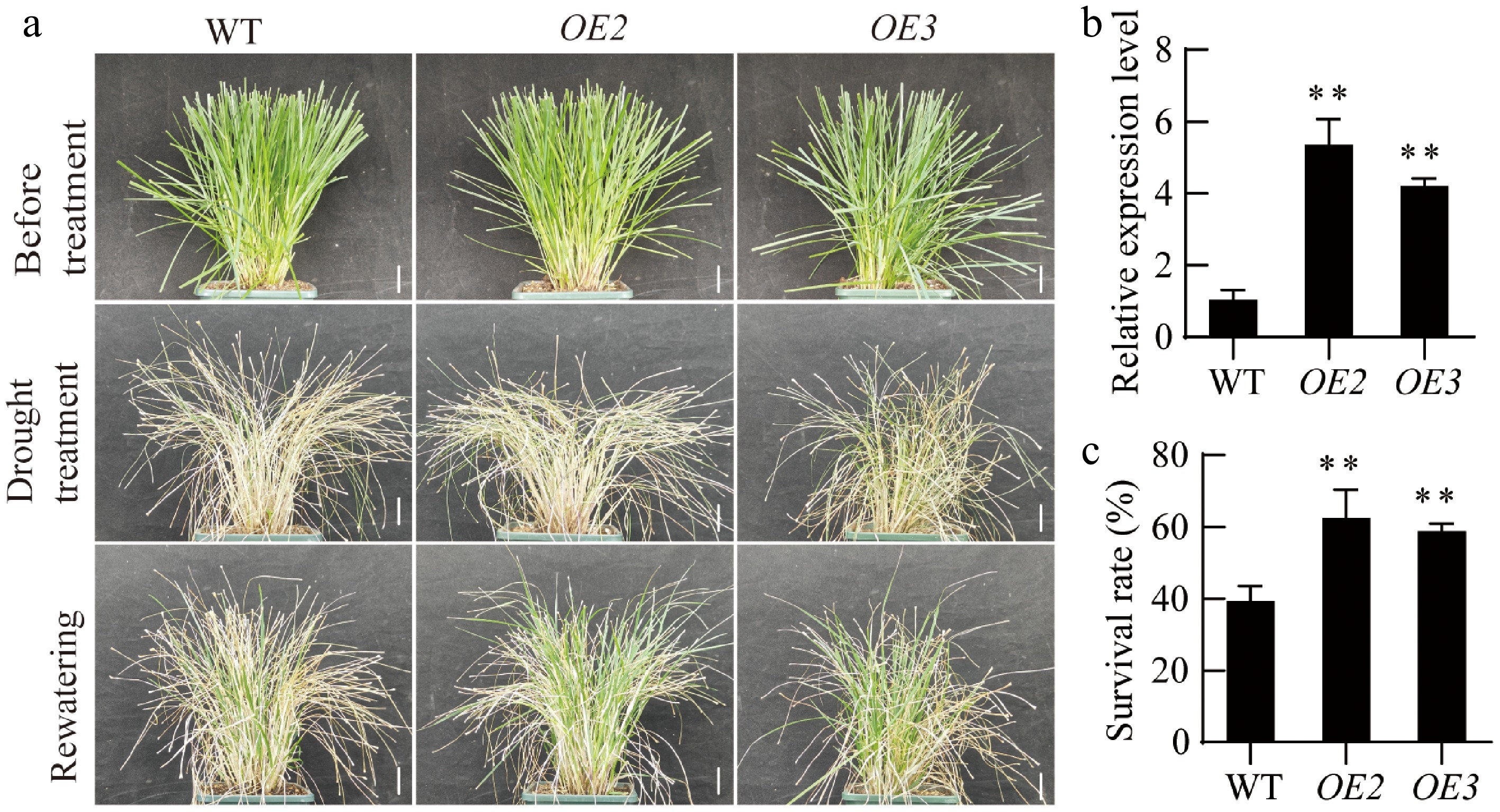
Figure 2.
Overexpression of LpNAC11 improves survival rates in transgenic perennial ryegrass under drought conditions. (a) Growth phenotypes of wild-type (WT) and LpNAC11-overexpressing plants (OE2 and OE3). Bars = 2 cm. (b) qPCR analysis of LpNAC11 expression in the overexpression lines. LpActin1 was used as an internal reference gene. (c) Survival rates of WT and LpNAC11-overexpressing plants after rewatering. Data presented in (b), (c) are shown as the mean ± SD from three biological replicates. Statistical significance was determined by Student's t-test (** p < 0.01).
Overexpression of LpNAC11 enhances drought tolerance in perennial ryegrass
-
To further elucidate the role of LpNAC11 in drought tolerance, we measured relative leaf water content, electrical conductivity, and malondialdehyde (MDA) content in WT and LpNAC11-overexpressing plants. Under normal conditions, there was no significant difference in these parameters between the two genotypes. Under drought stress, however, the LpNAC11-overexpressing plants exhibited significantly higher relative leaf water content, as well as significantly lower electrical conductivity and MDA content, than WT plants (Fig. 3a–c). These results indicate that LpNAC11-overexpressing plants sustained less damage under drought stress than WT plants. Proline, a key osmotic regulator in plants, plays an important role in response to abiotic stresses such as drought[22]. We therefore measured proline content under both normal and drought conditions. The results showed that under normal conditions, proline levels did not differ significantly between WT and LpNAC11-overexpressing plants; however, under drought stress, proline content was higher in the overexpression lines than in WT plants (Fig. 3d). As drought stress can induce oxidative stress, we also analyzed reactive oxygen species (ROS) accumulation using NBT and DAB staining in perennial ryegrass leaves. Under drought stress, LpNAC11-overexpressing plants showed lighter staining compared with WT plants (Fig. 3e, f), suggesting that they experienced lower oxidative stress. Taken together, these findings suggest that overexpression of LpNAC11 enhances drought tolerance in perennial ryegrass.
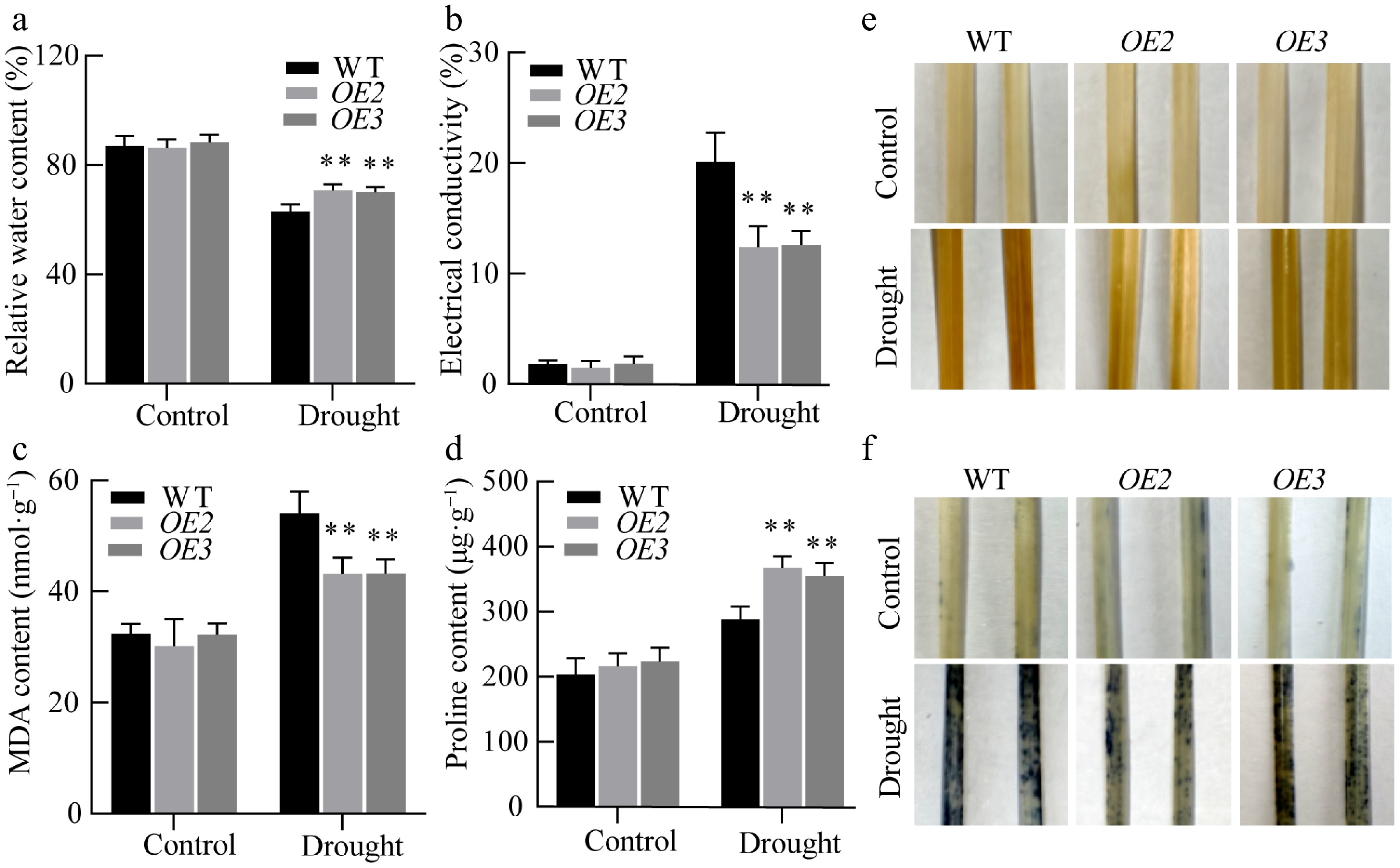
Figure 3.
Overexpression of LpNAC11 improves drought tolerance in transgenic perennial ryegrass; (a) relative water content, (b) electrical conductivity, (c) malondialdehyde (MDA) content, and (d) proline content of WT and LpNAC11-overexpressing plants under normal and drought conditions. (e) DAB and (f) NBT staining of leaves for ROS from WT and LpNAC11-overexpressing plants under normal and drought conditions. Data presented in (a)–(d) are shown as the mean ± SD from three biological replicates. Statistical significance was determined by Student's t-test (** p < 0.01).
LpNAC11 regulates the expression of drought-stress-response genes
-
To investigate the molecular mechanism by which LpNAC11 enhances drought tolerance in perennial ryegrass, we examined the expression levels of several key drought-stress-responsive genes, including Δ1-pyrroline-5-carboxylate synthase 1 (LpP5CS1), dehydration-responsive protein 29B (LpRD29B), 9-cis-epoxycarotenoid dioxygenase 3 (LpNCED3), and late embryogenesis abundant protein 14 (LpLEA14). The results showed that the expression levels of these genes were significantly higher in LpNAC11-overexpressing plants than in WT plants (Fig. 4a–d). NAC transcription factors typically regulate gene transcription by directly binding to NAC-binding sites (NACBS, CGT[G/A])[10]. Promoter sequence analysis of these genes revealed multiple putative NAC-binding sites (Table 1), and these results suggest that LpNAC11 may directly regulate the transcription of these drought-stress-responsive genes.
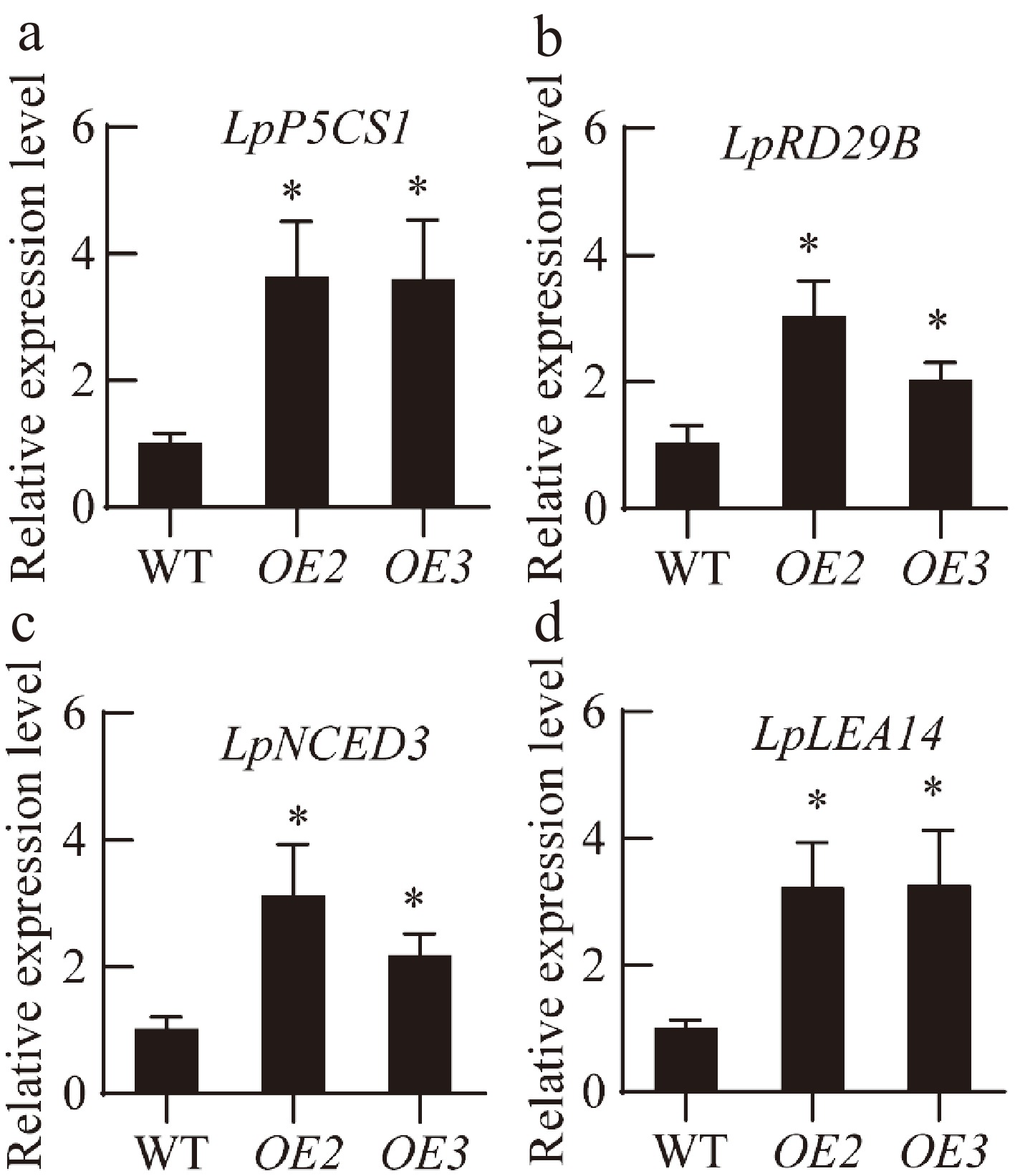
Figure 4.
LpNAC11 regulates the expression of drought resistance genes. qPCR analysis of (a) LpP5CS1, (b) LpRD29B, (c) LpNCED3, and (d) LpLEA14 expression in WT and LpNAC11-overexpressing plants. LpActin1 was used as an internal reference gene. Data presented in (a)–(d) are shown as the mean ± SD from three biological replicates. Statistical significance was determined by Student's t-test (* p < 0.05).
Table 1. NAC binding sites located on the promoters (from −1,000 to −1 bp) of LpP5CS1, LpRD29B, LpNCED3, LpLEA14.
Gene NAC-binding sites (−1,000 to −1 bp) LpP5CS1 −41 to −38 bp, −193 to −190 bp, −228 to −225 bp, −304 to −301 bp, −316 to −313 bp, −331 to −328 bp, −342 to −339 bp, −344 to −341 bp,
−383 to −380 bp, −387 to −384 bp, −495 to −492 bp, −697 to −694 bp, −830 to −827 bpLpRD29B −187 to −184 bp, −189 to −186 bp, −221 to −218 bp, −237 to −234 bp, −242 to −239 bp, −360 to −357 bp, −451 to −448 bp, −514 to −511 bp,
−598 to −595 bp, −811 to −808 bp, −888 to −885 bpLpNCED3 −25 to −22 bp, −39 to −36 bp, −233 to −230 bp, −261 to −258 bp, −317 to −314 bp, −340 bp to −337 bp, −342 to −339 bp, −387 to −384 bp,
−451 to −448 bp, −569 to −566 bp, −593 to −590 bp, −693 to −690 bp, −704 to −701 bp, −917 to −914 bp, −988 to −985 bp, −1,000 to −997 bpLpLEA14 −164 to −161 bp, −182 to −179 bp, −183 to −180 bp, −197 to −194 bp, −216 to −213 bp, −235 to −222 bp, −254 to −251 bp, −272 to −269 bp,
−598 to −595 bp, −680 to −677 bp, −685 to −682 bp, −764 to −761 bp, −805 to −802 bp, −827 to −824 bp, −829 to −826 bp, −983 to −980 bp,
−985 to −982 bp, −999 to −996 bp -
Perennial ryegrass is an important grass species widely used for turf and forage, yet its productivity and quality are highly susceptible to drought stress. NAC transcription factors represent a major class of plant-specific factors that are extensively involved in responses to abiotic stresses, including drought[23]. Previous studies have shown that drought stress induces LpNAC11 expression in perennial ryegrass[10]. In this study, subcellular localization analysis revealed that the LpNAC11 protein is localized to the nucleus (Fig. 1a), consistent with the typical function of transcription factors in regulating gene expression within the nucleus. NAC transcription factors are characterized by a divergent C-terminal regulatory domain that determines their role as either transcriptional activators or repressors[24,25]. Our analysis of transcriptional activity demonstrated that LpNAC11 possesses transcriptional activation activity, with the activation domain located at the C-terminus of the protein. These findings suggest that LpNAC11 functions as a transcriptional activator in the nucleus.
To further investigate the role of LpNAC11 in drought tolerance, we generated LpNAC11-overexpressing plants in perennial ryegrass. Following drought stress, phenotypic evaluation showed that LpNAC11-overexpressing plants exhibited higher survival rates and greater relative leaf water content compared with WT plants (Figs 2c, 3a). Abiotic stresses such as drought often induce oxidative stress, leading to membrane peroxidation[26,27]. We measured electrical conductivity, malondialdehyde (MDA) content, and reactive oxygen species (ROS) accumulation. The results showed that under drought stress, LpNAC11-overexpressing plants exhibited lower levels of electrical conductivity, MDA content, and ROS accumulation than wild-type plants (Fig. 3b, c, e, f), indicating that they suffered less drought-induced damage. Proline is a key osmotic regulator and an important physiological biomarker for evaluating plant stress tolerance[28]. Under drought conditions, LpNAC11-overexpressing plants accumulated higher proline levels than WT plants. Collectively, these results indicate that overexpression of LpNAC11 enhances drought tolerance in perennial ryegrass.
Mechanistic studies in various plant species have revealed that NAC transcription factors primarily improve drought tolerance by regulating the transcription of downstream stress-responsive genes. For instance, the NAC transcription factor SlJUB1 enhances drought tolerance in tomato (Solanum lycopersicum L.) by activating the expression of the drought-responsive genes SlDREB1 and SlDREB2[29]. In rice, OsNAC29a improves drought tolerance by upregulating stress-related genes including OsP5CS1, OsSRO1c, OsPOD1, OsLEA3, and OsRab16C[30]. In Fagopyrum tataricum, FtNAC3 is a drought-inducible NAC transcription factor, and FtNAC3 overexpression enhances drought tolerance by increasing the expression of multiple drought-responsive genes such as RD29A, RD29B, RD22, DREB2B, and NCED3[31]. In the present study, the expression levels of several key drought-responsive genes (LpP5CS1, LpNCED3, LpLEA14, and LpRD29B) were significantly upregulated in LpNAC11-overexpressing plants compared with WT plants (Fig. 4, Table 1). A cross-species comparison revealed that certain drought-responsive genes were commonly targeted by NAC transcription factors. For instance, P5CS, which encodes a key enzyme in proline biosynthesis, is upregulated by OsNAC29a in rice and LpNAC11 in perennial ryegrass, respectively. Similarly, LEA (Late embryogenesis abundant) family genes (e.g., OsLEA3, LpLEA14) and RD29B were induced by NAC transcription factors across species, including tomato, rice, buckwheat, and perennial ryegrass. These findings suggest that NAC transcription factors regulate a conserved core set of downstream genes involved in osmotic adjustment (P5CS), membrane protection (LEA), and stress signaling (RD29B), indicating an evolutionarily conserved drought response pathway mediated by NAC proteins. Interestingly, our previous studies showed that LpNAC22 enhances drought tolerance in perennial ryegrass by regulating the transcription of LEA family genes, such as LpLEA1 and LpLEA2-1[10]. In contrast, the present study reveals that LpNAC11 not only regulates LEA family gene transcription but also modulates drought-responsive genes from other pathways. Together, these findings demonstrate both conservation and divergence in the mechanisms by which LpNAC11 and LpNAC22 regulate drought resistance in perennial ryegrass.
-
In perennial ryegrass, the LpNAC11 protein is localized to the nucleus and possesses transcriptional activation activity. LpNAC11 enhances drought tolerance by regulating the expression of drought stress-responsive genes. Collectively, these findings suggest that LpNAC11 represents a valuable candidate for the genetic improvement of drought tolerance in perennial ryegrass. In future studies, we will employ techniques such as DAP-seq and RNA-seq to identify key drought-responsive genes directly regulated by LpNAC11, thereby elucidating the drought-resistance regulatory pathways mediated by NAC family transcription factors.
-
The authors confirm contributions to the paper as follows: study conception and design: Qiang Z, Qin T; data collection: Qiang Z; analysis and interpretation of results: Qiang Z, Xie W, Yao M, Ding Y, Lan J, Zeng Z; draft manuscript preparation: Qiang Z, Xie W. All authors reviewed the results and approved the final version of the manuscript.
-
All data generated or analyzed during this study are included in this published article.
-
The authors declare that they have no conflict of interest.
-
accompanies this paper online at: https://doi.org/10.48130/grares-0026-0018.
- Supplementary Table S1 Primers used in this study.
- Copyright: © 2026 by the author(s). Published by Maximum Academic Press, Fayetteville, GA. This article is an open access article distributed under Creative Commons Attribution License (CC BY 4.0), visit https://creativecommons.org/licenses/by/4.0/.
-
About this article
Cite this article
Xie W, Yao M, Ding Y, Lan J, Zeng Z, et al. 2026. Overexpression of LpNAC11 improves drought tolerance in perennial ryegrass. Grass Research 6: e025 doi: 10.48130/grares-0026-0018 

Overexpression of LpNAC11 improves drought tolerance in perennial ryegrass
- Received: 09 May 2026
- Revised: 02 June 2026
- Accepted: 12 June 2026
- Published online: 24 August 2026
Abstract: Drought is one of the key factors limiting the yield and quality of Lolium perenne L. NAC transcription factors are a plant-specific family that is widely involved in plant responses to abiotic stresses such as drought. In this study, we analyzed the subcellular localization, transcriptional activity, and phenotype of LpNAC11-overexpressing plants to elucidate its role in the drought stress response of perennial ryegrass. The results showed that the LpNAC11 protein localizes to the nucleus and has transcriptional activation activity. Under drought conditions, LpNAC11-overexpressing plants exhibited better growth and higher survival rates than WT plants. In these overexpressing plants, leaf relative water content and proline content were significantly increased, whereas electrical conductivity and malondialdehyde (MDA) content were significantly decreased. Furthermore, histochemical staining revealed that LpNAC11-overexpressing plants accumulated fewer reactive oxygen species under drought treatment. Quantitative real-time PCR (qPCR) analysis revealed that the expression levels of multiple drought stress-responsive genes were significantly upregulated in the LpNAC11-overexpressing plants. This study reveals the function of LpNAC11 in regulating the drought stress response in perennial ryegrass, providing a theoretical foundation for breeding drought-tolerant cultivars in this species.
-
Key words:
- Drought stress /
- NAC transcription factor /
- Perennial ryegrass