











-
The rapid evolution of intelligent driving technology has fundamentally transformed the global automotive industry, shifting the paradigm from mere vehicle mechanics to complex, cyber-physical systems. By integrating advanced sensors, sophisticated controllers, high-performance computing platforms, and cutting-edge algorithms, intelligent vehicles (IVs) are now capable of autonomous perception, decision-making, and control. While this technological revolution promises to enhance road transportation, it simultaneously introduces significant operational risks that challenge not only vehicle safety but also the overall security and efficiency of the transportation system. Consequently, safety risk assessment has become an indispensable component in the development of intelligent driving technologies. As these vehicles operate in increasingly complex and dynamic environments, the accurate perception and evaluation of potential risks are prerequisites for making safe driving decisions. Therefore, research on risk perception and quantitative assessment for IVs is not merely a technical necessity, but a systematic endeavor critical to supporting the establishment of robust Intelligent Transportation Systems (ITS).
Beyond the intrinsic safety of the vehicle itself, the deployment of IVs intersects with broader transportation planning, management, and policy objectives. Effective risk assessment mechanisms are vital for optimizing traffic flow, reducing congestion, and ensuring equitable mobility for all road users. From a 'human-vehicle-road' synergistic perspective, risk perception technology—which employs radar, LiDAR, cameras, and other devices—provides the comprehensive environmental awareness required for real-time decision-making[1−3]. Concurrently, quantitative risk analysis methods that leverage statistical analysis, machine learning, and deep learning are essential tools for evaluating safety performance across diverse scenarios. These methods reveal hidden risk patterns and enable multi-dimensional risk quantification, which are crucial for researchers and policymakers to understand the systemic impacts of autonomous driving on the transport network[4,5].
However, despite these technological advancements, the widespread deployment of IVs faces substantial challenges that extend into the realms of governance and ethics. Current research must address not only sensor limitations and environmental interference but also the complexities of data governance, such as breaking down data silos between traffic management agencies and automotive manufacturers. Furthermore, the integration of IVs into society raises critical questions regarding ethical trade-offs in risk quantification—particularly the fairness constraints between pedestrian protection and passenger protection—and the alignment of legal frameworks with international standards. This study adopts a systematic perspective to review the current state of risk perception and quantification. By exploring the mechanisms of these technologies and their implications for transportation policy and planning, this research provides a scientific foundation for enhancing vehicle safety and, more broadly, for optimizing intelligent transportation systems to deliver safer, more efficient, and more sustainable mobility solutions.
Therefore, research on risk perception and quantitative assessment for IVs represents a systematic and forward-looking endeavor. By exploring the mechanisms and applications of risk perception technologies and integrating them with quantitative analysis methods, this research provides a scientific foundation for enhancing vehicle safety and optimizing intelligent transportation systems. Consequently, intelligent driving technologies are poised to deliver safer, more efficient, and comfortable mobility solutions for society in the near future. Figure 1 shows the flowchart of the framework.
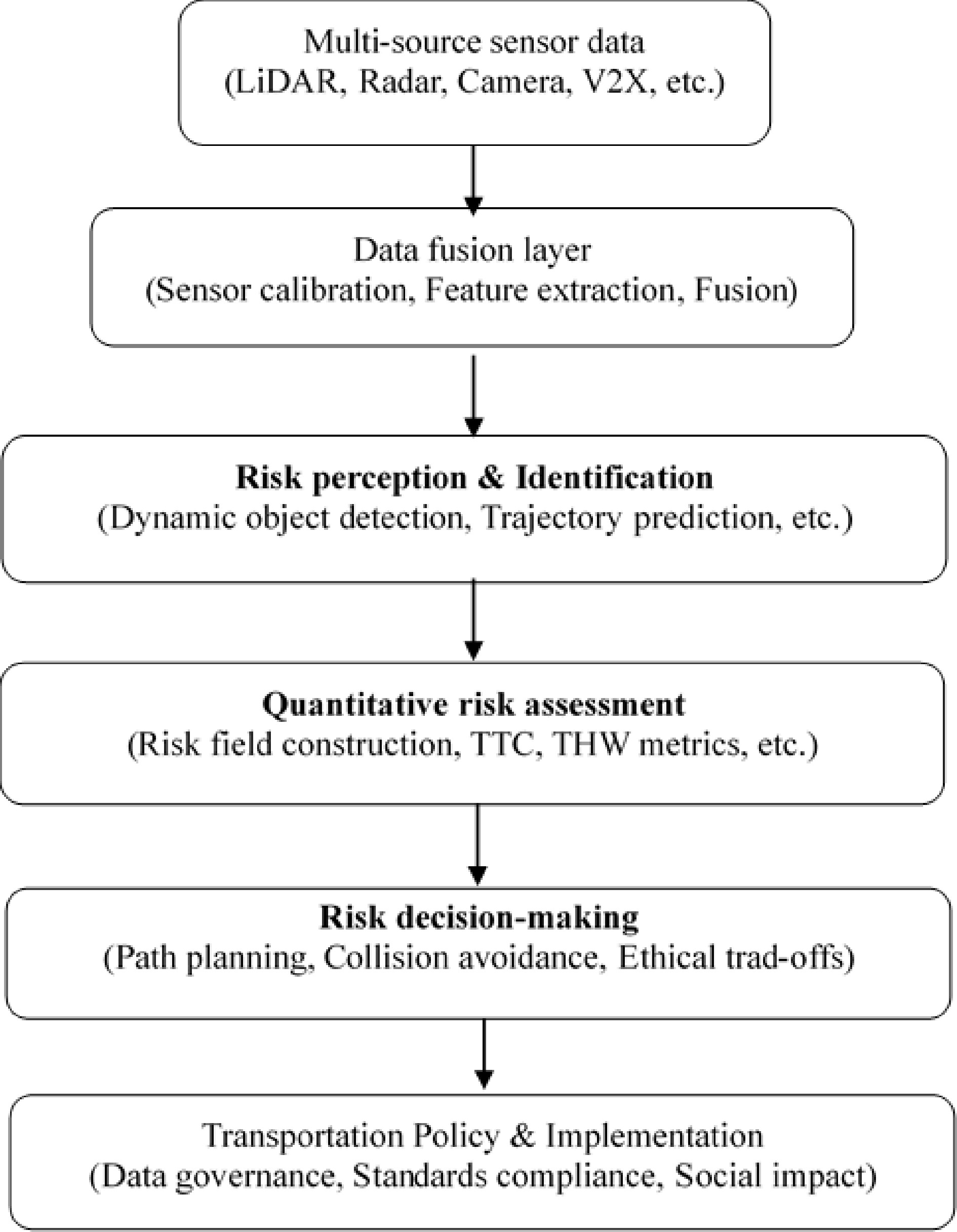
Figure 1.
Research framework of this study.
The main contributions of this paper are summarized as follows:
(1) It proposes a holistic review framework that bridges the gap between vehicle-level risk perception technologies and broader transportation system management, moving beyond isolated technical methodologies.
(2) It establishes a comprehensive chain of 'theoretical modeling—data-driven optimization—standard validation' by systematically reviewing four dimensions: risk architecture, risk identification and prediction, quantitative risk evaluation, and risk decision-making.
(3) It uniquely examines the interplay between risk assessment technologies and transportation policy, specifically addressing societal challenges such as ethical trade-offs in risk quantification and the governance of data silos, offering strategic insights for the future mobility landscape.
-
The study of risk perception and quantitative assessment for IVs is a critical foundation for the safe deployment of autonomous driving technologies, involving interdisciplinary approaches and dynamic modeling of complex systems.
Methodology for literature search and selection
-
To ensure a rigorous and reproducible systematic review, we conducted a comprehensive literature search following the PRISMA (Preferred Reporting Items for Systematic Reviews and Meta-Analyses) guidelines. The Web of Science (WoS) Core Collection was selected as the primary database due to its high-quality coverage of engineering and transportation journals.
Search strategy: The search query was constructed using Boolean operators to combine keywords related to 'Intelligent Vehicles' (e.g., 'autonomous driving,' 'connected vehicles') AND 'Risk' (e.g., 'risk perception,' 'risk assessment,' 'safety evaluation'). The time range was set from January 2010 to December 2024 to capture the rapid development of IV technologies over the last decade.
Screening process: An initial total of 500 records were identified. After removing duplicates and non-English publications, titles and abstracts were screened against the following inclusion criteria: (1) focus on risk perception or quantitative assessment methodologies; (2) application to intelligent or autonomous vehicles; and (3) peer-reviewed journal articles or high-quality conference papers. Non-relevant studies focusing solely on mechanical failures or general traffic flow without IV integration were excluded. Finally, 300 articles were retained for full-text analysis, forming the basis for the bibliometric analysis and qualitative synthesis presented in Fig. 2. Shown in Fig. 2a, the keyword cloud forms a three-tier logical chain centered on 'model', aligning with the progressive framework of risk identification and assessment in IVs: Inner Layer ('risk', 'safety', 'attack') constitutes the foundational risk modeling framework; Middle Layer ('prediction', 'behavior', 'simulation') corresponds to dynamic risk identification for predicting driving risks; Outer Layer ('risk-assessment', 'optimization', 'decision-making') represents risk quantification, evaluation, and decision-making processes. Similarly, Fig. 2b illustrates the bibliographic coupling of IV-related sources, reflecting analogous structural relationships. Consequently, this literature review focuses on four key dimensions: risk architecture, risk identification and prediction, quantitative risk evaluation, and risk decision-making.
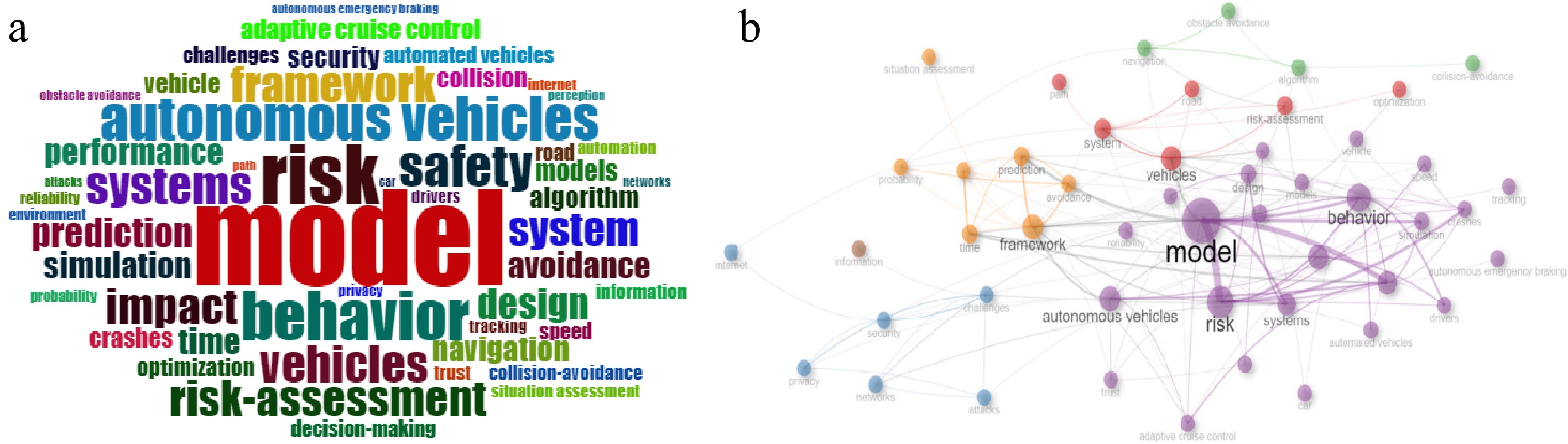
Figure 2.
Relationship between IVs and related studies.
To clarify the positioning and novelty of this work, we compare it with recent reviews in the field. While existing studies have provided valuable insights into specific technical domains—such as risk assessment algorithms or driving behavior modeling—they often treat the vehicle as an isolated system. For instance, Xiong et al.[4] reviewed risk assessment specifically for multi-vehicle interaction scenarios, and Cheng et al.[6] focused on the progress of driving safety risk identification and warning technologies. However, few studies have systematically bridged technical risk assessment with transportation policy and ethical governance. Table 1 compares the focus areas of this review with representative recent studies.
Table 1. Comparison between this review and existing literature.
Study Focus area Scope Limitation addressed by this study Xiong et al.[4] Driving risk assessment in multi-vehicle interaction Specific scenarios (interactions) Limited to specific interaction scenarios; does not cover broader risk architecture or decision-making ethics. Pei & Hou[5] Safety assessment of urban arterial traffic
flowTraffic flow level Focuses on traffic flow management rather than vehicle-level risk perception mechanisms. Cheng et al.[6] Driving safety risk progress (identification, prediction, warning) Technical methodologies Lacks integration with transportation policy and ethical governance. This review Risk perception, quantitative assessment, policy, and decision-making Systematic: 'human-vehicle-road' + policy integration Proposes a holistic framework integrating technical standards with practical transport applications and ethical considerations. Theoretical architecture and model construction for risk perception and quantification
-
Current research emphasizes a unified risk assessment framework from the synergistic perspective of 'human-vehicle-road'. For example, Sun et al.[7] analyzed vehicle active safety control for collision avoidance for intelligent vehicles based on driving risk perception, predicting surrounding vehicle trajectories, and establishing vehicle dynamics to identify the safety domain of active collision avoidance. From the human-machine hybrid intelligence perspective, Yuan & Li[8] constructed a multi-vehicle coordination-enhanced intelligent driving framework, introducing the fish swarm effect to build an IV system with self-adaptability and scalability. Song et al.[9] proposed a human-machine shared lateral control strategy based on the reliability of driver risk perception. By identifying driver risk perception via eye movements, human-machine shared lateral control was realized through model predictive control, demonstrating the synergy and complementarity of human-machine intelligence. Lisowski[10] estimated multi-object collision risk neural domains using radar perception during autonomous driving, synthesizing a radar perception algorithm by mapping the neural domains of autonomous objects featuring the collision risk. Cheng et al.[6] summarized the progress in driving safety risk; from risk perception and identification to prediction, quantification, and early warning, highlighting that future work should prioritize object detection accuracy, vehicle information security, and trajectory prediction precision.
Multi-source data fusion, risk identification, and prediction
-
Current research relies on multi-modal data collection and processing, including vehicle operational data (speed, acceleration, sensor status), environmental perception data (high-definition maps, traffic participant states, weather conditions), and driver behavioral data (physiological metrics, operational habits). For example, spatiotemporal clustering analysis of naturalistic driving data (NDS) identifies high-risk scenarios (e.g., intersection conflicts, lane-changing gaming), while machine learning models (LSTM, Transformer) predict short-term risk evolution trends.
Recent studies focus predominantly on sensor status. For example, Chen et al.[11] presented a safety benefit evaluation method of intelligent driving systems based on multi-source data mining, utilizing neural networks to learn the behavior of the objects, and employing a Monte Carlo simulation with a trained network controller to compute injury risk. Li et al.[12] proposed map-based localization for IVs using bi-sensor data fusion. Image and light detection, and ranging (LiDAR) data were included, and extracted to match them with the multi-scale map, which generated a LiDAR-image feature. A similar study by Zhu et al.[13] developed a variational Bayesian-based localization for IVs by fusing GPS and LiDAR. Zhang et al.[14] investigated the operational risk field of IVs based on dual multiline LiDAR, fusing multiview characteristics of point cloud timing and multitarget interaction information to establish a risk assessment model using artificial potential field theory. Based on multi-source data fusion, Zou et al.[15] integrated sensing devices and realized real-time target detection and tracking. Millimeter-wave radar data were dealt with, providing distance and velocity of the targets, and radar point cloud was used to project onto the image plane. The results indicated that the proposed system can provide an accurate recognition effect and scene adaptation ability. Recent advances in computer vision have significantly improved traffic surveillance consistency across varying lighting conditions, addressing day-night detection gaps[16]. A holistic survey of vision technologies confirms that integrating multi-camera networks is essential for comprehensive situational awareness in IVs[17].
In typical scenarios like car-following and lane-changing, research quantifies risks through spatiotemporal risk distribution modeling. Metrics, including Time-to-Collision (TTC) and Time Headway (THW), are integrated with potential field theory to produce dynamic risk heatmaps, offering real-time obstacle guidance for obstacle avoidance and path planning. Ahmad et al.[18] investigated accident causes in the UK and developed accident risk prediction and avoidance in intelligent semi-autonomous vehicles. A random forest algorithm exhibited the highest performance (95% accuracy), and was deployed on an Internet of Things server based on Arduino to predict driving risk levels. Han et al.[19] proposed a spatial-temporal risk field (STRF) for intelligent connected vehicles to evaluate the dynamic driving risk. A biased sweeping method was devised for concrete elements, whereas a Gaussian distribution was employed for abstract elements. The results displayed that STRF can benefit trajectory planning and reflect the dynamics and continuity of spatial-temporal risk. Zhang et al.[20] predicted pedestrian spatial-temporal risk levels for IVs. The pedestrian trajectory prediction module was used to forecast the relative positions with a long short-term memory (LSTM) model, and a hybrid clustering and classification method was employed to evaluate pedestrian risk patterns. Pedestrian risk levels can be identified with spatial-temporal features and risk patterns.
Risk evaluation in complex scenarios
-
In vehicle-to-everything (V2X) environments, research focuses on risk prediction for multi-vehicle gaming interactions. Hybrid models combining game theory and reinforcement learning simulate vehicle intentions (e.g., yielding, or aggressive maneuvers) and adjust ego-vehicle strategies via dynamic risk potential fields to balance safety and efficiency. Trajectory prediction-driven risk assessment methods (e.g., LSTM + social pooling) demonstrate higher accuracy in intersection conflict scenarios, as highlighted in Chen et al.[21] and Yang et al.[22]. Xiong et al.[4] reviewed driving risk assessment of IVs in multi-vehicle interaction scenarios, outlining data collection, vehicle interaction mechanisms, risk evaluation methods, and future directions for real-world scenarios. Gao et al.[23] constructed a comprehensive risk evaluation framework by integrating driver behavior, sensor perception, motion prediction models, and road infrastructure under multi-dimensional uncertainties. Extended Kalman Filtering was used to capture uncertainties in sensor perception; a probabilistic motion prediction model based on a Gaussian distribution was developed for driver behavior, and collision risk was quantified using heuristic Monte Carlo sampling, demonstrating superior prediction accuracy. Zhang & Guo[24] investigated the risk assessment and early warning based on a predictive risk field. An attention-bidirectional LSTM model was established, and the predictive risk field was obtained utilizing an improved risk field model. Experimental results demonstrated the effectiveness of the operational risk assessment in urban road scenarios. Recently, Wang et al.[25] assessed IV safety considering drivers' risk perception information in a fuzzy environment. A multi-level evaluation system was developed, and a hybrid decision-making methodology with Orthopair fuzzy sets was proposed for safety assessment. Empirical applications verified that the proposed method provided an accurate and effective assessment tool.
Beyond traditional metrics like TTC, recent studies have explored novel Surrogate Safety Indicators (SSIs) to better measure conflict riskiness and severity, providing a more nuanced understanding of potential collisions[26]. Furthermore, addressing temporal heterogeneity in crash data is crucial; causal inference analysis from multi-scale time factors reveals that neglecting time-variant risks can lead to biased safety evaluations[27]. These insights suggest that future quantitative risk models must account for both spatial severity and temporal heterogeneity to ensure robust safety assessment.
For rare but high-risk 'corner cases', Generative Adversarial Networks (GANs) synthesize extreme driving scenarios, while Bayesian networks evaluate system failure probabilities. Standards like ISO 26262 (functional safety) and ISO 21448 (SOTIF—Safety of the Intended Functionality) mandate dual verification to address risks such as perception blind spots and sensor failures.
Decision-making and driver behavior analysis
-
Various decision-making methods have been explored in recent years. Okumura et al.[28] overviewed challenges in perception and decision making for IVs, while Yan et al.[29] addressed driving mode decision-making with a multiclass Support Vector Machine (SVM) algorithm. Lu et al.[30] provided a two-layer reinforcement learning approach for IV decision making and motion planning, proposing a kernel-based least-squares policy iteration algorithm for higher-layer decision-making and employing dual heuristic programming for lower-layer motion planning. The simulation results demonstrated the effectiveness and efficiency of the proposed method. An identical study by Xu et al.[31] verified the effectiveness of reinforcement learning in the decision-making of IVs on highways. Shi et al.[32] presented DeepAD, an integrated decision-making framework for intelligent autonomous driving that realizes macro-level and micro-level behaviors through deep reinforcement learning, satisfying efficiency, safety, and comfort objectives. Dai et al.[33] established an integrated longitudinal and lateral decision-making model by considering lane-changing time under emergency collision avoidance for IVs. A mixed integer nonlinear model with predictive decision-making was designed to optimize emergency collision avoidance decisions, and the results demonstrated an improvement in safety and stability of collision avoidance. Regarding lane changing decision making, Li et al.[34] proposed an improved method for vehicle taillight detection and intent recognition based on YOLO v8. A context-aware reassembly operator model was considered to accommodate fine perception issues of small targets; the triplet attention mechanism module was focused on the identification of positive samples, and the EfficientP2Head model was optimized to strengthen detection capability for small targets. Based on the Soft Actor-Critic (SAC) algorithm, Fang et al.[35] came up with a robust deep reinforcement learning method for ramp metering decision-making of IVs. A hybrid action space was designed, combining discrete lateral actions with continuous longitudinal actions, and an on-ramp simulation platform was constructed with SUMO and actual roads. The experimental results demonstrated that the proposed method outperformed others in accuracy and robustness. A similar study by Wang et al.[36] employed the CARLA simulation platform to make driving decisions based on a variational AutoEncoder network and SAC algorithm. Extending this line of work, Li & Tang[37] summarized the deconstruction and optimization of cyber-physical systems based on fuzzy soft sets and multi-attribute group decision making.
Behavior analysis is an important component of decision-making in IVs. Zheng et al.[38] presented a behavioral decision-making model of intelligent vehicles based on driving risk assessment to achieve both safety and high efficiency. A combined spring model was proposed to evaluate driving risk, and a multi-objective optimization cost function was built for the decision-making model, based on the least action rule. The results demonstrated that optimization theory gave insights into drivers' behavior as well as contributing to the development of intelligent-driving algorithms. Dewangan & Sahu[39] analyzed IV driving behavior for lane detection from a vision-based perspective, designing a lane detection model with a vehicle prototype using Raspberry Pi, verifying it as cost-effective and power-efficient. Wang et al.[40] combined lane-changing behavior prediction with decision-making strategy for autonomous vehicles. Fuzzy Inference Systems (FIS) and LSTM neural networks were integrated to predict lane-changing feasibility and vehicle trajectory, while the decision-making strategy was designed for path planning to guarantee driving safety. The results revealed that the decision strategy can enhance the performance of driving in tackling lane-changing behavior. Zhang et al.[41] proposed a multi-modal fusion positioning method with adaptive driving behavior for intelligent vehicles. A multi-modal assisted positioning physical model with adaptive driving behavior was established, and an interactive multi-model was employed to estimate vehicle positioning parameters. The simulation results revealed that the proposed method can improve positioning accuracy and stability. Wang et al.[42] reviewed the vehicle behavior prediction in highway scenarios. The role of vehicle behavior predictions, the application scenarios, and the mechanisms used in the behavior prediction methods were summarized. The latest work by Yin et al.[43] presented a dynamic game for lane-changing decision-making by considering humanlike driving preferences. Analytic hierarchy process (AHP) and criteria importance through intercriteria correlation (CRITIC) methods were considered to perform subjective and objective analyses on the next generation simulation (NGSIM) traffic dataset, while fuzzy control theory and intelligent driver model (IDM) were employed to predict driving behavior and make lane-changing decisions.
Risk field models play a critical role in decision-making. For instance, Li et al.[44] established a driving risk field model and analyzed influencing factors, providing a theoretical basis for IV decision-making. Similarly, Luo et al.[45] presented a driving risk field model based on field theory to analyze transportation factors and vehicle conditions. It was found that the model can avoid the obstacles for a suitable path, and the results can satisfy safety and traffic laws. Table 2 summarizes risk assessment methodologies for IVs.
Table 2. Summary of risk assessment methodologies for intelligent vehicles.
Assessment dimension Typical methods Key indicators/models Strengths Limitations Ref. Risk architecture 'Human-vehicle-road' synergistic framework Driving risk field, neural domains Holistic perspective: Integrates multi-source factors High modeling complexity: Difficult to quantify interactions Sun et al.[7]; Lisowski[10] Risk identification and prediction Multi-source data fusion LiDAR, radar, camera fusion; LSTM,
transformerHigh real-time capability: High prediction accuracy in structured environments Sensitive to sensor noise: Poor generalization in unstructured scenarios Zhang et al.[14]; Han et al.[19] Quantitative risk evaluation Spatiotemporal risk modeling TTC, THW, Spatial-Temporal Risk Field
(STRF)Visualizable risk distribution: Good guidance for path planning Parameter tuning relies on experience: Static environment assumptions Ahmad et al.[18]; Zhang & Guo[24] Risk decision-making Reinforcement learning and game theory DRL (SAC, DDPG), dynamic game, MPC Adaptive decision-making: Handles multi-vehicle interactions 'Black box' nature: Ethical trade-offs hard to encode Fang et al.[35];
Yin et al.[43] -
Besides the four dimensions of risk perception and quantitative assessment for IVs, standardization frameworks and validation methods should be considered to meet the international requirements for IVs. International standards (ISO 26262, ISO 21448) and industry practices (SAE J3016) define risk classification and validation protocols. For example, ISO 21448 requires quantitative analysis of scenario coverage and hazard trigger probabilities, with continuous model optimization via shadow mode testing.
Platforms like VISSIM and CARLA simulate virtual test environments, while real-world data (e.g., BYD DiPilot) validate model generalization. Baidu Apollo's simulations cover 80% of typical urban-rural road scenarios in China, achieving risk prediction error rates below 5%.
As for application scenarios, research addresses heterogeneous risk modeling for unstructured roads (e.g., narrow rural lanes) and vulnerable road users (VRUs—farm vehicles, pedestrians) in mixed urban-rural traffic. For instance, dynamic pricing strategies for rural microcirculation routes (e.g., Deqing IoV data analysis) must align risk levels with operational costs to optimize safety redundancy.
There are some technical bottlenecks and challenges to be confronted:
(1) In the fields of traffic management and automotive data sharing, data silos represent one of the major challenges to cross-departmental collaboration. These silos result in ineffective information sharing, thereby hindering collaboration efficiency and innovation.
The primary issues faced in the field of traffic management include the fragmentation and heterogeneity of data sources, which make cross-departmental data sharing and collaboration difficult. For example, various departments may handle real-time traffic information, public transport schedules, and other data separately, yet they lack a unified data platform, resulting in decentralized decision-making processes and inefficiencies. Data silos also limit the capacity for traffic incident management (TIM), as traditionally, transportation agencies store internal data in isolated systems, impeding a comprehensive understanding of the impacts of traffic incidents. To address these issues, some regions have established integrated traffic big data centers to integrate government data, industry data, and IoT data, thereby enhancing cross-level and cross-departmental information sharing capabilities.
The automotive industry also faces significant data silo issues, particularly in supply chain management and autonomous driving technology. For instance, there are numerous silos of unstructured data and supply chain data between original equipment manufacturers (OEMs) and tier-one suppliers, which hinder the development of autonomous driving technology. Data silos also impede the efficiency of digital transformation within the automotive industry, as isolated organizational structures limit cross-departmental collaboration and decision-making transparency. To tackle these challenges, the automotive industry is exploring the use of API interfaces, middleware, and blockchain technology to achieve cross-system data integration and standardization.
In both traffic management and the automotive industry, the key to breaking down data silos lies in establishing unified data standards and norms to facilitate cross-departmental collaboration. For example, the European Union plans to create a common European Mobility Data Space (EMDS) to support cross-border traffic data sharing. Technological solutions such as digital twin technology and blockchain are also widely used to integrate scattered data resources and improve the security and efficiency of data sharing.
Although the problem of data silos in traffic management and the automotive industry is complex, through standardization, technological innovation, and leadership drive, the efficiency of cross-departmental collaboration and innovation capabilities can be significantly enhanced.
(2) In the risk quantification of IVs, the fairness constraint between pedestrian protection and passenger protection involves complex ethical trade-offs.
On the one hand, a design that prioritizes passenger protection may be legally clearer, helping to clarify responsibility attribution and thereby reducing legal disputes. However, such a design may violate the fundamental principles of fairness and justice, as pedestrians, as part of the traffic environment, have the right to protection on public roads. Unilaterally shifting the focus of protection to passengers may lead society to believe that certain lives are more valuable than others, which is unfair.
On the other hand, random decision-making is considered a fair approach to mitigate algorithmic bias, as supported by recent ethical studies[46]. However, practical implementation remains controversial. Regarding utilitarian perspectives, while prioritizing the protection of more lives aligns with macro-societal interests, it conflicts with individual rights. For instance, the German Ethics Commission on Automated and Connected Driving explicitly states that any distinction based on personal characteristics (age, gender) is prohibited, and public safety must take precedence, providing a normative baseline for algorithm design[47]. Furthermore, a recent empirical study by Joo et al.[48] suggested that public acceptance of utilitarian algorithms varies significantly across cultural contexts, necessitating localized ethical frameworks; however, this decision also encounters moral debates regarding the ethics of sacrificing a minority (e.g., passengers) for the greater good (e.g., a large number of pedestrians).
Fairness is also evident in the protection of vulnerable groups. For instance, pedestrian safety concerns are particularly prevalent in low-income communities, highlighting the influence of socioeconomic status on pedestrian safety. Therefore, when designing ethical decision-making algorithms for autonomous vehicles, it is necessary to comprehensively consider the interests and fairness of different groups.
The ethical trade-offs involved in risk quantification for IVs necessitate balancing legal clarity, fairness, and overall societal interests. Simply prioritizing passenger or pedestrian protection may not meet all ethical requirements, while random decision-making or algorithms based on utilitarianism may provide a compromise solution.
(3) Real-time risk assessment technologies are pivotal in enabling millisecond-level decision-making systems for autonomous vehicles, ensuring safe and efficient driving.
These systems leverage advanced sensors, such as radars, LiDARs, and cameras, along with artificial intelligence algorithms to rapidly analyze environmental data and make instant decisions. For instance, Real-Time Operating Systems (RTOS) can complete critical task scheduling within milliseconds, prioritizing safety needs to mitigate accident risks. Furthermore, the application of deep learning and machine learning algorithms allows autonomous vehicles to detect potential hazards in real-time and take corresponding measures, such as collision avoidance and lane-keeping.
Real-time risk assessment also involves dynamic risk assessment models, which undergo both simulation and road testing to verify their safety and efficiency. For example, context-based risk assessment methods integrate vehicle trajectories and environmental information to generate safe operating rules. Additionally, Edge AI enhances decision-making reliability by processing data locally, reducing latency.
Real-time risk assessment technologies significantly improve the safety and reliability of autonomous vehicles through their millisecond-level rapid response and efficient decision-making. Table 3 summarizes technical bottlenecks and potential solutions in IV risk assessment.
Table 3. Summary of technical bottlenecks and potential solutions in IV risk assessment.
Category Key challenges Impact on deployment Potential solutions/future directions Data governance Data silos: Fragmentation between traffic management agencies and OEMs: Heterogeneous data standards. Hinders cross-departmental collaboration: Limits system-wide optimization: Inefficient incident management. Establish unified data standards (e.g., European Mobility Data Space); Utilize Blockchain for secure sharing; Build integrated traffic big data centers. Ethical trade-offs Fairness Constraints: Conflicts between pedestrian vs passenger protection: Algorithmic bias in risk quantification. Raises legal disputes: Erodes public trust: Hinders social acceptance of IVs. Develop ethical guidelines aligned with legal frameworks; Incorporate fairness metrics into algorithm design; Adopt transparent 'utilitarian' or 'random' decision protocols. Model
generalizationEnvironmental Adaptability: 'One-size-
fits-all' models fail in unstructured
roads (rural lanes) or corner cases.Safety risks in complex/mixed traffic scenarios: Limitation of simulation validation. Context-aware risk modeling; Scenario-based testing (ISO 21448); Integration of Edge AI for real-time local processing. Based on the review above, we summarize the applicability and limitations of different methodological routes:
(1) Data-driven methods (e.g., LSTM, Transformer): These models excel in real-time prediction accuracy within structured environments (e.g., highways) where abundant historical data is available. However, they suffer from limited interpretability (the 'black box' issue) and poor generalization to 'corner cases,' making certification challenging under ISO 26262.
(2) Risk field models: These provide superior interpretability and visualization for path planning by modeling risk as a potential field. They are highly suitable for local trajectory planning but often rely on subjective parameter tuning (e.g., field intensity), which may lack precision in complex dynamic interactions compared to data-driven methods.
(3) Reinforcement Learning (RL) and game theory: These approaches demonstrate the strongest generalization and adaptability in multi-vehicle interaction scenarios (e.g., ramp merging). They effectively handle gaming.
Further research is needed to explore innovative approaches that enhance risk prediction and decision-making capabilities for IVs. Quantum computing and neuro-symbolic hybrid models offer promising avenues for advancement. Additionally, efforts should be directed towards:
(1) Developing standardized data sharing protocols and platforms to facilitate collaboration and promote a more integrated transportation ecosystem.
(2) Formulating ethical guidelines and regulations to ensure fair and responsible deployment of IV technologies.
(3) Investigating the social impact of risk perception and quantification to understand the potential effects on driver behavior, public acceptance, and ethical decision-making.
(4) Conducting real-world tests and evaluations to assess the effectiveness and generalizability of risk assessment models in diverse environments.
By addressing these challenges and embracing the potential of risk perception and quantification technologies, we can pave the way for a safer, more efficient, and equitable future of transportation.
-
This study provides a systematic and comprehensive review of risk perception and quantification for IVs, establishing a robust framework that integrates theoretical modeling, data-driven optimization, and standard validation. By leveraging bibliometric analysis, the research organizes existing knowledge into four critical dimensions: risk architecture, risk identification and prediction, quantitative risk evaluation, and risk decision-making. Unlike traditional reviews that focus solely on isolated technical methodologies, this paper emphasizes the broader implications of these technologies on transportation systems. It bridges the gap between technical advancements and transportation policy by examining how risk assessment models influence traffic safety, efficiency, and equity. Furthermore, the study addresses the intersection of technology and society, exploring how ethical considerations and data governance shape the deployment of autonomous driving in complex environments, particularly within the unique context of China's evolving transportation ecosystem.
The key findings of this study underscore the necessity of a unified 'human-vehicle-road' risk assessment framework that transcends vehicle-centric engineering to include traffic policy and social equity. The research highlights that multi-source data fusion is not merely a technical requirement but a prerequisite for effective traffic management and cross-departmental collaboration, essential for breaking down data silos that currently hinder system-wide efficiency. Additionally, the study reveals that real-time risk assessment technologies act as a critical enabler for proactive traffic management and policy enforcement, moving beyond mere vehicle safety to overall system optimization. Significantly, the analysis identifies that the quantification of risk involves complex ethical trade-offs—such as the balance between passenger and pedestrian protection—that require carefully aligned legal and policy frameworks to ensure fairness and societal acceptance.
Despite providing a holistic view of the current state of the art, this review faces limitations inherent in the rapid evolution of IV technologies and the heterogeneity of global transportation systems. The primary limitation lies in the generalization of risk assessment models across diverse regulatory and cultural environments, as the analysis suggests that 'one-size-fits-all' models often fail when applied to specific local contexts without adaptation. The challenge is also to ensure that risk assessment models are robust and adaptable to diverse scenarios, including complex traffic environments and unexpected situations. Finally, there is a need for clearer guidelines and regulations to address the ethical and legal challenges associated with risk quantification for IVs.
Future research must therefore pivot towards developing adaptable, context-aware risk models that can account for local traffic regulations, infrastructure disparities, and varying social norms. Specifically, future directions should prioritize the establishment of international standards for data sharing to facilitate cross-border transportation safety, the integration of ethical frameworks into algorithm design to resolve moral dilemmas in autonomous driving, and the exploration of policy mechanisms that support the safe testing and deployment of IVs in mixed urban-rural traffic scenarios. These efforts are vital for ensuring that risk perception and quantification technologies translate effectively into safer, more efficient, and equitable transportation networks worldwide.
-
The authors confirm contributions to the paper as follows: study conception and design: Xiao D, Xu X; resources and literature: Liu Y, Xu X; analysis and interpretation of results: Šarić Ž, Xu X; draft manuscript preparation: Xu X. All authors reviewed the results and approved the final version of the manuscript.
-
Data sharing not applicable to this article as no datasets were generated or analyzed during the current study.
-
This work was jointly supported by the National Natural Science Foundation of China (No. 72131008), and the National Key Research and Development Program (No. 2022YFC3800103-03).
-
The authors declare that they have no conflict of interest.
- Copyright: © 2026 by the author(s). Published by Maximum Academic Press, Fayetteville, GA. This article is an open access article distributed under Creative Commons Attribution License (CC BY 4.0), visit https://creativecommons.org/licenses/by/4.0/.
-
About this article
Cite this article
Xiao D, Liu Y, Xu X, Šarić Ž. 2026. Risk perception and quantitative assessment for intelligent vehicles: a systematic review of methodologies, policy implications, and transportation systems integration. Digital Transportation and Safety 5(2): 136−143 doi: 10.48130/dts-0026-0011 

Risk perception and quantitative assessment for intelligent vehicles: a systematic review of methodologies, policy implications, and transportation systems integration
- Received: 04 March 2026
- Revised: 02 April 2026
- Accepted: 12 May 2026
- Published online: 29 June 2026
Abstract: Risk perception and quantitative assessment are pivotal for the safe deployment of autonomous driving, yet their implications extend far beyond individual vehicle safety to influence the broader transportation system. While traditional reviews concentrate on isolated technical methodologies, this study adopts a holistic perspective to bridge vehicle-level technologies and transport system management. Leveraging bibliometric analysis, we systematically review the field across four dimensions: risk architecture, risk identification and prediction, quantitative risk evaluation, and risk decision-making. We establish a comprehensive chain of 'theoretical modeling—data-driven optimization—standard validation'. Crucially, this paper examines the interplay between risk assessment technologies and transportation policy. We address societal challenges hindering widespread deployment, specifically focusing on ethical trade-offs in risk quantification, the governance of data silos in traffic management, and the adaptation of risk models to complex environments. By linking technical standards with practical transport applications, this review provides a scientific foundation for optimizing Intelligent Transportation Systems (ITS). Finally, the study identifies emerging directions—such as quantum computing and neuro-symbolic models—offering strategic insights to enhance safety, efficiency, and equity in the future mobility landscape.